Twenty years ago, a somber chapter in Formula 1 history began to unfold. It was May 20, 1994, and the Autodromo Enzo e Dino Ferrari in Imola, Italy, was abuzz with activity as the San Marino Grand Prix weekend commenced. Situated just 40 miles north-west of the diminutive republic it was named after, Imola represented the second stop on the F1 calendar, drawing passionate Italian crowds and international media alike.
The paddock, usually a hive of excitement, was tinged with a brewing controversy. Just two weeks prior, at the Pacific Grand Prix, an illegal traction control device had been discovered on the beloved Ferraris. This political storm had dominated headlines and sparked intense speculation about the integrity of the competition. However, this F1 political row, which had gripped the sport, was soon to be overshadowed by events far more profound and tragic. What transpired over the subsequent days would etch itself into the annals of motorsport as one of its most dire and devastating weekends, forever changing the perception of safety in Formula 1.
The 1994 San Marino Grand Prix weekend would tragically claim the lives of two drivers from starkly different points in their careers: the relatively unknown Austrian racer, Roland Ratzenberger, who arrived at Imola with only a single F1 race start to his name, and Brazil’s revered three-time world champion, Ayrton Senna. Their deaths would send shockwaves through the sport and ignite an urgent, critical re-evaluation of Formula 1 safety standards.
Years of Living Dangerously: A False Sense of Security
In isolation, any one of the five serious crashes that marred the 1994 San Marino Grand Prix weekend would have been severe enough to trigger a reassessment of Formula 1’s safety protocols. Yet, it was the unimaginable occurrence of two fatalities that profoundly shocked a generation of F1 fans. These fans had grown accustomed to witnessing drivers emerge from truly ferocious accidents seemingly unscathed, fostering a widespread, albeit false, sense of invincibility within the sport. The illusion was that F1 cars had become so robust, and safety measures so advanced, that driver fatalities were a relic of a bygone era.
The death of Senna, broadcast live on television, minutes after an explosive start-line crash, reverberated through the sport to its very core. The sport’s most famous and beloved driver was fatally injured in an accident that, on the surface, appeared no worse than countless other incidents from which his peers had miraculously walked away. Until the deaths of Ratzenberger and Senna, the possibility of a driver being killed at the wheel of a Formula 1 car had come to seem incredibly remote. More than a decade had passed since a driver last perished during a race weekend, leading to a dangerous complacency within the F1 community.
The last time F1 had experienced such a tragedy was in 1982, when heavy frontal impacts claimed the lives of both Gilles Villeneuve and Riccardo Paletti. In the intervening years, extensive redesigns had been implemented to enhance the cars’ ability to withstand such brutal crashes, particularly in the frontal impact zones. These efforts had seemingly paid off, contributing to the perception of F1 as an increasingly safer sport.
While Elio de Angelis died in an accident four years later in 1986, his passing was largely attributed to shortcomings in safety standards at test sessions, rather than inherent flaws in race conditions or car design itself. A similar narrative surrounded Philippe Streiff, who was left paralysed after a testing crash in Rio de Janeiro in 1989. These incidents, while tragic, were often compartmentalized as specific failures in testing environments, rather than systemic dangers in the Grand Prix arena.
Meanwhile, other drivers had indeed survived accidents of appalling ferocity, further cementing the belief in the indestructible nature of modern F1 cars. Not long after Streiff’s accident, a terrifying inferno consumed Gerhard Berger’s Ferrari at Imola itself in 1989. Yet, the quick actions of marshals swiftly doused the flames, and Berger, though shaken, was remarkably back racing within a few weeks, a testament to rapid emergency response and chassis integrity.
The life-saving intervention of Professor Sid Watkins, F1’s pioneering medical delegate, became legendary after Martin Donnelly’s horrific crash at Jerez in 1990. Donnelly was thrown from his car, still attached to his seat, a truly gruesome sight. Senna, who was increasingly preoccupied with safety matters and had a deep respect for Watkins, made a point of appearing at the scene of the accident, visually demonstrating his concern for his fellow driver. This was not an isolated incident for Senna; his commitment to driver safety was becoming an increasingly vocal and personal crusade.
Two years later, when Erik Comas hit the barriers hard at Blanchimont in Spa, Belgium, Senna was once again among the first drivers to arrive at the scene. In an extraordinary act of courage and compassion, he parked his car and ran to tend to Comas, who had been knocked unconscious by his front-right wheel. Senna’s quick thinking to switch off Comas’s engine as a vital safety precaution, preventing potential fire or further injury, underscored his growing understanding and advocacy for immediate, decisive safety actions.
Spa was the scene of yet another dramatic crash a year later, in 1993. Alessandro Zanardi’s Lotus hammered into the formidable Armco barrier at Eau Rouge after a failure in his car’s active suspension system. Despite the high-speed impact in one of motorsport’s most notorious corners, Zanardi walked away relatively unharmed. This incident, like many before it, was seemingly another compelling indication that Formula 1 cars were indeed tough enough to protect their occupants, even in the most extreme and violent of accidents, reinforcing the dangerous complacency that would soon be shattered.
However, cracks in this facade of invincibility began to show even before the Imola weekend. At the beginning of 1994, two drivers from leading teams suffered crashes serious enough to keep them from competing. Benetton’s JJ Lehto was only making his return to racing at Imola after injuring his neck in a pre-season testing accident. Meanwhile, at Ferrari, Jean Alesi was conspicuously absent, missing his second consecutive race after also sustaining a debilitating neck injury. If these preceding accidents had been perceived as isolated incidents, or as mere indications that F1 cars could withstand anything but the most extreme forces, that comforting illusion was about to be irrevocably shattered. But before the ultimate tragedy, the sport was to receive one more chilling warning, a harbinger of the chaos and sorrow yet to come.
Barrichello: The First Omen
Rubens Barrichello could scarcely have imagined a better start to the 1994 Formula 1 season. His remarkable fourth-place finish at his home Grand Prix in Brazil had already earned Jordan as many points as the team had managed to accumulate during the entirety of the 1993 season. The young Brazilian was brimming with confidence, and his talent was undeniable.
The very next race, at the Pacific Grand Prix in Japan, Barrichello went one better, securing his – and Jordan’s – first-ever podium finish in Formula 1. He held a clear upper hand over his team mate, Eddie Irvine, who had sidelined himself from contention by collecting a controversial three-race ban at the season-opening round. Barrichello arrived at Imola, therefore, not just beaming with a burgeoning confidence, but also carrying the weight of expectation and the momentum of early-season success.
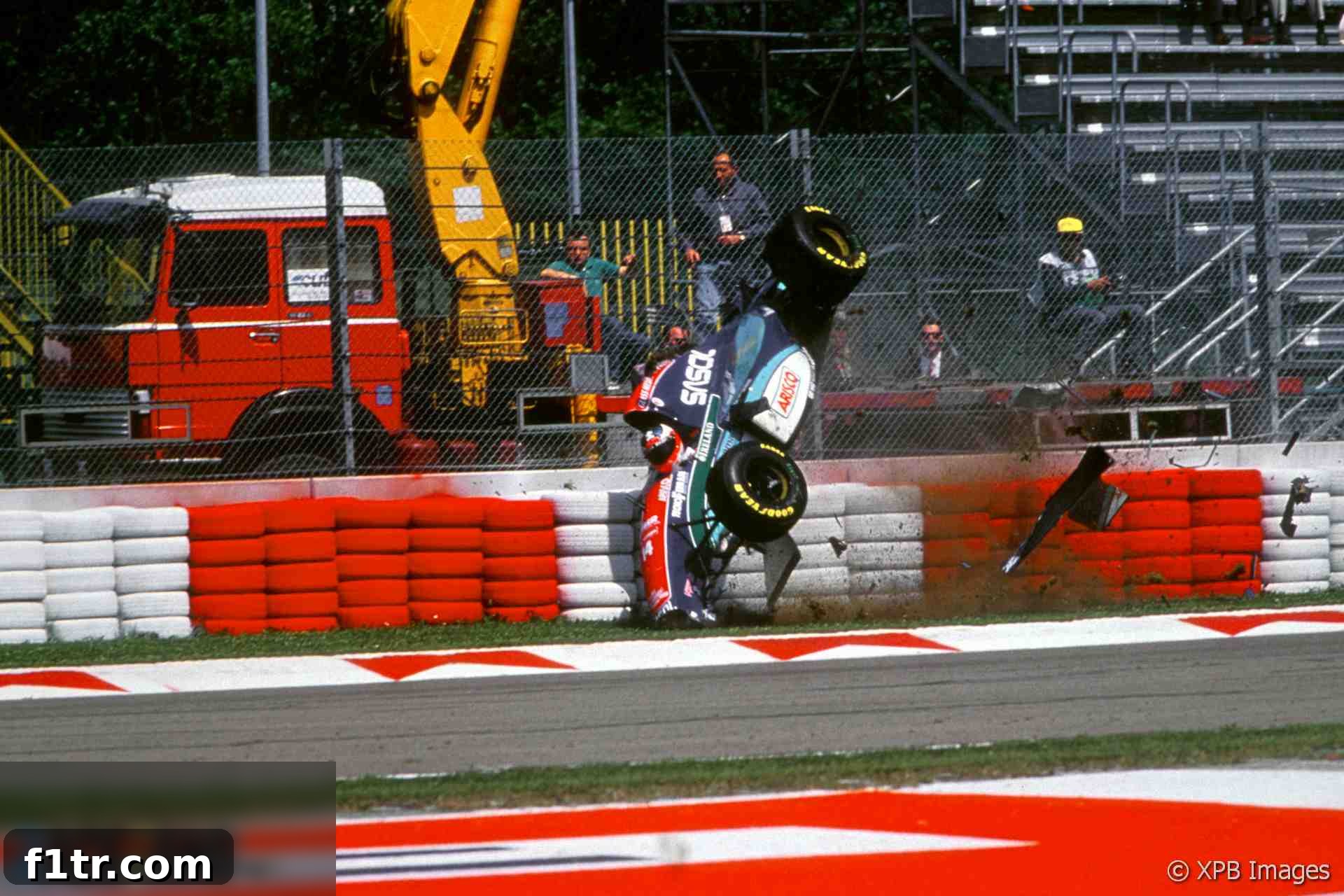
As the first of two qualifying sessions commenced on Friday, Barrichello took to the Imola circuit. The Jordan 194 felt superb beneath him, a responsive and potent machine. On his second lap, approaching the notoriously fast Variante Bassa chicane, he pushed harder, travelling an astonishing 15 kilometers per hour faster than on his preceding lap. It was a testament to his confidence and the car’s apparent stability, but also a fateful decision. The car, perhaps pushed beyond its limits on the tight racing line, got off-line and struck a steep kerb with brutal force. This kerb, rather than simply defining the track edge, acted like an unforgiving ramp, violently launching the Jordan 194 shoulder-high into the air.
In a primal, instinctive reaction, Barrichello raised both hands to cover his face just as the car slammed into the top of a tyre barrier. From cornering at an astonishing 223 kilometers per hour, the car decelerated with a violent, bone-jarring force. It then hit the ground nose-first before tumbling over, ultimately coming to a terrifying rest on its side. On the pit wall, team owner Eddie Jordan watched in horror, gripped by the chilling fear that his promising young driver had been instantly killed. The silence in the garage was deafening, momentarily broken only by the screech of tires as marshals scrambled into action.
Marshals sprinted to the scene within seconds, their training kicking in. Within moments, they had managed to turn the car the right way up. However, as they did so, Barrichello’s head slammed alarmingly against the cockpit side, a chilling echo of the impact’s severity. Concerns for his condition worsened further as it became starkly apparent that the right-hand side of the car, particularly around the cockpit, had sustained catastrophic damage.
Professor Sid Watkins and the dedicated medical team arrived on the scene shortly afterwards, bringing with them a sense of urgent professionalism. They found Barrichello unconscious and struggling desperately to breathe, his airway partially obstructed by blood flowing from a severe cut on his face. Watkins, a veteran of countless trackside emergencies, swiftly and expertly inserted an airway. As Barrichello was carefully recovered from the wreckage and transported to the circuit’s medical center, his condition visibly began to improve, a fragile beacon of hope amidst the palpable fear that had gripped the paddock.
With the session red-flagged due to the severity of the incident, Eddie Jordan rushed to the medical center. There, he found none other than Ayrton Senna already at the side of his recovering countryman. Senna, ever the concerned and vigilant figure, stayed until he was assured of Barrichello’s improving state. As qualifying eventually resumed, Senna returned to his Williams garage, pursued by a flock of anxious reporters, seeking any information about the fate of the young Brazilian.
“He’s alright,” Senna declared, his voice a mixture of relief and lingering concern, relaying the first words Barrichello himself heard after regaining consciousness. “He is shocked of course, but he is alright.” Despite Senna’s reassuring words, the sense of shock lingered throughout the paddock. Endless slow-motion replays of the horrific crash revealed just how perilously close Barrichello’s Jordan had come to clearing the tyre wall entirely and reaching the chain-link fence that separated the track from the unsuspecting crowd. The incident was a stark, undeniable warning of the track’s inherent dangers.
The session eventually restarted after a twenty-minute delay, and a semblance of normality, however fragile, returned to the circuit. With Barrichello ruled out for the remainder of the weekend due to his injuries, Jordan was represented solely by Andrea de Cesaris, who had taken over from Aguri Suzuki as Irvine’s stand-in. Under the extraordinary and chaotic circumstances, the team could perhaps be forgiven for the almost comical lapse which saw De Cesaris sent out of the pits with his right-rear wheel improperly secured – it worked free halfway around the lap and bounced dangerously down the track, adding another bizarre incident to an already fraught day.
Barrichello wasn’t the only driver to crash his car at the notorious Variante Bassa that ominous Friday. Towards the very end of the session, Olivier Beretta spun backwards into the wall, severely damaging his Larrousse, yet, mercifully, he climbed out unhurt, albeit shaken. They were the lucky ones, spared by fortune on a weekend where fate would show little mercy to others, a weekend that had only just begun to reveal its true, horrifying face.
Grand Prix Flashback
- 40 years ago today: How a tyre war prompted Senna’s unfinished Monaco masterpiece
- Schumacher seals record-breaking 10th constructors championship for Ferrari
- Strategic superiority clinches Schumacher’s first Ferrari title
- Disaster for Hakkinen brings title within Schumacher’s grasp
- Schumacher turns the tide against McLaren on tragic day at Monza
Browse all Grand Prix flashbacks
1994 F1 Season
- Vettel to demonstrate Senna’s last McLaren during Imola race weekend
- Imola to mark 30 years since Senna and Ratzenberger’s deaths at grand prix
- “He died and we didn’t even know”: How one fan witnessed the 1994 San Marino GP
- Newey gives new insight into Senna’s death and why he feels guilty over it
- Schumacher’s first title tainted by clash with Hill
Browse all 1994 F1 season articles