McLaren’s Ascent: Unpacking the Aerodynamic Upgrades Fueling Their F1.5 Dominance Over Renault
In the fiercely contested battle for ‘best of the rest’ honors, often dubbed ‘Formula 1.5’, McLaren has orchestrated a remarkable turnaround, significantly pulling ahead of their engine supplier, Renault. Just three races prior, the gap was a mere two points, a testament to the intense competition behind the top three teams. However, the performance pendulum has decidedly swung in McLaren’s favor over the past half-dozen races, culminating in a commanding 21-point advantage.
This shift isn’t accidental; it’s the direct result of a relentless and well-executed development strategy. McLaren’s MCL34 has been the recipient of a series of meticulously designed upgrades, with a particular focus on aerodynamic efficiency and airflow management. Renault, on the other hand, has faced a different set of challenges, striving to unlock consistent performance amidst difficulties with tire interaction and aerodynamic balance.
The Formula 1.5 Battle: A Midfield Showdown Intensifies
The “Formula 1.5” championship represents a crucial fight within Formula 1, determining which team emerges as the strongest contender outside of the established front-runners like Mercedes, Ferrari, and Red Bull. For manufacturers like Renault and historic teams such as McLaren, securing this fifth-place spot in the Constructors’ Championship carries significant prestige, financial implications, and the morale boost of being at the head of the chasing pack. It’s a battleground where engineering prowess, strategic development, and operational efficiency are put to the ultimate test, often with tighter margins than at the very front of the grid.
The recent performance trajectory vividly illustrates the divergence between these two rivals. McLaren’s steady, incremental improvements have yielded tangible results on track, allowing them to consistently outscore Renault. This consistency has not only widened the points gap but has also instilled a growing confidence within the Woking-based team, signaling a potential return to their former glory as a top-tier competitor.
McLaren’s Aerodynamic Revolution: The MCL34’s Relentless Evolution
McLaren’s MCL34 has been a canvas for continuous innovation, with its aerodynamic package undergoing significant revisions aimed at maximizing downforce and optimizing airflow efficiency. The team’s proactive approach to development has been evident in a series of upgrades, with the Silverstone event introducing yet another crucial revision to its intricate bargeboard assembly. These developments are not isolated; they are part of a broader, well-defined aerodynamic philosophy that has been evolving since the Spanish Grand Prix.
The Crucial Bargeboard Overhaul
Bargeboards are among the most complex and aerodynamically sensitive areas of a Formula 1 car. Positioned just behind the front wheels, they play a critical role in managing the turbulent airflow generated by the spinning tires and the front wing. Their primary function is to direct this complex flow, channeling it efficiently towards the floor and the rear of the car, thereby optimizing downforce generation and reducing drag. McLaren’s latest iteration, building upon their Spanish Grand Prix ‘mark two’ update, demonstrated a refined understanding of these intricate flow dynamics.
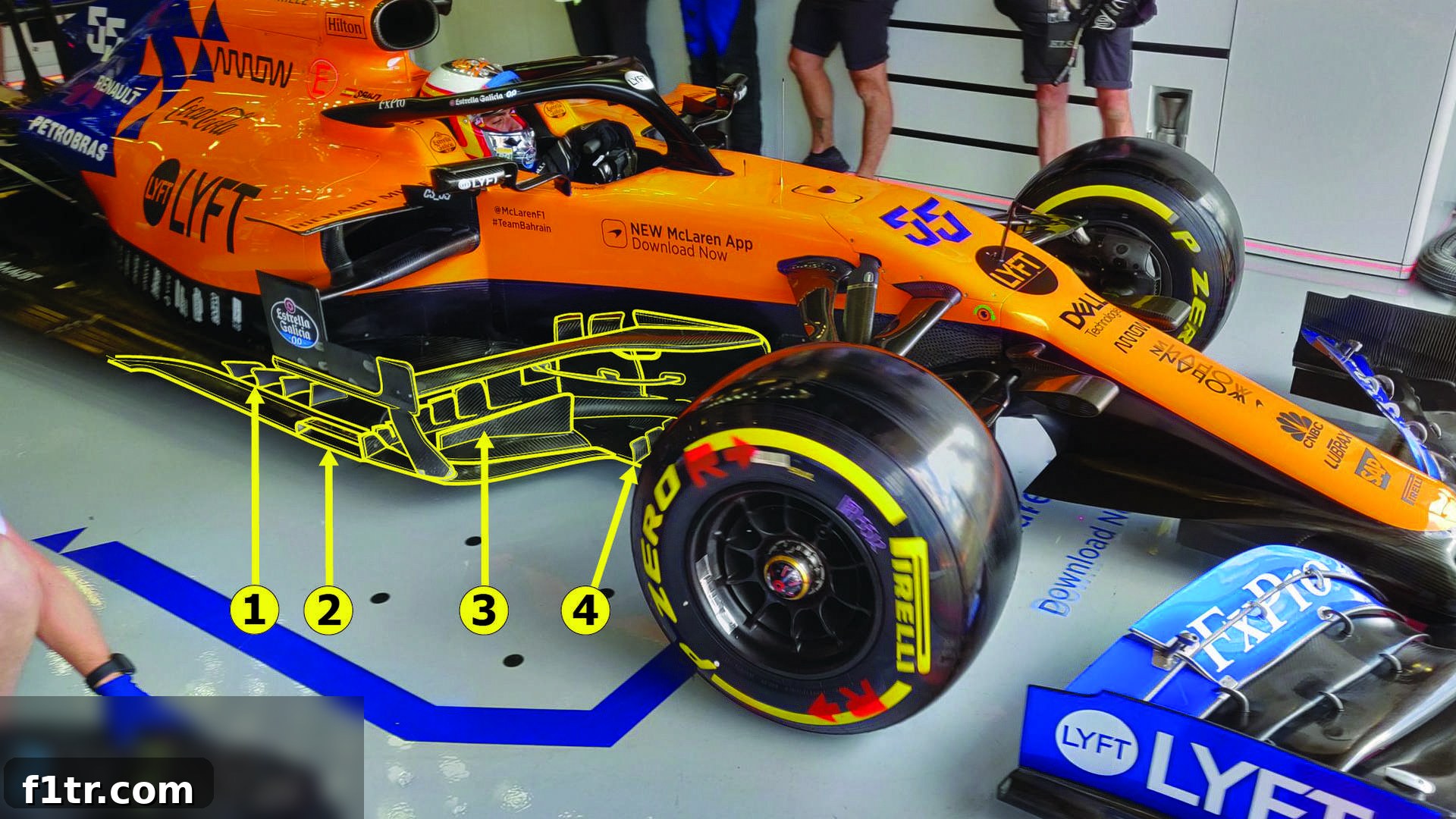
The Silverstone update saw several key modifications, starting with the floor edge situated behind the main bargeboard package. McLaren experimented with two distinct variations during practice. One configuration, tested but ultimately not raced, featured a series of four small fins (1) meticulously integrated into the floor edge. These fins were designed to sit precisely within the space behind the floor edge flap, likely aiming to generate small vortices to seal the floor more effectively or manage tire wake. The alternative design, which remained on the car for the entire race weekend, was a simpler yet highly effective extension of the existing edge-flap. This flap, which was previously quite short (2), was significantly lengthened—approximately four times its original dimension—to extend above the rolled edge of the floor below. This elongated flap is crucial for better sealing the underfloor, preventing high-pressure air from bleeding into the low-pressure zone beneath the car, thereby enhancing the ground effect and increasing overall downforce.
Within the main bargeboard area, the floor foot plates (3) underwent a significant revision. The previous format, characterized by two separate floor plates topped by a turning vane, was replaced by an innovative triple-footplate setup. Crucially, this new configuration omitted the turning vane altogether. This change suggests a strategic shift in how McLaren aims to manage the airflow in this critical region. More footplates, meticulously shaped, can create a more powerful and precisely controlled vortex system, which is essential for guiding airflow along the car’s flanks and feeding the diffuser at the rear. Removing the turning vane indicates that the new footplate design might be more efficient at generating the desired flow structures on its own, or that the overall flow path has been re-optimized to render the vane redundant.
The final significant modification was to the series of vertical and horizontal fins (4) that initiate the bargeboard assembly. To accommodate the revised floor footplates and the overall optimized flow structure, these fins were made narrower. Additionally, an extra vane was introduced to lead the five vertical fins, further refining the initial interaction with the oncoming airflow. This meticulous shaping of these leading elements is vital for effectively conditioning the air before it reaches the more complex downstream components, ensuring that the entire bargeboard package operates at peak efficiency.
These intensive modifications to the bargeboards are a direct consequence and follow-on from the Spanish Grand Prix update, where McLaren fundamentally shifted its front wing philosophy from an outboard-loaded to an inboard-loaded design. While the inboard-loaded front wing proved effective in certain aspects, its steeper shape inadvertently reduced the airflow efficiency to the bargeboards downstream. The comprehensive bargeboard development seen at Silverstone was specifically engineered to counteract this drawback, meticulously recovering the lost performance and integrating seamlessly with the new front wing concept. This demonstrates a sophisticated understanding of holistic car aerodynamics, where changes to one area necessitate careful re-optimization of connected components.
Subtle but Significant: Front Wing Fences
Beyond the primary focus on bargeboards, the MCL34 also featured smaller yet significant revisions to the two fences located under the front wing. The outermost fence, a critical component in managing tire squirt and channeling airflow around the front wheel, was subtly shortened. Front wing fences are crucial for generating and directing vortices that help to control the airflow downstream, influencing everything from brake duct cooling to the performance of the bargeboards. Shortening the outermost fence could be an intentional move to alter the strength or trajectory of these vortices, perhaps to reduce drag, fine-tune the interaction with the front wheel wake, or optimize the flow feeding into the newly revised bargeboard area. Such small changes often have a magnified effect on overall aerodynamic performance.
Rigorous Testing and Refinement
The implementation of these extensive updates wasn’t a simple bolt-on affair. McLaren subjected the various packages to rigorous testing during the free practice sessions at Silverstone. This included detailed flow-visualization (flow-viz) runs in the first practice session, where fluorescent paint was applied to the car’s surface to visually trace airflow patterns. This invaluable data, combined with driver feedback on car balance and feel, allowed the engineering team to carefully evaluate the effectiveness of each component. Ultimately, the team settled on the updated bargeboards featuring the elongated floor edge flap and without the four experimental fins, confirming their optimal performance for the specific track conditions and overall aerodynamic goals.
Renault’s Persistent Pursuit: Navigating Chassis and Tyre Challenges
While McLaren celebrated its upward trajectory, Renault has been battling its own set of complex challenges with the RS19. A primary concern for the French team, shared by several others on the grid, has been the intricate interaction between its chassis and Pirelli’s sensitive tires. This fundamental issue has often hindered their ability to extract consistent performance, making it difficult to find a stable operating window for the tires across different track layouts and temperatures. Renault’s efforts to address this problem have involved a combination of targeted updates to the RS19 and extensive experimentation with its car setup.
The Tyre Interaction Enigma
The Pirelli tires in Formula 1 are notoriously difficult to manage, requiring precise temperature and pressure ranges to operate at their peak. For many teams, including Renault, failing to hit this narrow operating window can lead to rapid degradation, inconsistent grip, and a significant drop in lap time. The chassis setup – encompassing suspension geometry, weight distribution, and aerodynamic balance – plays a pivotal role in how the tires behave. A car that doesn’t optimally load its tires will struggle to generate heat evenly or maintain it through a stint, leading to underperformance. Renault’s persistent struggle in this area suggests deeper issues in harmonizing their aerodynamic package with the mechanical setup to provide the tires with the consistent support they need.
The Austrian GP Conundrum: Downforce vs. Drag
The challenges faced by Renault were vividly highlighted during the Austrian Grand Prix. In an attempt to boost downforce levels, the team introduced more aggressive wing angles. While theoretically providing more grip through corners, this approach severely penalized the RS19 on the straights, where increased drag compromised top speed. This trade-off proved detrimental to overall lap times, forcing the team to revert to a lesser downforce configuration. This regression, while improving straight-line speed, subsequently hurt their performance through the critical final four turns of the circuit, where high-speed cornering stability is paramount. This incident underscored Renault’s difficulty in finding an optimal aerodynamic balance that delivers both sufficient downforce and acceptable drag across an entire lap, a balancing act crucial for success in modern F1.
Consequently, significant time during free practice sessions was dedicated to testing various setup configurations. This methodical approach aimed to establish a better baseline understanding of the RS19’s characteristics, providing the engineers with more robust data from which to tackle the pervasive tyre issues in future races. This ongoing struggle to find a stable setup hints at an underlying difficulty in chassis understanding or perhaps a narrow operating window for their current aerodynamic package.
Silverstone’s Targeted Aero Updates
Technical changes introduced by Renault at Silverstone were more limited in scope compared to McLaren’s extensive overhaul, but they were no less strategic. The key visual modification was a revised front wing flap setup, a move that echoed a direction previously explored by Toro Rosso earlier in the season. Renault’s engineers extended the inner tips of the front wing flaps, a change specifically designed to create a stronger Y250 airflow vortex.
The Y250 vortex, named for its generation point 250mm from the car’s centerline, is a crucial aerodynamic element. It acts like an invisible seal along the edges of the car’s floor, preventing high-pressure air from infiltrating the low-pressure zone beneath the car. A stronger and more stable Y250 vortex enhances the efficiency of the entire underfloor and the rear wing by improving the clarity of the airflow feeding these components. This specific change comprised entirely new front wing flaps (1) that extended right up to the Y250 line (highlighted in yellow in diagrams). By strengthening this vortex, Renault aimed to improve overall aerodynamic efficiency, which should partially offset the downforce-related issues encountered in Austria and provide a more stable platform for the tires.
Additionally, the “cape under nose vane” (2), first introduced in France, was also visibly present on the RS19 at Silverstone. This innovative device strategically utilizes the previously redundant space directly underneath the car’s nose. Its purpose is to re-energize the airflow in this area and direct it more effectively towards the turning vanes and bargeboards located downstream. By conditioning the air early, the cape vane helps these subsequent aerodynamic elements work more efficiently, contributing to greater overall downforce and flow stability around the car’s central axis, reducing turbulent losses that can otherwise negatively impact performance.
The F1.5 Pendulum: McLaren’s Clear Path vs. Renault’s Struggle
The divergent paths taken by McLaren and Renault highlight the fundamental differences in their current development cycles and overall understanding of their respective packages. McLaren’s consistent progress with the MCL34, characterized by well-integrated aerodynamic updates like the comprehensive bargeboard overhaul, suggests a clear and effective development pipeline. Their ability to identify an aerodynamic weakness (reduced airflow to bargeboards from the front wing philosophy change) and then meticulously engineer a solution demonstrates a cohesive approach to car design and optimization. This clear path has allowed them to systematically improve their car’s performance, leading to their current dominance in the F1.5 battle.
Renault, conversely, appears to be grappling with more fundamental issues, particularly the challenging interaction between their chassis and the Pirelli tires. While their targeted aerodynamic updates, such as the revised front wing flaps and the under-nose cape vane, are designed to enhance efficiency, they seem to be fighting a broader battle for overall car balance and setup optimization. The Austrian GP experience, where they struggled with the downforce-drag trade-off, further underscores their ongoing quest to find a stable and fast operating window for the RS19. This continuous struggle creates a less predictable performance curve and makes it harder for them to consistently challenge McLaren.
Looking Ahead: Implications for the Season
The current trajectory suggests that McLaren has established itself as the clear front-runner in the F1.5 segment of the championship. Their methodical and effective upgrade strategy has given them a significant edge, allowing them to extract consistent performance from the MCL34. For Renault, the task is much tougher. They must not only continue their aerodynamic development but also address the underlying issues of tire interaction and chassis balance to close the gap. The remainder of the season will be a true test of both teams’ engineering resilience and development capabilities, but for now, McLaren holds a commanding position, solidifying their ambition to return to the forefront of Formula 1.
Advert | Become a RaceFans supporter andgo ad-free
F1 technology
- McLaren, Red Bull and Ferrari bring rear corner updates to Imola
- Ferrari, McLaren and Red Bull bring upgrades again for Saudi Arabian Grand Prix
- McLaren introduce major floor upgrade for Norris’ car at Mexican Grand Prix
- McLaren, Mercedes and Red Bull detail upgrade packages for United States GP
- Red Bull remove engine cover ‘cannons’ in major RB20 update – but they may return
Browse all F1 technology articles