Bahrain Grand Prix 2024: Mercedes’ Hopeful Start vs. Red Bull’s Hidden Pace
The opening day of the 2024 Formula 1 season in Bahrain delivered an intriguing mix of caution and unexpected optimism. While snippets of driver sentiments prior to the sessions suggested a challenging path ahead for some, the initial on-track results offered a glimpse into potential shifts in the competitive landscape.
Advert | Become a Supporter & go ad-free
“At the moment, we’re not going to be in the race for the win,” was one early assessment, reflecting a measured outlook. Another driver added, “We’ve got a lot to work on,” a familiar refrain from teams grappling with new machinery. Yet, the starkest admission, “Today, we found out that we are a long way off,” hints at the inherent unpredictability of the first competitive sessions of a new F1 campaign.
For Lewis Hamilton, the first grand prix weekend of the year has, in recent memory, been a source of profound frustration. The pursuit of an elusive eighth world championship, a title he narrowly lost in 2021, has been overshadowed by two consecutive seasons of uncompetitive Mercedes cars. Emerging from his cockpit on day one in 2022 and 2023, the Briton was often faced with the daunting prospect of an uphill battle, knowing his Mercedes W13 and W14 models lacked the inherent pace to contend for victories, let alone championships. The car was often described as “unpredictable” and “nervous,” making it a handful for even a seven-time world champion.
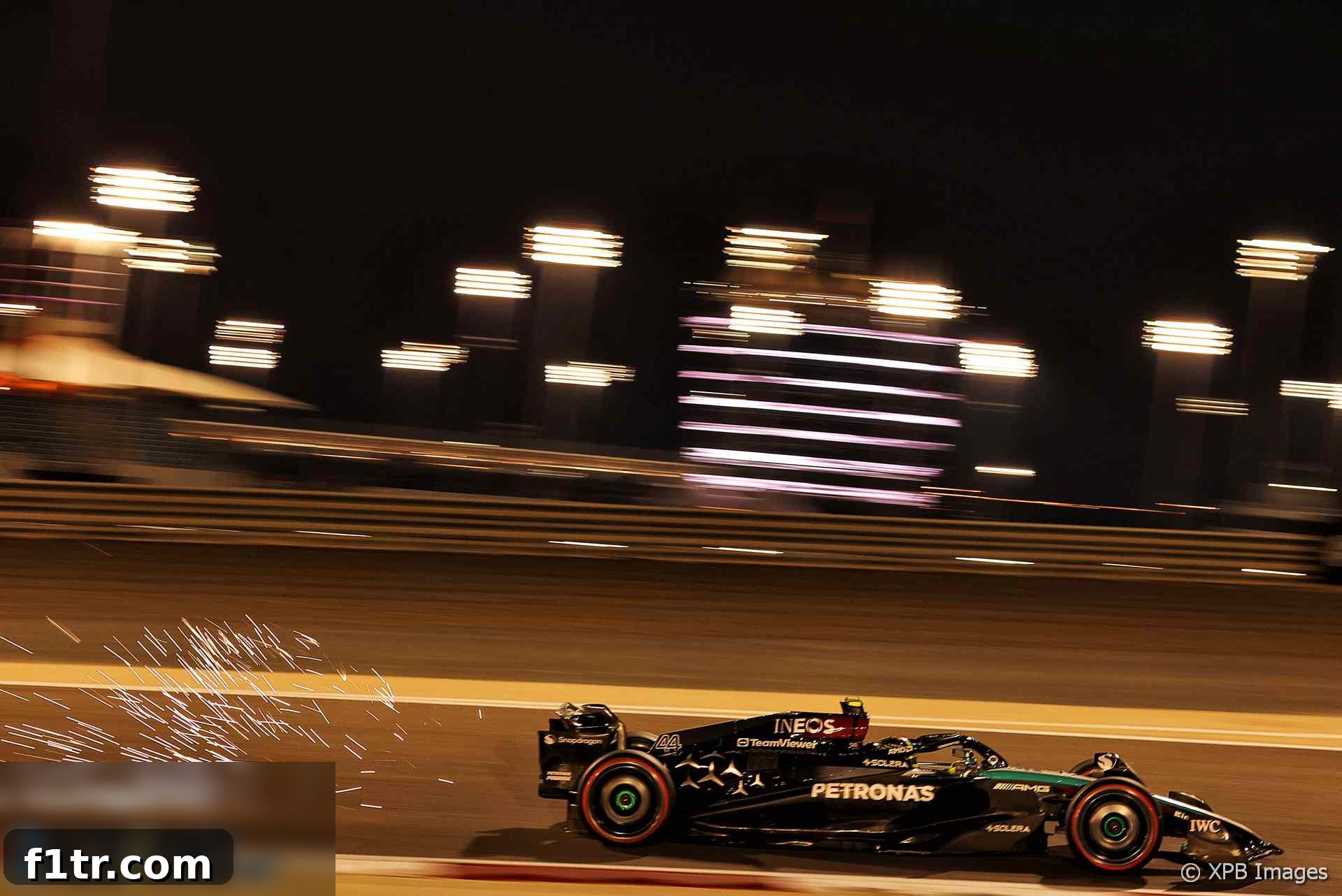
However, 2024 began with a distinctly different narrative. At the close of Thursday’s practice sessions in Bahrain, Hamilton found himself in an unfamiliar yet welcome position: quickest of all. His Mercedes team mate, George Russell, was just two-tenths behind in second place, suggesting a considerably more promising start for the Silver Arrows than in the preceding two years. This dual performance immediately ignited hopes among fans and within the team that the W15 could finally represent a significant step forward, offering a more stable and competitive platform.
Mercedes’ Promising Start: A Shift in Fortunes?
Following his impressive 1’30.374 lap time, Hamilton expressed a newfound confidence in his machine. “We didn’t know exactly where we would stack up against everyone else, but we had a positive FP2 session,” he commented. The veteran driver’s relief was palpable as he articulated a sentiment that has been missing for some time: “Overall, I’m feeling much happier with the car than last year. We’ve made some good improvements and it feels much more like a race car.”
Advert | Become a RaceFans supporter andgo ad-free
This positive feedback from both Hamilton and Russell is crucial. After two seasons of trying to understand and rectify a fundamentally flawed car concept, Mercedes appears to have found a more harmonious balance with the W15. The team’s technical leadership had been open about the aggressive design changes implemented for 2024, aiming to move away from the “zero-pod” philosophy that plagued them. The early results suggest these radical changes are bearing fruit, providing drivers with a more predictable and responsive car, which is fundamental for extracting maximum performance and building confidence.
The Red Bull Enigma: Hidden Pace and Strategic Silence
As encouraging as Mercedes’ practice performance may seem, the Formula 1 paddock knows better than to draw definitive conclusions from early lap times. Reigning world champion Max Verstappen, who finished sixth in practice, provided a characteristic dose of reality. His Red Bull, along with the Aston Martin of Fernando Alonso, Carlos Sainz Jnr’s Ferrari, and Oscar Piastri’s McLaren, all placed ahead of him. However, Verstappen was quick to point out that his team was not pushing their power units anywhere near their full potential. This strategic understatement, often referred to as “sandbagging,” is a common tactic in F1, especially during practice and testing sessions, where teams prefer to keep their true performance under wraps until qualifying.
Further supporting this theory was the speed trap data, which revealed Verstappen as the slowest of the four Honda-powered cars. This is highly unusual for a Red Bull, a car typically renowned for its straight-line speed. It strongly indicates that Red Bull was running with lower engine modes, conserving components and masking their actual top-end performance. Hamilton himself acknowledged this potential disparity, admitting that he still anticipates Mercedes to be trailing the Red Bulls once the true competitive intensity of qualifying and the race kicks in.
“I think we’re going to be in the mix,” Hamilton stated, reflecting on Mercedes’ position relative to their rivals. “I think it’s a bit too early to say, but I think we’re there or thereabouts with Ferrari and maybe Aston and McLaren. I don’t know exactly where we lay with those guys, but we’re around those. So it’s going to close. I think if Max is in the front, he will clear off as he has done for the last couple of years.” This measured assessment underscores the respect for Red Bull’s consistent dominance and their capability to unlock significant extra pace when it matters most.
Indeed, numerous indicators suggest Red Bull holds a substantial pace advantage that they deliberately concealed on Thursday. Their best lap time was a full 1.1 seconds slower than their quickest lap during the pre-season testing just days prior at the same circuit. This was the largest deficit of any team between the test and the first practice session, strongly implying they had ample performance in reserve. Analyzing the telemetry further, even with seemingly de-tuned power units, the RB20 exhibited formidable speed, particularly through the fast sweeping turns five, six, and seven, where Verstappen carried immense cornering speed. Additionally, the traction out of slow corners, such as turn ten, appeared exceptional, allowing Verstappen to get on the throttle earlier and power down the subsequent back straight with remarkable efficiency.
Advert | Become a RaceFans supporter andgo ad-free
Even with their engines supposedly not “turned up” to their maximum, both Verstappen and team mate Sergio Perez registered higher top speeds at the end of the pit straight on their fastest laps compared to their closest rivals for pole position. This dual advantage of being slippery on the straights and exceptionally quick through corners suggests the RB20 is a complete package. For other teams, this might make beating Red Bull to pole position an even more critical strategic objective, as overcoming their race pace from behind could prove incredibly difficult.
Qualifying Challenges: Track Limits and New Lap Time Rules
While the focus is often on raw speed, the first qualifying session of the year will also test drivers’ discipline under two critical regulatory frameworks. As always, adhering to track limits – specifically keeping within the white lines that delineate the edge of the circuit – is paramount. Throughout Thursday’s practice sessions and last week’s testing, numerous drivers were observed running wide at the exit of turn four and other tricky sections. Such infringements result in the immediate invalidation of lap times, as demonstrated by the 13 lap times deleted during Thursday’s F3 qualifying session across turns two, four, 13, and 15. The pressure of a qualifying “push lap” often tempts drivers to push the boundaries, making track limits a constant threat to a clean lap time.
The second, more subtle, but potentially impactful factor lies in the revised maximum lap time rules. Last season, drivers were timed for every lap in qualifying, and exceeding a maximum lap time set by Race Director Niels Wittich would lead to a summons from the stewards. This rule remains in place for 2024, but with an added layer of complexity. Drivers may now also be in breach if they go too slowly through any of the many “microsectors” that collectively constitute a full lap.
The implication of this modification is profound for driver strategy. Previously, a driver might back off significantly in certain parts of the track during an out-lap or cooldown lap to create a gap for a clear run, knowing that as long as their total lap time was under the maximum, they were safe. Now, slowing down excessively in any specific microsector, even if the overall lap time remains within the limit of 1’54, could trigger an infraction. This introduces an additional mental burden and risk for drivers, who must now maintain a more consistent pace throughout the entire circuit, even on non-flying laps. This change aims to prevent dangerous slow driving on track, particularly when drivers are trying to position themselves for a qualifying lap, but its practical application and potential for penalizing innocent actions remain to be seen. It could well lead to a longer queue of drivers outside the stewards’ office, similar to the discussions and investigations seen at the end of 2023.
Advert | Become a RaceFans supporter andgo ad-free
Combined Practice Times: A Snapshot of Early Pace
While long-run pace will be crucial for the race on Saturday, Friday’s qualifying session provides the first true opportunity for teams to unleash the genuine speed of their 2024 contenders. The combined practice times from Thursday’s sessions offer a preliminary ranking:
| P. | # | Driver | Team | FP1 time | FP2 time | Gap | Laps |
|---|---|---|---|---|---|---|---|
| 1 | 44 | Lewis Hamilton | Mercedes | 1’33.302 | 1’30.374 | 47 | |
| 2 | 63 | George Russell | Mercedes | 1’33.251 | 1’30.580 | 0.206 | 48 |
| 3 | 14 | Fernando Alonso | Aston Martin-Mercedes | 1’33.193 | 1’30.660 | 0.286 | 42 |
| 4 | 55 | Carlos Sainz Jnr | Ferrari | 1’33.385 | 1’30.769 | 0.395 | 51 |
| 5 | 81 | Oscar Piastri | McLaren-Mercedes | 1’33.113 | 1’30.784 | 0.410 | 52 |
| 6 | 1 | Max Verstappen | Red Bull-Honda RBPT | 1’33.238 | 1’30.851 | 0.477 | 46 |
| 7 | 27 | Nico Hulkenberg | Haas-Ferrari | 1’37.938 | 1’30.884 | 0.510 | 50 |
| 8 | 18 | Lance Stroll | Aston Martin-Mercedes | 1’33.868 | 1’30.891 | 0.517 | 46 |
| 9 | 16 | Charles Leclerc | Ferrari | 1’33.268 | 1’31.113 | 0.739 | 50 |
| 10 | 11 | Sergio Perez | Red Bull-Honda RBPT | 1’33.413 | 1’31.115 | 0.741 | 50 |
| 11 | 23 | Alexander Albon | Williams-Mercedes | 1’33.583 | 1’31.333 | 0.959 | 43 |
| 12 | 3 | Daniel Ricciardo | RB-Honda RBPT | 1’32.869 | 1’31.516 | 1.142 | 49 |
| 13 | 2 | Logan Sargeant | Williams-Mercedes | 1’34.213 | 1’31.715 | 1.341 | 46 |
| 14 | 20 | Kevin Magnussen | Haas-Ferrari | 1’37.477 | 1’31.764 | 1.390 | 52 |
| 15 | 22 | Yuki Tsunoda | RB-Honda RBPT | 1’33.183 | 1’31.881 | 1.507 | 53 |
| 16 | 10 | Pierre Gasly | Alpine-Renault | 1’35.144 | 1’31.951 | 1.577 | 49 |
| 17 | 77 | Valtteri Bottas | Sauber-Ferrari | 1’33.354 | 1’32.001 | 1.627 | 45 |
| 18 | 31 | Esteban Ocon | Alpine-Renault | 1’34.807 | 1’32.027 | 1.653 | 46 |
| 19 | 24 | Zhou Guanyu | Sauber-Ferrari | 1’33.923 | 1’32.048 | 1.674 | 44 |
| 20 | 4 | Lando Norris | McLaren-Mercedes | 1’32.901 | 1’32.608 | 2.234 | 50 |
Advert | Become a RaceFans supporter andgo ad-free
The Road Ahead: From Qualifying to Race Day
While the combined practice times table paints a picture of Mercedes at the top, the true measure of their progress and Red Bull’s dominance will emerge during qualifying. The Bahrain International Circuit, with its abrasive asphalt and demanding layout, places a high premium on tire management and long-run consistency. All 20 drivers covered significant distances on the soft tire compound during the second practice session, gathering crucial data for race strategy. The performance observed on Thursday, particularly the ability to maintain pace over several laps, will be a critical determinant of success on Saturday. The dynamic conditions and the fierce competition among the top teams promise an electrifying qualifying battle, followed by an even more intense race where strategy, tire degradation, and driver skill will ultimately decide the victor of the 2024 Formula 1 season opener.
The 2024 Bahrain Grand Prix is shaping up to be a fascinating start to the new season, with Mercedes showing signs of a strong comeback, while Red Bull continues to hide its ultimate hand. The stage is set for an epic showdown, not just between teams and drivers, but also against the clock and the ever-present challenge of F1’s evolving regulations.
More on the 2024 Bahrain Grand Prix
- Tsunoda accepts he got “a bit heated” in team orders dispute with Ricciardo
- “We’re fighting with one arm behind our back”: Hamilton and Russell’s race radio
- Red Bull say RB20 draws inspiration from rivals in less obvious areas
- All cars finish two consecutive F1 races for first time ever
- “I don’t know what the car’s going to do every time I brake”: Leclerc’s race radio
Browse all 2024 Bahrain Grand Prix articles