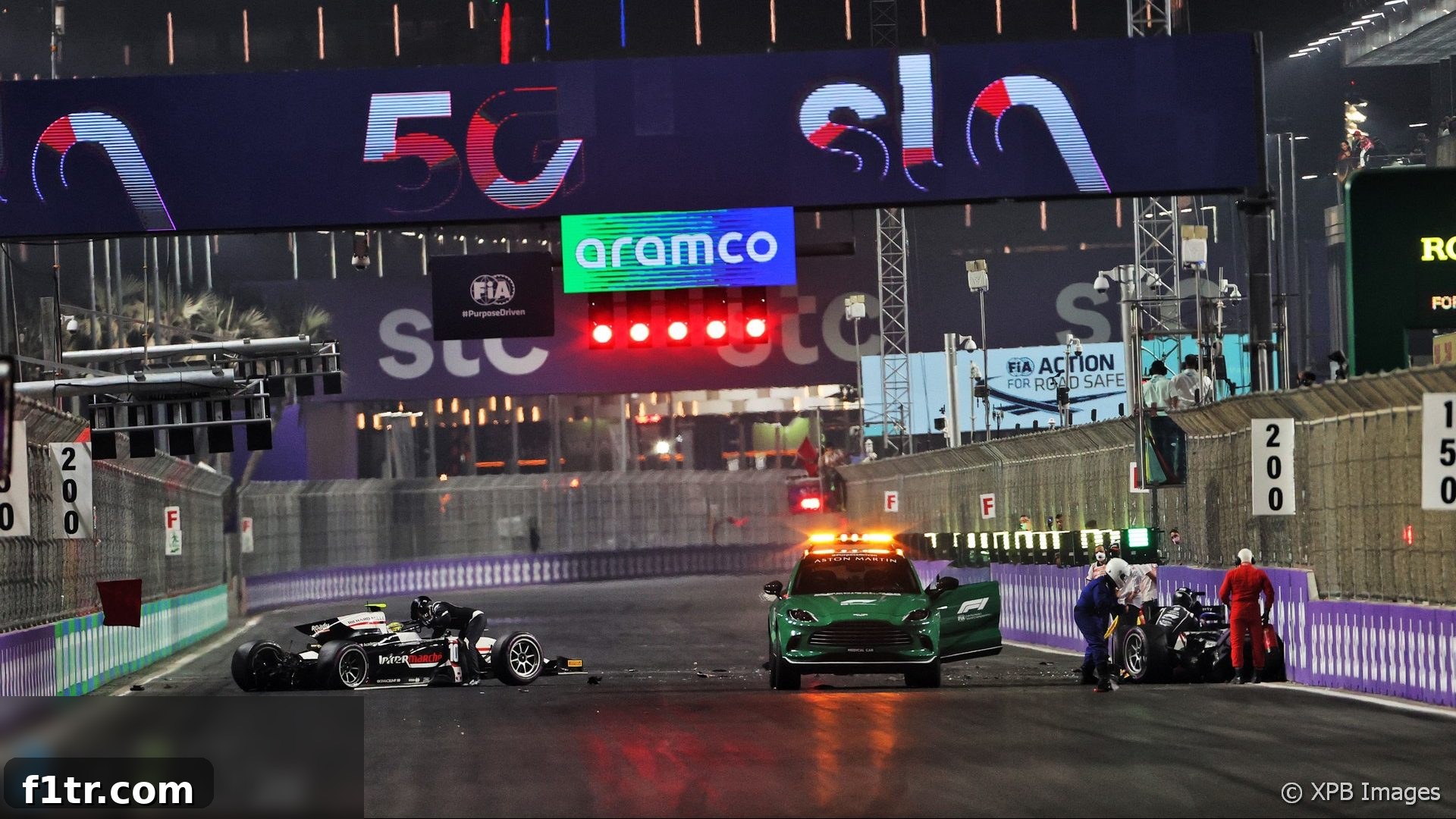
In a sport defined by speed, precision, and inherent risks, the world of Formula 2 was reminded of its unforgiving nature last weekend. A harrowing start-line collision at the Jeddah Corniche Circuit in Saudi Arabia sent shockwaves through the paddock, involving promising talents Enzo Fittipaldi and Théo Pourchaire. Both drivers were swiftly taken for medical assessment following the terrifying incident during the Feature Race. Fittipaldi, grandson of two-time Formula 1 world champion Emerson Fittipaldi, has since provided a vital update on his condition, offering a beacon of hope amidst concerns for his well-being.
Advert | Become a Supporter & go ad-free
The Cataclysmic Start: A Moment of High Drama and High Impact
The incident unfolded on Sunday evening as the grid prepared for the Formula 2 Feature Race, an event that promised high-octane action but delivered a stark reminder of motorsport’s perils. As the lights went out, a critical malfunction occurred several rows ahead: Théo Pourchaire’s ART Grand Prix car stalled on the grid. In the blink of an eye, the fast-approaching Charouz Racing System car of Enzo Fittipaldi, unable to react in time or find a clear path through the rapidly accelerating pack, ploughed into the rear of Pourchaire’s stationary vehicle. The collision was immediate and brutal, with the sheer force of the impact sending significant debris scattering across the circuit, some even reaching over the pit wall, highlighting the severity of the crash.
The race was instantly red-flagged, and medical teams were on the scene within seconds, a testament to the rigorous safety protocols in place. The extraction of both drivers from their heavily damaged machines was a delicate and lengthy process, indicative of the extensive structural compromise sustained by the cars. Fittipaldi later confirmed the impact force registered a staggering 72G, a figure that underscores the immense strain placed upon the human body and the critical role of modern safety cells in protecting drivers in such extreme scenarios.
Enzo Fittipaldi’s Road to Recovery: Resilience and Optimism
Initial concerns for both drivers were palpable, with Pourchaire thankfully reporting he was uninjured later that evening. However, information regarding Fittipaldi’s condition only emerged the following day, Monday, bringing relief to fans and the motorsport community alike. From his hospital bed, Fittipaldi took to social media to share an update that resonated with his characteristic fighting spirit.
“Hey guys, I am very grateful that I only broke my heel and have some cuts and bruises,” Fittipaldi posted. His message expressed profound gratitude not only for the outpouring of support but also for the swift and professional care provided by the FIA and the medical staff. “Thank you all for the messages, as well as the FIA and medical staff for taking great care of me. I am very happy that Theo is okay. I will be back on track soon and faster than ever.” This defiant pledge to return “faster than ever” speaks volumes about the mental fortitude required to compete at this level and recover from such a significant setback.
The FIA later released an official statement confirming the extent of Fittipaldi’s injuries: a fracture in his right heel and a “lesion on his left eyebrow.” The statement also provided an encouraging update on his recovery, noting that he had spent a night in intensive care but was “making good progress.” Such incidents serve as a stark reminder of the fine line between triumph and tragedy in motorsport, and Fittipaldi’s relatively limited injuries, considering the force of the impact, are a testament to the continuous evolution of safety standards in Formula 2.
Théo Pourchaire’s Account and the Lingering Questions of Anti-Stall Systems
Théo Pourchaire, who had his own high-speed encounter with the barriers at Turn 22 earlier in the Saudi Arabian Grand Prix weekend – an incident he remarkably recovered from to charge from 19th to sixth in Saturday’s sprint race – also reached out to reassure his fans. His social media update, while expressing relief for his own condition, was heavily focused on his concern for Fittipaldi.
“I’m globally fine,” Pourchaire wrote. “For the moment I don’t know if it’s already the end of the season for me. But the most important is not that, that was a really big one and Enzo is injured. I wish him the best recovery possible.” This statement underscores the camaraderie within the racing community, where rivalries are fierce on track but superseded by human concern in the face of danger.
Beyond his personal well-being, Pourchaire also raised a critical safety concern, engaging in an exchange with fellow driver Jake Hughes. His comments brought to the forefront the contentious issue of anti-stall electronics in Formula 2 cars. “This is not acceptable to not have an anti-stall,” he asserted. “We could have avoided that.” This strong statement ignited a discussion about the technical specifications of the Dallara F2 2018 chassis, which has been in use for three years.
A History of Stalling: The F2 Chassis and Safety Evolution
The problem of cars stalling on the grid is not new to the current generation of Formula 2 chassis. When the Dallara F2 2018 car was first introduced to the championship, a spate of failed getaways became a frequent and worrying occurrence. These incidents, which often led to potential hazards similar to what was witnessed in Jeddah, prompted the series organizers to take drastic action. Temporarily, standing starts were replaced with rolling starts, a measure aimed at mitigating the risks associated with stalled cars on the grid during competitive launches.
Since then, teams have implemented various strategies to reduce the likelihood of stalling. The primary method involves using different throttle maps, which are software configurations designed to optimize engine response and prevent the engine from cutting out during the crucial launch phase. While these adjustments have undoubtedly improved the situation, Pourchaire’s recent stall and the subsequent crash serve as a powerful reminder that the issue may not be entirely resolved, and perhaps a more robust, standardized electronic anti-stall system is warranted. The debate now intensifies: are current team-specific solutions sufficient, or does the series need to mandate a universal, failsafe anti-stall mechanism to enhance driver safety further?
Impact on the F2 Season Finale and Team Operations
The Formula 2 season is scheduled to conclude this weekend with the final round in Abu Dhabi, just days after the dramatic events in Jeddah. The crash has left both ART Grand Prix and Charouz Racing System facing significant logistical and technical challenges. Neither team has yet confirmed whether they will be able to complete the extensive chassis repairs required for the two cars to be race-ready by Friday’s practice sessions. The sophisticated nature of modern racing machines means that repairing such severe damage is not merely a matter of replacing parts; it involves intricate structural checks and complete overhauls to ensure the car’s integrity and safety for racing conditions. This situation puts immense pressure on the teams, not only in terms of resources but also the time constraints of a back-to-back race weekend.
For Théo Pourchaire, the uncertainty about participating in Abu Dhabi adds another layer of complexity. As a front-runner and a strong contender in the championship, missing the final races could have significant implications for his overall standing and career trajectory. For Enzo Fittipaldi, his immediate focus is on recovery, with his participation in Abu Dhabi naturally out of the question. The incident has undoubtedly cast a long shadow over what should be a celebratory finale to the F2 season, shifting the focus from championship battles to driver safety and logistical challenges.
The Enduring Spirit of Motorsport: Looking Ahead
The Jeddah incident serves as a poignant reminder of the ever-present dangers in motorsport, even as safety innovations continually advance. Enzo Fittipaldi’s resilience and optimistic outlook, coupled with Théo Pourchaire’s quick recovery and his call for improved safety measures, highlight the extraordinary character of these athletes. The F2 community, and indeed the broader motorsport world, will be watching closely as both drivers embark on their respective paths to recovery and return to the track.
While the physical scars for Fittipaldi will heal, and the damaged cars will be repaired or replaced, the discussions around safety, particularly regarding anti-stall technology, are likely to intensify. This crash could well serve as a catalyst for further enhancements in Formula 2 safety protocols, ensuring that the thrill of racing can be pursued with the utmost confidence in driver protection. The sport’s commitment to continuous improvement remains unwavering, aiming to make every race safer without compromising the excitement that defines Formula 2.
Advert | Become a RaceFans supporter andgo ad-free
2021 Saudi Arabian Grand Prix
- Mercedes seal record eighth consecutive constructors title as Hamilton misses driver’s crown
- Analysis: Is Jeddah circuit’s layout fit for F1 or a “recipe for disaster”?
- Hamilton closes on another Schumacher record with first ‘hat-trick’ of 2021
- How Hamilton and Verstappen’s roughest scrap yet played out on the radio
- Brawn defends Masi following criticism of Saudi Arabian GP decisions
Browse all 2021 Saudi Arabian Grand Prix articles