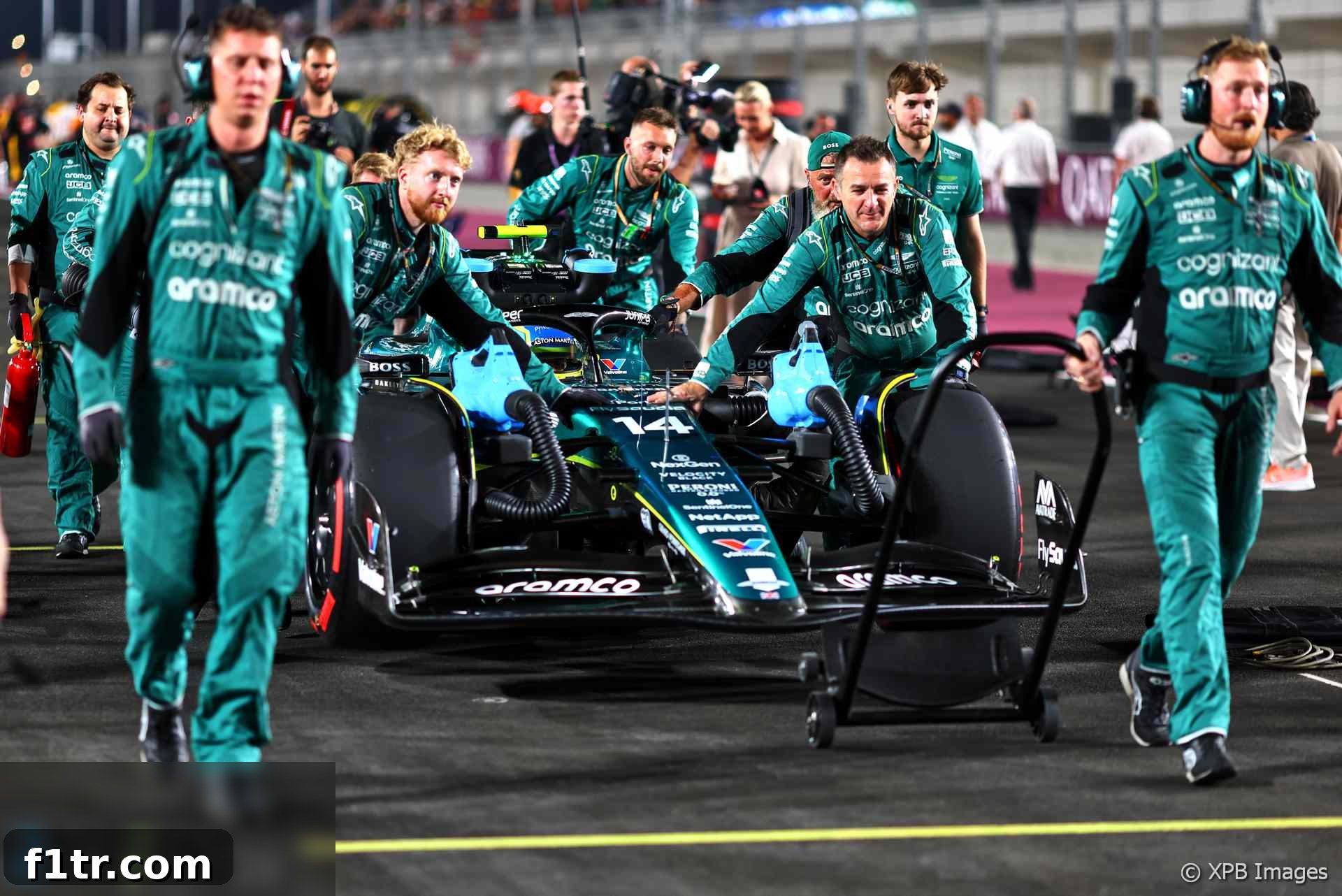
In a strategic move that has captivated the Formula 1 paddock, Fernando Alonso and his Aston Martin team made a calculated decision to consciously compromise their performance in the recent Qatar Grand Prix Sprint race, all in pursuit of a significantly stronger outcome in the main 57-lap Grand Prix. This bold gamble, born from unprecedented tyre concerns and potential rule changes, underscores the intricate strategic depth inherent in modern Formula 1 racing, especially under challenging circumstances like those presented by the Lusail International Circuit.
Advert | Become a Supporter & go ad-free
Advertisement Placeholder
The backdrop to Aston Martin’s audacious plan was a mounting safety concern regarding tyre integrity at the high-speed Lusail circuit. The FIA, F1’s governing body, was actively considering a dramatic intervention: mandating three pit stops for all competitors in Sunday’s Grand Prix. This unprecedented measure was a direct response to data indicating potential tyre delamination and excessive wear under the unique combination of the circuit’s abrasive surface, high-speed corners, and the intense heat and humidity of the Qatari desert. Such a rule would fundamentally alter every team’s tyre strategy, requiring them to conserve more sets of the durable medium and hard compounds than initially allocated for a standard race weekend.
With this looming uncertainty hanging over the weekend, teams found themselves in a precarious position, forced to prepare for various scenarios. For many, including Aston Martin, this meant a radical shift in their approach to the Sprint race. Traditionally, the Sprint offers an opportunity to score a few valuable championship points and fine-tune race settings. However, the potential need for additional medium and hard tyres for Sunday’s main event meant that using these crucial compounds in the Sprint became an unacceptable risk. Consequently, several drivers opted to start the Sprint race on the soft tyre compound, knowing it would degrade faster but crucially preserve their stock of the more resilient compounds for the Grand Prix.
Fernando Alonso, a two-time world champion renowned for his strategic acumen and ability to extract every ounce of performance from his machinery, articulated Aston Martin’s reasoning with characteristic frankness. Having qualified ninth for the Sprint race after a track limits infringement saw his best time deleted in the earlier qualifying session, Alonso stated that the team had made a conscious decision to prioritise the Grand Prix, even if it meant sacrificing the Sprint entirely. The risk-reward balance simply wasn’t in favour of pursuing a minimal points haul in the shorter race.
“We had to throw one race away,” Alonso declared, his words echoing the harsh realities of strategic decision-making at the pinnacle of motorsport. “We throw this one and not tomorrow. This approach was purely about foresight and mitigating potential risks in a race weekend fraught with unique challenges. The team understood that securing a strong position in the Grand Prix, with its significantly higher points yield, was paramount compared to the handful of points available in the Sprint.
Elaborating on the team’s rationale, Alonso explained, “We don’t know what will be the strategy tomorrow. So we have to cover all the scenarios and we have to throw away one race. We decided today that starting P9 it was just possible, maybe one or two points, and it was not worth the risk.” This statement perfectly encapsulates the intricate calculations teams undertake. A ninth-place start in the Sprint, while offering a slim chance of a point or two, wasn’t deemed valuable enough to compromise the tyre allocation for a Grand Prix that could potentially offer a top-five finish and substantially more championship points. The focus was unequivocally on Sunday, viewing the Sprint as a necessary casualty in their overarching strategic play.
Despite their pre-race decision to treat the Sprint as a sacrificial lamb, the outcome for Alonso was ironically somewhat fortuitous. Demonstrating his formidable race craft and benefiting from the attrition and penalties that often characterise Sprint events, Alonso still managed to score a point for eighth place. This unexpected gain came after the chequered flag, when Charles Leclerc of Ferrari was penalised for repeatedly exceeding track limits. This turn of events meant that even with a compromised tyre strategy, the Asturian veteran managed to put a single championship point on the board, a small but welcome bonus for a race that wasn’t a priority.
The true prize, however, lies in the Grand Prix. Alonso’s impressive qualifying performance earlier in the weekend secured him a formidable fourth position on the starting grid for Sunday’s main event. This strong grid slot, coupled with a refreshed and optimally allocated tyre bank, positions him perfectly to contend for a significant points haul. The initial decision to conserve tyres for this very race now appeared profoundly prescient, giving Aston Martin a tangible advantage over competitors who might have used up more of their preferred compounds in the Sprint.
Looking ahead to the Grand Prix, Alonso exuded confidence, a testament to the team’s meticulous planning and execution throughout the challenging weekend. “I think the weekend has been spectacular so far,” he remarked, reflecting on his strong pace in all sessions leading up to the Grand Prix. This consistency across practice, qualifying, and even the partially sacrificed Sprint, indicated a car and driver combination that was truly on form at the Lusail circuit. “So I don’t think that we need to pray for points,” he added, a subtle jab at past races where Aston Martin might have struggled more for top positions.
His optimism was well-founded: “We’ve been in the top four or five for every session, every lap we did. So if we keep doing this job tomorrow we will be in the top five at the end of the race. That will be the aim.” This unwavering belief in their capabilities highlights the team’s strong performance trajectory. The ambition for a top-five finish is not merely a hope but a strategic target, underpinned by a well-executed plan that prioritized the main event above all else. The decision to “throw away” the Sprint race appears to be a calculated risk that is poised to pay off handsomely, solidifying Aston Martin’s position as a serious contender and reaffirming Alonso’s reputation as one of F1’s most astute strategic thinkers.
The Qatar Grand Prix weekend has thus far been a masterclass in strategic adaptability and risk assessment for Aston Martin. Faced with the unique challenge of potential mandatory pit stops and tyre conservation, the team, guided by the seasoned expertise of Fernando Alonso, chose the path less travelled. By sacrificing immediate gratification in the Sprint, they have meticulously prepared themselves for the ultimate prize: a strong finish and a significant points haul in the Grand Prix. As the lights go out for the main race, all eyes will be on Alonso and Aston Martin, eager to see if their bold gamble yields the championship rewards they so carefully planned for.
Advert | Become a RaceFans supporter andgo ad-free
Advertisement Placeholder
2023 Qatar Grand Prix Insights
- Albon fears Qatar GP conditions risked creating dangerous “wet bulb effect”
- Alonso: New-spec fireproofs and pre-race anthem timing made Qatar heat worse
- Magnussen admits he took “too long to learn” Losail circuit
- Analysis: Sargeant’s Qatar radio reveals his painful struggle to end point-less run
- Alfa Romeo ‘finally understand their upgrade’ Bottas believes as team target Williams
Browse all 2023 Qatar Grand Prix articles