F1 23 Review: Charting the Course of Codemasters’ Latest Formula 1 Experience
For countless racing enthusiasts and dedicated Formula 1 fans worldwide, Codemasters’ official F1 game series remains the ultimate gateway to experiencing the pinnacle of motorsport. Without the staggering budgets or the extraordinary talent required to compete at an elite level, these games offer the closest virtual approximation to piloting the planet’s fastest racing machines. This year, F1 23 accelerates onto the scene with an earlier release date than any preceding Codemasters F1 title under the EA Sports banner, prompting a crucial question: Has this expedited launch led to a rushed product, or does it genuinely improve upon its predecessor, F1 22, which garnered a somewhat mixed reception?
Become a Supporter & go ad-free
Three years into its tenure on the current generation of consoles, F1 23 is not a revolutionary ground-up reinvention, nor does it transition to an entirely new game engine. Instead, it embodies a familiar evolution, serving as this year’s iteration of the established F1 game formula that players have grown accustomed to over many years – a fact that carries both advantages and disadvantages, depending on individual expectations.
Refined Gameplay: The Core Driving Experience
Beyond the updated rosters, fresh menus, and aesthetic tweaks, what tangible improvements does F1 23 offer to justify its premium price tag? Before delving into the prominent new features like F1 World and the return of Braking Point, let’s prioritize the aspect that truly defines the experience for dedicated players and series veterans: car handling and physics.
Last year, F1 22 faced considerable criticism from both casual players and professional esports racers for its often unpredictable and finicky handling model. Cars would frequently lose traction and spin under throttle, even out of high-speed corners, leading to frustrating and unrealistic moments. In response, Codemasters has implemented substantial revisions to the physics engine for F1 23. Using default car setups, players will immediately notice a more forgiving and predictable experience. No longer do cars inexplicably snap away under acceleration in scenarios where real-world F1 machines would maintain composure, such as the exit of Turn 4 at the Circuit de Catalunya. Furthermore, F1 23 cars exhibit noticeably stronger turn-in characteristics, making it more satisfying and precise to attack corners, especially through demanding, fast-flowing sequences like the iconic Esses at Suzuka.
For those who prefer to drive without assists, the cars in F1 23 feel more manageable than in the previous iteration. This improvement is most striking in time trial mode: hop into an RB19 under ideal track conditions, and you’ll find the car feels significantly more planted and “glued” to the road. However, this increased accessibility doesn’t mean the physics have been overly simplified or “neutered.” Start a career mode with a team like Williams, or begin at the back of the grid in MyTeam, and you’ll still be battling the car frequently. This demands a more cautious and measured driving style, requiring you to maintain sufficient margins to prevent costly spins until you’ve upgraded your car sufficiently to enhance its grip and overall performance.
Key Gameplay Additions and Quality-of-Life Improvements
Beyond the physics overhaul, F1 23 introduces several commendable additions to the gameplay experience. Perhaps the most celebrated is the introduction of the 35% race distance option. Previously exclusive to esports professionals, this setting provides races approximately 30-35 minutes in length. It strikes a perfect balance for players who find the 50% distance too much of a grind but the 25% distance too short for genuine immersion, offering a sweet spot for competitive yet time-conscious racing. Car setup adjustments have also been refined, with each parameter now offering more granular control, moving beyond the limiting one-to-ten scale and providing greater freedom for fine-tuning your vehicle.
After an absence of nearly a decade, red flags make a welcome return to the F1 game series – a timely re-introduction given their increased prevalence in the real sport compared to when they were last featured in F1 2014. These operate similarly to the existing Safety Car mechanism, activating when the game detects a significant obstruction on the track. However, unlike the Safety Car, red flags immediately halt the action, resetting all cars onto the grid. This pause allows drivers the strategic freedom to change tyres, potentially altering their race strategy, before resuming the remainder of the race from a standing start, adding a new layer of tactical depth.
Become a RaceFans supporter andgo ad-free
Naturally, red flags are designed to be a rare occurrence in organic gameplay. During extensive review sessions, RaceFans did not encounter a single red flag triggered by normal race incidents. While this might seem unremarkable, it underscores their situational nature. Deliberately obstructing the circuit can induce a red flag, though this somewhat defeats the intended purpose. Critically, red flags are available in online multiplayer. Here, they promise to inject a dynamic new element into races, particularly in league racing where accidents are more frequent, especially on notoriously tight street circuits like Monaco or the challenging Jeddah Corniche Circuit.
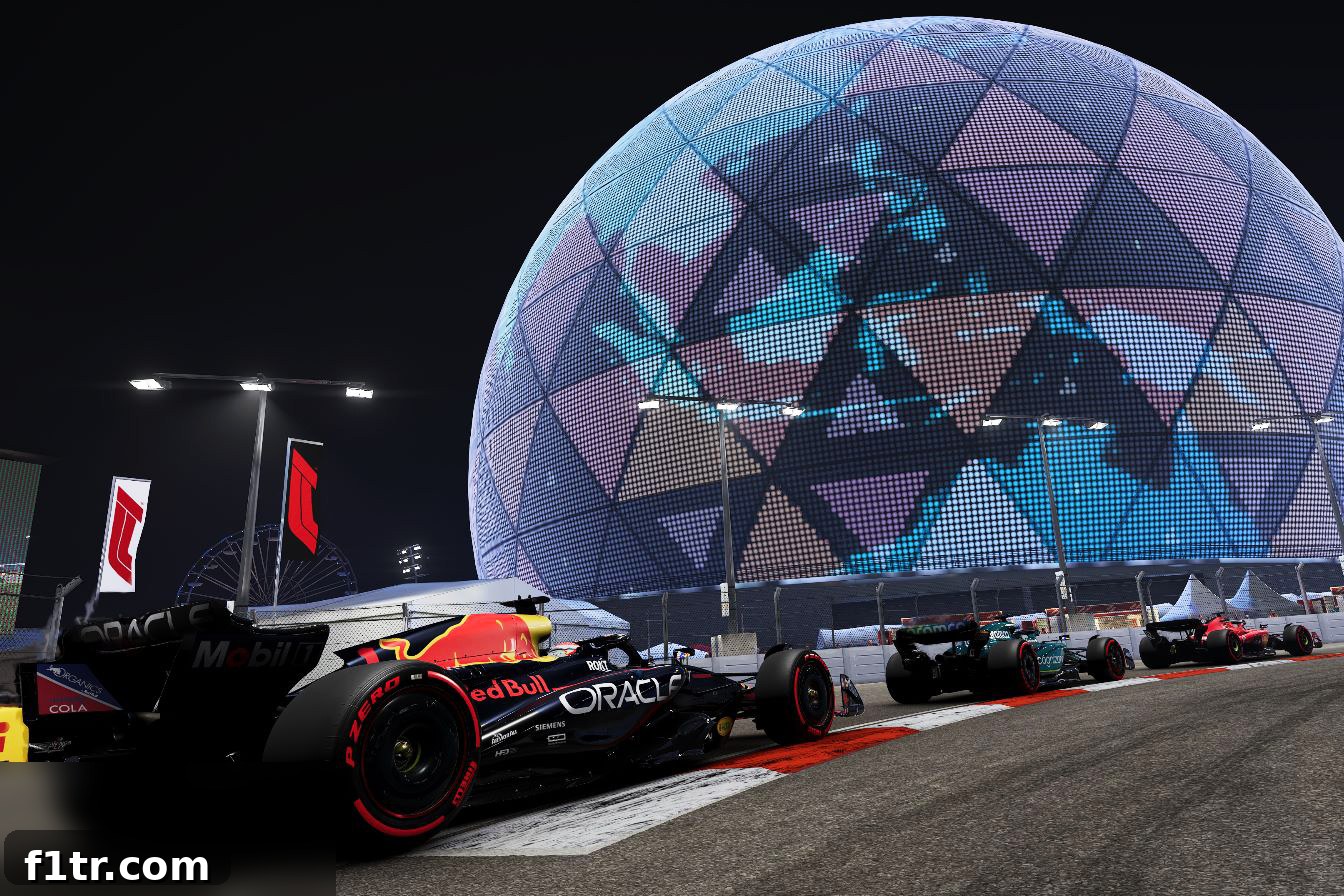
Speaking of circuits, F1 23 boasts an impressive roster of 26 tracks. Both the highly anticipated Las Vegas Strip Circuit and the Losail International Circuit are fully rendered and playable from day one, eliminating the wait for post-launch additions. Furthermore, three popular bonus circuits – Paul Ricard, Shanghai International Circuit, and Algarve International Circuit (Portimão) – are also included right away. While it’s not the first time EA has featured non-calendar tracks in an F1 game, their inclusion is undeniably a very welcome bonus, adding considerable variety for players.
Lingering AI Frustrations and Single-Player Stagnation
Players hoping for a drastic overhaul of the Artificial Intelligence (AI) behavior are likely to be left somewhat underwhelmed. Last year’s computer-controlled opponents were often overly aggressive, with many finding them volatile and unpredictable to race against. While F1 23 sees a slight reduction in their side-by-side aggressiveness, which is a positive step, some fundamental frustrations with AI behavior persist. For instance, faster AI cars will courteously move out of your way during practice or qualifying laps, but then bizarrely fail to create any space for your car during their own push laps. This results in them constantly breathing down your neck throughout your practice program, a scenario that is as unrealistic as it is irritating and detrimental to immersion.
For players whose primary engagement with the F1 game revolves around its single-player modes, F1 23 may also disappoint due to a noticeable lack of innovation. While the driver career and MyTeam modes have been robust and engaging in previous years, they remain virtually identical to their F1 22 counterparts. Although there are minor tweaks, such as the addition of new MyTeam icons available for hire – including legendary figures like Jacques Villeneuve, Kamui Kobayashi, Pastor Maldonado, and even three-time W Series champion Jamie Chadwick – starting a career mode only to be greeted by the exact same menus, email structures, and general progression as three years ago (with Natalie Pinkham merely replacing Will Buxton for interviews) is bound to leave many yearning for more significant developments.
Become a RaceFans supporter andgo ad-free
Braking Point and F1 World: The New Pillars of F1 23
It’s evident that the primary development focus for F1 23 has been squarely on two major areas: the much-anticipated return of the story mode, Braking Point, and the introduction of the brand-new F1 World mode. Braking Point, which offered a compelling piece of cinematic entertainment in F1 2021, makes its comeback to continue the dramatic narrative of fictional F1 drivers Aiden Jackson and Devon Butler. After their intense rivalry in the original story, the duo are now unexpectedly united as teammates for the newly formed Konnersport Racing Team, leading to predictably explosive results both on and off the track.
For those familiar with the original Braking Point, the sequel delivers a largely similar experience. The narrative unfolds through beautifully rendered cutscenes, while the drivers’ motorhome serves as a central hub where characters receive emails, phone calls, and peruse news clippings reacting to the latest dramatic developments. On the track, players are presented with straightforward challenges, such as “reach 13th place before the end of the race,” often accompanied by bonus objectives that reward additional reputation for your characters.
Undeniably, significant effort has been poured into Braking Point 2. The motion capture technology used for actor performances represents a clear generational leap over its predecessor, resulting in more convincing character portrayals. However, many of the criticisms leveled against the first Braking Point remain equally valid for this sequel. Given the mode’s complete creative freedom to craft any narrative it desires, it’s surprising how many of the core story beats and plot devices feel almost directly transplanted from the original, leading to a sense of déjà vu rather than fresh innovation.
The introduction of the tenacious Callie Mayer character does offer a refreshing counterpoint to the often-moody Jackson and the detestable Butler, injecting some much-needed new blood into the cast. Yet, it remains challenging to become fully immersed in the Braking Point narrative when the entire focus revolves around these fictional characters, with minimal crossover or interaction with any real-life F1 drivers or team principals. Despite being a highly polished and well-produced mode that undoubtedly surpasses cinematic motorsport efforts like Sylvester Stallone’s infamous 2001 IndyCar-based film ‘Driven,’ once the credits roll, one can’t help but ponder how F1 23 might have benefited had the considerable development resources invested in Braking Point been allocated to other areas of the core game instead.
F1 World: A New Hub for Progression and Competition
While most players will likely complete Braking Point within a weekend, F1 World is meticulously designed to be the central, long-term mode around which your F1 23 experience will revolve. After three years, EA has finally integrated an “Ultimate Team”-inspired feature into its acquired F1 franchise – thankfully, however, without a single pack of collectible cards in sight. This new mode aims to provide an engaging progression loop and a new avenue for both online and offline competition.
Become a RaceFans supporter andgo ad-free
Similar to FIFA or Madden’s popular Ultimate Team modes, F1 World puts players in control of their own customizable team and car, each with a specific performance level. The core objective is to continuously upgrade and improve these elements to compete effectively in a variety of online and offline challenges. Both your virtual car and your team are segmented into distinct aspects – for your car, this includes components like the power unit and brakes, while your team consists of key personnel such as your Head of R&D and Strategist. The combined performance level of all these individual components and staff members contributes to your overall “tech level,” which serves as the ultimate metric of your potential performance. A higher tech level theoretically translates to a faster and more competitive car.
Utilizing your customized F1 World car and team, you participate in a range of challenges, from races against AI opponents and online multiplayer contests to time trials. Success in these challenges earns you money and resources, which are then used to unlock superior car parts and hire more skilled staff members. Akin to the Ultimate Team model, each staff member requires a contract to be applied, activating their services for a set number of races. This introduces a strategic layer of resource management, as you must invest your earnings to retain the expertise of your highest-rated personnel.
If this progression system sounds like a potential breeding ground for aggressive microtransactions, your wariness is certainly justified. However, F1 23 notably lacks any direct mechanism to purchase high-level staff or resources using real money. Instead, F1 World resources are primarily integrated into the Podium Pass items, providing an advantage to those who opt for the VIP tier each season. Crucially, players earn money and resources organically for every lap completed across all modes that fall under the F1 World umbrella – including standard Grand Prix and time trial modes. For those keen to accelerate their progress, Pit Coin can be spent to purchase XP boosts for a limited period.
Multiplayer: Sharpening the Competitive Edge
While F1 World offers an enticing “just one more race” incentive that could lead to obsessive engagement for some players, the good news is that it can be easily bypassed if it doesn’t align with your preferences. Thankfully, Codemasters hasn’t neglected the competitive heart of online play. F1 23 introduces an entirely new divisions system, offering a fresh focal point for players who are passionate about serious racing against real opponents in equal machinery. Much like in WRC Generations, players will be categorized into one of seven tiers, ranging from ‘Bronze’ all the way up to ‘Elite,’ with weekly promotions and demotions to reward top performers and challenge those at the lower end of the ranks.
The driver license system has also undergone revisions this year. Players now have the option to activate it during offline play, allowing them to build up their safety rating in a controlled environment before venturing into the often-chaotic world of online multiplayer. Once online, a novel option enables players to toggle collisions off specifically for the first lap of a race – a feature that feels almost like a necessity for races around circuits notorious for first-lap pile-ups, such as Monza. Whether your preference lies in serious competitive league racing or the engrossing journey of building up your car in F1 World, F1 23 offers more tailored options than ever before to find the multiplayer experience that perfectly suits your style.
Become a RaceFans supporter andgo ad-free
Is F1 23 Worth the £70 Price Tag?
As has become standard, Formula 2 is included in the game, providing an additional layer of racing content. The supercars, introduced in F1 22, have surprisingly survived a potential cull after just a single year. However, having been relegated to a mere sideshow, it’s easy to overlook their presence within the game, indicating a missed opportunity for deeper integration or expansion.
Graphically, F1 23 presents some subtle yet noticeable enhancements, even as this iteration of the venerable Ego engine begins to show its age. Sunny weather conditions now feature a warmer, more vibrant lighting tone, making circuits like Miami feel significantly more atmospheric and balmy. In wet weather, cars exhibit discernible channels of spray through their bodywork, adding a layer of visual realism to challenging conditions. While the game remains playable in VR on PC-based headsets, it’s a significant disappointment that PSVR2 owners are not afforded the ability to race in virtual reality on PlayStation 5, especially given how Gran Turismo 7 has so powerfully demonstrated the immense potential of the system for racing simulations.
Inevitably, some bugs and glitches were encountered during the review period. At one point, the game consistently triggered red flags mere seconds after a restart, leading to an almost endless, frustrating loop – an inconsequential annoyance in a single Grand Prix but potentially race-destroying if it occurred during a crucial career mode event or a competitive league race. Commentator Alex Jacques also has a peculiar habit of occasionally sounding remarkably similar to David Croft when enunciating the grid order. Most amusingly, one F1 World race featured the entire AI field making the aggressive, yet nonsensical, strategic choice of full wet weather tyres for a bone-dry track – a scenario that would have made for an interesting challenge had it been by design.
With a collection of decent new additions to a game that, at its core, still feels largely familiar to a series many have been playing for years, it’s a difficult proposition to definitively state whether F1 23 fully justifies its £70 upgrade price for those who purchased last year’s installment. There is little doubt that F1 23 is a superior title at launch compared to what F1 22 offered. However, it remains to be seen whether players will ultimately hail this new iteration as Codemasters’ finest F1 product once the initial novelty wears off and its long-term appeal is tested.
F1 23 may not be the radical Formula 1 game that many hardcore fans yearn for, but this year, more than ever, it successfully delivers the most malleable and customizable F1 experience that any Codemasters F1 game has achieved. If the new Braking Point story mode and the F1 World progression system do not particularly appeal to you, it’s probably wise to exercise caution before immediately investing your hard-earned money. Nevertheless, at its heart, F1 23 is a game rich with diverse content, offering one of the best pure racing experiences available on the market today, catering to a wide spectrum of F1 enthusiasts.
Become a RaceFans supporter andgo ad-free
Video: F1 23 reviewed by RaceFans
Pictures: F1 23 – A Visual Showcase
RaceFans Rating: [Please insert your rating here]
Game Title: F1 23 Official Game Review
Platform(s): PlayStation 4, PlayStation 5, Xbox Series S, Xbox Series X, Xbox One, Steam, Epic Games Store
Developer: Codemasters
Publisher: EA Sports
Released: June 2023
Price: £69.99
More Reviews
- Controversies, Norris, Newey and more: Five new motorsport books reviewed
- Next new F1 game to arrive in 2027, EA to offer 2026 season as paid DLC
- “F1 Insider: Notes from the Pit Lane” – Ted Kravitz’s new F1 book reviewed
- “Rennsport”: The RaceFans review
- “Grid to Glory: 75 Milestone F1 Moments” – Alex Jacques’ new F1 book reviewed
Browse all Reviews