The dawn of Formula 1’s new era promised renewed rivalries and unpredictable outcomes, and the opening race weekend in Bahrain certainly delivered. Two formidable drivers, Max Verstappen and Charles Leclerc, immediately emerged as the leading contenders, setting the stage for an epic season-long duel for supremacy. This enthralling battle, which captivated audiences during the Bahrain Grand Prix, swiftly resumed upon the paddock’s arrival in Jeddah for the Saudi Arabian Grand Prix.
Throughout the three practice sessions leading up to qualifying in Jeddah, Charles Leclerc consistently demonstrated Ferrari’s raw pace, placing his car at the pinnacle of the timing screens. Max Verstappen, in his Red Bull, was never far behind, often just mere centimeters separating the two titans. Their fierce competition built immense anticipation for Saturday’s qualifying session, leaving fans and pundits alike to ponder a single, burning question: which of these two rising stars would secure the second pole position of the 2022 season?
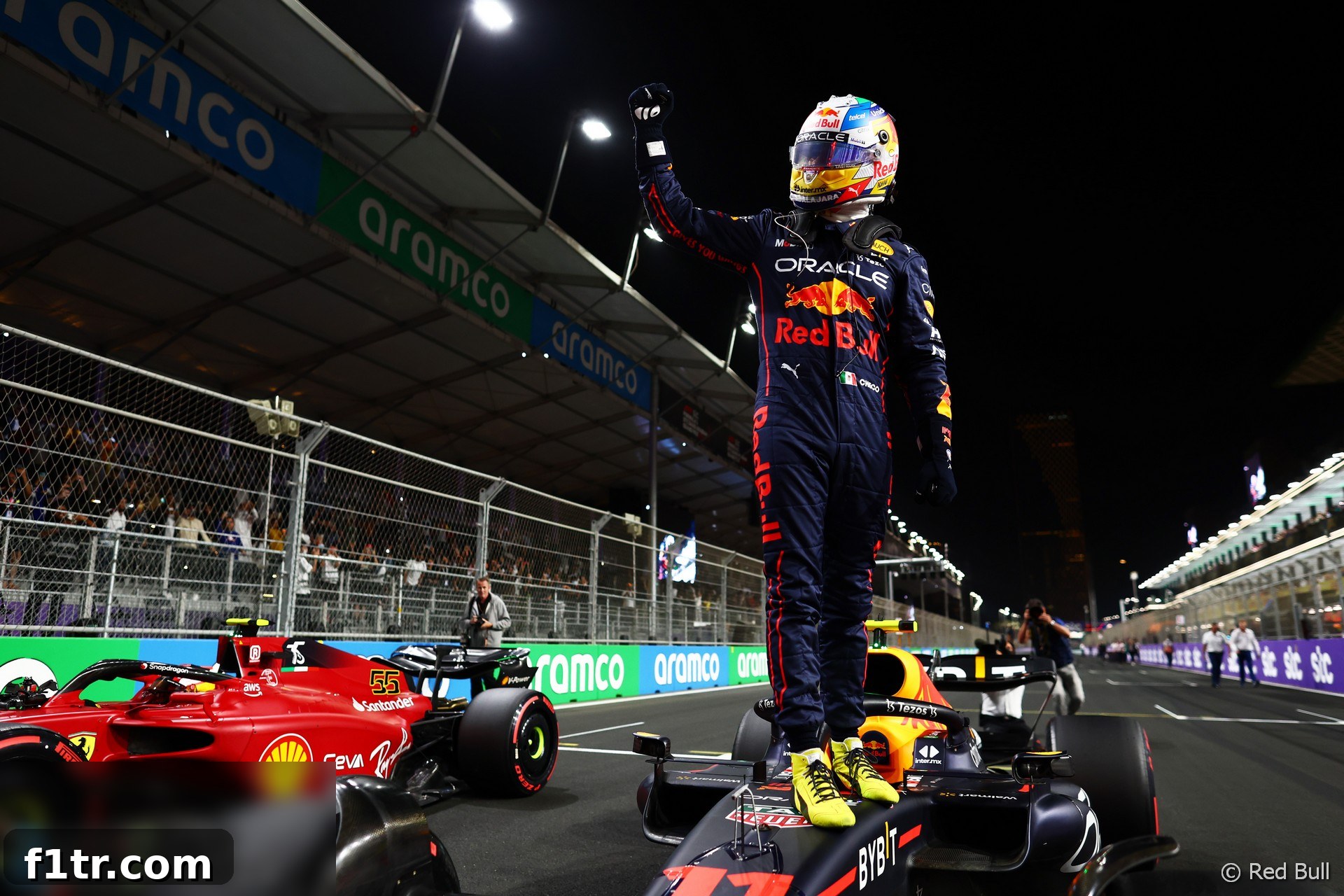
The answer, as it turned out, was a thrilling curveball: Sergio Perez. The Mexican driver, in his second season with Red Bull, had long expressed his belief that the sweeping regulations overhaul of 2022 would truly mark the beginning of his tenure at the team. With a completely new car, equally unfamiliar to both himself and his world champion teammate Verstappen, Perez envisioned a level playing field where he could genuinely challenge for top honors. And challenge he did. As Verstappen grappled with extracting the expected grip from his tyres, Perez delivered a sensational performance for Red Bull, snatching pole position and denying Ferrari, and Leclerc, their second consecutive qualifying triumph within a week.
Perez’s pole was not just a personal victory; it was a crucial moment for Red Bull, especially after both their drivers left Bahrain empty-handed. For Perez, this represented perhaps the most promising pre-race odds he had ever enjoyed for a Grand Prix victory. He exuded confidence that the RB18, already a potent machine, possessed even greater strength to unleash under the demanding conditions of race day. His pole position underscored the immense potential of the new Red Bull package and served as a powerful statement of intent for the team’s championship aspirations.
Addressing the media on Saturday night, flanked by the Ferrari drivers, a composed Perez explained his team’s strategic approach. “We’ve been focusing more on race pace than qualifying,” he revealed. “We felt that we’ve given away some qualifying performance to gain it in the race, but obviously we’re going to see. I expect these two [Leclerc and Sainz] are going to be very strong, but I really hope that we can have a strong race.” This insight suggested a calculated trade-off, prioritizing Sunday’s battle over Saturday’s glory, a strategy that could pay significant dividends in a long and arduous race.
Red Bull also appeared to hold a marginal strategic advantage heading into Sunday. Both Charles Leclerc and Carlos Sainz of Ferrari had unfortunately missed out on crucial high-fuel race simulation runs during Friday evening practice, a consequence of damaging their cars in separate brushes with the notoriously unforgiving Jeddah walls. Despite this setback, both Ferrari drivers remained remarkably optimistic, expressing confidence that their preparations would not be significantly compromised come race time.
“We changed a little bit our program this morning in third practice and we managed to do some few laps in high fuel which I think went well,” Leclerc clarified, indicating Ferrari’s quick adaptation to their disrupted schedule. “So I don’t think it will impact us that much.” Sainz echoed this sentiment, emphasizing the incredibly tight margins between the top two teams. With the performance gaps between Ferraris and Red Bulls consistently measured in mere hundredths of a second across the first five track days of the season, Sainz eagerly anticipated an “exciting” race.
“I think it’s a great battle to have two cars in one tenth and a half, two tenths like we saw today,” Sainz commented, reflecting on the qualifying results. “I think it’s great for Formula 1 to have all four drivers just battling it out there. And I think we all have good respect for each other.” This mutual respect, coupled with intense on-track competition, promised a compelling spectacle for fans worldwide, reinforcing the narrative of a thrilling championship fight.
Given the incredibly evenly matched performance of Red Bull and Ferrari at this nascent stage of the season, the already critical element of tyre management assumes an even greater significance. Pirelli, the sport’s sole tyre supplier, brought the C4 compound tyre to the Jeddah Corniche Circuit for the first time. Despite its introduction, Pirelli’s motorsport director, Mario Isola, shared feedback and data gathered over the weekend, suggesting a clear preference among teams. Few, it seemed, were keen to deploy the softer C4 compound in the race if they could possibly avoid it, pointing towards a more conservative tyre strategy.
“The majority of drivers have kept two sets of medium and one set of hard, which probably indicates that they will prefer to stick to these two compounds,” Isola confirmed. This data-driven insight points to a strategic dichotomy, where the strategy remains open between a conventional one-stopper and a more aggressive two-stopper. The ultimate decision, Isola noted, would be heavily influenced by the actual levels of tyre degradation experienced throughout the race, which, in turn, depends on a myriad of factors including track temperature, driver style, and car setup.
A notable rule change for the 2022 season removes the previous obligation for Q3 participants to start the race on the tyres they used to set their fastest Q2 lap. This change introduces a fascinating strategic wrinkle, creating a slim but tangible possibility that not a single top-ten starter might opt for the soft tyres at the race’s outset. If a one-stop strategy is deemed viable and preferable, the most logical and favored route would involve starting on the durable medium compound before making a single pit stop to switch to the hard tyres for the remainder of the race. This classic strategy aims for optimal balance between grip and longevity.
Alternatively, running a lengthy first stint on the hard tyres before transitioning to mediums for the final part of the race presents a much higher risk. While it could offer an advantage later in the race, it likely means being initially outmaneuvered by competitors on softer compounds at the start. This aggressive reverse strategy might be a compelling option for drivers starting further down the order, those with less to lose and more to gain from an unconventional approach. A two-stop strategy offers another tactical avenue, but with the soft tyre generally out of favor due to its high degradation characteristics on the Jeddah circuit, this approach will likely be restricted to drivers who have at least two fresh sets of medium tyres at their disposal, allowing for greater flexibility and pace across multiple stints.
However, attempting to apply conventional race strategy to a circuit as inherently hazardous and unpredictable as Jeddah has proven to be over its brief history could quickly turn into a foolish endeavor. December’s inaugural race on this very track was a prime example, featuring not one but two separate red flag stoppages that dramatically reshuffled all pre-race plans and forced teams to improvise on the fly. The circuit’s propensity for chaos was further highlighted in yesterday’s Formula 2 race, which saw multiple Safety Car deployments due to various crashes. Adding to the tension, F1 qualifying itself was halted twice for accidents, including a violent shunt for Mick Schumacher that, unfortunately, ruled him out of the main race. Given these precedents, it came as little surprise when pole-winner Sergio Perez candidly described the Jeddah Corniche Circuit as the “most dangerous” on the current Formula 1 calendar.
On a practical level, this inherent danger translates into potentially the highest risk of race interruptions by a red flag, or even multiple stoppages, among all races this season. Beyond the frenetic and often perilous opening lap, incidents like Schumacher’s crash in the early stages of the 2021 race here serve as a stark reminder that even a seemingly minor mistake can quickly escalate into a race-halting collision with the unforgiving barriers that line this high-speed street circuit. The unique blend of high speeds, blind corners, and close walls demands absolute precision from drivers, leaving virtually no margin for error.
For experienced drivers like Lewis Hamilton, who finds himself starting from an uncharacteristic 15th position on the grid, or many of his fellow Mercedes-powered rivals clustered around him who might not realistically expect to score points on pure performance alone, the unpredictability of Jeddah presents a unique strategic opportunity. There’s a strong incentive to extend stints as long as possible, prioritizing track position in the hope of capitalizing on a ‘free’ pit stop. Such an opportunity could arise during a Safety Car period or, more significantly, under a red flag, where drivers can change tyres without losing track time. With drivers still familiarizing themselves with the dramatically different 2022 cars and potentially running even closer together than in previous seasons, there’s every logical reason to anticipate that all 50 laps of the race distance will not unfold under continuous green flag conditions. The tactical gamble of a long stint could truly pay off for those outside the immediate points battle.
Finally, the critical question of reliability looms large over the paddock. Red Bull are adamant that they have identified and resolved the race-ending fuel pressure problem that afflicted both Max Verstappen and Sergio Perez late in the Bahrain Grand Prix. However, it was telling that the team had not encountered this specific issue during pre-season testing. The grueling 300 non-stop kilometers of a Grand Prix present a far more rigorous and comprehensive test of machinery than any controlled testing environment. Consequently, there remains a tangible chance that another team, perhaps even Red Bull itself, could uncover a previously unknown and very important reliability vulnerability in their 2022 car at the most inopportune moment, potentially throwing a wrench into their championship aspirations. Such an outcome could have profound implications for the early stages of the season.
Whatever the ultimate results may be from today’s highly anticipated race, one thing is almost certain: the 2022 Saudi Arabian Grand Prix is poised to be one of the most demanding and stressful nights of the year for both the courageous drivers pushing their machines to the limit and the dedicated teams orchestrating every strategic move from the pit wall. The combination of a dangerous circuit, new regulations, fierce rivalries, and the ever-present threat of reliability issues promises a spectacle of high drama and unpredictable twists.
Qualifying times in full
| Driver | Car | Q1 | Q2 (vs Q1) | Q3 (vs Q2) | ||
| 1 | Sergio Perez | Red Bull | 1’29.705 | 1’28.924 (-0.781) | 1’28.200 (-0.724) | |
| 2 | Charles Leclerc | Ferrari | 1’29.039 | 1’28.780 (-0.259) | 1’28.225 (-0.555) | |
| 3 | Carlos Sainz Jnr | Ferrari | 1’28.855 | 1’28.686 (-0.169) | 1’28.402 (-0.284) | |
| 4 | Max Verstappen | Red Bull | 1’28.928 | 1’28.945 (+0.017) | 1’28.461 (-0.484) | |
| 5 | Esteban Ocon | Alpine | 1’30.093 | 1’29.584 (-0.509) | 1’29.068 (-0.516) | |
| 6 | George Russell | Mercedes | 1’29.680 | 1’29.618 (-0.062) | 1’29.104 (-0.514) | |
| 7 | Fernando Alonso | Alpine | 1’29.978 | 1’29.295 (-0.683) | 1’29.147 (-0.148) | |
| 8 | Valtteri Bottas | Alfa Romeo | 1’29.683 | 1’29.404 (-0.279) | 1’29.183 (-0.221) | |
| 9 | Pierre Gasly | AlphaTauri | 1’29.891 | 1’29.418 (-0.473) | 1’29.254 (-0.164) | |
| 10 | Kevin Magnussen | Haas | 1’29.831 | 1’29.546 (-0.285) | 1’29.588 (+0.042) | |
| 11 | Lando Norris | McLaren | 1’29.957 | 1’29.651 (-0.306) | ||
| 12 | Daniel Ricciardo | McLaren | 1’30.009 | 1’29.773 (-0.236) | ||
| 13 | Zhou Guanyu | Alfa Romeo | 1’29.978 | 1’29.819 (-0.159) | ||
| 14 | Mick Schumacher | Haas | 1’30.167 | 1’29.920 (-0.247) | ||
| 15 | Lance Stroll | Aston Martin | 1’30.256 | 1’31.009 (+0.753) | ||
| 16 | Lewis Hamilton | Mercedes | 1’30.343 | |||
| 17 | Alexander Albon | Williams | Mercedes | 1’30.492 | ||
| 18 | Nico Hulkenberg | Aston Martin | Mercedes | 1’30.543 | ||
| 19 | Nicholas Latifi | Williams | Mercedes | 1’31.817 | ||
| 20 | Yuki Tsunoda | AlphaTauri |
Sector times
| Driver | Sector 1 | Sector 2 | Sector 3 |
|---|---|---|---|
| Sergio Perez | 32.299 (3) | 28.323 (1) | 27.578 (1) |
| Charles Leclerc | 32.134 (1) | 28.347 (3) | 27.714 (3) |
| Carlos Sainz Jnr | 32.289 (2) | 28.482 (4) | 27.631 (2) |
| Max Verstappen | 32.314 (4) | 28.335 (2) | 27.812 (4) |
| Esteban Ocon | 32.566 (7) | 28.589 (9) | 27.913 (6) |
| George Russell | 32.343 (5) | 28.548 (5) | 28.055 (10) |
| Fernando Alonso | 32.614 (8) | 28.581 (8) | 27.842 (5) |
| Valtteri Bottas | 32.544 (6) | 28.560 (6) | 27.955 (7) |
| Pierre Gasly | 32.698 (9) | 28.574 (7) | 27.970 (8) |
| Kevin Magnussen | 32.765 (12) | 28.703 (11) | 28.022 (9) |
| Lando Norris | 32.721 (10) | 28.669 (10) | 28.234 (13) |
| Daniel Ricciardo | 32.741 (11) | 28.776 (14) | 28.217 (12) |
| Zhou Guanyu | 32.985 (14) | 28.714 (12) | 28.077 (11) |
| Mick Schumacher | 32.896 (13) | 28.765 (13) | 28.236 (14) |
| Lance Stroll | 33.048 (15) | 28.884 (15) | 28.320 (16) |
| Lewis Hamilton | 33.085 (16) | 28.890 (16) | 28.291 (15) |
| Alexander Albon | 33.167 (17) | 28.975 (18) | 28.350 (17) |
| Nico Hulkenberg | 33.201 (18) | 28.896 (17) | 28.427 (18) |
| Nicholas Latifi | 33.655 (19) | 29.247 (19) | 28.644 (19) |
| Yuki Tsunoda | 39.346 (20) |
Speed trap
| Pos | Driver | Car | Engine | Speed (kph/mph) | Gap |
|---|---|---|---|---|---|
| 1 | Sergio Perez | Red Bull | Red Bull | 335.1 (208.2) | |
| 2 | Max Verstappen | Red Bull | Red Bull | 334.1 (207.6) | -1.0 |
| 3 | Kevin Magnussen | Haas | Ferrari | 330.0 (205.1) | -5.1 |
| 4 | Pierre Gasly | AlphaTauri | Red Bull | 328.9 (204.4) | -6.2 |
| 5 | Valtteri Bottas | Alfa Romeo | Ferrari | 328.7 (204.2) | -6.4 |
| 6 | Mick Schumacher | Haas | Ferrari | 328.3 (204.0) | -6.8 |
| 7 | Fernando Alonso | Alpine | Renault | 328.0 (203.8) | -7.1 |
| 8 | Zhou Guanyu | Alfa Romeo | Ferrari | 327.3 (203.4) | -7.8 |
| 9 | George Russell | Mercedes | Mercedes | 327.1 (203.3) | -8.0 |
| 10 | Alexander Albon | Williams | Mercedes | 327.1 (203.3) | -8.0 |
| 11 | Carlos Sainz Jnr | Ferrari | Ferrari | 327.1 (203.3) | -8.0 |
| 12 | Charles Leclerc | Ferrari | Ferrari | 327.0 (203.2) | -8.1 |
| 13 | Lance Stroll | Aston Martin | Mercedes | 326.9 (203.1) | -8.2 |
| 14 | Esteban Ocon | Alpine | Renault | 326.8 (203.1) | -8.3 |
| 15 | Nico Hulkenberg | Aston Martin | Mercedes | 326.6 (202.9) | -8.5 |
| 16 | Nicholas Latifi | Williams | Mercedes | 325.5 (202.3) | -9.6 |
| 17 | Lewis Hamilton | Mercedes | Mercedes | 324.4 (201.6) | -10.7 |
| 18 | Lando Norris | McLaren | Mercedes | 323.8 (201.2) | -11.3 |
| 19 | Daniel Ricciardo | McLaren | Mercedes | 322.2 (200.2) | -12.9 |
| 20 | Yuki Tsunoda | AlphaTauri | Red Bull | 165.3 (102.7) | -169.8 |
Over to you
With Sergio Perez starting from pole, can he hold off the formidable Ferrari threat from Charles Leclerc and Carlos Sainz? What strategies will Max Verstappen employ to recover from his fourth-place grid position? And what can a seasoned champion like Lewis Hamilton salvage from his unusually poor starting position of 15th on this treacherous circuit?
Share your predictions and insights on the 2022 Saudi Arabian Grand Prix in the comments section below.
Become a RaceFans Supporter
RaceFans is made possible thanks in part to the generous support of its dedicated readers. By contributing a modest £1 per month or £12 per year (or the equivalent in your local currency), you can directly help cover the essential costs of creating, hosting, and continually developing RaceFans, ensuring its future growth and independence.
Become a RaceFans Supporter today and enjoy an ad-free browsing experience across the entire site. Learn more and sign up via the links provided below:
- Become a RaceFans Supporter
- RaceFans Supporter FAQ
2022 Saudi Arabian Grand Prix
- Vettel will return to race for Aston Martin at Australian Grand Prix
- Mercedes “a second per lap” off Red Bull’s pace – Russell
- Transcript: How Verstappen fought Leclerc on his radio and on the track in Jeddah
- F1 intends to keep racing in Saudi Arabia despite missile attack
- Paddock Diary: 2022 Saudi Arabian Grand Prix
Browse all 2022 Saudi Arabian Grand Prix articles