The Return of Black: Mercedes F1’s Strategic Livery Shift for the 2023 Season
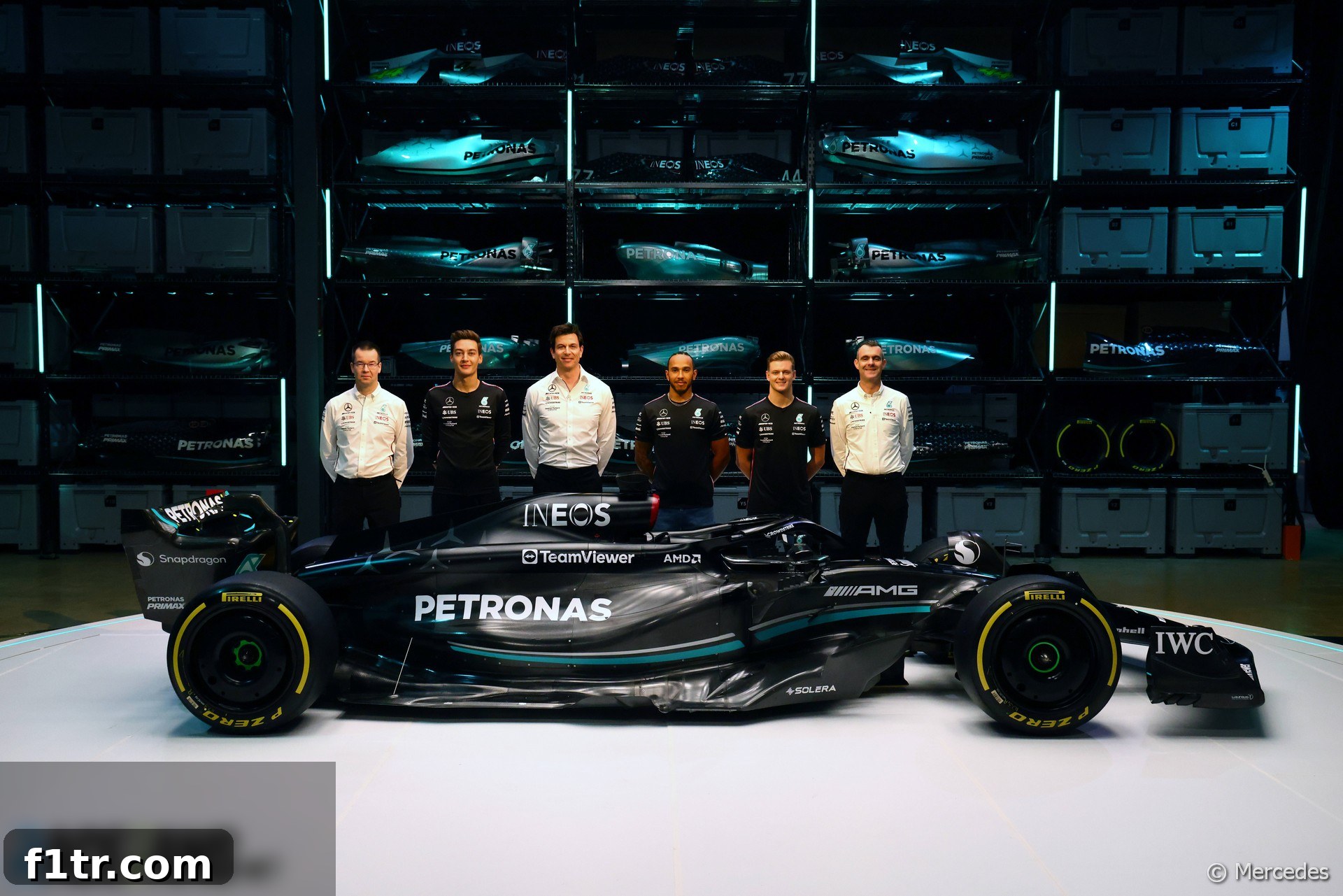
In a move that has captured the attention of Formula 1 enthusiasts and pundits alike, the Mercedes-AMG Petronas Formula One Team has unveiled its 2023 challenger, the W14, sporting a predominantly black livery. This strategic design choice marks a significant shift, reverting from the traditional silver that defined their 2022 season. However, unlike its previous iteration, this return to black is driven by a singular, crucial objective: performance optimization through weight saving. This decision underscores the relentless pursuit of every millisecond in the hyper-competitive world of Formula 1, where even the aesthetic choices are meticulously engineered for an on-track advantage.
A Weighty Decision: The Pursuit of Performance
The 2022 Formula 1 season presented an array of challenges for Mercedes, notably struggling with the new ground-effect regulations and their W13 car often exceeding the minimum weight limit. Being overweight in Formula 1 translates directly into a performance deficit, as every extra kilogram hinders acceleration, braking, and cornering speed. Team Principal Toto Wolff explicitly stated the team’s predicament, explaining, “We were overweight last year. This year we have tried to figure out where we can squeeze out every single gram.” This candid admission reveals the intense pressure on engineering teams to find innovative solutions within the strict regulatory framework.
The aesthetic consequence of this weight-saving drive is the prominent display of raw carbon fiber on the W14. Paint, even in thin layers, adds measurable weight. By leaving significant sections of the car unpainted or applying only a minimal matte black finish, Mercedes aims to shave off crucial grams, contributing to a lighter, and therefore faster, package. This trend isn’t exclusive to Mercedes; other teams on the grid have also incorporated more unpainted carbon into their liveries for the 2023 season, indicating a collective understanding of the fine margins that define success in modern F1. The visual impact of these bare carbon elements, combined with strategic matte black paint, creates a purposeful and aggressive aesthetic, reflecting the W14’s underlying mission.
The Black Livery’s Legacy: From Social Statement to Performance Imperative
The 2023 black livery, while performance-driven, inevitably evokes memories of Mercedes’ prior black cars in the 2020 and 2021 seasons. The original adoption of the black livery in 2020 was a powerful and unprecedented statement, born out of a critical global moment. Initially, the team’s 2020 car was unveiled in its traditional silver. However, in response to the worldwide wave of protests against racial inequality and injustice in the spring of 2020, epitomized by the Black Lives Matter movement, Mercedes made a profound and public commitment. They transformed their car’s livery to black, accompanied by the bold message “End Racism” emblazoned on the sidepods.
This decision was more than a cosmetic change; it was a visible signal of the team’s unwavering commitment to fighting racism and discrimination in all its forms. It resonated deeply with the principles championed by seven-time world champion Lewis Hamilton, who has been a vocal advocate for diversity and inclusion both within motorsport and globally. For two seasons, the black livery stood as a symbol of progress, a visible testament to Mercedes’ dedication to social responsibility.
Reflecting on this history, Toto Wolff acknowledged the duality of the black livery. While the current return is for practical reasons, he stated, “Of course, when we changed the livery in 2020 the main driving factor was to support the diversity and equality causes which are always close to our heart. The colour black became part of our DNA at that point, so we are pleased to return to it.” This sentiment highlights how a color can transcend its aesthetic function, embedding itself into a team’s identity through significant historical moments.
The Silver Arrows’ Heritage: A Balancing Act Between Tradition and Modernity
The decision to switch back to black, even for practical reasons, inevitably brings to the forefront the legendary “Silver Arrows” moniker that has been synonymous with Mercedes-Benz motorsport heritage for nearly a century. The tale of the Silver Arrows dates back to the 1934 Eifelrennen, where, legend has it, the white paint of a Mercedes racing car was scraped off overnight to meet weight regulations, revealing the bare aluminum beneath. While modern historical research has largely debunked the specific details of this “paint-scraping myth,” it has become an indelible part of the team’s folklore, symbolizing ingenuity and a relentless drive for lightness and speed.
Toto Wolff, during the W14 launch, referenced this very myth, underscoring its continued relevance to the team’s identity. He acknowledged the deep-seated connection to the silver color, stating last year that the black livery “has become part of our DNA, but the silver colour of the Silver Arrows is as much our DNA, it’s our history.” This encapsulates the dilemma faced by a team with such a rich heritage: how to balance reverence for tradition with the unyielding demands of cutting-edge innovation and performance. The 2023 livery perfectly illustrates this tension, where historical echoes of weight-saving meet modern engineering necessity. It’s a pragmatic nod to the past, applied with a forward-looking mindset focused squarely on competitive advantage.
Beyond the Surface: Mercedes’ Enduring Commitment to Diversity
While the primary driver for the 2023 livery change is performance, Mercedes has consistently demonstrated that its commitment to diversity and inclusion extends far beyond the color of its cars. The team’s “Accelerate 25” diversity initiative, launched two years prior, is a testament to this enduring dedication. This program aims to increase the representation of under-represented groups within its workforce, fostering a more inclusive environment within motorsport, an industry historically lacking in diversity.
The W14 launch itself served as a platform to highlight the tangible progress of this initiative. Mercedes proudly shared statistics indicating significant improvements: the percentage of female team members has increased from 12% to 16%, and the number of staff from minority ethnic backgrounds has grown from 3% to 9%. These figures, while still representing ongoing work, demonstrate a clear and measurable impact from dedicated programs. The team included apprentices and interns hired through Accelerate 25 in its launch event, underscoring that their commitment is not just aspirational but actionable, creating genuine pathways for talent from diverse backgrounds into Formula 1. This holistic approach ensures that even as the car’s exterior changes for performance, the team’s core values remain steadfast.
The W14’s Aspirations and the Road Ahead
The Mercedes W14, with its striking black and raw carbon livery, represents more than just a new racing car; it embodies a renewed determination from the Mercedes-AMG Petronas F1 Team. It is a visual manifestation of lessons learned from a challenging 2022 season and a clear statement of intent for 2023. The meticulous attention to weight saving, symbolized by the livery, is part of a broader engineering philosophy aimed at optimizing every aspect of the car’s design and performance.
The team, with Toto Wolff at the helm and Lewis Hamilton and George Russell in the cockpit, enters the 2023 Formula 1 season with high hopes of challenging for race victories and potentially the championship. The black livery, while recalling its past as a social statement, now serves as a stark reminder of the relentless pursuit of speed and efficiency that defines the pinnacle of motorsport. It’s a compelling narrative of how a team can balance its rich historical identity and profound social commitments with the ultimate, uncompromising goal of competitive excellence on the track. The W14 is poised not just to race, but to tell a story of adaptation, innovation, and an unwavering drive towards the top.