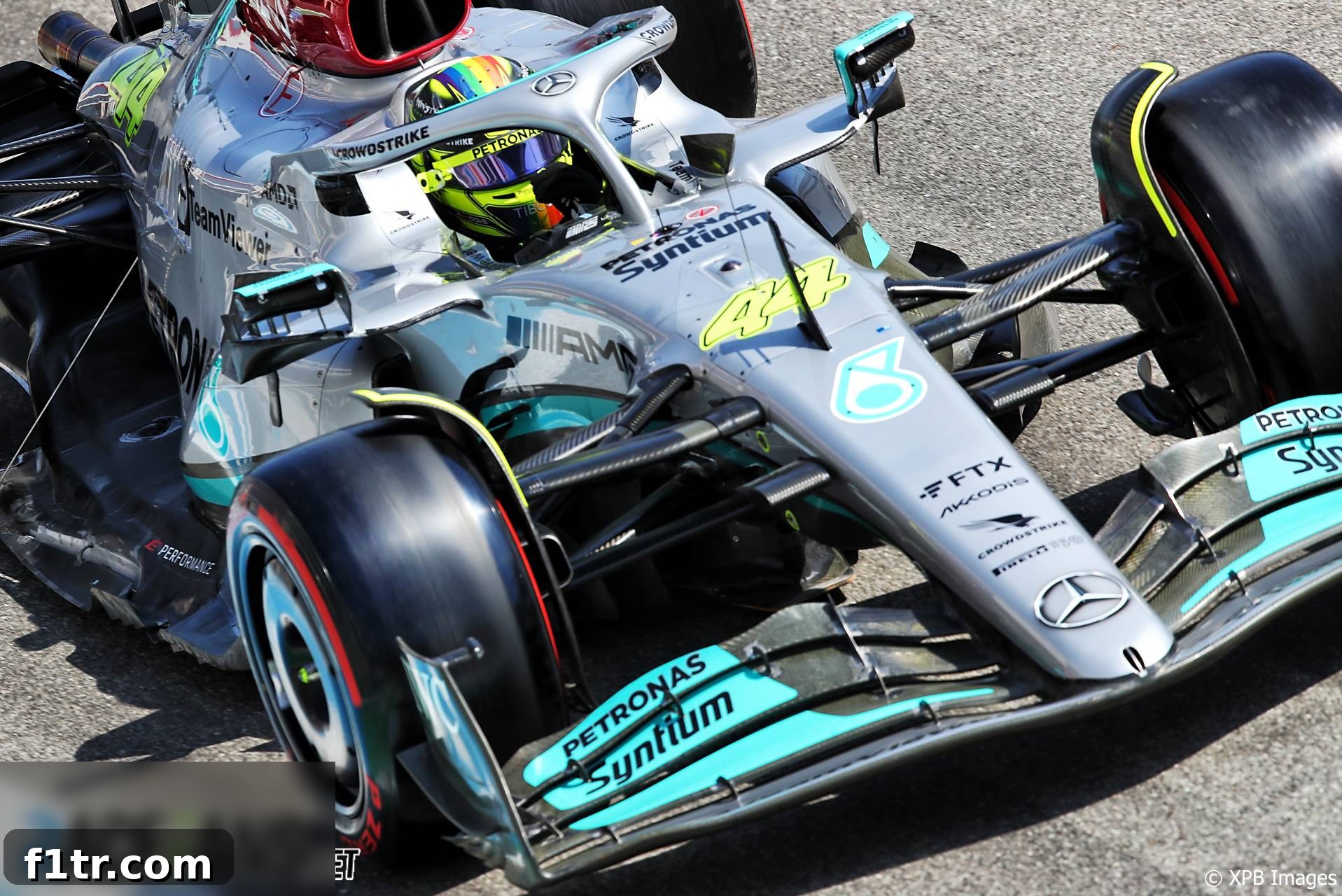
The atmosphere at Mercedes was one of profound disappointment following the qualifying session for the French Grand Prix. Team Principal Toto Wolff openly admitted his astonishment at the significant performance gap separating his squad from front-runners Ferrari and Red Bull, a scenario he deemed previously “not possible.” The high hopes arriving at the smooth, fast-cornered Paul Ricard circuit, especially with a suite of fresh upgrades for their W13 challenger, had been comprehensively dashed, leaving the team searching for answers.
Mercedes had entered the weekend with cautious optimism. The track characteristics of Paul Ricard, known for its flat surfaces and sweeping bends, were theorized to play to the strengths of the W13, a car that has shown flashes of its potential but has primarily been a challenging enigma throughout the 2022 Formula 1 season. Furthermore, the introduction of a new upgrade package was expected to narrow the deficit to their rivals, a crucial step in their ongoing quest to return to the pinnacle of the sport.
However, the reality proved starkly different. Lewis Hamilton, a seven-time world champion and usually a formidable force in qualifying, could only manage fourth place, a disheartening eight-tenths of a second adrift of pole-sitter Charles Leclerc. His teammate, George Russell, who has consistently pushed Hamilton this season, found himself a further two-tenths behind, underscoring a fundamental lack of pace that permeated the entire Mercedes garage. This considerable gap was not merely a matter of fine-tuning; it suggested a deeper, more systemic issue with the W13 on this particular track.
“If you would have told me that we are ending up [there], I would have said that’s not possible,” Wolff confessed to the media, his voice betraying a mix of frustration and bewilderment. He didn’t mince words, calling the result “a bit of a slap in the face” – a candid admission reflecting the team’s shock at their sudden regression after recent encouraging outings. This frank assessment highlighted the emotional toll the performance swings were taking on the leadership and the entire team.
Indeed, Mercedes’ form had shown signs of a significant upturn in the preceding races. Both Silverstone and the Red Bull Ring had offered glimmers of hope. At Silverstone, Hamilton fought for the win, demonstrating competitive race pace, while in Austria, a track historically challenging for Mercedes, the team found themselves surprisingly close to the pace, even securing a double podium. These weekends had fostered a belief within the team that they were “slowly but surely working our way back to the front-runners.” The W13 seemed to be shedding some of its notorious characteristics, particularly the aggressive porpoising that plagued its early season development, and the team believed they were beginning to unlock its true potential.
“There were good signs in Silverstone,” Wolff reiterated, “Then we went to Austria, a track where we are normally not competitive at all and we could clearly see the signs why we were not competitive but we were close. It’s a one-minute circuit and we were three tenths off, so that was acceptable.” The contrast with Paul Ricard was therefore even more perplexing. “Then we brought quite a nice update package to Paul Ricard, the track is smooth, off we go, let’s hunt them down. And boom, no performance. Like, no performance and we can’t figure it out, what went wrong.” The abrupt loss of pace, especially on a track predicted to be favorable, intensified the search for answers within the engineering department.
The team’s efforts to comprehend their lack of competitiveness were extensive and varied throughout the practice sessions and into qualifying. Engineers and drivers cycled through numerous setup configurations, desperately seeking to unearth the root cause of their struggles. This involved experimenting with different aerodynamic packages, particularly rear wing specifications, which dramatically alter a car’s downforce and drag profile. “We experimented with rear wings, from almost the biggest we have – which Lewis described as dragging a parachute behind him this morning – to a smaller version which makes us lose too much speed in the corners,” Wolff explained, illustrating the tightrope walk between straight-line speed and cornering grip.
Beyond aerodynamics, the team also delved into the complex world of tyre management and temperature. Tyres in Formula 1 are notoriously sensitive, operating within a narrow performance window, and getting them to the optimal temperature and pressure is crucial for unlocking grip. Even slight deviations can lead to significant performance losses, making this area a constant source of experimentation and fine-tuning. Despite these exhaustive efforts, a clear understanding of the W13’s erratic behavior remained elusive.
Wolff further admitted the team was at a loss to fully explain the drastic, almost contradictory, swings in performance observed even within a single session. He described a baffling scenario where the car’s performance would dramatically shift from one sector to another, or from one run to the next. “We are seeing within one session we go from totally uncompetitive in the first sector to – second run in Q3 – we’re the best in sector one. [From] uncompetitive in sector one, dreadful, to being the quickest in sector one at the end, and the opposite in the last sector.” This inconsistent behavior across different parts of the track suggested that external factors, such as wind conditions, or the car’s extremely sensitive relationship with its tyres, might be playing a disproportionate role.
The Mercedes W13, in Wolff’s view, appeared to be operating on a knife-edge. “The car is on the edge and between hero and zero there is just a super-fine margin that we don’t seem to hit and understand,” he concluded. This “hero and zero” dynamic encapsulates the challenge facing Mercedes. When they hit that elusive sweet spot, the car can perform exceptionally, as seen in flashes. However, straying even slightly from this optimal window results in a catastrophic drop in performance, leaving the team bewildered and unable to consistently exploit the car’s potential. This inconsistency makes it incredibly difficult to develop and optimize the car, as every change seems to introduce new variables rather than provide clear solutions.
The Paul Ricard setback served as a stark reminder that despite their undeniable progress in recent races, Mercedes still faced significant hurdles in taming the W13. The continuous quest for understanding, for unlocking the car’s inherent pace while mitigating its unpredictable tendencies, remains the team’s paramount objective. With the championship battles intensifying, and rivals Red Bull and Ferrari consistently pushing the boundaries, Mercedes knows that unraveling the W13’s mysteries is not just a technical challenge, but a critical imperative for their future success in the 2022 season and beyond. The French Grand Prix qualifying, while painful, underscored the immense engineering challenge that still lies ahead for the Brackley-based squad, highlighting the fine margins that separate victory from profound disappointment in the fiercely competitive world of Formula 1.
2022 French Grand Prix Insights
- Ferrari’s season of missed chances led to “difficult” criticism for Binotto
- McLaren looking into why their starts are “more inconsistent” this year
- Mercedes expect Hungarian GP will ‘expose our qualifying weakness’
- Hamilton and Russell ‘out-performing a car that’s not good enough’ – Wolff
- “We need to decide now”: Inside Sainz and Ferrari’s French GP strategy dilemma
Browse all 2022 French Grand Prix articles