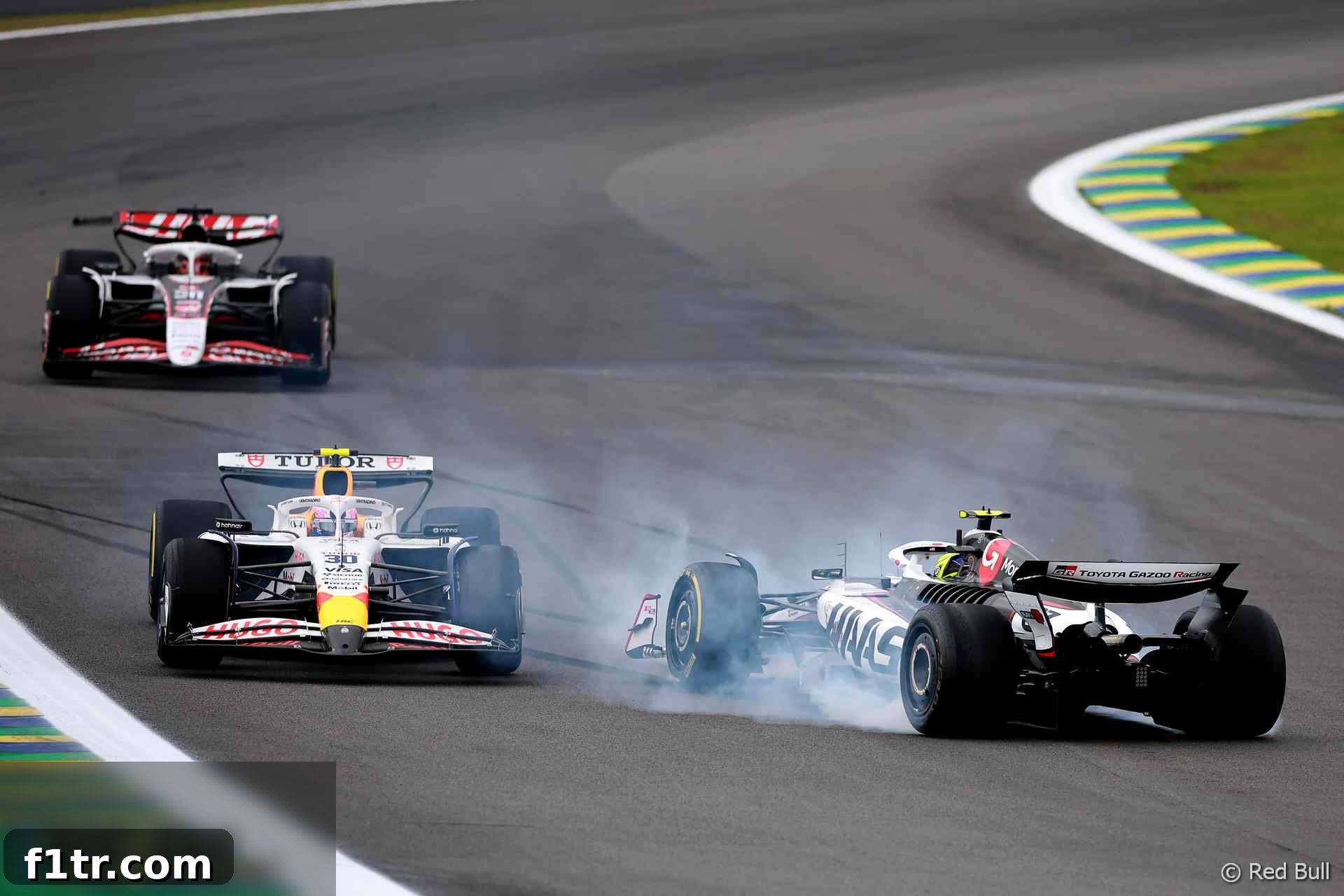
Brazilian Grand Prix Sprint: Bearman and Lawson Receive Penalties in Fiery First Lap Encounter
Oliver Bearman found himself immediately back in hot water at the Brazilian Grand Prix, picking up a penalty point just days after two points were removed from his Super Licence. The young driver now stands precariously close to an automatic race ban following a contentious incident with Liam Lawson during today’s thrilling sprint race.
Advert | Become a Supporter & go ad-free
The stewards’ panel at Interlagos has issued a penalty to Bearman for an aggressive manoeuvre on the opening lap, forcing Lawson off the track. This decision sees one penalty point added to Bearman’s licence, elevating his total to nine. With 12 points triggering an automatic one-race suspension, Bearman is now just three points away from a mandatory sideline stint, a scenario no driver wants to face, especially in their debut season.
Adding to the drama, Lawson also received a penalty for his role in a subsequent collision with Bearman at Turn Four, an incident that saw Bearman’s car spin. This article delves into the specifics of both incidents, the stewards’ rationale, the drivers’ reactions, and the broader implications for their respective seasons and Formula 1 careers.
The Contested First Lap: Bearman vs. Lawson Showdown
The stage for the chaotic events was set on the very first lap of the sprint race. As the cars navigated the high-speed section between the Curva do Sol and Descida do Lago, Oliver Bearman executed a move that would quickly draw the attention of race control. It was here that Bearman squeezed Liam Lawson towards the inside of the straight, leaving the Racing Bulls driver with virtually no room to maneuver, forcing him onto the wet grass.
Incident One: Bearman’s Aggressive Move and Lawson’s Complaint
Lawson, visibly frustrated after the race, recounted the moments leading up to the contact. “I think he had a bad exit out of [turn] three,” Lawson explained to the official Formula 1 channel. “I don’t know if he got pushed off but he was quite slow on the straight, so I had a big run. I went to go to his left and he just pushed me on the grass.”
Lawson’s description painted a vivid picture of the danger involved, especially given the treacherous conditions. “At that point I think you’re asking for an aeroplane crash. We’re doing 300 down the straight and it’s wet,” he stressed, highlighting the severe risks associated with such high-speed, close-quarters racing in damp conditions. The Racing Bulls driver was unequivocal in his belief that Bearman’s actions were unduly aggressive and jeopardized both their safety.
This early skirmish undoubtedly heightened tensions, with Lawson suggesting that Bearman’s initial push-off was a significant precursor to their eventual collision just moments later. The incident demonstrated the fine line drivers walk between aggressive racing and dangerous driving, especially during the opening stages of a race when positions are fiercely contested and tyre temperatures are still suboptimal.
Stewards’ Verdict on Bearman: High Speed, High Risk
The race stewards, after reviewing all available evidence, sided with Lawson’s assessment. They determined that Bearman’s manoeuvre constituted “unnecessary risk,” a critical finding in the context of Formula 1’s stringent safety regulations. Their official notes detailed the sequence of events:
“After losing momentum at the exit of turn three, car 87 [Bearman] was approached by car 30 [Lawson], which had greater speed and was in the process of drawing alongside on the straight towards turn four. As car 30 attempted to move alongside, the driver of car 87 moved to the left, leaving insufficient room and forcing car 30 to place two wheels on the wet grass. Although car 30 managed to keep control and avoid contact, this manoeuvre occurred at high speed and created an unnecessary risk.”
The stewards were clear in their condemnation of Bearman’s driving, stating, “The stewards consider that the move of Car 87 constituted potentially dangerous driving, in breach of Appendix L, Chapter IV, Article 2 e) of the International Sporting Code.” This classification underscores the seriousness of the infraction, which goes beyond mere racing incident and touches upon fundamental safety protocols.
As a consequence, Bearman received a five-second time penalty, though this had no bearing on his 12th-place finishing position in the sprint race. More significantly for his immediate future, he was handed one penalty point on his Super Licence. The stewards justified the penalty, stating, “As no contact occurred and Car 30 was able to maintain control, and considering consistency with comparable previous cases, the stewards deem a five-second time penalty and one penalty point to be appropriate and proportionate.” This suggests a desire for consistency in sanctioning similar infractions across the season, reinforcing F1’s commitment to fair and safe racing.
The Subsequent Collision at Turn Four
The drama between Bearman and Lawson was far from over after the initial squeeze. Moments later, as they entered Descida do Lago (Turn Four), the two cars made contact, resulting in Bearman spinning out. This second incident also came under the scrutiny of the stewards, leading to another penalty, this time for Lawson.
Lawson’s Perspective: The Unavoidable Touch
Lawson believed that the prior incident on the straight directly contributed to their collision at Turn Four. “We went into turn four and I had completely wet tyres and struggled for grip and we touched,” he explained. The New Zealander felt that the preceding aggressive move by Bearman put him in a compromised position, affecting his tyres and subsequent grip. “It’s lap one, we’re buried anyway, I’m not sure why the high risk. The gap was there when I went for it down the straight and he just kept coming across to the left.”
Bearman, on the other hand, offered a more terse reaction to the Turn Four incident in a statement released by his team, Haas. “There’s no point in commenting on the lap one turn four incident,” he said, adding simply, “it’s done.” This brief comment suggests a desire to move past the event quickly, perhaps acknowledging the intensity of first-lap racing without dwelling on specific blame.
Stewards’ Analysis: Shared Blame and Mitigating Factors
Despite Lawson’s contention that Bearman’s earlier action was the root cause, the stewards ultimately held Lawson “predominantly to blame” for the collision at Turn Four. Their detailed explanation shed light on the complex nature of the incident:
“On the first lap, car 30 attempted to overtake car 87 on the inside (left-hand-side) while approaching and through turn four. After the apex, as both cars were exiting the corner, there was contact between the two cars. In turn four, car 30, slightly offset alongside car 87, moved slightly to the right, while car 87, following the natural line of the left-hand corner, turned slightly towards car 30. As a result, the left rear wheel of car 87 became entangled with the right front wheel of car 30, causing car 87 to spin. Both cars were able to continue the race thereafter.”
A key aspect of their ruling revolved around the “racing room” guidelines. “Video evidence from circuit cameras and onboard footage did not clearly establish whether the front axle of car 30 was at least momentarily alongside the rear-view mirror of car 87 prior to the apex, let alone whether this overlap was maintained at the apex – as would be required under the Driving Standards Guidelines for an overtaking car on the inside to be entitled to racing room.” This detail is crucial in F1 racing, as it defines when an overtaking driver is entitled to space and when they are solely responsible for completing a move safely.
Lawson’s own testimony was considered. He explained that the collision was a direct consequence of the prior incident, which left him with “colder and damp left tyres.” This, he stated, resulted in understeer, causing his car to drift towards Bearman’s and initiating the contact. The stewards acknowledged these factors as “mitigating circumstances.”
Considering the track conditions, Lawson’s compromised tyre state, and the fact that his front axle was “almost alongside the mirror of car 87,” the stewards applied a reduction to the standard penalty. Instead of a 10-second time penalty, Lawson received a five-second penalty, along with one penalty point on his Super Licence. This brings Lawson’s total penalty points to seven, placing him closer to a ban, though not as immediately as Bearman. The nuanced decision reflects the complexities of on-track incidents, where multiple factors often contribute to the outcome.
The Broader Implications for Both Drivers
The Brazilian Grand Prix sprint race may have been short, but its consequences for Oliver Bearman and Liam Lawson are significant, extending beyond just their finishing positions. Both drivers are young talents vying for permanent spots in Formula 1, and every incident, every penalty point, is scrutinized heavily.
Oliver Bearman’s Licence Under Scrutiny
For Oliver Bearman, the accumulation of nine penalty points is a stark reminder of the fine line between aggressive driving and crossing the threshold into dangerous territory. With only three points separating him from an automatic race ban, he will need to exercise extreme caution in upcoming races. A single misstep could see him sidelined, a scenario that would severely impact his momentum and reputation. Such a ban, especially early in a career, can be a major setback, raising questions about a driver’s discipline and judgment under pressure. Teams, particularly Haas, will be closely monitoring his driving standards moving forward, as they invest in his development and future within the sport.
Liam Lawson’s Season and Future
Liam Lawson, while not as close to a ban as Bearman, now has seven penalty points, placing him firmly on the stewards’ radar. For a driver who has impressed with his maturity and speed, particularly in challenging conditions, this penalty is a blot on his copybook. While his explanation regarding cold, damp tyres and understeer was taken into account as a mitigating factor, the “predominantly to blame” verdict for the collision still carries weight. Lawson is seen as a strong contender for a full-time F1 seat in the near future, and incidents like this, even with mitigating circumstances, will be part of the evaluation by team principals. Consistency and clean racing are paramount for aspiring F1 stars, and Lawson will be keen to avoid further entanglements.
Safety and Driving Standards in Formula 1
These incidents underscore Formula 1’s unwavering commitment to driver safety and maintaining high driving standards. Lawson’s vivid description of an “aeroplane crash” scenario when forced onto the wet grass at 300 km/h serves as a potent reminder of the inherent dangers of motorsport. The stewards’ reference to “unnecessary risk” and “potentially dangerous driving” highlights their role in enforcing boundaries that protect drivers from avoidable harm. The International Sporting Code, particularly Appendix L, Chapter IV, Article 2 e), is a foundational document in this regard, setting out the rules of engagement and the consequences for transgressions. Balancing the thrill of wheel-to-wheel racing with the imperative of safety is a constant challenge for both drivers and race officials, and these penalties serve as a deterrent against overly aggressive or reckless actions on track.
Fan Reaction and The Debate: Were the Penalties Just?
Following the stewards’ decisions, the Formula 1 fan community, often passionate and divided, engaged in spirited debate. Online forums and social media platforms buzzed with discussions about the fairness and proportionality of the penalties issued to both Bearman and Lawson. Many fans expressed agreement with the stewards, particularly regarding Bearman’s initial squeeze, viewing it as an overly aggressive move that jeopardized a fellow competitor’s safety. The consensus, for a significant portion of the audience, was that such actions need to be unequivocally penalized to maintain order and safety on the track.
However, there was also a notable contingent who felt that the penalties, especially Lawson’s, might have been too harsh or that the mitigating circumstances were not given enough weight. Some argued that racing incidents, particularly on a chaotic first lap in damp conditions, should be treated with more leniency, seeing them as an unavoidable part of hard racing. The intricacies of the “racing room” rule and the impact of cold, wet tyres became focal points of these discussions, demonstrating the complexity of judging on-track events from a fan’s perspective versus the precise application of regulations by the stewards. Ultimately, while opinions varied, the discourse highlighted the enduring passion and analytical depth of the F1 fanbase.
Conclusion: Looking Ahead
The Brazilian Grand Prix sprint race provided a microcosm of the intense competition and inherent risks of Formula 1. The penalties handed down to Oliver Bearman and Liam Lawson serve as a potent reminder of the high stakes involved, not just in terms of championship points, but also regarding driver safety and adherence to sporting regulations. Both drivers are immensely talented, and these incidents, while a setback, will undoubtedly be part of their learning curve in the pinnacle of motorsport. Moving forward, both will need to refine their race craft and judgment to navigate the fine line between aggressive, exciting racing and moves that invite the stewards’ intervention. The remainder of the season, and indeed their careers, will be watched closely as they continue their journey in Formula 1.
Advert | Become a RaceFans supporter andgo ad-free
Miss nothing from RaceFans
Get a daily email with all our latest stories – and nothing else. No marketing, no ads. Sign up here:
(Note: Subscription form functionality has been removed in this HTML-only output as per instructions.)
Related Articles: 2025 Brazilian Grand Prix
- 2026 rules will stop F1 teams making “strategic” engine changes for performance
- Tsunoda admits he could have “easily” scored points in Brazil
- Top 10: Most controversial penalty calls during a Formula 1 title fight
- Verstappen is eighth F1 driver to race from pits to podium: Brazilian GP stats
- Verstappen’s latest setback makes this season look even more like a 2007 repeat
Browse all 2025 Brazilian Grand Prix articles