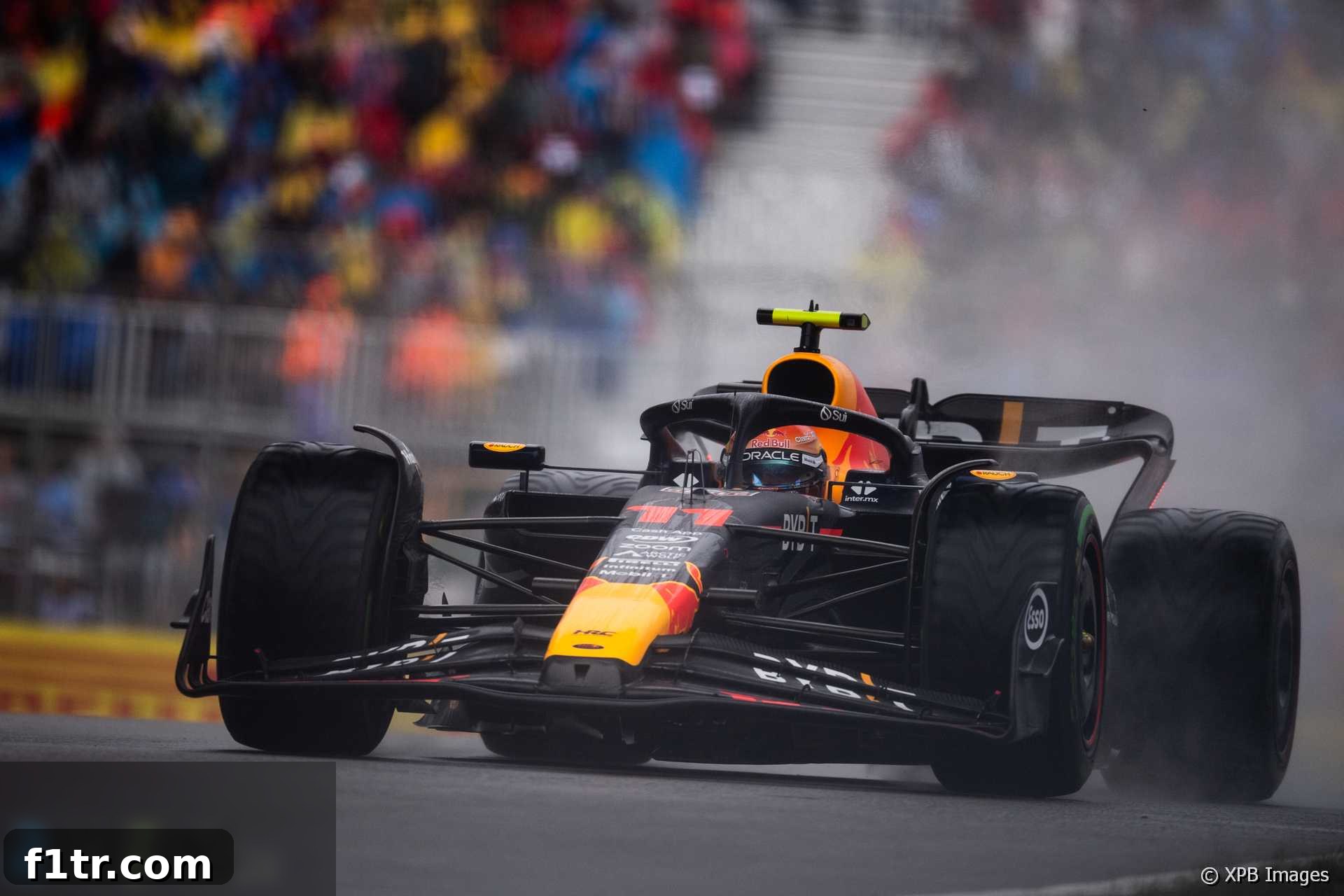
Sergio Perez’s Costly Canadian Grand Prix Qualifying Blunder: A Deep Dive into Strategic Misjudgment
For the third consecutive race weekend, Sergio Perez found himself outside the top ten in qualifying, a frustrating pattern that continued at the Canadian Grand Prix. The Red Bull driver openly admitted that his decision to switch to slick tyres in Q2 came “half a lap too late,” a critical miscalculation that ultimately cost him a spot in the final qualifying session. This recurring struggle raises significant questions about strategic execution and its profound impact on a driver’s championship aspirations.
A Recurring Challenge: Perez’s Qualifying Woes Intensify
Sergio Perez’s 2023 season has been a tale of two halves, or more accurately, a tale of dominant race wins interspersed with increasingly problematic qualifying performances. After a strong start to the championship, securing victories and challenging his teammate Max Verstappen, a worrying trend has emerged in recent weekends. Missing Q3 in Monaco, then Spain, and now Canada, places immense pressure on Perez and compromises his race strategies significantly. Each missed Q3 means starting deeper in the pack, necessitating more aggressive overtakes, increasing tyre wear, and exposing him to potential incidents. This consistent struggle in qualifying jeopardizes his ability to consistently secure podium finishes and, critically, to keep pace with Verstappen in the drivers’ championship.
Advert | Become a Supporter & go ad-free
The Montreal circuit, with its notoriously unpredictable weather, presented a unique challenge, amplifying the stakes of every strategic decision. The track transitioned from wet to dry, then back to wet, creating a treacherous window where timing was everything. In such conditions, intuition, clear communication, and decisive action are paramount. Perez’s recent form suggests a dip in confidence or a disconnect in strategic calls, which F1’s unforgiving nature quickly exploits. His inability to adapt swiftly to the rapidly evolving track conditions has become a glaring vulnerability, allowing rivals to gain an advantage and further widening the gap to his championship-leading teammate.
The Pivotal Q2: Navigating Changing Conditions
The second phase of qualifying at the Circuit Gilles Villeneuve was a tense affair, characterized by rapidly changing weather. Both Red Bull drivers, Sergio Perez and Max Verstappen, initially ventured out on intermediate tyres, a standard choice given the damp track. However, the critical difference in their outcomes lay in the timing of their pit stops. Verstappen, demonstrating impeccable timing and decisive action, returned to the pits one lap earlier than Perez to switch to slick tyres. This seemingly small tactical difference proved to be monumental.
Perez, opting for an additional lap on the intermediates, inadvertently squandered his prime opportunity. By the time he finally committed to the slick rubber, the brief window of optimal track conditions had vanished. The rain, which had momentarily subsided, returned with increased intensity, rendering the slick tyres ineffective for setting a competitive lap time. This delayed switch meant that as Perez began his flying lap, the track was already too wet to extract the necessary performance from the dry-weather tyres. The Red Bull driver succinctly encapsulated his predicament, stating, “It was basically half a lap too late,” further noting, “the track position was really poor with Alfa Romeo ahead.” This poor track positioning, compounded by the deteriorating weather, meant he was unable to capitalize on the drying track and secure a place in Q3.
Adding to his woes, Perez also lost valuable time by dropping behind Valtteri Bottas before commencing his first flying lap in Q2. In a session where every tenth of a second and every inch of track position is critical, such small delays accumulate into significant disadvantages. The fluctuating conditions of a wet-to-dry track demand split-second decision-making, where hesitation can be catastrophic. Verstappen’s ability to anticipate the change and make an earlier call contrasted sharply with Perez’s delayed response, highlighting a key difference in their approach and immediate adaptability to the evolving environment.
The Call from the Cockpit: Team Radio and Joint Decisions
The intricate dance between driver and pit wall is a cornerstone of Formula 1 strategy, especially when weather conditions are volatile. Sergio Perez’s radio messages during Q2 reveal a fascinating glimpse into the real-time decision-making process. As the track gradually dried, discussions between Perez and his race engineer, Hugh Bird, revolved around the pivotal moment to switch from intermediate to slick tyres. Bird initially queried, “How are conditions, ready for the slick yet? A few cars have gone for it.” This indicates that other teams were already gambling, putting pressure on Red Bull to make a call.
Perez, providing feedback from the cockpit, acknowledged the improving conditions but highlighted critical wet patches: “It’s getting close. How are they doing?” and later, confirming Bird’s observation, “Yeah that’s the worst part” regarding turns one and two. This back-and-forth illustrates the inherent uncertainty in these situations. The decision was not a unilateral one from the pit wall, nor solely from the driver. Perez confirmed, “That was always a plan to do one lap and come back onto the slick tyre. We took the decision together and we got it wrong.” This shared responsibility underscores the collaborative nature of F1 strategy, where the driver’s feel for the track combines with the team’s data analysis and experience.
Advert | Become a RaceFans supporter andgo ad-free
The gamble, as Perez described it, was “literally a gamble,” acknowledging the fine margins involved. He estimated they were “missing four to five tenths” and that success was “all down to the track.” This highlights the razor-thin difference between triumph and failure in F1 qualifying, especially in changeable conditions. The team, factoring in Perez’s feedback and the performance of other cars, made the call to pit. However, the subsequent turn of events painted a clear picture of misjudgment. As Perez noted, “Once the tyres were up to temperature on the slick it started raining harder so we decided to box. And then when we went onto the inter it was all a bit too late.” This sequence of events perfectly illustrates the fleeting nature of opportunities in unpredictable F1 sessions.
The Unforgiving Reality: Rain Returns, Opportunity Lost
The moment Sergio Perez finally committed to slick tyres, the heavens reopened, unleashing a fresh downpour that rendered his strategy obsolete. This brutal twist of fate underscored the critical timing error. The brief window during which the track was optimal for slicks had slammed shut. Instead of gaining an advantage, Perez found himself on the wrong tyre at the wrong time, struggling for grip as the rain intensified. The frustration was palpable, not just for the driver but for the entire Red Bull garage.
Perez firmly believes that had he mirrored Max Verstappen’s earlier pit stop, his qualifying outcome would have been vastly different. “I think there was certainly much more potential in the car to get a lap earlier,” he asserted. “But we just didn’t get the lap when we could have.” This statement encapsulates the bitter pill of what-if scenarios that often plague motorsport. The raw pace of the Red Bull RB19 was undoubtedly there to place him comfortably within the top 10, but the strategic miscue denied him that opportunity. The inability to seize the moment, to execute the strategy with precision in variable conditions, has become a defining characteristic of Perez’s recent qualifying struggles. It’s a stark reminder that even with the fastest car on the grid, perfect execution is paramount for success in Formula 1.
A Season of Pressure: Championship Hopes Dwindle
Sergio Perez’s latest qualifying setback in Canada carries significant weight, not just for the immediate race but for his broader championship aspirations. Consistently starting outside the top ten means he faces an arduous task to recover positions, battle through traffic, and avoid losing further ground to his teammate, Max Verstappen, in the points standings. Verstappen’s relentless performance and strong qualifying results have allowed him to build a substantial lead, and every difficult Saturday for Perez makes that gap seem ever more insurmountable.
The mental toll of these recurring struggles is also undeniable. Perez openly admitted, “I’m definitely not feeling great, not going through a great moment.” Such honesty underscores the immense pressure F1 drivers operate under, especially when underperforming relative to expectations and their own potential. However, he remains defiant, drawing on past experiences of recovery: “But we’ve come back before and tomorrow it’s a new opportunity to hopefully get back into very strong points.” While his ability to perform strong recovery drives is well-documented, relying on this consistently is a high-risk strategy. The championship requires consistent front-running performances, starting with strong grid positions. The gap to Verstappen is not merely about points; it’s also about momentum, psychological advantage, and the narrative of dominance within the team. Perez needs to reverse this qualifying trend swiftly to reignite his title challenge and reaffirm his status as a true contender.
Perez’s Radio Messages: The Build-Up to the Slick Tyre Switch
| Bird | How are conditions, ready for the slick yet? A few cars have gone for it. |
| Perez | It’s getting close. How are they doing? |
| Bird | Albon sector one a few seconds off the pace. |
| Bird | Turn one two look to be the worst. |
| Perez | Yeah that’s the worst part. |
| Bird | Norris just coming out of the pits now. Positive on the brakes when you can. |
| Bird | Turn 10 Happy to go onto the slick? |
| Perez | Yeah I think the more laps we put in the better, no? |
| Bird | Okay so box Checo, we’ll pit. |
Advert | Become a RaceFans supporter andgo ad-free
Lessons Learned and The Road Ahead for Red Bull
The Canadian Grand Prix qualifying served as a stark reminder of Formula 1’s unforgiving nature, particularly when confronting unpredictable weather. For Red Bull, it highlights the importance of precise, timely decision-making, even for their second driver in the championship hunt. While the team often prides itself on strategic prowess, this instance suggests a lapse in judgment, a misreading of the conditions that ultimately sidelined one of their cars from Q3. Lessons from such scenarios are invaluable; they inform future strategy calls, refine communication protocols, and enhance the team’s ability to react swiftly to dynamic environments.
For Sergio Perez, the road ahead is clear but challenging. He needs to regain his qualifying form and build confidence in unpredictable sessions. His ability to deliver strong race day performances is not in question, but starting from the back compromises his ultimate potential. The Red Bull car is demonstrably capable of winning from any position, as proven by Verstappen, but Perez must find a way to consistently extract its one-lap pace when it truly matters. The pressure will undoubtedly mount, but Perez’s determination and experience suggest he is capable of turning this difficult period around. The team will likely double down on analyzing these critical moments to ensure that such strategic missteps are minimized in upcoming races, safeguarding their championship lead and maximizing their potential for a dominant season.
2023 Canadian Grand Prix: Further Reading
- Norris ‘even more’ sure Canada penalty was wrong after review request fails
- McLaren seeking more than just downforce gains from major upgrade
- Winning more races won’t necessarily lead to F1 seat – Palou
- Red Bull’s testing restriction will “massively affect” 2024 car development
- Schumacher’s set-up input gives Mercedes a “super advantage” – Wolff
Browse all 2023 Canadian Grand Prix articles