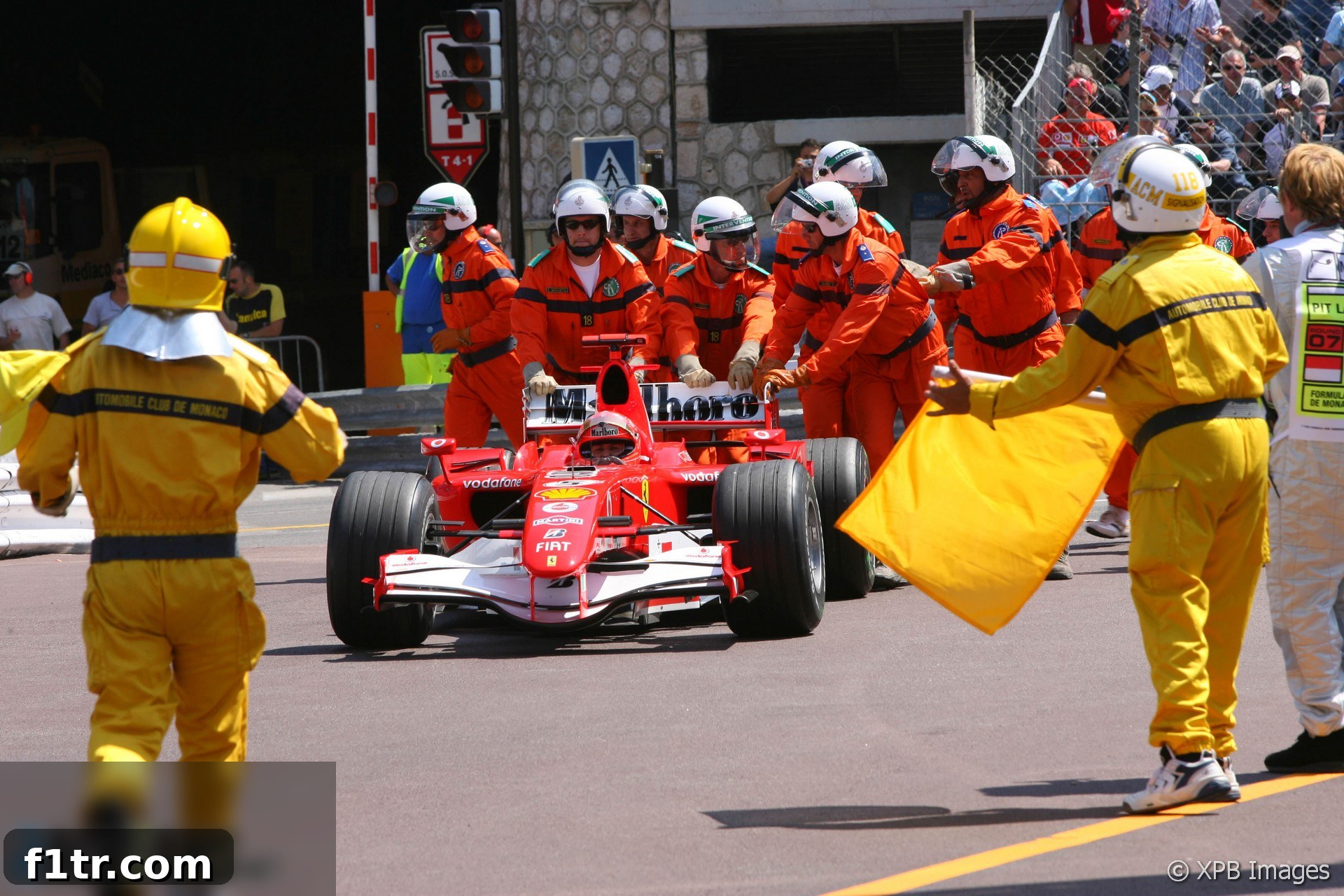
The streets of Monaco, a legendary battleground where qualifying position often dictates race outcome, set the stage for one of Formula 1’s most enduring controversies. In the high-stakes final moments of Q3 at the Monaco Grand Prix, a decision by Michael Schumacher sent shockwaves through the paddock and motorsport world, leading to a severe penalty that would see him start from the very back of the grid. This incident, forever etched in F1 history as ‘Rascasse-gate’, sparked intense debate about sportsmanship, strategic maneuvering, and the boundaries of fair competition.
The Rascasse Incident: A Controversial Stop in Monaco Qualifying
The year was 2006, and the battle for pole position at the Monaco Grand Prix was reaching a thrilling crescendo. With seconds ticking down in the final qualifying session (Q3), drivers were pushing their cars to the absolute limit around the unforgiving street circuit, aiming for that crucial fastest lap. Fernando Alonso had already set a blistering time, and Michael Schumacher, the seven-time world champion, was on his final flying lap, looking poised to challenge for pole.
As Schumacher’s Ferrari rounded the penultimate corner, La Rascasse, his car dramatically slowed, veering slightly wide and coming to a halt at the apex. The sudden stop effectively blocked the track, preventing any following drivers, most notably Fernando Alonso and Mark Webber, from completing their own final hot laps. Crucially, at this point, Schumacher had secured provisional pole, meaning that if no one could improve, he would start from the front. The immediate suspicion was that Schumacher had deliberately engineered the stoppage to safeguard his time and deny his rivals a chance to snatch pole position.
The timing and location of the incident were highly contentious. Rascasse is a tight, slow corner, and any obstruction there can easily impede subsequent cars. The act itself was witnessed live by millions and immediately became the focal point of intense scrutiny, with many in the F1 paddock expressing disbelief and outrage at what appeared to be a cynical, unsportsmanlike tactic. The sheer audacity of such a move from a driver of Schumacher’s stature only amplified the controversy, raising questions about the spirit of competition at the pinnacle of motorsport.
The Stewards’ Investigation and Damning Verdict
Following the qualifying session, the FIA stewards launched an immediate and thorough investigation into the incident. This involved meticulously reviewing telemetry data, onboard camera footage, and interviewing Michael Schumacher himself, along with other relevant parties. The evidence gathered painted a damning picture.
Advert | Become a Supporter & go ad-free
The stewards’ findings were unequivocal. They highlighted the data showing Schumacher’s unusually heavy and prolonged braking at Rascasse, a maneuver inconsistent with a genuine driving error. In their official statement, they declared: “The stewards can find no justifiable reason for the driver to have braked with such undue, excessive and unusual pressure at this part of the circuit, and are therefore left with no alternatives but to conclude that the driver deliberately stopped his car on the circuit in the last few minutes of qualifying, at a time at which he had thus far set the fastest lap time.”
This conclusion left no room for ambiguity. The stewards determined that the stop was not accidental but a calculated and deliberate act to impede his competitors. As a result, they swiftly handed down a severe penalty: Schumacher would be sent to the back of the grid for the Monaco Grand Prix. This punishment fell under Article 112 of the sporting regulations, which importantly denies any right to appeal, sealing Schumacher’s fate for the race weekend.
The gravity of the stewards’ decision underscored their belief that a line had been crossed. Such a deliberate act of obstruction, especially in a crucial qualifying session at a circuit where track position is paramount, was deemed unacceptable. The ruling sent a clear message that strategic maneuvering would not be tolerated when it bordered on sabotaging the competition through unsportsmanlike conduct.
Reactions Across the Paddock and Beyond
The stewards’ verdict ignited a firestorm of reactions across the Formula 1 paddock and among fans and media worldwide. Many drivers, team principals, and pundits openly condemned Schumacher’s actions, viewing it as a blatant disregard for fair play. Fernando Alonso, whose potential pole lap was directly compromised, was particularly vocal, expressing his belief that the act was intentional and deserved the harshest possible penalty.
Mark Webber, another driver whose final flying lap was affected, also conveyed his frustration, emphasizing the unique nature of Monaco qualifying where every tenth of a second and clear track access is critical. The general consensus among many of Schumacher’s peers was that the maneuver was an affront to the integrity of the sport, particularly from a driver of his experience and legendary status. Critics suggested that such a tactic, if left unpunished, could set a dangerous precedent, encouraging drivers to resort to unsporting actions to gain an advantage.
Schumacher’s Defense and Public Perception
For his part, Michael Schumacher vehemently denied any deliberate intent, attributing the incident to a simple driving error. He claimed that he had locked his wheels under braking, causing him to momentarily lose control and stall the car at Rascasse. He maintained that it was a genuine mistake made under the immense pressure of a qualifying session, rather than a malicious act of obstruction.
However, his explanation struggled to gain traction amidst the overwhelming evidence and the strong opinions of the stewards and the wider F1 community. The telemetry data showing the “undue, excessive and unusual pressure” on the brakes, coupled with the convenient timing of the incident relative to his provisional pole, made his defense difficult for many to accept. Public perception was largely critical, with many accusing Schumacher of cynical gamesmanship and attempting to cheat. The incident, for some, added a shadow to his otherwise illustrious career, raising questions about his approach to competition at all costs.
The Immediate Consequences: Starting from the Back
The penalty had profound implications for Schumacher’s Monaco Grand Prix. Starting from the very back of the grid at a circuit notoriously difficult for overtaking meant that his chances of a strong points finish, let alone a victory, were severely diminished. Monaco’s narrow, twisting streets offer very few opportunities to pass, making qualifying position exceptionally critical. The back of the grid is often a place where races are effectively over before they begin for even the most talented drivers.
Despite his disadvantage, Schumacher demonstrated his exceptional driving skill during the race, managing to climb through the field and finish in fifth position. It was a testament to his race craft and the Ferrari car’s performance. However, his recovery drive was overshadowed by the qualifying controversy. Ultimately, the race was won by Fernando Alonso, who, ironically, was one of the drivers most affected by Schumacher’s Rascasse maneuver. Alonso’s victory further cemented his position at the top of the Drivers’ Championship, a title he would eventually secure that year, denying Schumacher a record eighth championship.
A History of Controversy: Monaco’s Unique Demands and F1 Fair Play
The Monaco Grand Prix has always been a race apart, its unique street circuit demanding absolute precision and nerves of steel. Qualifying at Monaco is often considered more important than the race itself, as overtaking opportunities are scarce. This inherent characteristic amplifies the pressure on drivers to secure the best possible grid slot, making any incident that impacts qualifying even more controversial.
The Rascasse incident, while extreme, was not an isolated example of controversial tactics in Formula 1 history. The sport has seen its fair share of contentious moments where drivers have pushed the boundaries of fair play for competitive advantage, from blocking maneuvers to strategic pit stops designed to impede rivals. However, the deliberate nature of Schumacher’s stop, as concluded by the stewards, set it apart as a particularly egregious example of unsportsmanlike conduct.
Giancarlo Fisichella’s Parallel Penalty
Interestingly, the same race weekend also saw another driver, Giancarlo Fisichella, penalised for blocking. Fisichella was found guilty of impeding David Coulthard during qualifying. His punishment involved losing his three fastest qualifying times, a penalty exactly in line with what Jacques Villeneuve had received for blocking Fisichella himself in qualifying for the European Grand Prix. These incidents, while less sensational than Schumacher’s, highlight the FIA’s consistent stance against impeding fellow competitors during qualifying sessions.
Advert | Become a RaceFans supporter andgo ad-free
While Fisichella’s penalty was for blocking, a common infraction, Schumacher’s was for a perceived deliberate act of stopping to gain an advantage. The difference in severity of the actions was reflected in the disparity of the penalties, with Schumacher’s being far more drastic due to the intentional nature attributed to it by the stewards.
The Enduring Legacy of Rascasse-gate
The Rascasse incident remains one of the most talked-about controversies in Formula 1 history. It stands as a stark reminder of the fine line between aggressive driving and unsportsmanlike conduct, especially when the stakes are as high as they are in a Monaco Grand Prix qualifying session. For Michael Schumacher, a driver revered for his relentless pursuit of victory and strategic brilliance, the incident arguably cast a shadow on his otherwise unparalleled career, with some questioning his ethical approach to racing. However, his most fervent supporters continued to defend him, maintaining that it was a genuine error.
The controversy also served as a crucial test for the FIA and its stewards, demonstrating their willingness to take decisive action against even the sport’s biggest stars when the integrity of competition is at stake. The clear and forceful judgment reinforced the principles of fair play and sent a strong message that deliberate obstruction would not be tolerated. Even years later, the Rascasse incident is frequently referenced in discussions about F1 controversies, driver ethics, and the unique challenges of racing on the iconic streets of Monaco.
Ultimately, ‘Rascasse-gate’ became more than just a penalty; it became a defining moment that sparked conversations about the boundaries of competitive strategy, the role of driver intent, and the enduring quest for fairness in the thrilling, high-speed world of Formula 1.