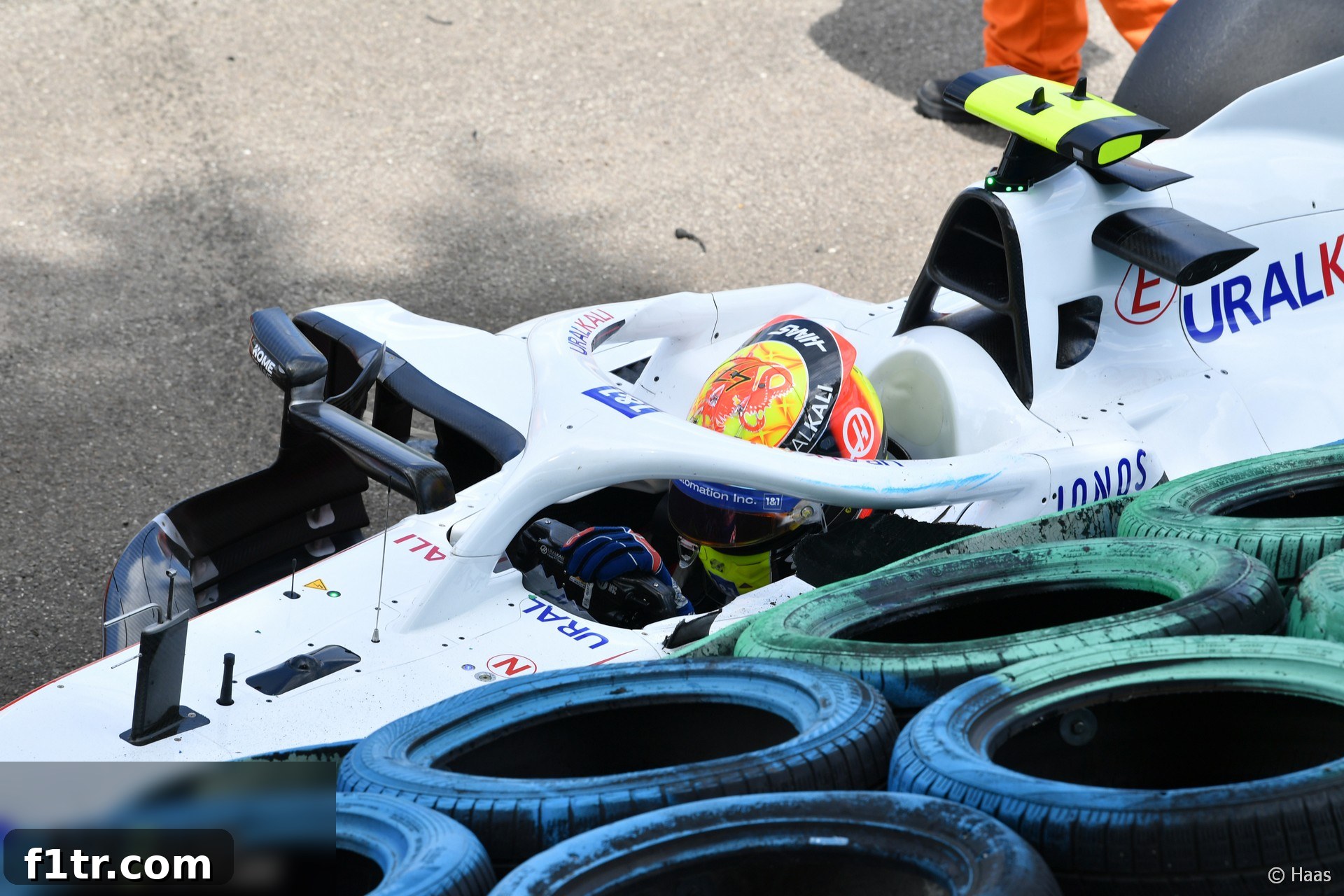
The unforgiving nature of Formula 1, where milliseconds and millimetres dictate success or failure, was starkly highlighted during the Hungarian Grand Prix weekend. Haas F1 Team driver, Mick Schumacher, found himself at the sharp end of this reality after a significant crash in the final practice session (FP3) threatened to derail his qualifying efforts. Despite the severe damage to his car, Schumacher expressed immense gratitude and admiration for his Haas crew, who came astonishingly close to completing the monumental repair job in time for him to participate in the crucial qualifying session.
The incident unfolded at Turn 11 of the Hungaroring circuit, a notoriously challenging track that demands precision and punishes errors. Schumacher spun into a barrier, inflicting substantial damage that typically spells the end of a session for a driver. For a team like Haas, operating on a tighter budget compared to F1’s front-runners, such an incident represents a significant logistical and financial hurdle. This wasn’t Schumacher’s first brush with misfortune in his rookie season; he had also missed qualifying for the Monaco Grand Prix earlier in the year following a similar crash during practice, adding an extra layer of frustration to the Budapest incident.
Recounting the dramatic moments after the crash, Schumacher revealed the extent of the team’s heroic efforts. “Unfortunately, the way I hit the wall made things very complicated for us to repair it afterwards,” he explained, acknowledging the specific angles of impact often dictate the ease or complexity of post-crash repairs. “So again, I think it’s a very unfortunate moment because we missed out on qualifying again. But I’m very, very proud about how the team managed to get so close. I think we were around five to ten minutes off getting the car out.” This narrow miss underscores the incredible dedication and expertise of Formula 1 pit crews, whose ability to dismantle, inspect, and rebuild a highly complex machine under immense time pressure is nothing short of miraculous.
The young German driver reflected on how tantalizingly close he was to rejoining the session. He mused that if Q1 had experienced a red flag delay, as Q2 later did, he would have likely had enough time to take to the track. “It would have been enough to have a red flag or whatever that we would have been able to do a lap at least,” Schumacher stated, highlighting the fine margins that separate participation from spectating in the cut-throat world of F1 qualifying. Missing qualifying entirely is a significant blow, especially for a rookie seeking to gain every possible kilometer of track experience and improve his grid position for the race.
Understanding the Incident: A Delicate Balance of Factors
Beyond the immediate disappointment, Schumacher delved into the technical nuances that contributed to the crash, attributing it to a complex interplay of aerodynamic balance and tyre temperatures. “The whole situation started actually in turn seven, where the exit was already quite on the limit with wheelspin, which in that case does overheat the surface,” he explained. This initial instability set off a chain reaction, creating a challenging scenario for the driver.
Formula 1 tyres operate within a very narrow optimal temperature window. When tyres overheat, particularly the surface, their grip diminishes rapidly. Wheelspin, which occurs when the driven wheels lose traction and spin faster than the vehicle is moving, generates excessive friction and heat, pushing the tyres beyond their ideal operating range. At Turn 7, a critical corner that sets up the next sequence, this overheating was a precursor to the subsequent loss of control.
“As a result, I had [Turn] nine in a difficult place already with the rear being quite on the limit,” Schumacher continued. Turn 9, following a short straight after Turn 7, would have amplified the compromised grip levels. The car’s rear becoming “on the limit” suggests a tendency for oversteer, where the rear of the car wants to slide out. However, Schumacher noted his familiarity with this particular challenge: “But again, [Turn] nine I kind of understood because it was a place where I’ve usually had snaps already all weekend long, so I kind of was ready to counter that.” This demonstrates a driver’s ability to adapt and anticipate, even when pushing the boundaries.
The ultimate loss of control, however, occurred unexpectedly at Turn 11. “Coming into Turn 11, we’re turning in nearly flat, and at that time when the rear went, I was kind of more of a passenger,” he recounted. To take a corner “nearly flat” means the driver is carrying significant speed, barely lifting off the throttle or perhaps even staying full throttle, requiring absolute confidence in the car’s grip. The sudden loss of the rear in such a high-speed, commitment-demanding corner left Schumacher with no opportunity to react, highlighting the razor-thin margins and the brutal abruptness of F1 crashes.
The F1 Car’s Sensitivity: Wind and Track Conditions
Schumacher admitted that the change in the car’s balance at Turn 11 caught him entirely by surprise. Formula 1 cars are incredibly sensitive machines, designed to extract every ounce of performance, making them susceptible to even subtle environmental shifts. “What’s a bit difficult this year is that our car seems to be quite affected by wind conditions and also by surface overheating, which adds on to, I think, what happened in FP3 today,” he explained, shedding light on the inherent characteristics of the Haas VF-21 chassis.
Wind conditions, often underestimated by casual observers, play a pivotal role in F1 aerodynamics. A sudden gust or a change in wind direction can significantly alter the airflow over the car’s intricate aerodynamic surfaces – the front wing, floor, diffuser, and rear wing. This can lead to a momentary loss of downforce or an unexpected shift in aero balance, making the car unstable, particularly in high-speed corners where downforce is paramount. For a driver turning in “nearly flat,” even a fleeting loss of grip can be catastrophic.
Furthermore, the issue of “surface overheating” combined with high track temperatures created a treacherous cocktail. The Hungaroring is known for its twisting layout and often hot summer conditions, which naturally elevate track temperatures. Higher track temperatures typically mean more grip initially, but they also accelerate tyre degradation and make tyres more prone to overheating beyond their optimal range. “For example, Turn 11 was never a particular issue for me over the whole course of the weekend, so it kind of caught me off-guard that I lost the rear in that corner,” Schumacher stated, emphasizing how a previously benign corner can become treacherous under specific conditions.
The post-incident analysis, crucial for driver learning and team development, confirmed these suspicions. “But obviously looking at it, looking at the data and everything, it just seems like the wind conditions and surface overheating just increased that little bit more compared to the run before, also because of the track temperature being so high.” This meticulous data analysis is standard practice in F1, allowing teams to pinpoint the exact causal factors of an incident, no matter how minute. It highlights that in Formula 1, the difference between a clean lap and a crash can be a matter of a few degrees in tyre temperature, a slight change in wind speed, or a fraction of a millisecond in driver input.
The Broader Implications for Mick Schumacher and Haas
Missing qualifying is a significant setback for any driver, but especially for a rookie like Mick Schumacher. It means starting from the back of the grid, often in the midst of slower or more unpredictable traffic, which complicates race strategy and increases the risk of further incidents. For Haas, the financial and operational strain of a significant crash is substantial. Not only does it incur repair costs, but it also consumes valuable time and resources that could otherwise be dedicated to performance upgrades or car development. In a season where Haas opted not to develop their car, focusing instead on the 2022 regulations, such incidents are particularly unwelcome.
Despite the challenges, Schumacher’s composure and appreciation for his team speak volumes about his character and professional approach. His ability to articulate the technical reasons behind the crash, rather than simply blaming external factors, demonstrates a mature understanding of the sport and a commitment to continuous learning. As he navigates the demanding world of Formula 1, these experiences, though difficult, are invaluable lessons that contribute to his growth as a Grand Prix driver.
The Hungarian Grand Prix weekend served as a stark reminder of the fine margins in Formula 1, where the pursuit of ultimate performance often pushes drivers and machinery to their absolute limits. While the crash was a setback, the resilience of the Haas team and Schumacher’s dedication to understanding and overcoming challenges underscore the spirit of motorsport at its core. Every Grand Prix weekend is a testament to the incredible human and mechanical effort involved in competing at the pinnacle of racing, where even a near-miss can be a story of extraordinary effort and perseverance.
Explore further insights and analysis from the 2021 Hungarian Grand Prix