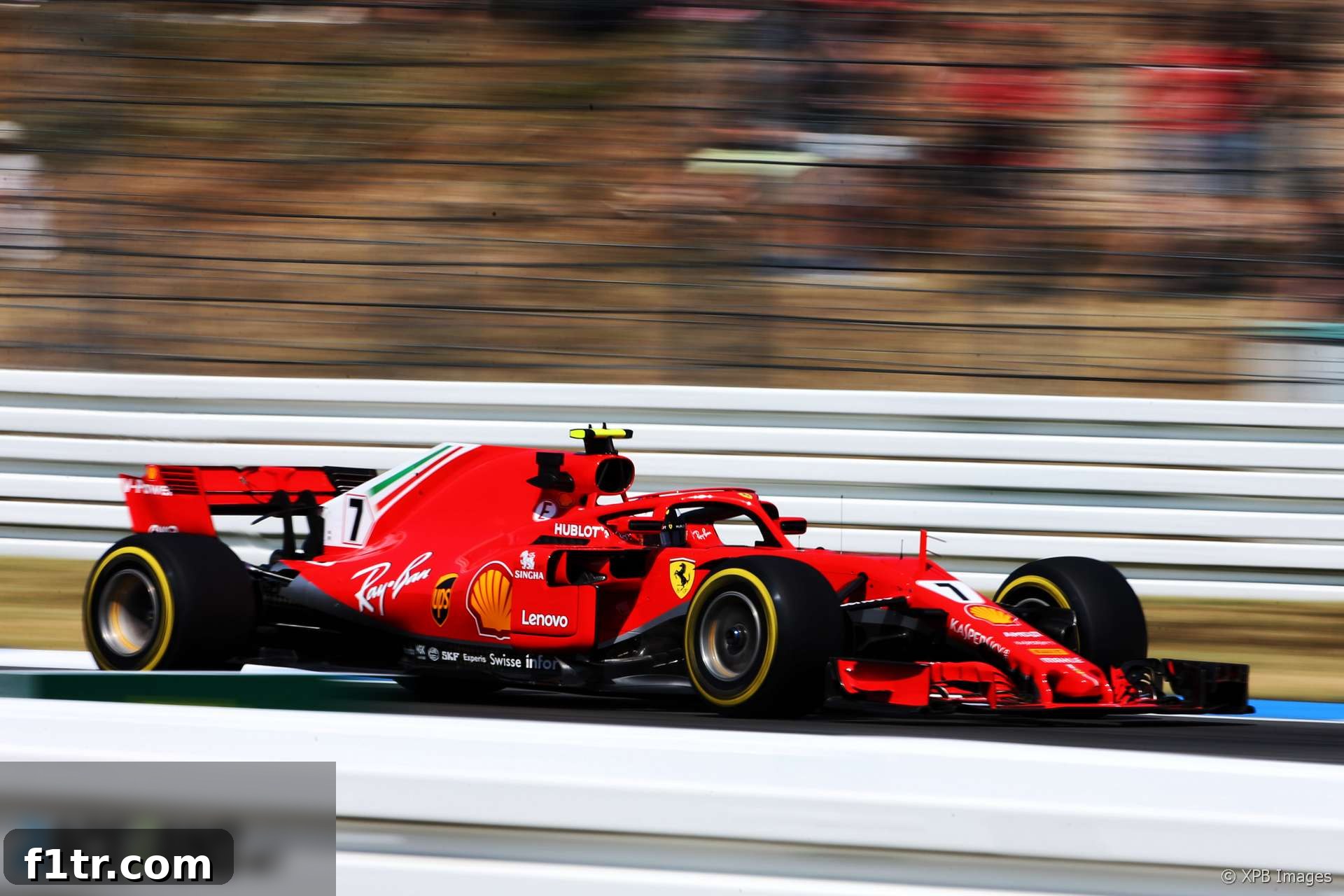
The exhilarating world of Formula 1 often delivers unexpected twists, and the practice sessions at the Hockenheimring for the German Grand Prix were no exception. Ferrari’s remarkable performance on the straights immediately caught the attention of Mercedes driver Lewis Hamilton. The reigning champion and perennial contender for the title couldn’t help but notice a significant step forward from their closest rivals, suggesting that the Scuderia had unlocked an impressive surge in pace.
While Hamilton typically maintains a calm and focused demeanor, his comments after Friday practice revealed a hint of intrigue. Despite ending the session a couple of tenths of a second quicker than Sebastian Vettel’s Ferrari, Hamilton was realistic about what the timesheets indicated. He anticipated a much more competitive challenge from the Italian team as the weekend progressed, a common tactical play in the high-stakes environment of F1.
Hamilton’s Initial Observations: A Familiar Pattern or a Real Threat?
“Every Friday they sandbag so it doesn’t mean much,” Hamilton remarked, referring to the practice of teams deliberately not showing their full performance potential early in the weekend. This strategic tactic is employed to keep rivals guessing and to avoid revealing all their cards before the crucial qualifying and race sessions. However, even with this understanding, Hamilton acknowledged the inherent speed of the scarlet cars: “They are quick today and I think tomorrow will be very much similar unless all of a sudden they pull out even more time.” This subtle observation suggested a deeper concern, hinting that even if Ferrari was holding back, their baseline pace was already formidable.
The specific area of Ferrari’s apparent improvement was unmistakable: straight-line speed. At a circuit like Hockenheim, which features significant long straights such as the iconic Parabolika and the run down to Turn 2, raw power and aerodynamic efficiency are paramount. Hamilton’s observations highlighted a clear advantage for Ferrari in these critical sectors, an advantage that could prove decisive in both qualifying and the race.
Unpacking Ferrari’s Sudden Straight-Line Advantage: The Power Unit Enigma
“Today they were very quick on the straights,” Hamilton noted with a keen analytical eye. “Which I find really interesting because they’ve not had a new engine but all of a sudden they’ve got a lot more power. So it’ll be interesting to see if they still have that tomorrow.” His words underscored a pivotal question: how could Ferrari find such a significant performance boost without introducing a new internal combustion engine (ICE)? This inquiry immediately directed attention towards other components of the complex F1 hybrid power unit, particularly the energy recovery systems.
The MGU-K and MGU-H Under Scrutiny
The F1 power unit is a marvel of engineering, comprising not just the traditional internal combustion engine but also sophisticated hybrid components. Two key elements are the Motor Generator Unit – Kinetic (MGU-K) and the Motor Generator Unit – Heat (MGU-H). The MGU-K recovers energy generated under braking and converts it into electrical energy, which can then be deployed for a power boost. The MGU-H, on the other hand, is arguably the most complex part of the system, recovering energy from the turbocharger’s exhaust gases, either to power the MGU-K directly, recharge the battery, or eliminate turbo lag. A highly efficient MGU-H system can provide a significant advantage, especially on straights where sustained power delivery is crucial.
Coincidentally, Ferrari had indeed introduced a new MGU-K on all six Ferrari-powered cars at Hockenheim. This included not only the factory Ferrari entries of Sebastian Vettel and Kimi Raikkonen but also their customer teams. Furthermore, Vettel and Raikkonen also received new energy stores this weekend. While a new MGU-K can offer performance benefits, the scale of Ferrari’s straight-line improvement seemed to suggest something more profound, leading many to revisit earlier speculation surrounding their power unit.
For months, whispers had circulated within the F1 paddock regarding the workings of Ferrari’s power unit, specifically its MGU-H. It was believed that Ferrari might be utilizing its MGU-H in a unique and highly efficient way to recover and deploy energy more quickly than its rivals. Such an innovative approach, if true, could explain sudden bursts of power and enhanced straight-line speed. The FIA, F1’s governing body, had previously investigated Ferrari’s system following the Azerbaijan Grand Prix to ensure its legality. After a thorough examination, the FIA concluded that the system adhered to all technical regulations, effectively clearing Ferrari of any wrongdoing at that time. Despite the FIA’s verdict, Hamilton’s comments and Ferrari’s Hockenheim pace reignited the debate, underscoring the relentless pursuit of marginal gains and the constant technical arms race in Formula 1.
Mercedes’ Strategic Response: Focus on Self, Not Rivals
In the face of intensifying competition and persistent technical speculation, Lewis Hamilton emphasized Mercedes’ unwavering strategy: self-focus and optimization. “Other people are doing interesting things,” he acknowledged, referencing the innovative, sometimes controversial, developments from rival teams. However, he quickly redirected the narrative back to his own squad. “For us we can’t get distracted by what other people are doing.”
This mindset is crucial in F1, where a distraction can cost vital tenths of a second. Hamilton articulated Mercedes’ clear priorities: “All we can do it try to do the best job we can and that’s what we’re focused on. We’re not focused on all the other people, whatever they’re doing.” The team’s attention remains squarely on refining their own package and extracting every ounce of performance from their W09 chassis and power unit. This involves an exhaustive review of data from Friday practice to understand tyre behavior, optimize tyre temperatures across different compounds, and perfect crucial race elements like starts.
“We’re literally just trying to make sure we understand our tyres, tyre temperatures, all these different things. Try to be as perfect as we can on the starts. Hopefully that’ll be enough.” This statement highlights the intricate details that define success in modern F1. Tyres are notoriously complex, and managing their temperatures for optimal grip and longevity is a fine art. Similarly, a perfect race start can make or break a Grand Prix, especially at a circuit like Hockenheim where overtaking can be challenging. Mercedes’ philosophy is to maximize what they can control, trusting that a flawless execution of their own plan will be sufficient to counter any advancements from their rivals.
The Broader Championship Battle: Mercedes vs. Ferrari in 2018
The 2018 Formula 1 season was shaping up to be a classic title fight, primarily between Lewis Hamilton of Mercedes and Sebastian Vettel of Ferrari. The fluctuating fortunes and technical battles, such as the one observed at Hockenheim, added immense drama and complexity to the championship narrative. Every perceived advantage, every technical upgrade, and every strategic move played a significant role in the psychological and physical warfare unfolding on and off the track. Ferrari’s renewed straight-line pace, whether a result of the new MGU-K, further optimization of their MGU-H, or other factors, represented a direct challenge to Mercedes’ dominance and intensified the high stakes of the championship race.
Hockenheimring: A Test of Power and Precision
The Hockenheimring, a circuit with a rich history in Formula 1, presents a unique set of challenges. Its layout is a blend of high-speed sections and more technical corners. The long, flat-out blasts, particularly through the Motodrom and on the main straight, put a premium on engine power and aerodynamic efficiency for straight-line speed. However, the circuit also features a series of medium-speed corners and chicanes that demand excellent chassis balance and downforce. A car that excels on the straights might compromise in the corners, and vice versa. Ferrari’s observed advantage on the straights, therefore, suggested a potent package that could be exceptionally strong in qualifying, where ultimate speed over one lap is key, and also on race day, where it could facilitate overtaking and defending.
Beyond Practice: The Road to Qualifying and Race Day
Friday practice sessions in Formula 1 serve as an initial benchmark, a testing ground where teams gather data, evaluate setups, and understand the car’s behavior. However, they are far from conclusive. Track conditions evolve, rubber gets laid down, and teams spend the night meticulously analyzing gigabytes of data to refine their strategies and car settings. What appears to be a dominant performance on Friday can sometimes evaporate by Saturday qualifying, or a challenging Friday can transform into a strong race pace. Hamilton’s experience teaches him to be wary of early conclusions and to anticipate Ferrari’s true potential to emerge during the crucial sessions.
The Mental Game of Formula 1
Beyond the technical intricacies and raw speed, Formula 1 is also a profound mental game. Drivers like Lewis Hamilton operate at the absolute peak of their sport, and maintaining focus amidst the swirling rumors, competitive threats, and relentless media scrutiny is paramount. His comments about not being distracted by rivals’ “interesting things” reflect a seasoned veteran’s approach to mental fortitude. It’s about building a mental shield, trusting the team, and channeling all energy into their own performance, rather than allowing external factors to disrupt their equilibrium. This psychological strength is often what separates champions from contenders.
Conclusion: Awaiting the True Pace
As the German Grand Prix weekend unfolded, Lewis Hamilton’s observations at Hockenheim set the stage for a thrilling contest. Ferrari’s apparent surge in straight-line speed, particularly in light of technical developments like the new MGU-K and ongoing speculation around their MGU-H, injected an exciting element of unpredictability into the championship battle. While Mercedes remained focused on their meticulous approach to optimizing their own package, the challenge from Maranello was undeniable.
The true measure of Ferrari’s advancements, and Mercedes’ ability to counter them, would ultimately be revealed in Saturday’s qualifying session and Sunday’s main event. Hamilton’s calm assessment, combined with his underlying recognition of Ferrari’s potent pace, ensured that all eyes would be on the red cars, eagerly anticipating whether their newfound straight-line advantage would translate into a dominant performance at the Hockenheimring and further ignite the captivating 2018 F1 season.
Related Articles: 2018 F1 Season
- F1 feared “death knell” for Drive to Survive after Ferrari and Mercedes snub
- McLaren staff told us we were “totally crazy” to take Honda engines in 2018 – Tost
- ‘It doesn’t matter if we start last’: How Red Bull’s junior team aided Honda’s leap forward
- Honda’s jet division helped F1 engineers solve power unit problem
- McLaren Racing losses rise after Honda split
Browse all 2018 F1 season articles