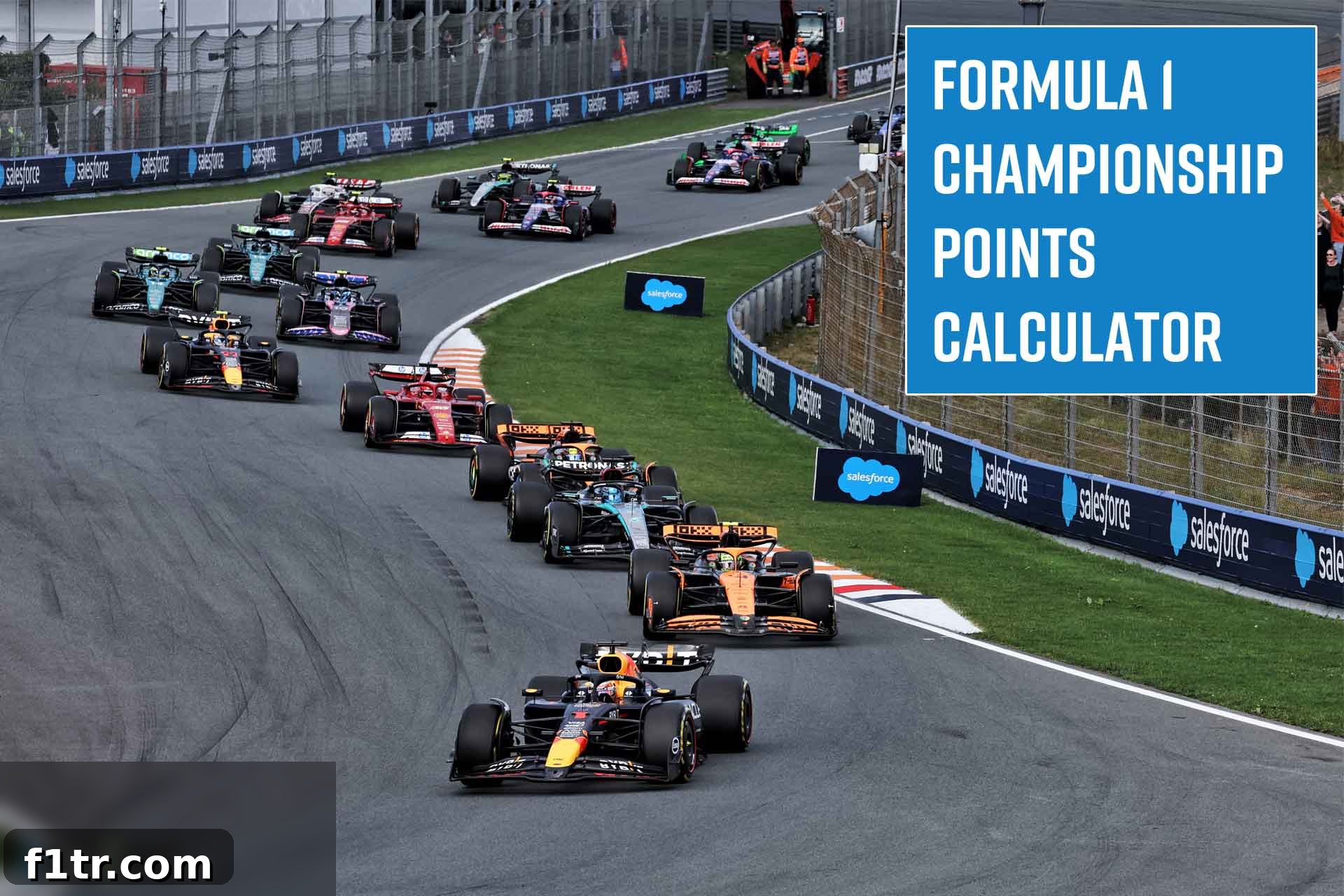
The 2024 Formula 1 season has, at various points, teased fans with the promise of a truly epic championship battle. For a significant stretch, McLaren’s Lando Norris mounted a compelling challenge, steadily chipping away at Max Verstappen’s seemingly insurmountable points lead. His impressive performances and the McLaren team’s resurgence injected a thrilling dose of unpredictability into what many initially expected to be another dominant season for Verstappen and Red Bull Racing.
However, as the season progresses, the narrative shifts. Heading into recent races, Norris has found himself struggling to secure points-paying positions in some rounds, while Ferrari’s Charles Leclerc, fresh off a victory in the previous round, has emerged as the strongest contender looking to narrow Verstappen’s considerable advantage. Despite these shifts in momentum, the stark reality remains: both Norris and Leclerc face monumental tasks in preventing Max Verstappen from clinching his fourth consecutive drivers’ championship. While their chances might appear slim from a distance, understanding the intricate dynamics of the modern F1 points system reveals just how every single point, and every strategic decision, can influence the ultimate outcome.
The quest for the Formula 1 drivers’ championship is no longer a straightforward calculation based solely on race wins and podium finishes. Over the past few years, a series of significant adjustments to the championship points system has transformed it into a complex, multi-layered puzzle. These changes, introduced to enhance excitement, reward performance in various scenarios, and ensure fairer outcomes, have inadvertently made it more challenging for fans and even seasoned analysts to accurately project championship standings. To truly grasp the current title fight, one must first delve into the evolution of how points are awarded in the pinnacle of motorsport.
The Evolving Landscape of F1 Points: A Historical Perspective
Formula 1 has a rich history of point allocation, with systems evolving to reflect the changing nature of the sport. For decades, the methodology was relatively simple, designed to reward consistent performance in Grand Prix races. However, recent innovations have introduced layers of complexity, making the championship a true test of adaptability and strategy.
The Traditional Scoring System: Simplicity Before Complexity
For a significant period, including as recently as the 2018 season, the scoring system was beautifully straightforward. Drivers earned points based purely on their finishing position in the Grand Prix. A win was a win, a second place was a second place, and the points awarded were fixed. This system was easy to understand: the driver who consistently finished higher would accumulate more points. If a driver secured a victory, they could confidently expect to gain a substantial advantage, typically at least seven points, over their nearest rival, depending on where that rival finished. This simplicity allowed fans to easily track the championship battle, with every race finish directly impacting the standings without additional variables.
The Fastest Lap Bonus Point: Adding a Strategic Twist
The first major deviation from this traditional model came in 2019 with the introduction of the bonus point for setting the fastest lap during a Grand Prix. This change was implemented with a clear objective: to encourage drivers to push harder throughout the race, even if their finishing position was already decided, thereby adding an extra layer of excitement and strategic intrigue. However, there was a crucial caveat: a driver could only claim this extra point if they also finished within the top 10 positions. This rule prevented drivers who were far down the order from pitting for fresh tyres purely to snatch the fastest lap point, thus maintaining the integrity of the race outcome.
The fastest lap bonus significantly impacted race strategy. Teams now had to consider late-race pit stops for fresh soft tyres if their driver was in a position to gain the extra point without jeopardising their primary race result. It added another dimension to driver-team radio communications and pushed drivers to manage their tyres and pace with even greater precision. While seemingly minor, a single point can prove decisive in a championship, and this bonus point has occasionally played a critical role in tight title fights, forcing rivals to not only beat each other on track but also monitor who sets the quickest lap.
The Sprint Race Challenge: Accelerating the Points Haul
The introduction of sprint races further complicated F1’s points system. Conceived as a way to inject more competitive action into Grand Prix weekends and experiment with different formats, sprint races are shorter, standalone events held on Saturday, which now award championship points. Initially, points were only awarded to the top three, but this was quickly expanded to the top eight finishers to make the sprints more impactful on the championship standings. At selected rounds of the championship, drivers can now score a substantial number of additional points – up to eight points for winning a sprint race – before the main Grand Prix even begins. This means a driver could theoretically score 34 points in a single weekend (25 for the GP win, 8 for the sprint win, 1 for the fastest lap).
The inclusion of sprint races has had a profound effect on championship dynamics. It offers more opportunities for drivers to accumulate points, potentially widening gaps or allowing contenders to recover lost ground more quickly. However, it also introduces additional risks, as any incident in a sprint race can compromise a driver’s position for the Grand Prix or even lead to DNFs. Teams must balance the pursuit of these extra points against the potential for damage or grid penalties for the main event. This strategic tightrope walk adds another fascinating element to the overall championship narrative, making some weekends significantly more point-heavy than others.
Addressing Shortened Races: The Post-2021 Belgian Grand Prix Reforms
Perhaps the most significant and certainly the most controversial points system adjustment came in the wake of the infamous 2021 Belgian Grand Prix. That race, severely affected by torrential rain, saw drivers complete only a handful of laps behind the Safety Car before the event was called off, yet full points were initially awarded. The widespread dissatisfaction and perceived unfairness of this outcome prompted the FIA to implement a new set of regulations for races that are significantly shortened. As a result, Formula 1 agreed upon three alternative points systems to be used in the event of races failing to complete a certain percentage of their scheduled distance.
These tiered systems ensure that points are awarded proportionally to the amount of racing completed. For example, if less than 25% of the race distance is covered, only the top five finishers receive points, with significantly reduced values. If between 25% and 50% is completed, points extend to the top nine, again with a scaled-down distribution. Finally, if between 50% and 75% of the race is completed, points are awarded to the top ten, still on a modified scale, before the full points system kicks in for races exceeding 75% distance. While these specific shortened race points systems have, thankfully, not yet been required in a Formula 1 Grand Prix, they have already been put into practice in junior championships, demonstrating their practical application and providing a fairer framework for points distribution in adverse conditions. This ensures that while every point counts, the integrity of the competition is maintained even when races cannot run to their full length, reflecting a commitment to fairer sporting outcomes.
Navigating the 2024 Championship with Precision
Given the multifaceted nature of the current F1 points system, accurately predicting the outcome of the championship or understanding the implications of a single race result has become an increasingly complex task. The days of simple arithmetic are long gone. Fans, journalists, and even team strategists need robust tools to keep pace with all the potential scenarios that can unfold over a race weekend and throughout the season. This intricate scoring mechanism is precisely why interactive tools are more valuable than ever for enthusiasts who want to delve deeper into the championship battle.
Unveiling the F1 Championship Calculator: Your Essential Companion
To empower fans with the ability to cut through this complexity and gain unparalleled insight into the championship standings, RaceFans has developed and updated its acclaimed F1 Championship Calculator. This sophisticated, user-friendly tool is designed to be the ultimate companion for tracking and simulating the 2024 Formula 1 season, allowing you to explore an almost endless array of “what if” scenarios.
More than just a static leaderboard, the F1 Championship Calculator offers dynamic functionality that puts you in control. You can input the official results for any upcoming races, immediately seeing how they impact the drivers’ and constructors’ championships. But its true power lies in its ability to allow users to manipulate past race results. Ever wondered how the championship would look if a certain driver hadn’t retired from a key race, or if a penalty had been applied differently? With this calculator, you can alter historical outcomes to observe how even minor changes could have dramatically reshaped the championship narrative.
This interactive tool is indispensable for hardcore fans, fantasy league players, and anyone who enjoys dissecting race strategy and championship permutations. It provides a real-time, customizable view of the standings, reflecting all the nuances of the fastest lap bonus, sprint race points, and the potential impact of shortened race scenarios. It helps to visualize just how significant every single point truly is, especially in a sport where championships can be won or lost by the smallest margins. Don’t just follow the championship – actively explore its possibilities. Find your gateway to advanced F1 analysis here:
- RaceFans Formula 1 Championship Points Calculator
We are committed to continuously improving the F1 Championship Calculator to ensure it remains the most accurate and insightful tool for Formula 1 fans. Your feedback is invaluable in this process. Please share any suggestions for improvements, new features, or usability enhancements in the comments section below. Among the planned updates for future versions are revisions to formatting and layout to provide an even more seamless and intuitive experience across all devices, particularly for users accessing the calculator on smaller screens, ensuring optimal readability and functionality.
As the 2024 Formula 1 season hurtles towards its thrilling climax, every Grand Prix, every sprint race, and every strategic decision will play a pivotal role. While Max Verstappen continues to demonstrate formidable pace, the ever-present threat from contenders like Lando Norris and Charles Leclerc, coupled with the intricate points system, ensures that the championship battle remains a captivating spectacle. With the RaceFans F1 Championship Calculator, you have all the tools at your disposal to navigate this exciting journey, understanding every twist and turn of the points standings as the season unfolds.
Become a RaceFans supporter and go ad-free.
Miss nothing from RaceFans
Get a daily email with all our latest stories – and nothing else. No marketing, no ads. Sign up here:
Explore More: 2024 Azerbaijan Grand Prix Insights
Delve deeper into the latest race discussions and analyses from the 2024 Azerbaijan Grand Prix. Stay informed on team strategies, driver performances, and key technical developments that shaped the race weekend.
- Verstappen: “Important” for FIA to clarify legality of McLaren’s ‘mini DRS’ wing
- Hamilton explains suspension set-up change behind “miserable” Baku weekend
- Piastri needs “crazy” results to become title contender despite Baku win
- FIA taking new look at flexing bodywork amid intrigue over McLaren’s rear wing
- Norris knew Verstappen broke VSC rules in Baku because he did the same in Melbourne
Browse all 2024 Azerbaijan Grand Prix articles