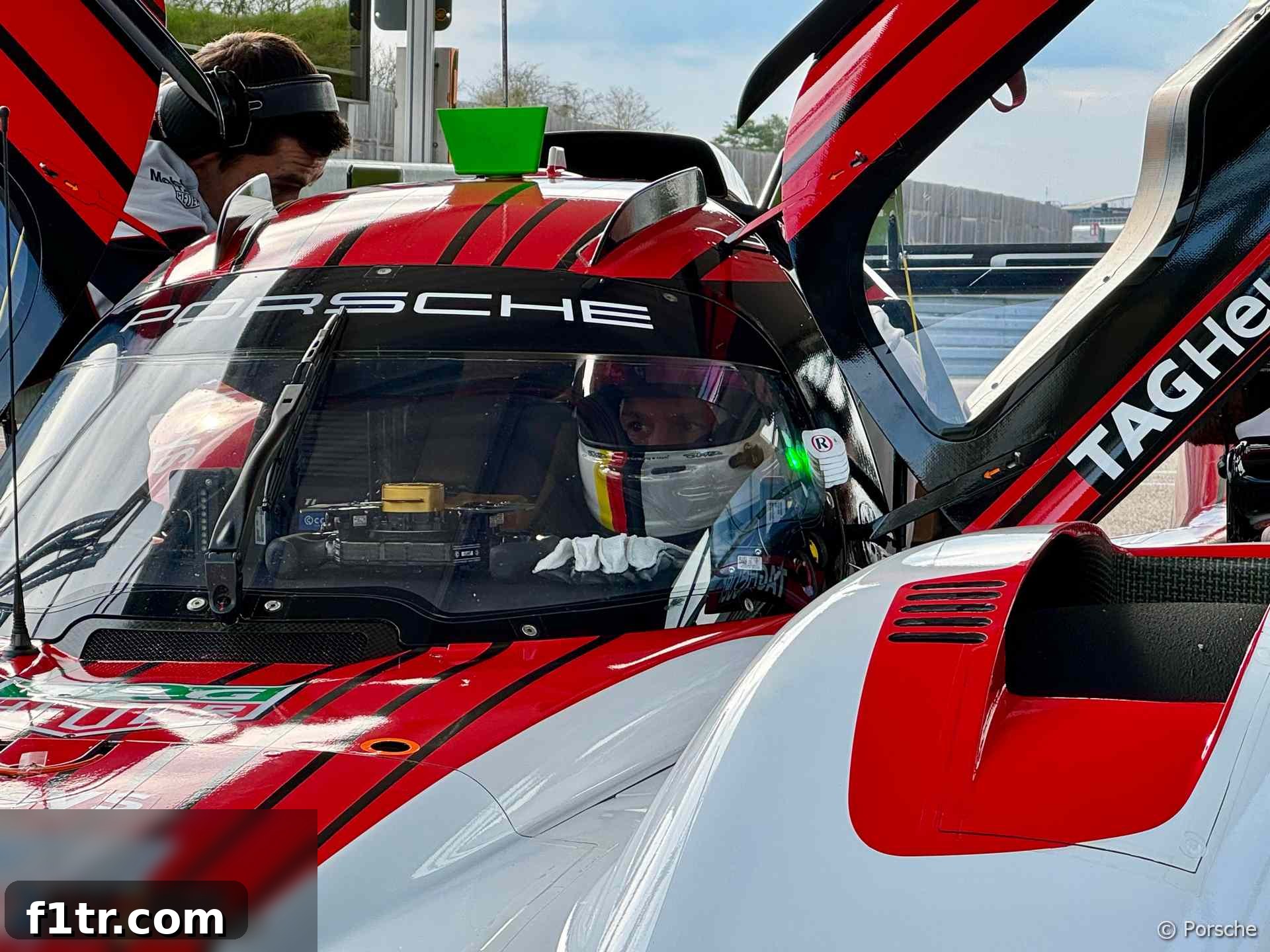
Four-time Formula 1 world champion Sebastian Vettel is set to embark on a compelling new chapter in his illustrious motorsport career, as he prepares to test Porsche’s formidable 963 hypercar next week. This significant development fuels widespread speculation about a potential return to competitive racing, specifically a bid for the highly coveted 24 Hours of Le Mans, two years after his retirement from Formula 1.
The highly anticipated test will take place at the challenging Motorland Aragon circuit in Spain, as part of a rigorous 36-hour endurance session organized by Porsche’s factory-backed World Endurance Championship (WEC) team, Porsche Penske Motorsport. This extensive evaluation is a critical component of their preparation for the championship’s crown jewel event, the legendary 24 Hours of Le Mans, where the team aims to build on its early season success.
Porsche Penske Motorsport has already demonstrated its potent capabilities in the current WEC season, securing a commanding victory at the season-opening Qatar 1812km race earlier this month with one of its two Porsche 963 entries. While the team has yet to finalize the driver lineup for its third car at Le Mans, Vettel’s participation in this crucial test strongly suggests he could join the ranks, potentially partnering with established endurance racer Mathieu Jaminet in the number four machine.
Sebastian Vettel Eyes Le Mans Comeback with Porsche 963 Hypercar Test
The signs of Vettel’s serious consideration for a return to racing are increasingly clear. His preparation has been meticulous, commencing with an initial drive of the hybrid prototype at Porsche’s renowned Weissach base just recently. This on-track familiarization was preceded by what Porsche described as an “extensive simulator session” held last week, underlining the thoroughness of his integration into the nuances of endurance racing machinery. For a driver of Vettel’s caliber, such dedicated preparation is a testament to the gravity of the challenge and his respect for the discipline.
Speaking about his foray into endurance racing, Vettel expressed a natural curiosity that has long simmered beneath the surface of his Formula 1 career. “I’ve always followed other racing series and my curiosity for endurance events encouraged me to just give it a shot,” said the German ace. “Now I’m excited about the long run in Aragon and I’m looking forward to my time behind the wheel.”
Vettel acknowledged the significant transition required to adapt from the high-downforce, open-wheel environment of Formula 1 to the complex world of endurance prototypes. “It’ll definitely take an an adjustment and some getting used to but everyone in the team is very open and helps me. This will be a new experience for me. We will then see what happens next in this respect – at the moment there are no further plans for the future.” While his statement keeps future commitments open-ended, the sheer depth of this test implies a clear interest beyond mere curiosity.
A Legendary Return to the Track: Vettel’s Journey Beyond F1
Sebastian Vettel’s career in Formula 1 is nothing short of legendary. With four consecutive world championships clinched between 2010 and 2013, he stands among the sport’s most successful drivers. Known for his meticulous approach, technical feedback, and aggressive yet precise driving style, Vettel amassed 53 Grand Prix victories before announcing his retirement at the end of the 2022 season. His decision was rooted in a desire to spend more time with his family and explore new interests, but the allure of motorsport, clearly, has remained potent.
His potential move to the World Endurance Championship, and specifically a shot at the 24 Hours of Le Mans, represents a fascinating pivot. Endurance racing offers a stark contrast to the sprint format of F1, demanding different skill sets including consistent pace over long stints, managing fuel and tires, navigating multi-class traffic, and working collaboratively within a multi-driver team. For a driver who has achieved everything in F1, the quest for the Le Mans trophy, arguably motorsport’s toughest race, presents a fresh, compelling challenge.
The Porsche 963: A Hypercar of Distinction
At the heart of Vettel’s potential new venture is the Porsche 963, a formidable LMDh (Le Mans Daytona h) prototype that competes in the WEC’s Hypercar class and IMSA’s GTP class. This sophisticated machine is powered by a 4.6-liter twin-turbo V8 engine, augmented by a standardized hybrid system, delivering impressive performance while adhering to strict efficiency regulations. Designed to be a global contender, the 963 represents the pinnacle of modern endurance racing technology, combining outright speed with durability.
Porsche Penske Motorsport, the factory team responsible for the 963 program, is a collaboration between the legendary German manufacturer and Penske Racing, one of the most successful outfits in global motorsport. Their combined expertise has quickly propelled the 963 to success, demonstrating its competitive edge against rivals like Toyota, Ferrari, Cadillac, and Peugeot in the fiercely contested Hypercar category. The Qatar victory was a clear statement of intent, and with Le Mans on the horizon, the team is leaving no stone unturned in its preparation.
Intense Preparations for a New Challenge
Vettel’s preparation regimen for the Porsche 963 underscores the significant differences between Formula 1 and endurance racing. While F1 cars are bespoke machines tailored for maximum performance over short distances, the 963 demands versatility and a deep understanding of hybrid systems, energy recovery, and prolonged chassis behavior. The “extensive simulator session” would have allowed Vettel to acclimate to the car’s ergonomics, control layouts, and crucial hybrid management strategies, all without the pressure of a live track environment.
The initial shakedown at Weissach provided the opportunity for a physical seat fit, ensuring comfort and optimal control during extended stints, and a first real-world taste of the car’s dynamic characteristics. Vettel’s remarks about the need for “adjustment and some getting used to” highlight the sensory and technical shifts. From the cockpit view, the steering weight, brake feel, power delivery of the hybrid system, and the sheer physical size and weight of the prototype all differ substantially from an F1 car. Moreover, managing multi-class traffic – navigating slower GT cars while battling fellow Hypercars – is a unique skill critical for endurance success.
Motorland Aragon: A Grueling 36-Hour Test
The upcoming 36-hour test at Motorland Aragon is far more than just a casual drive; it’s a comprehensive dress rehearsal for the ultimate endurance challenge, the 24 Hours of Le Mans. Such a marathon test allows Porsche Penske Motorsport to evaluate everything from powertrain reliability over extended periods to driver fitness and strategic simulations for pit stops, tire changes, and fuel management under varying conditions, including night driving.
Vettel will be one of seven highly skilled drivers participating in this critical session, benefiting from the immense experience within the Porsche Penske ranks. The lineup includes the two full-time factory crews: André Lotterer, Kevin Estre, and Laurens Vanthoor, who together piloted the winning 963 at Qatar, alongside Matt Campbell, Michael Christensen, and Frédéric Makowiecki. These seasoned endurance racers provide a wealth of knowledge that Vettel can tap into, facilitating his adaptation to the 963 and the nuances of multi-driver strategy.
The fact that Vettel is being integrated into such an important test, especially given the speculation around the third Le Mans entry, suggests that Porsche sees him as a genuine candidate. Teaming him with an established WEC driver like Mathieu Jaminet, who has a proven track record in the series, would create a formidable partnership and elevate the profile of the third car considerably.
Porsche’s Vision and Vettel’s Potential Impact
Porsche Motorsport vice president Thomas Laudenbach articulated the manufacturer’s enthusiasm for Vettel’s involvement, viewing the test as a “perfect” opportunity for both parties. “There was no question for us that we’d be thrilled to support his request for an opportunity to test and provide him with extensive preparation and plenty of time to drive our hybrid prototype,” Laudenbach stated, underscoring Porsche’s commitment to accommodating the F1 legend.
Laudenbach also highlighted the mutual benefits of this collaboration: “There’s no doubt we’ll learn a lot from his valuable feedback.” An F1 champion’s analytical mind and profound understanding of vehicle dynamics, even across different disciplines, can offer invaluable insights for fine-tuning the 963. Vettel’s precision and feedback could contribute significantly to optimizing chassis setup, hybrid deployment, and overall race strategy, potentially providing that marginal gain necessary for Le Mans glory.
For Porsche, securing a driver of Vettel’s global stature is also a significant strategic and marketing coup. It elevates the profile of their WEC program, attracts new audiences to endurance racing, and reaffirms their ambition to dominate the sport. Porsche boasts a peerless record at Le Mans, with 19 overall victories, more than any other manufacturer. Their pursuit of a historic 20th win is a monumental objective, and bringing in a proven winner like Vettel, even for a single race, aligns perfectly with that ambition.
The Hypercar Landscape at Le Mans
The 2024 edition of the 24 Hours of Le Mans is shaping up to be one of the most competitive in recent memory, particularly within the Hypercar class. A plethora of manufacturers, including Porsche, Toyota, Ferrari, Cadillac, Lamborghini, BMW, and Alpine, are all vying for overall victory, making it a golden era for prototype racing.
To maximize their chances in this grueling event, manufacturers often field multiple entries. This year, a total of six Porsche 963s are slated to contest Le Mans. Beyond the two factory-run cars from Porsche Penske Motorsport, privateer teams Jota and Proton will each enter their own customer-run 963s. Jota, a highly respected independent outfit, will field two cars, while Proton Competition will run one. This widespread presence of the 963 across both factory and customer teams underscores the car’s versatility and the strategic depth of Porsche’s assault on the world’s most famous endurance race, as they relentlessly pursue their monumental 20th overall triumph.
Pictures: Sebastian Vettel Familiarizes Himself with the Porsche 963
Related World Endurance Championship Insights
- WEC cancels its Qatar season-opener due to US-Iran war
- Porsche to end WEC Hypercar programme after just three seasons
- Mercedes won’t return to Le Mans because “we don’t like Balance of Performance” – Wolff
- “Luck” needed to win Le Mans because of Balance of Performance – Verstappen
- McLaren finally confirms it will enter the World Endurance Championship in 2027
Browse all World Endurance Championship articles