Formula 1, the pinnacle of motorsport, consistently delivers seasons filled with unparalleled excitement, strategic brilliance, and breathtaking racing. The 2018 season was no exception, showcasing intense battles for both the coveted Drivers’ and Constructors’ Championships. As fans globally followed every twist and turn, the year culminated in a dramatic display of skill, technology, and sheer determination. This comprehensive overview delves into the final standings of both championships, offering insights into the performances that defined the season and setting the stage for one of its most memorable races, the Brazilian Grand Prix.
Understanding the intricacies of how points are accumulated and the sheer effort required to secure a championship title is key to appreciating the data presented. Each race weekend contributes valuable points, with consistency, reliability, and raw speed being paramount. The 2018 season saw established champions assert their dominance while emerging talents began to carve their names into the sport’s rich history. Join us as we explore the final tallies that tell the story of a thrilling year in Formula 1.
2018 FIA Formula 1 Drivers’ Championship: A Season of Dominance and Fierce Rivalry
The 2018 Formula 1 Drivers’ Championship was a captivating contest, ultimately seeing Lewis Hamilton secure his fifth world title with a masterful display of driving and strategic prowess. His campaign was characterized by remarkable consistency and clutch performances, solidifying his status as one of the sport’s all-time greats. Hamilton’s ability to extract maximum performance from his Mercedes W09 EQ Power+ car, coupled with the team’s flawless execution, proved to be an unstoppable combination, leading him to a commanding lead by season’s end.
Trailing Hamilton, Sebastian Vettel of Scuderia Ferrari mounted a significant challenge early in the season. Vettel’s SF71H often appeared to be the faster car on pure pace, especially in the initial races. However, a series of critical errors, both by the driver and the team, in the latter half of the season allowed Hamilton to pull away decisively. Despite these setbacks, Vettel’s relentless pursuit provided fans with many thrilling on-track duels, particularly against his British rival.
Kimi Räikkönen, in what would be his final season with Ferrari, enjoyed a strong resurgence, securing third place in the championship. The veteran Finn showcased his characteristic cool demeanor and impressive race craft, often finding himself on the podium and even securing a memorable victory at the United States Grand Prix. His consistent point-scoring efforts were vital for Ferrari’s Constructors’ Championship bid.
Valtteri Bottas, Hamilton’s Mercedes teammate, finished fourth. While a solid points scorer, Bottas experienced a challenging season marked by unfortunate incidents and an inability to convert promising positions into victories, often playing a supporting role in Mercedes’ championship charge. Max Verstappen, driving for Red Bull Racing, had a season of two halves. Early on, he was plagued by incidents and aggressive driving. However, in the latter part of the year, Verstappen demonstrated incredible maturity and blistering pace, securing multiple podiums and a couple of impressive victories, hinting at the future champion he was destined to become.
The midfield battle was exceptionally tight and provided some of the most exciting racing. Daniel Ricciardo, also with Red Bull, endured a frustrating season marred by mechanical failures despite showing flashes of his incredible overtaking ability. Nico Hülkenberg led the charge for Renault, consistently bringing home points and cementing his reputation as one of the grid’s most reliable performers. Sergio Perez and Kevin Magnussen also had strong campaigns for Force India and Haas respectively, demonstrating the competitiveness of their teams.
Fernando Alonso, in his penultimate F1 season, continued to impress with his sheer skill and determination despite driving a struggling McLaren. His ability to extract every ounce of performance from his car, often battling far beyond its true capability, was a testament to his legendary status. Emerging talents like Charles Leclerc, in his rookie year with Sauber, showcased immense potential, often outperforming expectations and catching the eye of top teams. Pierre Gasly for Toro Rosso also had a commendable first full season, proving his worth.
The championship table reflects not just individual talent but also the machinery and team support behind each driver. From the champions at the top to those fighting for every single point in the lower echelons, the 2018 Drivers’ Championship was a comprehensive test of endurance, speed, and mental fortitude.
| Pos | Driver | Total Points |
|---|---|---|
| 1 | Lewis Hamilton | 383 |
| 2 | Sebastian Vettel | 302 |
| 3 | Kimi Raikkonen | 251 |
| 4 | Valtteri Bottas | 237 |
| 5 | Max Verstappen | 234 |
| 6 | Daniel Ricciardo | 158 |
| 7 | Nico Hulkenberg | 69 |
| 8 | Sergio Perez | 58 |
| 9 | Kevin Magnussen | 55 |
| 10 | Fernando Alonso | 50 |
| 11 | Esteban Ocon | 49 |
| 12 | Carlos Sainz Jnr”>Carlos Sainz Jnr | 45 |
| 13 | Romain Grosjean | 35 |
| 14 | Charles Leclerc | 33 |
| 15 | Pierre Gasly | 29 |
| 16 | Stoffel Vandoorne | 12 |
| 17 | Marcus Ericsson | 9 |
| 18 | Lance Stroll | 6 |
| 19 | Brendon Hartley | 4 |
| 20 | Sergey Sirotkin | 1 |
2018 FIA Formula 1 Constructors’ Championship: Engineering Excellence and Strategic Victories
The Constructors’ Championship is a testament to a team’s collective strength – the synergy between car design, engine performance, strategic decisions, and driver talent. The 2018 season saw Mercedes-AMG Petronas F1 Team clinch their fifth consecutive Constructors’ title, demonstrating an unparalleled level of engineering excellence and operational efficiency. Their ability to develop a dominant car, the W09, and execute near-flawless race weekends, consistently outperforming their rivals, was truly remarkable. The combined efforts of Lewis Hamilton and Valtteri Bottas, though not always individually triumphant, collectively secured enough points to keep them at the pinnacle of the sport.
Scuderia Ferrari provided the most formidable challenge to Mercedes, finishing a strong second. Their SF71H was a potent machine, often capable of matching or even exceeding the Mercedes in terms of raw pace. The partnership of Sebastian Vettel and Kimi Räikkönen delivered numerous victories and podiums, highlighting the technical prowess of the Italian team. However, a combination of strategic missteps, reliability issues, and driver errors ultimately prevented them from overthrowing Mercedes’ reign. The battle between these two giants was a defining feature of the season.
Red Bull Racing secured a respectable third place, firmly establishing themselves as the best of the rest. With the dynamic pairing of Max Verstappen and Daniel Ricciardo, Red Bull frequently capitalized on opportunities, particularly on circuits that favored their chassis design. Despite an engine disadvantage compared to Mercedes and Ferrari, their agile cars and aggressive race strategies often put them in contention for wins, especially as the season progressed. Their performances underscored their reputation for innovative aerodynamics and bold tactical calls.
Further down the grid, the midfield battle for Constructors’ points was intense and highly competitive. Renault Sport F1 Team finished a commendable fourth, showing consistent improvement throughout the season. Their drivers, Nico Hülkenberg and Carlos Sainz Jr., regularly scored points, demonstrating the team’s upward trajectory. Haas F1 Team, in fifth, had their strongest season to date. Leveraging a close technical partnership with Ferrari, they fielded a highly competitive car, with Kevin Magnussen and Romain Grosjean frequently battling for points, often punching above their weight.
McLaren, a historic name in F1, finished sixth, enduring another challenging season. Despite the efforts of Fernando Alonso, who consistently performed beyond the car’s capabilities, and Stoffel Vandoorne, the team struggled with an underperforming chassis and engine package, highlighting the difficulties of competing at the sharp end of the grid. Force India, despite facing significant financial turmoil and mid-season ownership changes, impressively managed to secure seventh place, showcasing the resilience and talent within their ranks.
Sauber F1 Team, powered by Ferrari engines and featuring the exciting talent of Charles Leclerc, made significant strides, finishing eighth. Their improved performance was a clear sign of progress and hinted at a bright future. Scuderia Toro Rosso, Red Bull’s junior team, finished ninth, often acting as a proving ground for young talent and contributing valuable development data. Finally, Williams Racing, a team with a storied history, faced a deeply challenging season, finishing tenth. This championship table vividly illustrates the hierarchy and competitive landscape of Formula 1, where every point is hard-earned and contributes to a team’s ultimate standing.
| Pos | Team | Total Points |
|---|---|---|
| 1 | Mercedes | 620 |
| 2 | Ferrari | 553 |
| 3 | Red Bull | 392 |
| 4 | Renault | 114 |
| 5 | Haas | 90 |
| 6 | McLaren | 62 |
| 7 | Force India | 48 |
| 8 | Sauber | 42 |
| 9 | Toro Rosso | 33 |
| 10 | Williams | 7 |
The Dramatic 2018 Brazilian Grand Prix: A Race of High Stakes and Unforeseen Events
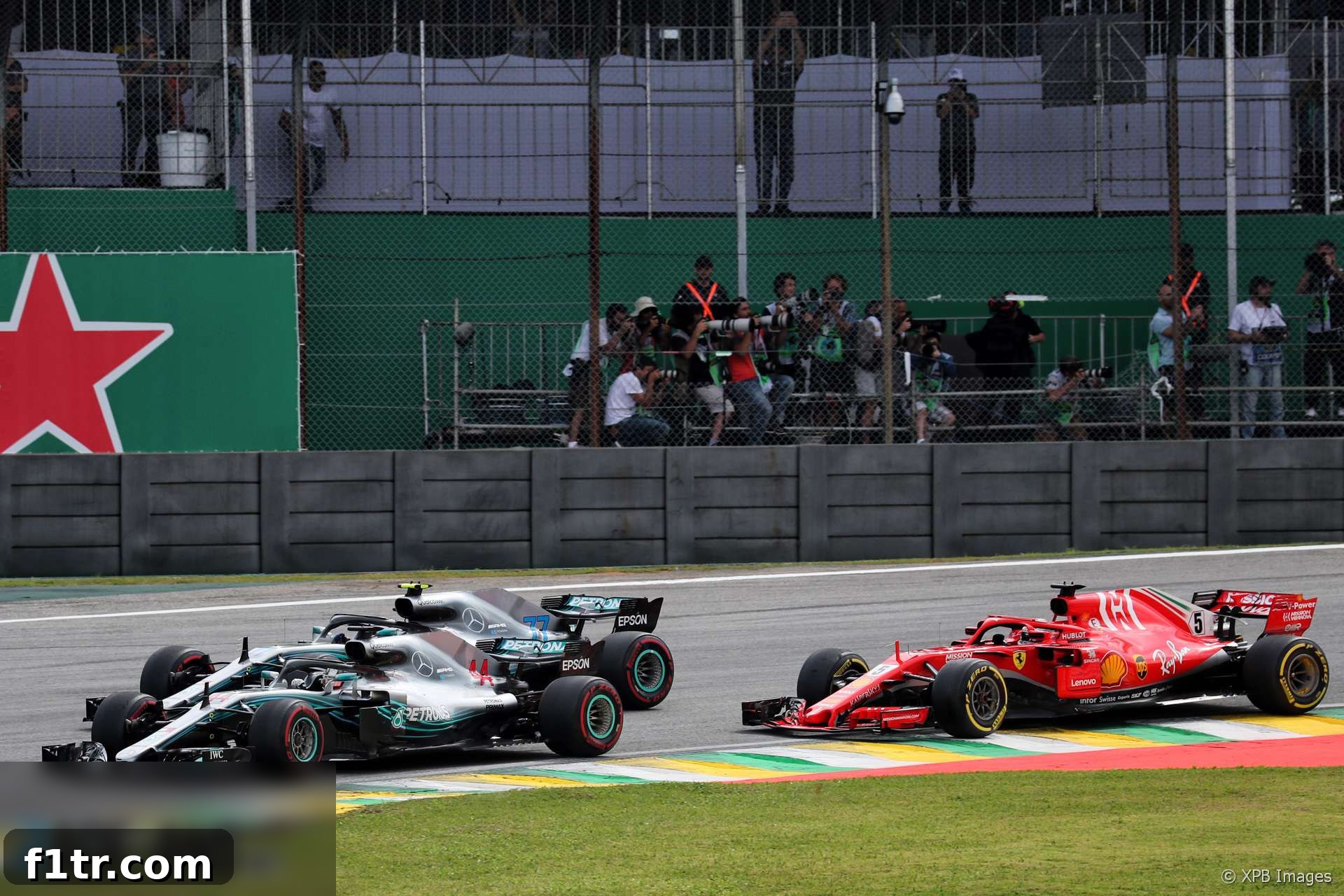
Even with the Drivers’ and Constructors’ Championships largely decided by the time Formula 1 arrived at the legendary Autódromo José Carlos Pace in Interlagos for the 2018 Brazilian Grand Prix, the race proved to be anything but a formality. This penultimate round of the season was a dramatic affair, adding another thrilling chapter to the storied history of this iconic circuit. Known for its challenging undulations, technical corners, and passionate atmosphere, Interlagos rarely disappoints, and 2018 was a prime example of its unpredictable nature.
The race saw Lewis Hamilton secure victory, but not without significant drama involving Max Verstappen. Verstappen, who had been driving a superb race, leading for much of the grand prix, was tragically involved in an incident with backmarker Esteban Ocon, costing him a potential win. This collision, which led to a penalty for Ocon, opened the door for Hamilton to claim the top step of the podium, further cementing his championship-winning season with another win. The team radio highlights from the event captured the raw emotion and frustration, particularly from Verstappen, offering a fascinating glimpse into the high-pressure world of F1.
The 2018 Brazilian Grand Prix was a showcase for “Star Performers,” with several drivers delivering exceptional drives under challenging conditions, demonstrating their skill and resilience. The visual spectacle of the event was also captured in “Top ten pictures,” showcasing the beauty and ferocity of Formula 1 racing at Interlagos. Ultimately, the race was summarized as “Verstappen’s ruined masterpiece becomes Hamilton’s latest triumph,” a poignant reflection on how fine the margins are in motorsport and how quickly fortunes can change.
The Brazilian Grand Prix is always a special event on the F1 calendar. Its unique counter-clockwise layout, blend of high-speed straights and tight corners, and unpredictable weather conditions often lead to memorable races. The 2018 edition, while not directly impacting the championship titles already sealed, provided all the thrills and spills that fans have come to expect from Formula 1, serving as an exciting precursor to the season finale. For a deeper dive into all the moments and analyses from this incredible race, explore the comprehensive coverage below.
- “I have this Force India behind…”: Team radio highlights from the Brazilian GP
- Hamilton takes 19th win in two years, needs 19 more to equal Schumacher
- 2018 Brazilian Grand Prix Star Performers
- Top ten pictures from the 2018 Brazilian Grand Prix
- Verstappen’s ruined masterpiece becomes Hamilton’s latest triumph
Browse all 2018 Brazilian Grand Prix articles