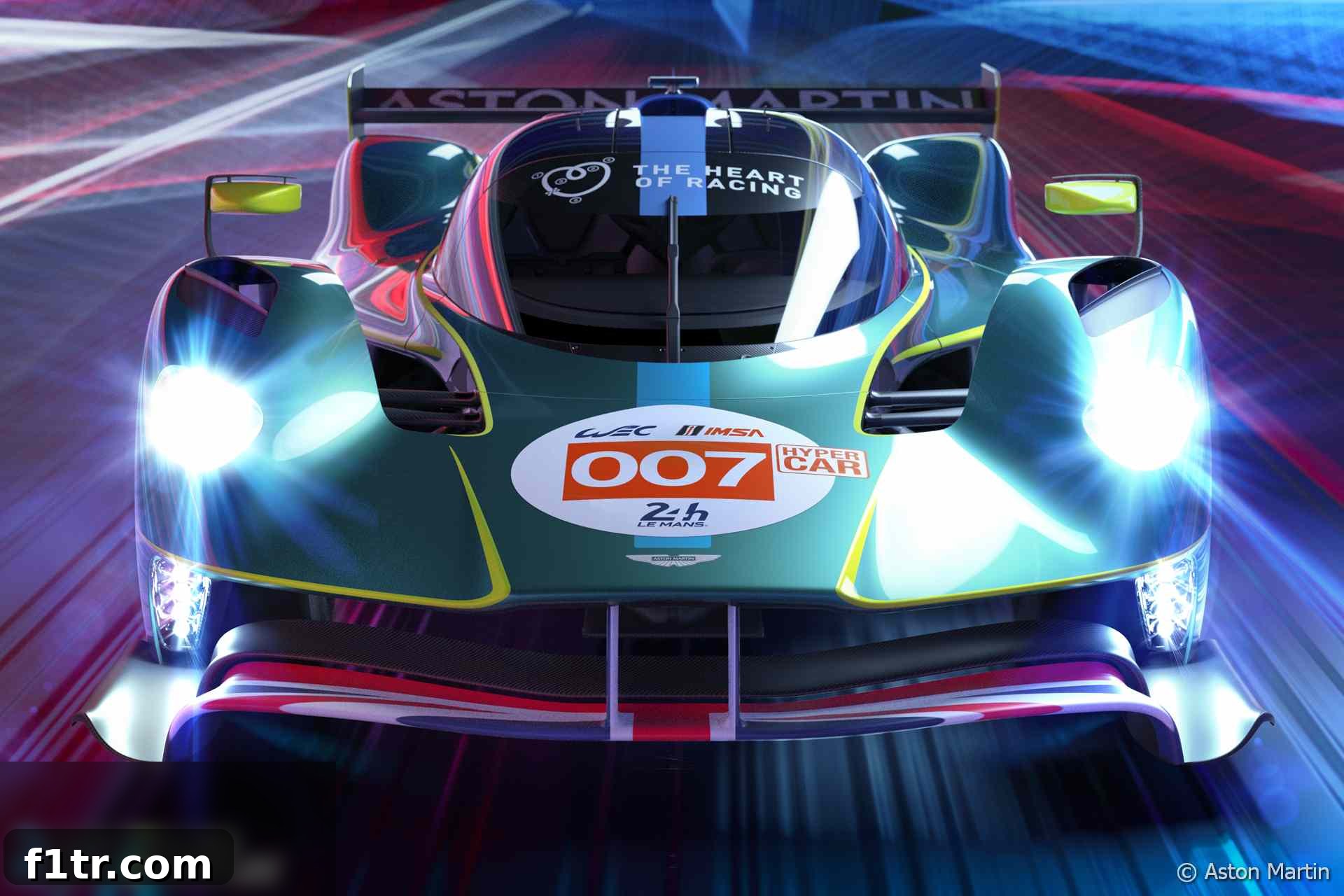
Aston Martin Unleashes Valkyrie Hypercar for Grand Return to Le Mans and WEC
In a move that sends ripples of excitement through the global motorsport community, Aston Martin has officially confirmed its highly anticipated return to the zenith of endurance racing. The prestigious British marque is set to enter two of its formidable Valkyrie AMR-LMH hypercars in the 2025 FIA World Endurance Championship (WEC), culminating in a monumental challenge at the legendary Le Mans 24 Hours. This declaration marks a significant statement of intent from Aston Martin, signaling its ambition to reclaim a top-tier position in the fiercely competitive world of international sportscar racing.
The announcement underscores Aston Martin’s commitment to the WEC’s groundbreaking Hypercar category, which continues to attract an ever-growing roster of automotive giants. Teaming up with its long-standing partner, The Heart of Racing, Aston Martin will unleash its cutting-edge Valkyrie LMH on some of the world’s most iconic circuits. The Heart of Racing, a team with a proven track record in GT racing, including a current Aston Martin Vantage GT3 entry at this weekend’s Le Mans 24 Hours, will serve as the works team, bringing invaluable experience and dedication to this ambitious program. This partnership is designed to ensure Aston Martin has the strongest possible foundation as it embarks on this thrilling new chapter.
A Dual Attack: Adhering to New Hypercar Regulations
Aston Martin’s decision to field a two-car entry for the 2025 season is in direct response to a pivotal new regulation implemented by the WEC. For the upcoming season, all manufacturers competing in the Hypercar class are mandated to run at least two cars, a rule designed to intensify competition and elevate the spectacle of endurance racing. This strategic decision by Aston Martin will see them join an elite group of manufacturers, including established powerhouses like Toyota, Ferrari, Peugeot, BMW, and Alpine, all of whom are committed to multiple entries in the series. The presence of two Valkyrie hypercars on the grid not only bolsters Aston Martin’s chances but also contributes significantly to the overall depth and excitement of the Hypercar grid, promising thrilling battles for race victories and championship titles.
The Hypercar class represents the pinnacle of contemporary sportscar racing, blending state-of-the-art technology with breathtaking performance. It allows for two different technical approaches: Le Mans Hypercar (LMH) and Le Mans Daytona h (LMDh). Aston Martin’s Valkyrie AMR-LMH aligns with the LMH regulations, allowing manufacturers more freedom in chassis and powertrain design. This approach enables Aston Martin to showcase its unique engineering prowess and brand identity through the Valkyrie platform, distinct from the shared chassis and hybrid systems often seen in the LMDh category.
The Valkyrie AMR-LMH: A Non-Hybrid V12 Powerhouse
At the heart of the Aston Martin Valkyrie AMR-LMH lies a modified version of the awe-inspiring Cosworth V12 engine, a powerplant already legendary in its road-going iteration. This naturally aspirated 6.5-liter V12 is renowned for its visceral sound, incredible power delivery, and high-revving characteristics, making it a truly exceptional choice for endurance racing. Unlike many of its contemporary Hypercar rivals, the Valkyrie LMH will race without a hybrid system. This non-hybrid approach positions Aston Martin uniquely within the class, potentially offering different strategic advantages related to weight distribution, complexity, and fuel consumption management over extended stints.
While many competitors leverage sophisticated hybrid powertrains for an additional burst of electric power, Aston Martin’s reliance on pure internal combustion emphasizes a different philosophy. This could present both engineering challenges and competitive benefits. A non-hybrid system typically means a lighter and less complex vehicle, potentially translating into superior handling and reliability over long distances. The raw power and characteristic sound of the Cosworth V12 are expected to thrill fans and offer a distinct identity on track, harking back to a more traditional form of motorsport engineering while meeting the stringent performance targets of the Hypercar regulations.
A Legacy Unrivaled: Aston Martin’s Deep Roots in Endurance
Adam Carter, Aston Martin’s Head of Endurance Motorsport, articulated the profound significance of this return, emphasizing the brand’s unparalleled heritage at the Le Mans 24 Hours. “We first raced at Le Mans more than 95 years ago – something no other road-going hypercar manufacturer can say,” Carter proudly stated. This deep-rooted history provides Aston Martin with a unique narrative, distinguishing it from newer entrants and even some long-established competitors. The marque’s storied past includes iconic victories and countless appearances, embedding Aston Martin firmly within the fabric of endurance racing lore.
Carter continued to express the brand’s unwavering commitment: “We are very proud of our association with this wonderful event, and with that in mind, it’s very clear that we are committed to WEC’s hypercar concept and bringing our famous wings back to the very forefront of international sportscar racing, including at the 24 Hours of Le Mans.” This sentiment highlights not only a desire to compete but a profound ambition to lead, leveraging the brand’s distinguished legacy to fuel future success. The iconic Aston Martin wings, synonymous with speed, elegance, and performance, are poised to once again grace the highest echelons of global sportscar competition, striving for outright victory.
The Road to 2025: Development and Homologation
The journey to the 2025 grid is a meticulous one, involving intense development and rigorous testing. According to Carter, “The Valkyrie AMR-LMH programme is on schedule with a significant amount of development taking place behind the scenes and ahead of the car’s track debut later this summer.” This behind-the-scenes work involves countless hours of simulation, aerodynamic refinement, engine calibration, and component testing, all crucial for creating a competitive and reliable hypercar.
Following its track debut, an intensive period of physical testing awaits. “We then anticipate an intensive period of testing to put miles on the car and learn all we can ahead of its planned homologation in the autumn,” Carter explained. This phase is critical for accumulating data, validating designs, fine-tuning the car’s setup, and pushing its limits to ensure it can withstand the gruelling demands of endurance racing. Homologation, the final approval process by motorsport governing bodies, is the gateway to competition, confirming the car meets all regulatory requirements and safety standards. Success in this phase will pave the way for Aston Martin to line up alongside the world’s best, ready to fight at the front of the grid.
Broader Horizons: IMSA Ambitions and Historical Context
Beyond the WEC, The Heart of Racing also harbours ambitions to race a Valkyrie in future seasons of the IMSA Sportscar Championship, particularly in the prestigious GTP class. This potential expansion signifies Aston Martin’s broader strategic vision for endurance motorsport, aiming to compete across multiple premier series and showcase the Valkyrie’s capabilities on a global stage. Success in both WEC and IMSA would solidify Aston Martin’s position as a dominant force in top-tier sportscar racing.
Aston Martin’s last foray into the top class at Le Mans was in 2011 with two entries for its AMR-One model. Unfortunately, that campaign was marred by early retirements, with both cars failing to complete five laps. This painful memory serves as a stark reminder of the immense challenges inherent in endurance racing and highlights the comprehensive effort and vastly different approach being taken with the Valkyrie program. The lessons learned from previous endeavors, combined with the Valkyrie’s advanced design and the robust partnership with Heart of Racing, instill confidence that this return will be far more successful and enduring, aiming to write a triumphant new chapter in Aston Martin’s rich racing history.
The return of Aston Martin to the Hypercar class, especially with such a distinctive and potent machine as the Valkyrie AMR-LMH, promises to be one of the most compelling storylines of the 2025 endurance racing season. Fans worldwide eagerly await the sight and sound of the V12-powered Valkyries battling for supremacy against the might of other automotive titans, as Aston Martin once again sets its sights on ultimate glory at Le Mans and throughout the World Endurance Championship.
World Endurance Championship Articles
- WEC cancels its Qatar season-opener due to US-Iran war
- Porsche to end WEC Hypercar programme after just three seasons
- Mercedes won’t return to Le Mans because “we don’t like Balance of Performance” – Wolff
- “Luck” needed to win Le Mans because of Balance of Performance – Verstappen
- McLaren finally confirms it will enter the World Endurance Championship in 2027
Browse all World Endurance Championship articles