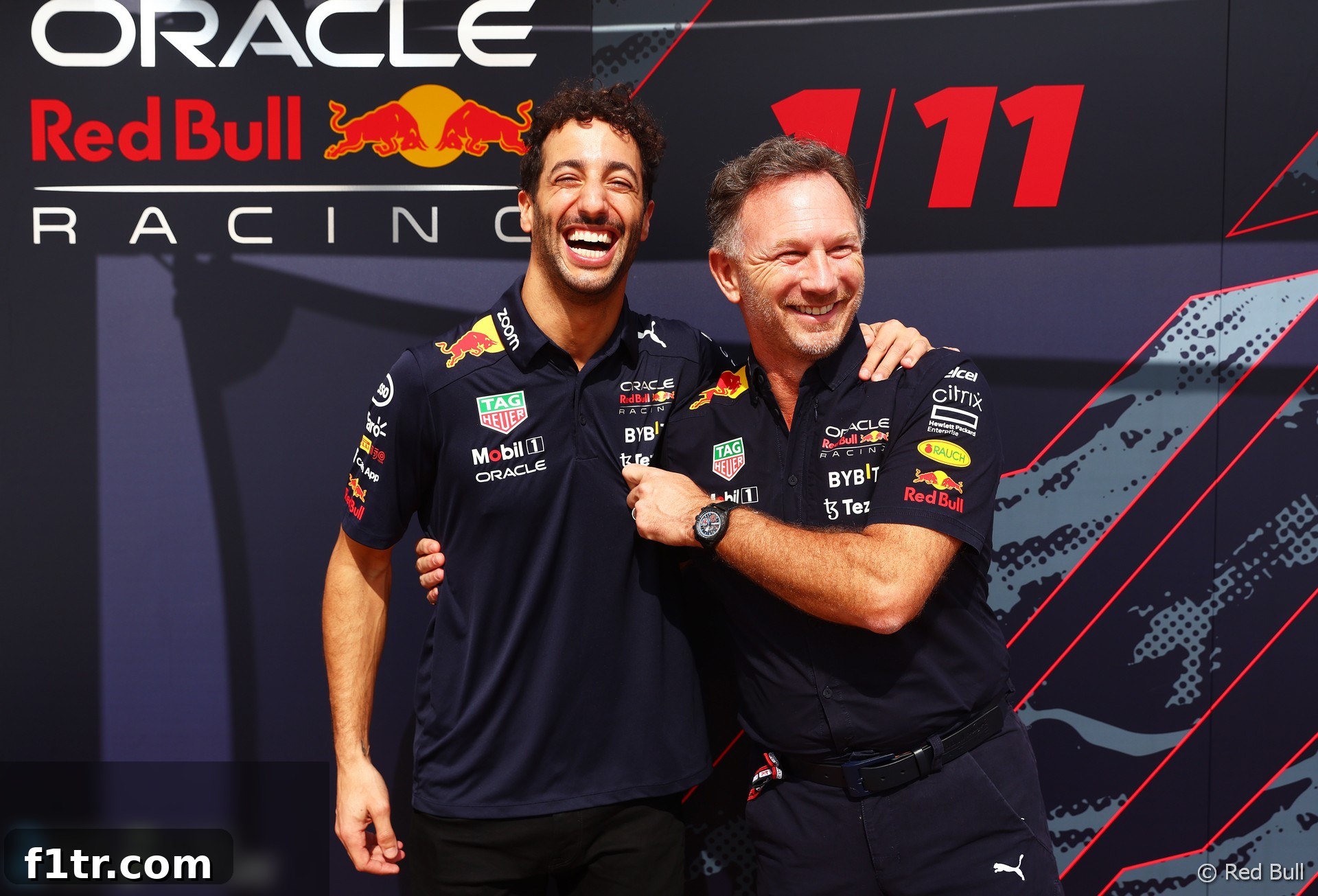
Daniel Ricciardo, a name synonymous with infectious charisma and aggressive yet fair racing, has captivated Formula 1 fans for over a decade. From his iconic late-braking overtakes to his trademark “shoey” celebrations, the Australian quickly established himself as one of the sport’s most beloved figures. However, his glittering career, particularly since his departure from Red Bull Racing in 2018, has been marked by a series of high-stakes gambles, unforeseen challenges, and a journey of introspection that has brought him full circle back to the very team he left. This article delves into the pivotal decisions that shaped Ricciardo’s post-Red Bull career, analyzing the motivations behind his moves, the struggles he encountered, and the uncertain future that now lies ahead for the “Honey Badger.”
The Baku Catalyst: A ‘Shitshow’ That Sparked Change
The year 2018 was a defining period for Daniel Ricciardo, ultimately leading to one of the most significant career shifts in recent Formula 1 history. The season, which had begun with flashes of brilliance, including two victories in the opening six races, was marred by a series of unfortunate events and a growing tension within the Red Bull garage. At the heart of this escalating friction was his increasingly fierce rivalry with then-teammate Max Verstappen. The nadir arrived dramatically at the Azerbaijan Grand Prix.
The streets of Baku had become a recurring scene of on-track drama for Red Bull in 2018. During the race, Ricciardo and Verstappen, both known for their uncompromising racing styles, found themselves locked in an intense, wheel-to-wheel battle that saw them touch tires twice in earlier skirmishes. The tension was palpable, a testament to two highly competitive drivers vying for supremacy within the same outfit. The inevitable, and catastrophic, collision occurred on lap 40. As Verstappen attempted an ambitious overtake on Ricciardo into Turn 1, a misjudgment resulted in both Red Bulls making contact at high speed, ending their races instantly in a cloud of carbon fiber and shattered aspirations.
Ricciardo’s raw frustration was evident in his post-race remarks, famously declaring the incident a “shitshow” and asserting, “You guys deserved this,” a pointed comment aimed at his own team. This public outburst, while uncharacteristic for the usually jovial Australian, underscored a deeper discontent brewing beneath the surface. He later admitted that Red Bull’s handling of the notorious clash, and indeed the broader dynamic between him and Verstappen, played a significant role in his decision to seek pastures new. The team’s decision to reprimand both drivers, rather than explicitly apportion blame, left Ricciardo with a “bitter taste,” a feeling no amount of the team’s energy drink sponsorship could wash away.
The Verstappen Dynamic: A Shifting Power Balance
Ricciardo had initially outperformed Verstappen during their inaugural season as teammates in 2016. However, it was clear that Verstappen, then a prodigious talent barely out of his teens, was on an relentless upward trajectory. The performance gap between the two narrowed considerably in 2017, and by 2018, it became increasingly apparent that Verstappen was not just a rising star, but the focal point around whom Red Bull’s future aspirations were coalescing. The young Dutchman’s ambition to become a world champion was undeniable, and the team seemed increasingly aligned with this vision.
Despite this perceived shift in internal dynamics, Ricciardo’s raw statistics from his nearly three-year tenure alongside Verstappen paint a picture of an incredibly strong competitor. He concluded his time with Red Bull having accumulated 457 points compared to Verstappen’s 377 during their shared seasons. Ricciardo also secured 18 podium finishes to Verstappen’s 11, with both drivers achieving three victories each. On paper, these figures illustrate Ricciardo’s formidable presence. Yet, from the moment Verstappen made history by becoming the youngest-ever Grand Prix winner on his Red Bull debut, there was an underlying narrative that he, not Ricciardo, represented the ultimate future of the team. This subtle but significant psychological shift, combined with the escalating on-track incidents and perceived unequal treatment, set the stage for Ricciardo’s dramatic exit.
The Renault Gamble: A Leap of Faith into the Midfield
In the aftermath of the Baku collision and the broader disillusionment with Red Bull, Daniel Ricciardo made one of the boldest and most consequential decisions of his career. He announced his departure from Red Bull Racing, a team that had nurtured his talent from a young age and propelled him into Formula 1. His destination was Renault, a move widely regarded as a huge gamble, transitioning from a proven front-running team to a midfield outfit striving to regain its former glory. The motivation behind this audacious switch was multi-faceted: a desire for a fresh start, a belief in Renault’s long-term project, and perhaps, a yearning to be the undisputed number one driver in a team built around him.
The initial phase of this new chapter in 2019 proved challenging. Ricciardo struggled to adapt to the characteristics of the Renault R.S.19, often finding himself outside the points and finishing a modest ninth in the drivers’ standings with 54 points. It was a stark contrast to his consistent front-running performances with Red Bull. However, 2020 offered a glimpse of the potential he sought. Ricciardo found his rhythm with the updated Renault package, delivering a series of impressive drives that saw him finish fifth in the standings with 119 points, securing two podium finishes for the French manufacturer – their first in nearly a decade. This resurgence suggested that the gamble might finally be paying off, that Ricciardo could indeed elevate a team and achieve success outside the Red Bull ecosystem.
Yet, even before the promising 2020 season concluded, Ricciardo had already made another pivotal decision, one that surprised many and arguably undermined Renault’s burgeoning progress. He had signed a deal to join McLaren for the 2021 season. McLaren, under new management, had shown significant strides in 2019 and 2020, becoming a highly competitive midfield contender. With Carlos Sainz Jnr moving to Ferrari for 2021, a coveted vacancy opened up, which Ricciardo swiftly seized. This move, however, did not sit well with Renault team principal Cyril Abiteboul, who openly expressed his irritation at Ricciardo’s early departure, particularly after the team had invested heavily in him and were starting to see positive returns.
McLaren Misfortune: A Dream Partnership Unravels
Daniel Ricciardo arrived at McLaren for the 2021 season with a wave of optimism and high expectations, both from himself and the team. His strong 2020 campaign with Renault had rekindled belief in his ability to extract performance from any car and lead a team. The prospect of partnering with the highly talented Lando Norris and spearheading McLaren’s return to the top seemed like a match made in heaven. Yet, from the very outset, it became painfully clear that Ricciardo simply did not gel with the unique characteristics of the McLaren MCL35M and later, the MCL36.
The McLaren chassis, known for its strong front end but often tricky rear, required a very specific driving style, particularly favouring late braking and a sharp turn-in. While Norris, who had grown up with the team’s philosophy, adapted seamlessly, Ricciardo, whose style relies more on smooth, flowing inputs and carrying speed through corners, found himself constantly fighting the car rather than working with it. This fundamental incompatibility manifested in a significant performance deficit, especially in qualifying.
Throughout his two seasons at McLaren, Ricciardo consistently found himself trailing his younger teammate. In 2021, despite delivering a sensational, morale-boosting one-two finish with Norris at the Italian Grand Prix at Monza – a race where Ricciardo dominated and secured McLaren’s first win since 2012 – this proved to be an isolated highlight rather than a turning point. The joyous scenes at Monza, complete with another “shoey,” momentarily masked the underlying struggles. However, the grim statistics from his tenure tell a starker tale.
The 2022 season, intended to be a year of resurgence, instead saw his struggles deepen dramatically. Ricciardo was out-qualified by Norris an astonishing 20 times in 22 Grands Prix. The points disparity was equally crushing, with Norris outscoring him by a massive 85 points. The once-unshakeable confidence of Ricciardo appeared visibly shaken, and the smile that had become his trademark seemed increasingly forced. What was initially intended to be a three-year contract was mutually agreed to be cut short after just two seasons, leaving Ricciardo without a race seat for the 2023 F1 season. The McLaren dream had, unequivocally, turned into a nightmare.
The Controversial Return: Back to the Bull as a Third Driver
The circumstances surrounding Daniel Ricciardo’s departure from McLaren were as unexpected as his initial move away from Red Bull. In a scenario that would have been unthinkable just four years prior, the Australian found himself returning to Red Bull Racing, not as a lead driver, but in a ‘third driver’ capacity for the 2023 season. This role, typically reserved for aspiring young talents or experienced test drivers, signifies a significant step back from the competitive grid for a driver of Ricciardo’s proven caliber.
Unsurprisingly, Red Bull team principal Christian Horner did not shy away from expressing his long-held conviction that Ricciardo had made the wrong choice to leave the team. “Daniel joined us as a teenager and he grew up with the team here,” Horner remarked after Ricciardo’s return to Red Bull was announced. “He had some great success here with us, and then he went and did something stupid and went to drive for a couple of other teams and it never quite worked out.” Horner’s words, while perhaps blunt, echoed a sentiment shared by many within the paddock and among fans, suggesting that Ricciardo had strayed from a path that could have led to greater success.
However, despite the public narrative and the apparent ‘failure’ of his stints at Renault and McLaren in terms of championship aspirations, Ricciardo himself remains steadfast in his belief that his decision to leave Red Bull was not a mistake. Speaking in Brazil, he stated, “I don’t regret it. People can say ‘his career didn’t work out after Red Bull, he went to Renault, stayed there two years went to McLaren, stayed there two years. I get it from that point of view, it looks like it failed if you will. But I know the way I was feeling that I needed to try and move on.”
Ricciardo maintains a philosophical outlook, asserting that his journey, though challenging, has been personally enriching. “Obviously, I haven’t won world championships since leaving Red Bull. But I feel like for myself and the things I’ve learned and gone through, I still feel better for it,” he explained. This perspective highlights a desire for personal growth and a need to forge his own path, even if it meant sacrificing immediate on-track success.
Ricciardo’s Rationale: Escaping a Downward Spiral
Delving deeper into his reasoning for leaving Red Bull, Ricciardo points to a significant downward spiral he experienced during the latter half of the 2018 season, despite its promising start. “I was watching some season highlights, I had eight or nine DNFs [did not finish], it was a brutal season. Especially the way it started: two wins in the first six races, then it was then kind of a horror season,” he recalled. This sequence of retirements, often due to mechanical issues, chipped away at his confidence and enjoyment.
“Although I was with a great team at the time, the energy inside, I was pretty down,” he admitted. “I felt like going back to that moment and how I felt it was the right thing for me to do, even if on paper you can say ‘oh you never should have left’.” This candid reflection suggests that his departure was not merely about a contractual dispute or a desire for more money, but a profound need for a change of environment to reinvigorate his passion and mental well-being, even if the on-track results at subsequent teams didn’t align with his ambitions. He genuinely believed that breaking away from his “shell” at Red Bull was a necessary step for his personal and professional development, regardless of the perceived outcome. He remains certain that he will be in good shape to return if there is a place for him on the grid for the 2024 F1 season, confident that he would “thrive in that position” if given a top seat.
A Future on the Sidelines? The Road Ahead
The sight of a driver with Daniel Ricciardo’s undeniable talent and effervescent personality on the sidelines has disappointed many across the Formula 1 paddock and fan base. Even his challenging 2022 campaign could not diminish the widespread recognition of his inherent ability. “I think he should be racing personally,” voiced seven-time world champion Lewis Hamilton. “I think he’s far too talented to [be a reserve driver], and he’s earned the right to be amongst us all racing.” George Russell echoed similar sentiments, underscoring the high regard in which Ricciardo is held by his peers.
For the immediate future, however, Ricciardo’s F1 activities will primarily be confined to simulator work, marketing engagements, and supporting the Red Bull team from the pit wall. This raises a crucial question: is this the beginning of the end for his career as a full-time Grand Prix driver? There are no guarantees that he will ever start another F1 race, and his current role is typically one occupied by young drivers hoping to break into the sport, or seasoned veterans winding down their careers.
Ricciardo notably had opportunities to remain on the grid for 2023, with vacancies at teams like Haas or Williams. His decision to forgo these chances and instead opt for a reserve role with a top team represents another significant gamble. He has chosen the risky path of stepping away from active competition in the hope of securing a highly coveted, competitive seat for the 2024 F1 season. This strategy is fraught with peril; without direct race experience, maintaining sharp racecraft can be challenging, and the fierce competition for seats means his absence could easily become permanent. While he outwardly expresses satisfaction with his career decisions and maintains a strong belief in his ability to “thrive in a top seat,” one cannot help but wonder what the Daniel Ricciardo of 2022, after a season of immense struggle, would advise his younger, equally determined self in 2018. Only time will tell if this latest gamble pays off, or if the “Honey Badger” has, for now, run out of bites on the Formula 1 grid.
News Focus
- No happy ending for Ricciardo’s made-for-Netflix redemption arc
- No ‘two alphas’ for Red Bull as team forms its longest-running driver line-up
- Will Mercedes come to the rescue of Ocon’s career a third time?
- How the midfield’s hottest team mate rivalry boiled over
- Petty officialdom or deserved decisions? Five drivers stripped of wins in 2024
Browse all News Focus articles