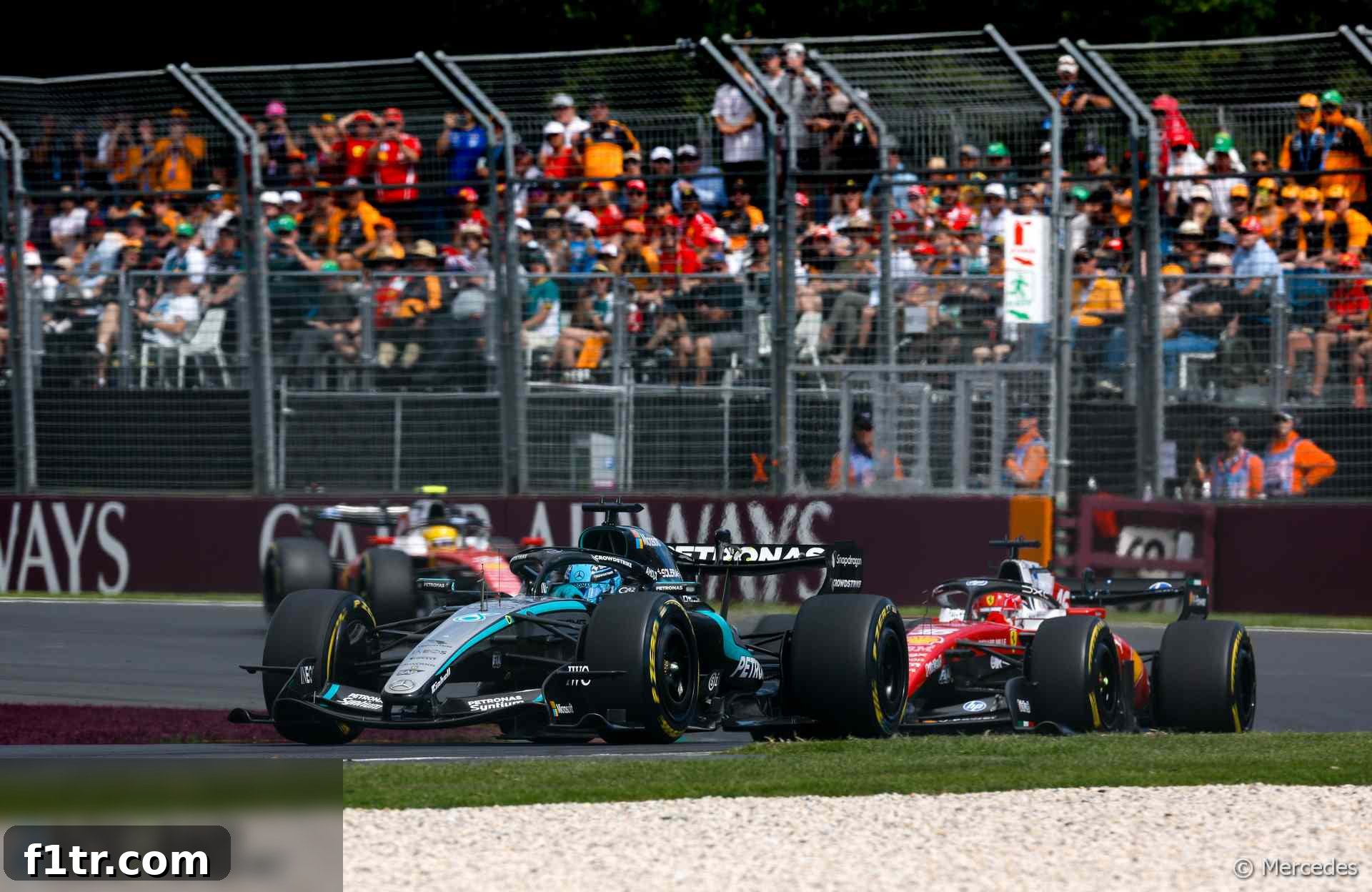
Charles Leclerc and George Russell’s captivating tussle for the lead during the opening laps of the Australian Grand Prix offered an insightful glimpse into the transformative impact of Formula 1’s latest power unit regulations on modern racing dynamics.
This thrilling wheel-to-wheel contest highlighted how critically drivers must now manage their energy resources and strategically deploy the potent “Overtake mode” that defines this new era of Grand Prix competition. Far more than just raw speed, the race showcased a complex interplay of power management, real-time strategy, and the crucial communication between driver and engineer.
Advert | Become a Supporter & go ad-free
Throughout the initial stages of the race, both Leclerc and Russell were in constant dialogue with their respective race engineers. These communications weren’t just about lap times or track conditions; they were intricate strategic discussions, guiding the drivers on whether they were within the critical one-second window to activate their Overtake mode, or if a competitor behind them was poised to do the same. Equally vital was the precise timing of energy deployment from their car’s sophisticated battery systems – knowing when to unleash a burst of electrical power for an attack or defense, and when to conserve it for later strategic advantages. This intricate dance of energy management has become a cornerstone of success in contemporary Formula 1, elevating the role of real-time data and strategic foresight.
The tension began even before the lights went out. As Leclerc prepared on the grid, he voiced concerns about his battery’s charge, fearing it might compromise his getaway. “I’m very low,” Leclerc informed his race engineer Bryan Bozzi, seeking intelligence on his teammate, Lewis Hamilton. “Let me know if he changes the procedure, let’s be reactive.” Bozzi, confirming a consistent team approach, reassured him: “No change on the procedure, Charles. Same across cars.” This brief exchange underscored the fundamental importance of a strong start, where every joule of energy can make a decisive difference.
Meanwhile, during the formation lap, Russell probed his engineer Marcus Dudley about his energy status: “Do I want to try and get this at 100% of the pack now?” Dudley’s concise reply, “We’re happy where we are currently,” signaled that Mercedes had a pre-planned energy deployment strategy, even in these crucial preliminary moments.
Despite his initial battery worries, Leclerc executed a superior start, expertly positioning his Ferrari to dive down the inside of Russell and seize the lead at Turn One. The immediate consequence was a warning from Dudley to Russell as they navigated Turn Five: “No boost presses.” This instruction was critical, reminding Russell to conserve his precious Overtake mode for a more opportune moment, a testament to the strategic discipline required in modern F1.
Advert | Become a RaceFans supporter andgo ad-free
As the second lap commenced, the strategic game intensified. Dudley informed Russell he had closed to within 0.9 seconds of Leclerc, thereby enabling the use of his potent Overtake boost. “Overtake enabled,” Dudley declared, adding: “Gap ahead 0.9, Lewis car behind, 2.6.” This scenario mirrored the previous DRS (Drag Reduction System) rules, which also required drivers to be within a second of the car ahead to activate the aerodynamic aid. The Overtake mode has effectively replaced DRS as the primary tool for gaining track position, shifting the emphasis from purely aerodynamic advantage to a strategic blend of electrical power and driver timing.
Leclerc was promptly alerted by Bozzi: “Overtake enabled for Russell.” There was little Leclerc could do to counter Russell’s superior straight-line speed, and the Mercedes driver swept past him as they approached Turn 11 on the second lap, temporarily claiming the lead.
However, the duel was far from over. Leclerc, demonstrating his tactical acumen, swiftly regained the position on the subsequent lap. Russell, perhaps conserving his energy or assessing Leclerc’s pace, seemed content to hold back slightly at this point, remaining within half a second of the Ferrari without launching an immediate counter-attack. This delicate balance of aggression and conservation became a recurring theme throughout their battle.
The conversation between Russell and Dudley revealed further layers of strategic complexity. “Let me know if you are happy with lift-and-coast levels,” Russell inquired, seeking guidance on his energy management. “Increase lift-and-coast Turn Six to get to the top of the pack,” Dudley advised. Lift-and-coast is a technique where drivers lift their foot off the throttle well before a corner and coast, saving fuel and energy while also managing tyre temperature and wear. Mastering this technique is crucial for optimizing race performance and extending tyre life, adding another dimension to a driver’s skill set.
At one particularly tense moment, Russell voiced a strong complaint about Leclerc’s defensive tactics. He claimed Leclerc was positioning his car dangerously, especially as he backed off early for energy saving while still defending his line into a corner. “That was very dangerous by Leclerc, especially what we spoke about in briefing,” Russell stated, a message broadcast widely on the world television feed. This incident underscored the fine line between aggressive defending and unsafe driving, particularly when differing energy management strategies lead to varied closing speeds.
Leclerc, seemingly anticipating Russell’s frustration regarding the speed differentials, offered his own technical explanation to Bozzi: “For info, this looks f*****g scary, but the K is cutting 200 metres before them, so I cannot do much.” Here, “K is cutting” refers to the energy recovery system (ERS) ceasing to deploy electrical power, leading to a sudden and noticeable deceleration. This strategic energy saving, while vital for overall race performance, created a significant speed disparity with Russell’s car, making the defensive moves appear more abrupt and potentially dangerous to the following driver.
Advert | Become a RaceFans supporter andgo ad-free
“Understood, Charles,” Bozzi replied, acknowledging the driver’s explanation. Crucially, after reviewing the incident, the race stewards deemed that no further investigation was required, affirming Leclerc’s driving as within the bounds of fair competition, despite the apparent danger perceived by Russell.
The strategic guidance continued. Bozzi then instructed Leclerc: “If you can, saving tyres Turn 10, 12.” Leclerc duly complied, demonstrating excellent tyre management, which Bozzi acknowledged with praise: “Good management, well done.” This constant communication and real-time adaptation to race conditions are paramount for optimizing performance and ensuring tyres last the intended stint, a critical factor in a modern F1 Grand Prix.
Russell eventually seized another opportunity to pass Leclerc into Turn One, but his eagerness saw him run wide, allowing the Ferrari driver to reclaim the position at Turn Three. A momentarily exasperated Leclerc, who had led for the majority of the race to this point, remarked: “F***, it’s a big advantage to be second!” Bozzi’s succinct reply, “Yes, we know,” highlighted the shared understanding within the team about the strategic benefits of trailing – notably, the slipstream effect and the ability to use Overtake mode for a decisive pass on the following lap. Being in second place offers a crucial strategic advantage, especially when an energy boost is available, as the lead car has to break the air resistance and defend simultaneously.
Soon after this intense exchange, the Virtual Safety Car (VSC) was deployed, a moment that fundamentally altered the race. Mercedes quickly reacted, calling Russell into the pits for a tyre change under the safety car conditions, a strategic gamble aimed at gaining track position. Ferrari, conversely, opted to leave Leclerc out on track, bringing their captivating direct battle for the lead to an abrupt and premature end. This divergence in strategy, triggered by the VSC, epitomized the high-stakes decision-making that defines Formula 1.
This incident, occurring early in the season, served as a potent learning experience for all involved. Drivers are still actively exploring and refining how to extract the maximum performance from their cars under the new regulations, especially in intense wheel-to-wheel scenarios. Post-race, Russell himself commented to Leclerc that he had made a mistake by failing to use his Overtake mode at a crucial juncture, clearly indicating that both drivers and teams are continuously identifying areas for improvement and refining their strategies in this evolving landscape of Formula 1. The Australian Grand Prix proved to be more than just a race; it was a testament to the intricate blend of driver skill, technological prowess, and strategic ingenuity that now defines the pinnacle of motorsport.
Miss nothing from RaceFans
Get a daily email with all our latest stories – and nothing else. No marketing, no ads. Sign up here:
2026 Australian Grand Prix
- Briatore “not happy at all” with Alpine’s “very weak” performance
- Drivers want rules changes to cut “dangerous” risk of crash at start
- Russell becomes the 68th different Formula 1 driver to lead the world championship
- Hadjar told Red Bull his car’s performance was “embarrassing” and “just c***”
- “How did you not call the pit?” Ups and downs in Hamilton’s first race with new engineer
Browse all 2026 Australian Grand Prix articles