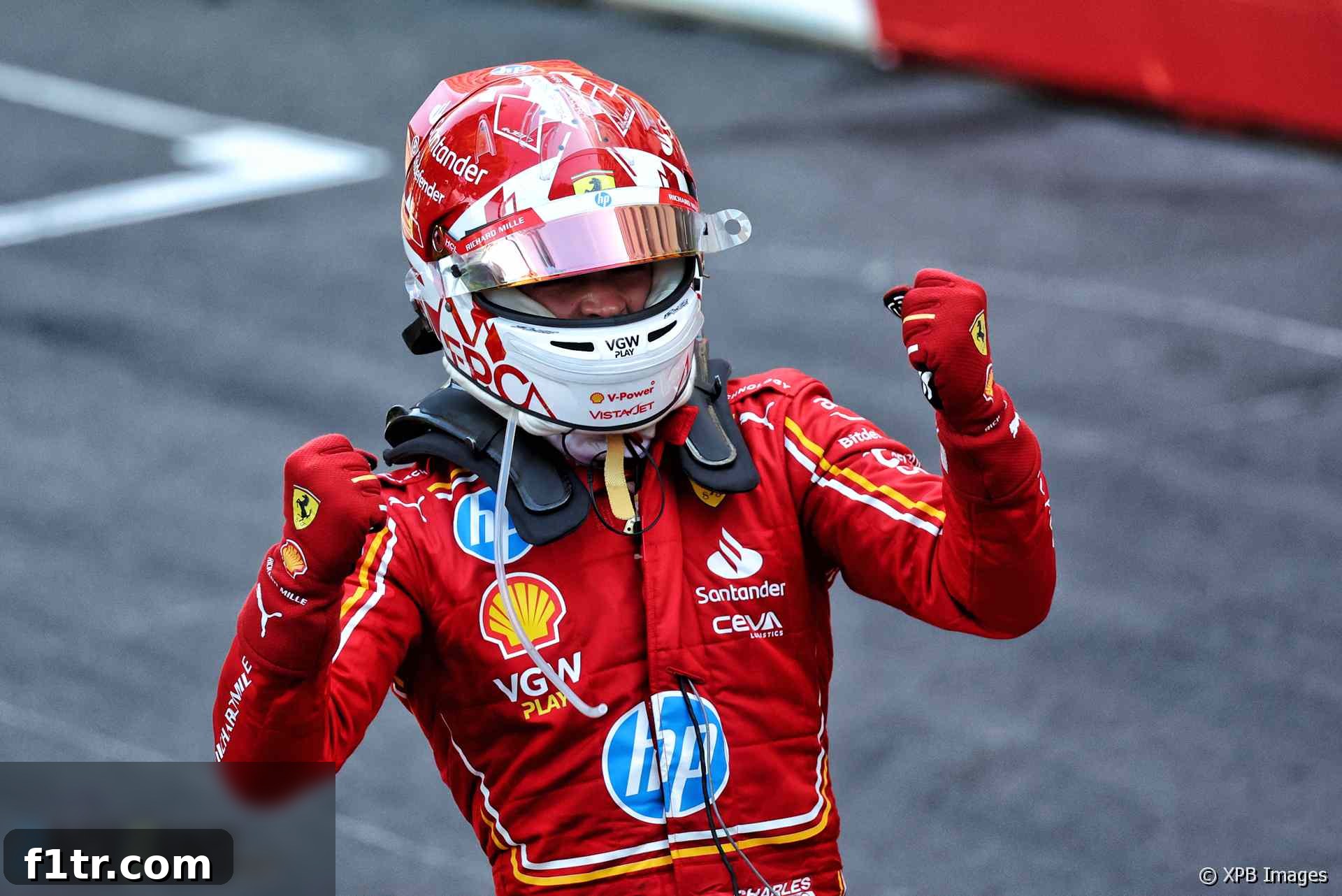
For Charles Leclerc, the journey through motorsport has always been a poignant tapestry woven with threads of extraordinary success and profound sorrow. His career, from the earliest days of karting to the pinnacle of Formula 1, has been marked by significant triumphs, yet often shadowed by personal loss.
Leclerc’s early life was deeply intertwined with motorsport, nurtured by his father, Hervé. He recounted how, as a child, he would refuse to stop driving his kart until the fuel ran out – a testament to his burgeoning passion. Hervé provided unwavering support and dedication, witnessing his son’s meteoric rise through the junior categories. Tragically, Hervé passed away just months before Charles made his Formula 1 debut, never seeing his son achieve his ultimate dream.
Another pivotal figure in Leclerc’s life was childhood family friend Jules Bianchi. Bianchi, a Ferrari junior driver himself, was instrumental in forging Leclerc’s connection with the Scuderia, a relationship that would eventually see him become one of Ferrari’s most celebrated talents. Yet, the cruel hand of fate meant Bianchi, too, was not there to witness Leclerc’s remarkable achievements, having succumbed to injuries sustained in a 2014 Grand Prix incident.
Even the momentous occasion of Leclerc’s maiden Grand Prix victory at Spa-Francorchamps in 2019 was tinged with tragedy. Just a day prior, the motorsport world mourned the loss of Anthoine Hubert in a horrific Formula 2 accident. Leclerc dedicated his victory to Hubert, a poignant reminder of the fragility of life and the inherent dangers of the sport.
On the track, Leclerc has frequently grappled with immense frustration and disappointment. His arrival at Ferrari coincided with a challenging period, as the Scuderia endured two consecutive winless seasons in 2020 and 2021. A promising start to the 2022 season, hailed as a potential championship charge, ultimately proved to be a false dawn, followed by another disheartening winless year. These experiences fostered a resilience within him, sharpening his resolve.
Perhaps the most persistent source of heartbreak, however, was his home race: the Monaco Grand Prix. This iconic event, which had ignited his passion for motorsport and fueled his entire career, seemed to be cursed. Despite securing back-to-back pole positions in previous years, mechanical failures, strategic blunders, or unfortunate circumstances consistently denied him the coveted victory. The prospect of winning on the streets he grew up on, in front of his friends and family, remained an elusive dream, a monumental challenge that tested his spirit time and again.
Conquering Destiny: The 2024 Monaco Grand Prix Qualifying
In the lead-up to the 2024 Monaco Grand Prix, a palpable shift in the Formula 1 landscape became evident. The dominant force of Red Bull, which had frequently seemed invincible, showed cracks in its armor. Over the initial two days of practice sessions, Ferrari, spearheaded by Charles Leclerc, emerged as the undeniable pace-setters. The highly technical and demanding Monaco circuit, renowned for placing an unparalleled premium on driver skill over raw car performance, highlighted just how finely balanced the field at the front truly was.
The stakes for qualifying in Monaco are arguably higher than at any other circuit on the calendar. With overtaking opportunities virtually non-existent, securing pole position is often considered more than half the battle won. The pressure on Leclerc, a local hero desperate to break his home race curse, was immense. Yet, when the crucial moment arrived, Leclerc did not falter. He delivered a masterful performance, extracting every ounce of performance from his Ferrari, claiming a pivotal pole position.
This time, unlike his previous two Monte Carlo poles, there were no lingering questions about his car’s competitiveness, no ominous rain clouds threatening to disrupt strategy, and no external factors complicating matters. There was nothing but a clear road ahead and an azure sky above. All that remained was for him to defend his lead into Sainte Devote against Oscar Piastri, driving a significantly improved McLaren, who started alongside him on the front row. The rest, he hoped, would surely follow with relative ease.
Chaos on Lap One: Red Flag Reshapes the Race
As the lights extinguished, signaling the start of the race, Charles Leclerc executed a flawless getaway. A quick glance in his mirrors would have confirmed that his lead into the tight Sainte Devote corner was secure. However, immediately behind him, the action was far more tumultuous. Leclerc’s teammate, Carlos Sainz Jnr, starting third, gained significant momentum and drew alongside Oscar Piastri’s McLaren. As they navigated the iconic first corner, Sainz squeezed Piastri at the apex, resulting in contact. The collision inflicted damage to the McLaren’s floor and, more critically for Sainz, caused a puncture to one of his Ferrari’s tires. Sainz continued up the hill, his pace quickly diminishing as he realized the severity of his issue.
The drama, however, was far from over. Further down the pack, a much more catastrophic incident unfolded. Towards the rear of the grid, Sergio Perez in the Red Bull found himself under fierce attack from Kevin Magnussen’s Haas. As they entered the sweeping Beau Rivage section, neither driver was willing to yield an inch in their battle for 17th place. The inevitable collision sent both cars careening into the unforgiving barriers. The impact was violent, sending debris flying and causing an army of trackside photographers to scramble for cover. One unfortunate individual was struck by debris but was quickly released from the medical center after a precautionary check-up.
By the time the tangled wreckage of Perez and Magnussen’s cars came to a halt near Massenet, they had collected a third innocent victim: Nico Hulkenberg. Miraculously, Zhou Guanyu, directly behind them, managed to avoid becoming a fourth casualty. However, his progress was severely hampered as the medical car stopped directly in front of him, its occupants evacuating to attend to the scene. As Zhou gingerly navigated through the debris-strewn track, the race was abruptly halted with a red flag, bringing the chaotic opening lap to an end.
The timing of the red flag proved to be a stroke of immense fortune for Carlos Sainz Jnr. Since Zhou had not yet crossed the Safety Car Line Two at the pit exit by the time the red flag was called, the race positions for the restart were reverted to the order at that specific line. This meant that Sainz, who had fallen to 16th place due to his puncture, was able to miraculously regain his third-place starting position. While Charles Leclerc’s lead remained unaffected, this turn of events effectively quashed McLaren’s hopes of leveraging their numerical strength (with Piastri and Norris) against Leclerc and Ferrari.
The red flag also presented a strategic boon for all teams: a ‘free’ tire change. Under Formula 1 regulations, drivers must use at least two different tire compounds during a dry race. By changing tires during the red flag period, teams could fulfill this obligation without losing precious track position via a pit stop under green flag conditions. Ferrari, having started Leclerc on medium tires, seized this opportunity to fit a fresh set of hard compound tires on his car, aiming to run the vast majority of the remaining race distance without another stop. Before the restart, Leclerc’s race engineer, Brian Bozzi, communicated the plan over the radio: “So Charles, we’ll now go behind the Safety Car – standing start. Then we will go to the end.” It was a strategy almost universally adopted by the front-runners, a clear signal of their intentions.
Masterful Control: Leclerc Dictates the Pace
Charles Leclerc emerged from the pitlane on fresh hard compound tires, as did the three drivers directly behind him – Oscar Piastri, Carlos Sainz Jnr, and Lando Norris. In fact, nearly the entire field had opted for a tire change, transitioning from mediums to hards or vice-versa, with the sole exception of Logan Sargeant in the 14th-placed Williams. A standing start restart was declared, meaning Leclerc’s task was clear: hold the lead into Sainte Devote, and then, with track position being paramount in Monaco, he could manage the race to stretch his hard tires all the way to the finish line.
Even with tires that offered less initial grip off the line compared to the softer compounds, Leclerc executed another strong getaway. He expertly fended off Piastri’s challenge into the first corner, maintaining his lead. The top ten positions remained unchanged after the restart, with Leclerc leading the field up the hill for the second time, followed by Piastri, Sainz, and Norris in tow. The order had been preserved, a critical factor on the notoriously difficult-to-pass streets of Monte Carlo.
Leclerc’s instructions from his engineer were to “slowly introduce” his tires from the second green flag lap. His tactical approach immediately became apparent. His first complete lap time after the restart was a conservative 1’22.625 – a staggering ten seconds slower than his pole position time. This demonstrated his clear intention to manage his tires meticulously, preserving them for the long haul. Piastri, unsurprisingly, stuck to the Ferrari’s gearbox in the early laps, consistently closing within a second over several circuits and even attempting a speculative lunge to the inside of Portier on lap 19.
Piastri later reflected on this moment: “I kind of knew that once I showed my hand in where I was going to try and overtake, that he would probably be wise to it from there. So I managed to get very close in turn seven one lap. I tried to show the nose in Portier, but he reacted just quick enough, so after that point I knew I was going to be very limited on options.” Leclerc’s defensive driving was impeccable, denying Piastri even a glimmer of an opportunity.
While Leclerc was pacing himself with remarkable self-control, George Russell, running fifth on medium tires, was circulating even slower. His challenge was to make his softer rubber last the same incredibly long distance as the hard-shod cars ahead. The growing gap between the leading quartet and Russell became a minor concern for Ferrari. Such a large gap could potentially open a ‘free’ pit stop window for Lando Norris in fourth. If Norris could pit for fresh, softer tires without losing track position to Russell, he might then be able to put significant pressure on Carlos Sainz Jnr and, in a more extreme scenario, even Charles Leclerc. Ferrari promptly instructed Leclerc to either match or run slower than the Mercedes to prevent this critical pit window from opening for McLaren, a testament to the intricate strategic chess match unfolding.
With overtaking opportunities virtually non-existent on the narrow, winding streets of Monaco, Piastri found himself with few options to challenge the leader. The laps steadily ticked by, the monotony for the front-runners occasionally broken only by the need to navigate lapped traffic. However, the traffic failed to create any significant openings or opportunities for Piastri to exert sustained pressure on the leading Ferrari. Leclerc remained firmly in control, meticulously managing his tires and the gap to his closest rival.
The Long Haul and the Emotional Finish
Charles Leclerc continued his composed drive, successfully keeping Russell at a distance of around 20 seconds. This strategic gap ensured that none of the top four drivers felt compelled to risk a pit stop and sacrifice their crucial track position for what would be minimal, if any, gain. Further back, however, Yuki Tsunoda had fallen 40 seconds behind seventh-placed Lewis Hamilton. Mercedes capitalized on this substantial advantage, pitting Hamilton for a fresh set of hard tires. Red Bull responded swiftly, bringing Max Verstappen in soon after to cover off the threat from Hamilton. Verstappen successfully maintained his sixth position and, crucially, now held a distinctive pace advantage over Russell ahead, setting up a potentially stressful final third of the race for the Mercedes driver.
Despite the leaders having already pushed their hard compound tires far beyond their originally anticipated lifespan, Leclerc remained remarkably confident in their condition. As the fuel load in his Ferrari gradually diminished, he subtly began to increase his pace, transitioning from lap times in the 1’18s to the quicker 1’17s. The only minor concern voiced by Ferrari engineer Brian Bozzi was a cautionary note about “micro-locks” on the approach to heavy braking zones like Sainte Devote and the Harbour chicane. Yet, nothing Leclerc was doing seemed to be extracting significant performance degradation from his Pirelli tires.
“I felt like we had everything under control,” Leclerc later explained, his voice still brimming with emotion. “The pace of the car was amazing. The tires felt really, really good. Even in the last laps, I felt like I could do another race.” His confidence was absolute, a stark contrast to the nervous energy that often accompanies such a high-pressure home race.
Leclerc’s lap times continued to improve, dropping from the 1’17s into the even faster 1’16s. Oscar Piastri, despite his McLaren having lost some downforce efficiency from the lap one clash with Sainz, was able to match Leclerc’s pace. However, matching was the best he could hope for; an overtake remained an impossibility. With fewer than 20 laps remaining, it seemed only a sudden mechanical failure, an unexpected puncture, or another major accident further back in the field could possibly deny Charles Leclerc his long-awaited victory.
In complete control out front, as the monumental reality of what he was on the cusp of achieving began to sink in, intrusive thoughts inevitably began to flash through Leclerc’s mind inside his helmet. Thoughts about his arduous journey to this point, the sacrifices made, those who had championed him, and, most profoundly, those who were no longer around to share in this celebratory moment. The weight of his personal history, intertwined with the destiny of his home race, pressed heavily upon him.
On lap 71, perhaps as a way to manage his surging emotions, Leclerc posted a personal best time of 1’15.162, suddenly stretching his lead over Piastri by several crucial seconds over just a handful of laps. He later explained that he was trying to cover any possible scenario, a final strategic flourish to ensure absolutely no chance of losing the win. Yet, it was also a visible manifestation of the emotional intensity he was experiencing.
“I think where I struggled most to actually contain my emotions was during the last 10 laps of the race,” he candidly admitted after the race. “I realized actually two laps to the end that I was struggling to see out of the tunnel just because I had tears in my eyes. And I was like, ‘fuck, Charles, you cannot do that now. You still have two laps to finish’.” It was a raw, human moment, revealing the immense emotional toll and profound significance of the victory.
After a quick reassurance to his team that he would safely bring the car home, Leclerc eased off slightly, dropping back into the 1’16s to savor his final laps. He drove past the very bus stops he used to wait at to get to school, past balconies overflowing with old friends cheering him on, and towards the royal box where Prince Albert II eagerly awaited. For the 78th and final time, Charles Leclerc expertly steered his Ferrari through the iconic streets of his home city, before taking the chequered flag. In that moment, a lifelong childhood dream, and indeed the dream of his late father, was gloriously realized.
“I remember being so young and watching the race with my friends, obviously with my father – who did absolutely everything for me to get to where I am today – and I feel like I didn’t only accomplish a dream of mine today, but also one of his,” he shared, his voice thick with emotion during the post-race interviews.
“I think the fact as well that we started twice on pole position in the past and that we couldn’t manage to get the win for one reason or another, that we couldn’t really control, not in our control, makes this one even more so special.” The weight of past disappointments only magnified the sweetness of this hard-won triumph.
A Meaningful Victory
Oscar Piastri crossed the finish line a commendable seven seconds behind Leclerc, securing a well-deserved second place. He was more than content with the runner-up spot, fully aware that he had extracted the absolute maximum from his car and that little more could have been done to challenge the Ferrari. Carlos Sainz Jnr skillfully converted his stroke of red flag fortune into a valuable third place, ensuring a double podium for Ferrari. Lando Norris, despite a strong performance, had to settle for fourth, becoming the only Ferrari or McLaren driver not to take home a trophy from Monaco.
George Russell impressively resisted Max Verstappen’s relentless pressure to claim a hard-fought fifth position on an astonishing 77-lap-old set of medium tires, a true testament to his tire management. Lewis Hamilton followed close behind them in sixth. Yuki Tsunoda secured a solid eighth place, while Alexander Albon delivered Williams’ highly anticipated first points of the season in ninth, a crucial result for the team. Pierre Gasly, surviving a contentious lap one assault from his Alpine teammate Esteban Ocon, scored the final point in tenth. Remarkably, and for the first time in the history of Formula 1, the top ten drivers on the grid all finished the race in precisely the same positions from which they had started.
In terms of pure spectacle, the 2024 Monaco Grand Prix may not be remembered as a thrilling, action-packed race. It was not characterized by intense wheel-to-wheel battles or a cascade of dramatic overtakes. Indeed, for many, it was not much of a “race” in the traditional sense, defined by its strategic conservatism after the red flag.
However, as Charles Leclerc stood on the top step of the podium, tears in his eyes, draped in the Monegasque flag, and looking down upon the beaming faces of his Ferrari team, none of those criticisms mattered. For him, for his family, and for the entire principality, this was everything. In that moment, and for the rest of time, he was a Monaco Grand Prix winner. This victory transcended mere sporting achievement; it was the realization of a lifelong dream, a tribute to those he had lost, and a profound personal triumph over adversity and expectation.
“To finally make it in front of my whole family, my friends that were watching all over the track is a very, very, very special feeling,” he concluded, encapsulating the deep emotional resonance of his long-awaited home victory.
2024 Monaco Grand Prix Related Articles
- Formula 1 will fix red flag rule loophole which ruined Monaco GP – Domenicali
- Magnussen ‘could have backed off but didn’t’ in Monaco crash, says team boss
- Ocon defends his driving after ‘hurtful abuse’ over Monaco GP crash with Gasly
- How the midfield’s hottest team mate rivalry boiled over
- “He’s really dangerous”: Unheard driver radio from F1’s slow show in Monaco
Browse all 2024 Monaco Grand Prix articles
F1 Race Reviews Archive
- Antonelli lucks in for second win and becomes youngest F1 championship leader
- Emotional Antonelli grabs first Formula 1 victory in Chinese Grand Prix
- Russell sees off Ferrari threat to lead Mercedes one-two in Melbourne
- Norris clinches F1 title by two points as Verstappen wins finale at Yas Marina
- McLaren strategy blunder in Losail hands Verstappen crucial win and shot at title
Read all F1 race reviews