Nikita Mazepin Slapped with Heavy Penalties After High-Impact F2 Crash
In a decisive and strongly worded verdict, Formula 2 stewards have issued a substantial 15-place grid penalty and four additional penalty points to Nikita Mazepin, holding him entirely responsible for a dramatic and dangerous multi-car collision during today’s F2 race. The incident, which saw cars careening off track and into barriers, underscored the critical importance of driver judgment and adherence to safety protocols in the high-stakes world of motorsport.
The ART Grand Prix driver’s punishment marks a significant setback for the upcoming championship round in Abu Dhabi, where the extensive grid drop will severely hamper his prospects. This ruling not only impacts Mazepin’s immediate competitive standing but also adds to his growing tally of penalty points, bringing him closer to a potential race ban.
The Incident Unfolds: A Sequence of Errors and Impact
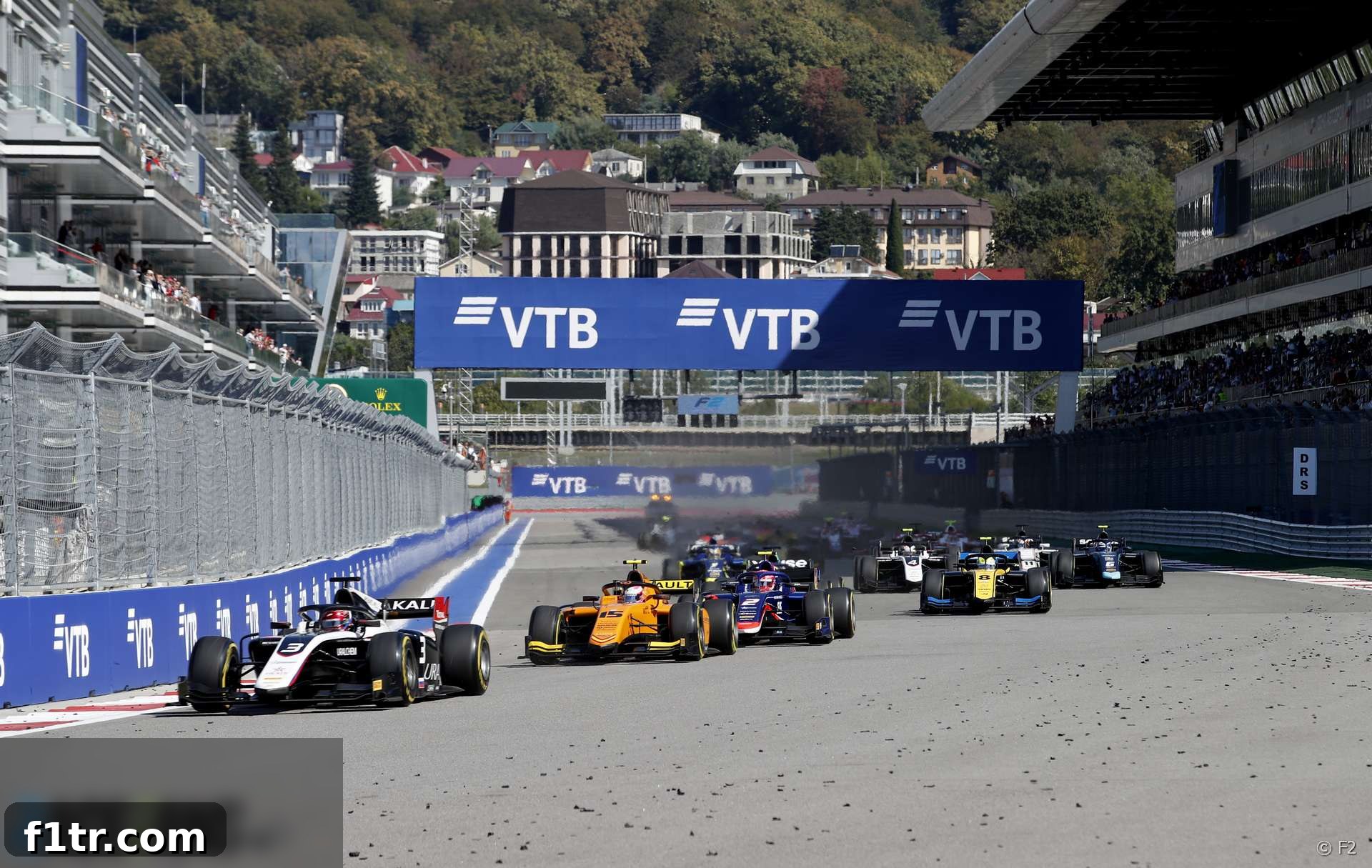
The pivotal moment occurred on the very first lap, at the challenging Turn Two. Both Mazepin and fellow competitor Jack Aitken found themselves running wide after attempting to negotiate the corner. What followed was a chain of events that culminated in a significant crash, drawing immediate concern from spectators and race control alike.
As the cars diverged from the racing line, they entered the designated run-off area. However, the stewards’ investigation meticulously detailed a critical divergence in driver conduct. While Jack Aitken, navigating Car 15, successfully followed the race director’s specified path through the Styrofoam blocks, Mazepin, in Car 3, failed to adhere to this directed route. Instead of safely rejoining the track or mitigating risk, Mazepin effectively “short-cut” the run-off area.
This shortcut proved disastrous. Mazepin’s car collided first with Aitken’s vehicle, which had been attempting to safely manage the run-off. The impact then propelled Mazepin’s car directly into the side of Nobuharu Matsushita’s Car 2, who was positioned on the track, leading to a brutal secondary collision. Matsushita’s car subsequently suffered a heavy and unavoidable impact with the trackside barrier, resulting in significant damage and his immediate retirement from the race. The severity of the crash necessitated a red flag, bringing the race to a halt while medical and recovery teams attended to the scene.
Driver Well-being and Immediate Aftermath
The immediate concern following such a high-speed impact is always driver safety. Both Jack Aitken and Nobuharu Matsushita were understandably shaken and required medical attention. They were both transported to a local hospital for precautionary checks and further assessment. Thankfully, reports confirmed that neither driver sustained any serious injuries, a testament to the robust safety standards embedded within modern motorsport and the protective equipment worn by the competitors. Mazepin himself was unable to attend the stewards’ hearing due to the need for medical evaluation, though details of his specific condition were not elaborated upon beyond his absence from the proceedings.
Stewards’ Investigation: Unanimous Blame and Lack of Due Care
Following the incident, the race stewards launched a comprehensive investigation, a standard procedure for such severe crashes. Their process involved reviewing extensive video footage from multiple angles, analyzing telemetry data, and conducting interviews with the drivers involved where possible. Jack Aitken provided his account of the events to the stewards, offering crucial insight into the perspectives of those directly involved.
After a thorough consideration of all available evidence, the stewards reached a unanimous and unequivocal conclusion: Nikita Mazepin was deemed “wholly at fault for the incident.” Their official statement meticulously outlined the sequence of events and Mazepin’s direct culpability.
The stewards’ findings highlighted several key infractions. Firstly, an earlier incident involving Car 1 (Louis Deletraz, though the original text incorrectly attributes “Car one [Louis Deletraz] arrived at the entrance of turn two at an excessively high rate of speed and unable to negotiate the corner on the track” to Mazepin’s incident, it seems to be an error in the source text or referring to a related but distinct action *before* Mazepin’s direct fault in the Aitken/Matsushita crash. The focus of the stewards’ ultimate verdict is clearly on Mazepin forcing Aitken off and then shortcutting). The core of their verdict, however, rested squarely on Mazepin’s actions:
- Forcing off track: “Car three [Mazepin] then forced car 15 [Aitken] off the track.” This initial maneuver was identified as the precursor to the subsequent chaos.
- Ignoring Race Director’s Notes: Crucially, the stewards noted that “Car three did not follow that same directed path [through the Styrofoam blocks], thereby short cutting the runoff area.” This direct disregard for established safety protocols in runoff areas was a major contributing factor.
- Causing Collision: The combination of these actions “resulting in a collision with first car 15 and then car two [Matsushita], resulting in car two’s retirement and causing a red flag in the race.”
The severity of the incident and Mazepin’s clear responsibility led the stewards to impose what they described as an “unusually large number of grid positions in the penalty and the large number of penalty points.” They explicitly stated their opinion that Mazepin “caused this incident by a total lack of due care for his fellow drivers and caused a bad incident that could have been much worse.” This strong language underscores the stewards’ concern regarding Mazepin’s driving standards and the potential for more severe consequences.
The Weight of the Penalties: Impact on Championship and Driver Record
The penalties handed down to Nikita Mazepin carry significant weight for his burgeoning career in Formula 2. The 15-place grid penalty for the next round in Abu Dhabi is a substantial handicap. In a championship as fiercely competitive as F2, starting so far down the order makes it incredibly difficult to score points, let alone challenge for podium finishes. This effectively writes off his prospects for a strong performance in that particular race, hindering his championship standing.
Beyond the immediate grid drop, the allocation of four penalty points to Mazepin’s super licence is a critical concern. These points are cumulative over a 12-month period, and accumulating too many can lead to an automatic race ban. With these four points, Mazepin now sits on a total of five penalty points. While not immediately threatening a ban (which typically occurs at 12 points), it places him under heightened scrutiny for future incidents. Any further infractions could quickly see him nearing the threshold for a forced absence from racing, a severe blow to any aspiring driver’s career progression.
The stewards’ decision to impose such a stringent penalty reflects the gravity of the incident and their firm stance on driver conduct. It sends a clear message across the F2 paddock that reckless driving and disregard for safety protocols will not be tolerated, particularly when they lead to high-impact collisions and jeopardize the well-being of fellow competitors.
Another Driver Under Scrutiny: Mahaveer Raghunathan’s Penalty Point Tally
In a separate but noteworthy incident from the same event, Mahaveer Raghunathan also found himself on the receiving end of a penalty point. Raghunathan, who had already served a one-event ban earlier in the year due to an accumulation of penalty points, was issued another point for failing to rejoin the track correctly at Turn Two. This latest infringement brings his total penalty points to nine. This places him precariously close to another race ban, being just three points away from the 12-point threshold. His situation highlights the constant pressure and fine margins involved in adhering to race regulations, even for seemingly minor infractions.
Looking Ahead: Implications for Abu Dhabi and Beyond
The repercussions of this incident will undoubtedly resonate throughout the Formula 2 paddock as the championship heads to its final round in Abu Dhabi. For Nikita Mazepin, the focus will shift from challenging for positions to damage limitation and navigating a difficult race weekend from the back of the grid. It also places his future driving conduct firmly under the microscope of race officials.
For Jack Aitken and Nobuharu Matsushita, the priority will be a full recovery and returning to peak performance. Incidents of this nature, while physically taxing, can also have a psychological impact, and their resilience will be tested as they aim to finish the season strongly.
Ultimately, the stewards’ decisive action serves as a powerful reminder of the inherent dangers in motorsport and the unwavering commitment to driver safety. Rules regarding track limits, run-off areas, and fair racing conduct are in place to minimize risk, and any deviation from these principles carries severe consequences. This incident reinforces the message that while competition is fierce, respect for fellow drivers and adherence to safety guidelines are paramount for every competitor on the track.
Formula Two Insights
Explore more in-depth analyses and news from the thrilling world of Formula Two:
- Formula 2 to debut in Miami and Montreal after Iran war cancellations
- Ex-McLaren junior Dunne’s move to Alpine finally confirmed
- Schumacher says his IndyCar feels like ‘an F2 car, just with better tyres’
- The Formula 2 team with an older driver line-up than almost half the F1 grid
- FIA to award more F1 superlicence points to IndyCar drivers from 2026
Browse all Formula 2 articles