In the high-stakes world of Formula 1, every millisecond and every move on track can be the subject of intense scrutiny and endless debate. Few incidents encapsulate this better than the contentious clash between Max Verstappen and Valtteri Bottas during the 2018 Italian Grand Prix. Despite years having passed and countless replays reviewed, the Red Bull Racing driver remains steadfast in his conviction that the five-second penalty he received for that collision was unjust. This unwavering stance highlights a perennial tension in F1: the fine line between aggressive, hard racing and infringements of the rules, often viewed differently by drivers, stewards, and fans alike.
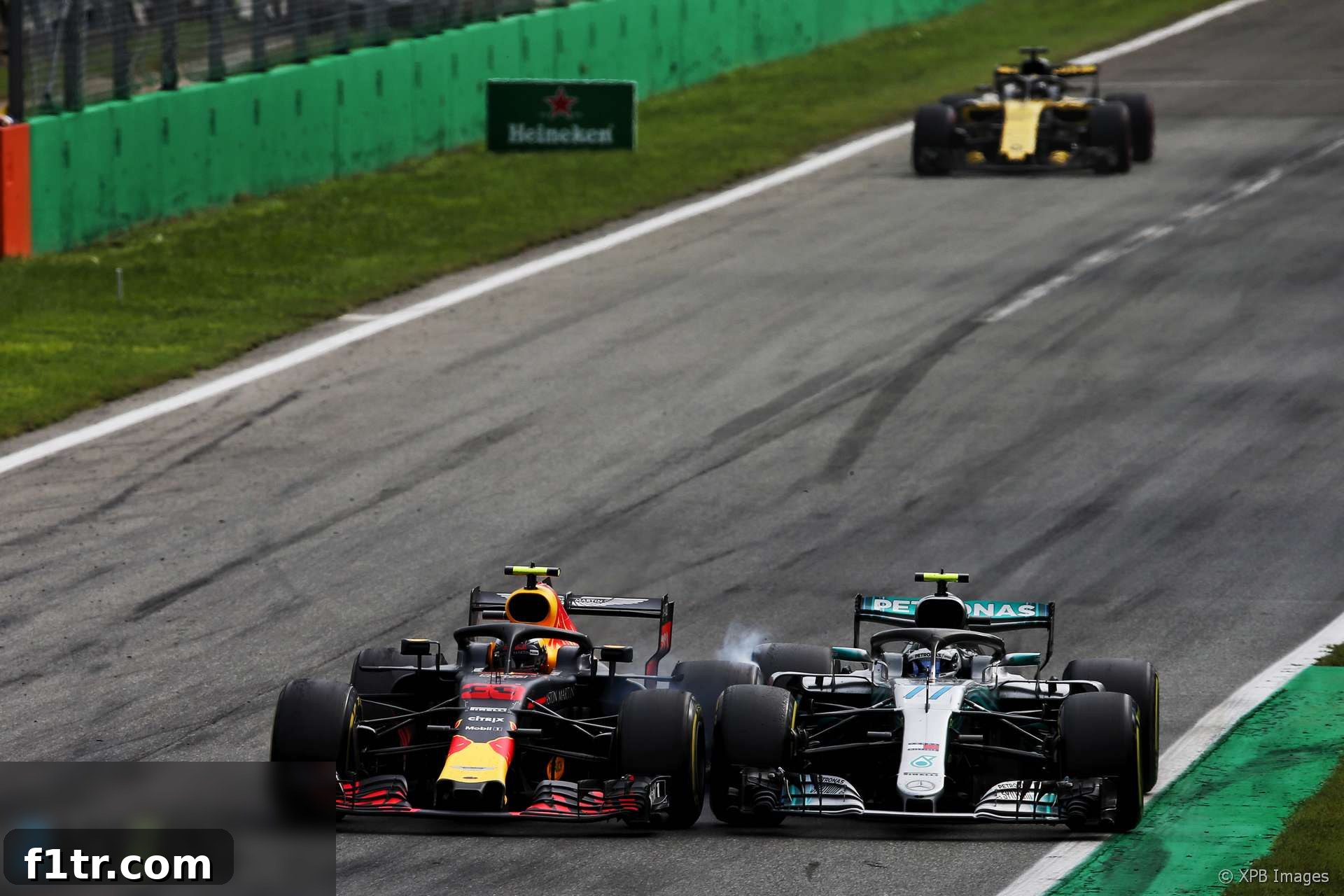
The incident at Monza, a circuit renowned for its high-speed battles and challenging chicanes, occurred on the approach to the Rettifilio chicane. Verstappen, then battling fiercely for track position, tangled with Bottas, a manoeuvre that ultimately drew the attention of the race stewards. The immediate consequence was a five-second time penalty added to his race time, a decision that saw him demoted from a well-earned third place to fifth. At the time, an incensed Verstappen didn’t mince words, famously accusing the stewards of “killing racing” with their call. His post-race comments to his official media partner, ZiggoSport, echoed his initial fury, confirming that even after meticulous review of the footage, his opinion remains unchanged: “I still don’t agree with the decision,” he stated emphatically, reigniting the discussion surrounding the incident.
Advert | Become a Supporter & go ad-free
The Monza Melee: A Driver’s Instinct vs. Regulation
Understanding the heat of the moment is crucial to appreciating Verstappen’s perspective. The Rettifilio chicane, following a long straight, is a prime overtaking spot, demanding precise braking and positioning. As Bottas attempted to make a move, Verstappen was in full defensive mode. “Obviously I’ve seen the footage. I just defended,” he explained, outlining the natural instinct of any competitive racing driver to hold their ground. His aim was to “make the space as small as possible so your turn-in to the corner is not compromised.” This is a common tactic in motor racing, pushing the limits of track space to defend a position without outright blocking.
The collision itself was a result of this intricate dance at astonishing speeds. Verstappen concedes, “We hit each other and maybe I could’ve given him a few millimetres more space, but he was on the white line.” This statement encapsulates the razor-thin margins involved. At 340 kilometres per hour, even a few millimetres can make the difference between a clean pass and contact. The Red Bull driver highlighted the stark contrast between real-time, high-pressure decision-making and the luxury of hindsight. “In hindsight it’s easy to say ‘I should’ve done this or that’, but when you arrive at a corner doing 340kph, it makes for a whole different decision making situation than when reviewing it on the video footage.” This sentiment resonates with many drivers who often feel decisions made in the heat of battle are judged too harshly in the calm of a stewards’ room.
The FIA’s Stance: Interpreting the International Sporting Code
The stewards, however, operate under the strict framework of the International Sporting Code. Their ruling against Verstappen indicated a violation, specifically referencing Appendix L, Chapter IV, Article 2 b). This particular regulation stipulates: “Any driver moving back towards the racing line, having earlier defended his position off-line, should leave at least one car width between his own car and the edge of the track on the approach to the corner.” This rule is designed to prevent dangerous blocking maneuvers and ensure drivers who have committed to an off-line defensive move do not then squeeze their opponent unfairly against the track edge. The intent is to promote fair racing and mitigate risks, particularly at high-speed corners like those at Monza.
The interpretation of “one car width” and “edge of the track” is often where the controversy lies. While a rule might seem clear on paper, its application in the dynamic, fluid environment of an F1 race can be highly subjective. Stewards are tasked with examining telemetry, driver onboard footage, and various camera angles to piece together the events, yet the human element of judgment remains. It’s a challenging role, requiring a deep understanding of racing dynamics, the rules, and a commitment to impartiality, all while under immense public scrutiny.
Inconsistency in Officiating: A Driver’s Recurring Grievance
Verstappen’s criticism extends beyond just this single incident; he points to a broader issue concerning the consistency of stewarding decisions in Formula 1. He believes that the application of rules, even seemingly clear ones, can vary depending on which panel of stewards is officiating a particular race. “It depends on the steward,” he argued. “Some will give a penalty, others won’t. I don’t think it has anything to do with the rules.” This perception of inconsistency is a recurring grievance among drivers and teams throughout F1 history. When similar incidents are judged differently at different races, it can lead to frustration, confusion, and a feeling that justice is not always uniformly applied.
The challenge for the FIA is significant. Each incident, while appearing similar, often possesses unique nuances related to track conditions, speeds, driver intentions, and the precise angles of contact. However, the pursuit of absolute consistency remains a holy grail for the sport, as it is vital for maintaining trust in the officiating process and ensuring a level playing field. Verstappen’s blunt assessment – “We can talk about the incident for ages, but the decision has been made and I won’t lose any sleep over it” – underlines a pragmatic acceptance of the outcome, even if the underlying disagreement persists. Yet, his frustration was evident during the race, captured by his spirited remarks, “I was pretty angry during the race, so no way he was going to get [past] me. At least he knows how the rear of my car looks.” This fiery determination is a hallmark of his driving style, often praised for its aggression, but sometimes criticized when it leads to contact.
Verstappen-Bottas collision: A Visual Retrospective
The Broader Debate: Aggressive Racing vs. Fair Play
The Verstappen-Bottas incident at Monza is more than just a single penalty; it’s a microcosm of the ongoing debate within Formula 1 regarding aggressive racing. On one side, there’s a strong desire from fans and purists to “let them race,” encouraging wheel-to-wheel combat and spectacular overtakes, even if it means occasional contact. This perspective often champions the gladiatorial spirit of the sport, where drivers push boundaries and assert dominance. Drivers like Verstappen embody this philosophy, always looking for the limit and unwilling to yield without a fight.
On the other side are the imperatives of safety and fairness, enforced by regulations like those in the International Sporting Code. Excessive aggression can lead to dangerous situations, compromising driver safety and damaging the integrity of the competition. Stewards are caught in the middle, trying to balance these competing ideals. The outcome of such decisions influences how drivers race, how teams strategize, and how fans perceive the sport’s competitive spirit. When penalties are seen as too harsh, they are accused of “killing racing.” When they are too lenient, they risk enabling reckless behavior. The Monza incident remains a touchstone for this enduring discussion, highlighting the delicate balance required to maintain Formula 1 as both a thrilling spectacle and a fair, safe competition.
Advert | Become a RaceFans supporter andgo ad-free
Beyond Monza: Reflections on the 2018 F1 Season and Legacy
The 2018 F1 season was packed with memorable moments and fierce rivalries, and the Max Verstappen-Valtteri Bottas incident at Monza remains a significant highlight of the year. It served as a potent reminder of the intense competition at the pinnacle of motorsport and the critical role played by race stewards in upholding the sport’s regulations. While Verstappen has moved on from the immediate sting of the penalty, his consistent disagreement reflects a fundamental tension in Formula 1: the ongoing quest for the perfect balance between exhilarating, no-holds-barred racing and the necessary enforcement of rules designed to ensure fairness and safety. As F1 continues to evolve, these debates will undoubtedly persist, shaping the future of racing and the legacies of its most tenacious competitors.
- F1 feared “death knell” for Drive to Survive after Ferrari and Mercedes snub
- McLaren staff told us we were “totally crazy” to take Honda engines in 2018 – Tost
- ‘It doesn’t matter if we start last’: How Red Bull’s junior team aided Honda’s leap forward
- Honda’s jet division helped F1 engineers solve power unit problem
- McLaren Racing losses rise after Honda split
Browse all 2018 F1 season articles