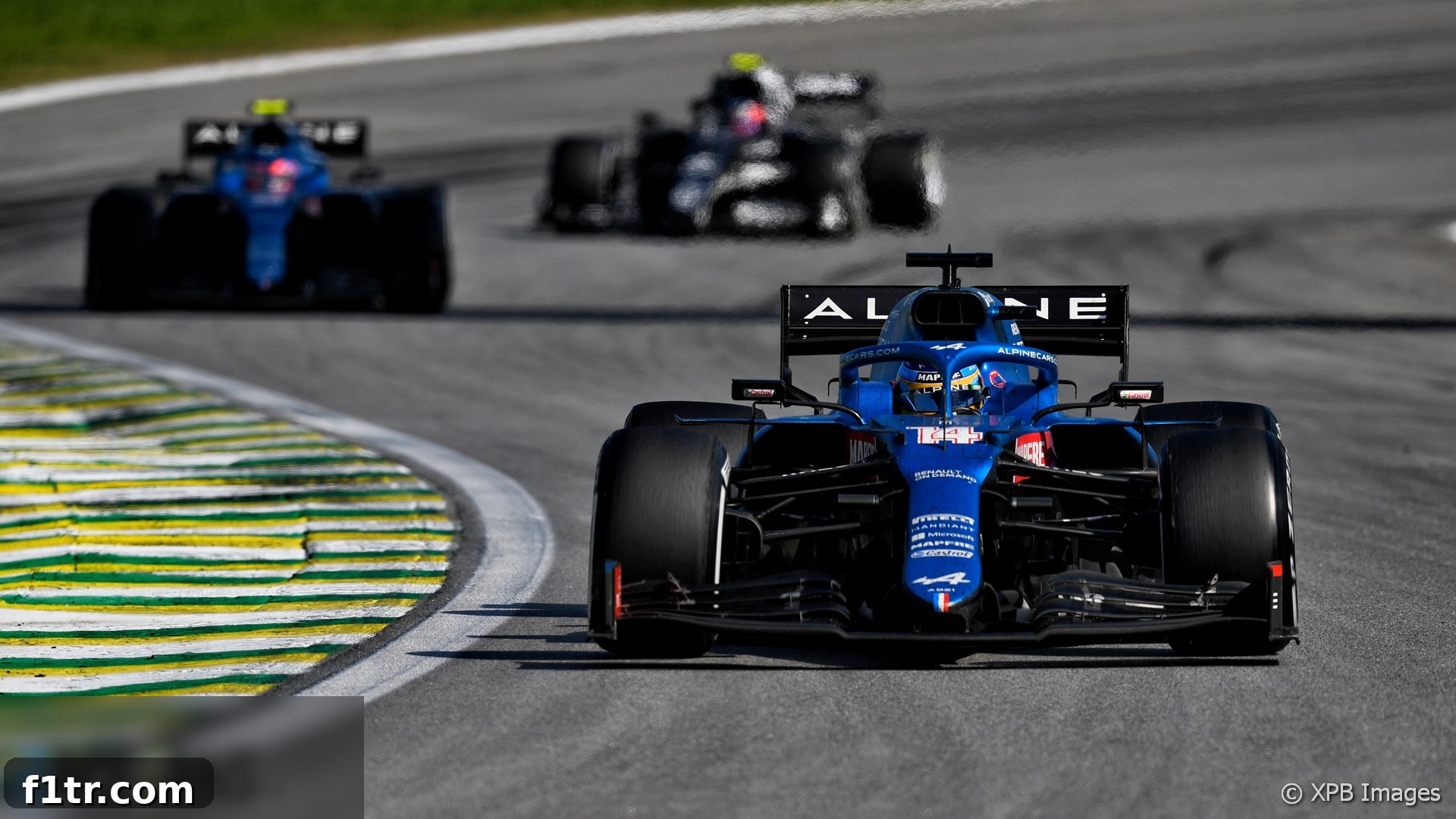
While the electrifying duel among the title contenders captured global attention at the iconic Interlagos circuit last weekend, a remarkably intense and strategically complex three-car battle unfolded just behind them. This intricate contest, often only glimpsed on television screens, was pivotal in the Constructors’ Championship.
At the heart of this high-stakes engagement were the two Alpine drivers, Fernando Alonso and Esteban Ocon, pitted against AlphaTauri’s formidable Pierre Gasly. Entering the Grand Prix, both Alpine and AlphaTauri were deadlocked on points in the Constructors’ standings, with AlphaTauri appearing to hold a slight pace advantage. Adding another layer of uncertainty, neither team had extensively tested the hard compound tyres, which were mandated for the race start, making their race strategies a plunge into the unknown.
Instead of relying on perceived strengths or weaknesses of the tyre compound, Alpine made a decisive strategic choice: to leverage both their cars in a concerted effort solely focused on containing Gasly. This meant a strict mandate for Alonso and Ocon – no internal battling, only a unified front against their direct championship rival. The team’s objective was clear: outscore AlphaTauri, or at the very least, prevent them from gaining a crucial lead in the standings.
Alpine’s carefully crafted deployment strategy began to show its true colors even before the main race. Following the sprint qualifying event, Gasly, who had been impressively quick on Friday – trailing only the Mercedes and Red Bulls – had slipped to eighth place. Ocon followed in ninth, with Alonso further back in twelfth. This scenario provided Alpine with an opportunity they intended to seize.
Alpine’s Sporting Director, Alan Permane, articulated the team’s confidence and strategic outlook after the sprint. “We’re tied for fifth [with AlphaTauri], and they had the edge on us yesterday, but today I think we have the edge on them,” Permane stated, highlighting the shift in momentum. “Pierre went backwards, we were being held up, Esteban felt with another couple of laps he’d have been able to get past him.” This assessment underscored their belief in their cars’ race pace and their drivers’ abilities to execute the plan over a full Grand Prix distance. “He’s got a lot more laps tomorrow to be able to do that. Both drivers said the car felt very good, very strong in the race. And we had a pretty decent showing in FP2. That wasn’t all show, it was homework for the sprint race. We’re feeling good for tomorrow,” Permane concluded, emphasizing the thorough preparation and the positive feedback from his drivers. Their mission was not merely to score points, but to strategically manage their position relative to their direct rival.
Permane unequivocally confirmed Alpine’s overarching goal: “needed to score more points” than AlphaTauri on Sunday. However, he also acknowledged a more nuanced acceptable outcome, admitting he would “take a scenario where Gasly beat them but the combined scores of his drivers meant AlphaTauri wouldn’t move ahead in the standings.” This pragmatic approach highlighted the strategic flexibility Alpine was prepared to employ to secure their championship position.
Alpine’s intricate strategy truly began to unfold on lap 30 of the 71-lap race. Esteban Ocon, running in a respectable sixth place, capitalized on a Virtual Safety Car (VSC) period to make his pit stop. The team had initially planned a highly efficient double-stack for both cars, aiming to bring Alonso in immediately after Ocon. However, circumstances dictated otherwise, and Fernando Alonso did not follow his teammate into the pits. Instead, Alonso pitted four laps later, under green flag conditions, a move that momentarily reshuffled their track positions but was crucial for their long-term plan.
As a result of their staggered pit stops, both Alpine drivers temporarily dropped out of the points-scoring positions. This initial setback was a calculated risk, positioning them to threaten Gasly if they could successfully commit to a one-stop strategy. Ocon’s race engineer delivered the crucial message, laying out the immediate objective: “The goal is to keep Gasly in our pit window. If he stops he will come out behind us. His tyres are five laps older than yours.” This communication confirmed Alpine’s singular focus on controlling Gasly’s race and underscored the importance of tyre management and track position.
At this critical juncture, Ocon found himself with a few cars between him and Alonso, who faced the immediate challenge of clearing both Sebastian Vettel and Gasly’s teammate, Yuki Tsunoda. As Vettel struggled to find a way past a determinedly defensive Tsunoda, Alonso expertly exploited this delay. Demonstrating his renowned racecraft, the Spaniard seized the opportunity, swiftly dispatching both drivers in quick succession. This decisive move significantly improved Alpine’s strategic outlook.
The incident drew a pointed remark from Vettel over his team radio, reflecting on his former team’s actions. “Not very clever from AlphaTauri,” Vettel commented, acknowledging the broader championship context. “They’re fighting Alpine in the championship.” This observation underscored the heightened tension and the intertwined nature of the battles unfolding on track.
Alonso’s rapid progress was a vital shot in the arm for Alpine’s strategic plan. Ocon was subsequently instructed to allow Alonso into his slipstream, a tactic designed to pull the two-time world champion into the optimal pit stop window relative to Gasly. This maneuver proved highly effective, as the gap between the Alpine drivers quickly began to diminish, setting the stage for the next phase of their coordinated attack. Another crucial message was then relayed to Ocon, signaling a direct team order:
| Peckett | I want you to swap places with Fernando please. Swap places with Fernando behind. |
| Ocon | Copy that. How far behind is he? |
| Peckett | 1.4 seconds. |
With just 20 laps remaining in the race, Pierre Gasly made his second pit stop. This strategic choice dropped him behind both Alpine cars, but with the distinct advantage of fresh hard tyres. The Alpines’ mission, however, was far from over; they now faced the formidable task of holding off a rapidly approaching Gasly with superior grip.
The team radio crackled again with instructions for Ocon: “Swap places with Fernando when you can,” he was told, followed by the urgent update, “Gasly is five seconds behind, on a new hard tyre.” Understanding the gravity of the situation, Ocon reacted immediately, slowing significantly on the straight leading to turn four to allow Alonso to sweep past. It was now Alonso’s turn to provide a crucial slipstream to Ocon, but the challenge of navigating dirty air on older tyres proved difficult. Ocon almost immediately began to slip out of DRS range, complicating their defensive efforts.
Initially, Ocon sought confirmation that the positions would be reverted at the end of the race, a reassurance he received. However, the radio channel reopened just one sector later as Alonso started to pull away, highlighting the difficulty of maintaining the perfect tow:
| Peckett | Gasly is now 3.5s behind. I know it’s tough. Try to stick with him. |
The one-second barrier separating Ocon from Gasly was decisively breached on lap 55, just four laps after Gasly had made his second stop. Despite Gasly’s relentless pace, a conveniently timed lapped Haas car actually aided Ocon, momentarily taking him out of DRS range of his pursuer at a critical section of the circuit. This unexpected turn of events also brought Ocon back into the slipstream of his teammate, Fernando Alonso. Gasly, undeterred, attempted to pass Ocon on the inside of turn one and the outside of turn four on lap 58, but found himself off the racing line, frustrated by Alpine’s steadfast defense.
Gasly’s passing attempts were further thwarted by Fernando Alonso, who maintained a vigilant watch in his mirrors. Alonso masterfully provided Ocon with precisely timed slipstreams, allowing his teammate to briefly pull away each time Gasly mounted a challenge. This coordinated defensive effort showcased Alpine’s commitment to their strategy, turning the race into a prolonged game of cat and mouse.
This intense defensive battle continued until lap 60. The lap began with words of praise from the Alpine pit wall directed at Ocon for his tenacious defense. Moments later, however, Ocon ultimately conceded eighth place as Gasly executed a decisive lunge down the inside of turn one. Yet, Alonso was still actively engaged in the strategic game. He provided Ocon with such a powerful slipstream on the run to turn four that only an exceptionally late braking maneuver from Gasly allowed him to narrowly maintain his hard-won position.
Pierre Gasly finally cleared Fernando Alonso a lap later, on lap 61. At last free from the formidable defensive tactics of the A521s, Gasly unleashed the full pace of his AlphaTauri. He rapidly pulled away, extending his lead to a significant 16 seconds over the remaining 10 laps, demonstrating the true potential of his car when not embroiled in a close-quarters battle.
Despite the intense fight and the relentless pressure, Alpine remained true to their pre-race promise. Ocon consistently lost time due to cooperating with blue flags for faster cars, yet the team honored their commitment to return his position. In a remarkable display of team loyalty and strategic execution, Fernando Alonso deliberately gave up nearly nine seconds through the final sector of the very last lap, allowing his teammate Esteban Ocon to move back through ahead of him.
The final classification saw Pierre Gasly finish a strong seventh, while Esteban Ocon crossed the line in eighth place, followed closely by Fernando Alonso in ninth. These results meant that despite Gasly finishing ahead of both Alpines, the two teams remained perfectly level on points in the Constructors’ Championship. Alpine, crucially, held onto their fifth-place standing by virtue of their earlier victory at the Hungarian Grand Prix, a testament to the effectiveness of their strategic sacrifice at Interlagos.
Reflecting on the race, Esteban Ocon enthused, “It’s been a mega team effort today. Everything that we’ve done in this race, the big fights all the way until the end.” He further emphasized the depth of their strategic execution: “We pushed the team tactics to the ultimate limit, really. Unfortunately, it was just not enough to keep Gasly behind. But very positive race for both of us, and we’ve shown how far we want to keep that fifth place in the constructors alive with that race today.” This strategic masterclass at Interlagos, though ultimately unable to keep Gasly completely at bay, perfectly exemplified Alpine’s determination and ability to execute complex team orders for the greater championship goal, proving the immense value of driver cooperation in the cutthroat world of Formula 1.
2021 Sao Paulo Grand Prix
- Red Bull and Mercedes summoned to FIA hearing on review of Sao Paulo incident
- McLaren must “get back to scoring the results that are on the table” – Seidl
- Hamilton makes his second-biggest climb to victory from 10th on the grid
- F1 releases missing video footage from Verstappen’s car of Hamilton incident
- How Alonso and Ocon “pushed team tactics to the ultimate limit” to delay Gasly
Browse all 2021 Sao Paulo Grand Prix articles