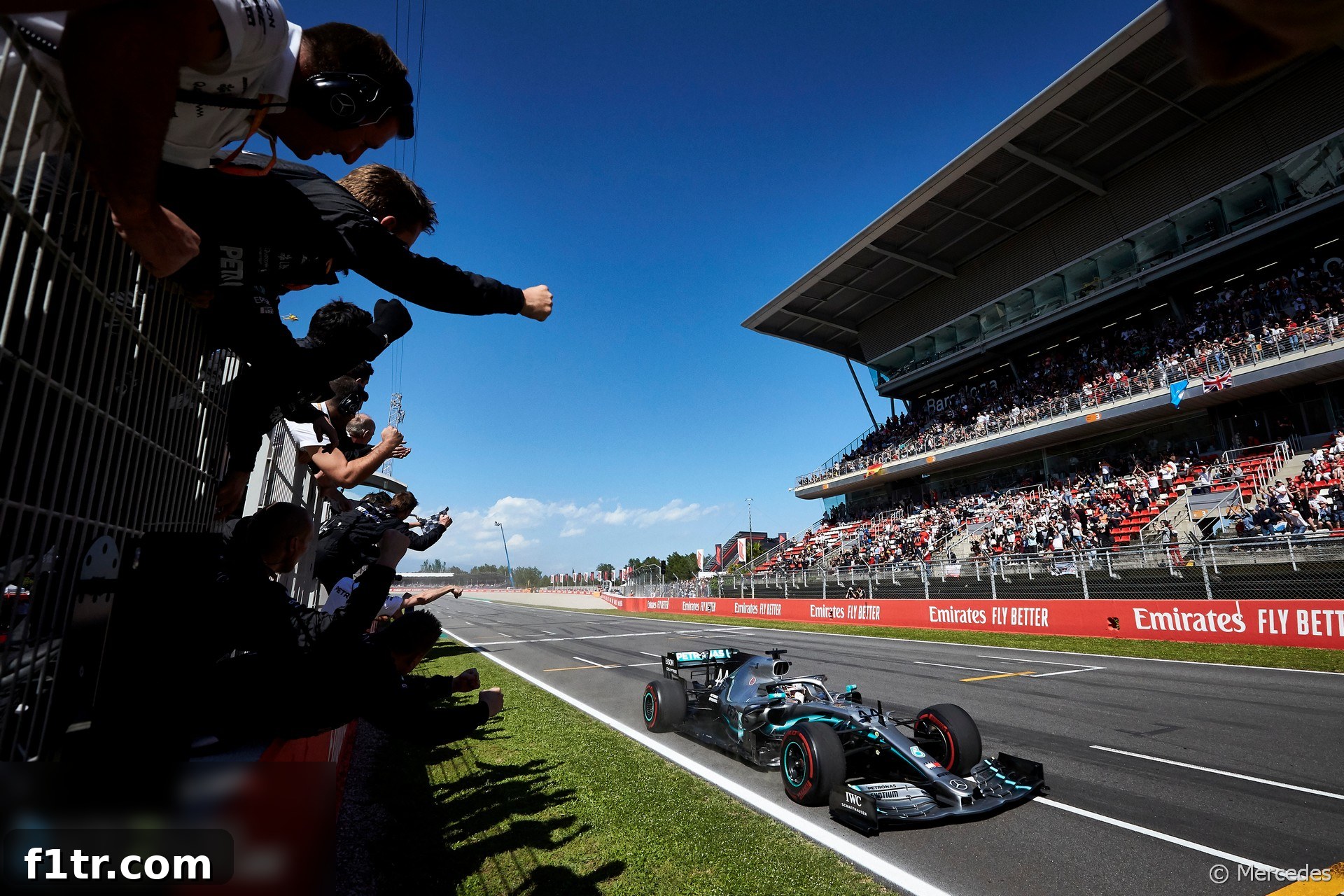
The Mercedes-AMG Petronas F1 Team has sent shockwaves through the paddock with an astonishing start to the 2019 Formula 1 season, establishing a formidable lead over their rivals after the initial five races. Their performance has been nothing short of spectacular, achieving five consecutive one-two finishes – a feat unprecedented in the sport’s history to begin a season. This remarkable consistency, coupled with two fastest laps out of a possible five, has propelled them to an almost perfect score of 217 points out of a maximum 220, showcasing an unparalleled level of dominance in the early stages of the championship.
Advert | Become a Supporter & go ad-free
Such a commanding opening has naturally led to widespread speculation: could Mercedes achieve the unthinkable and complete a clean sweep of the entire 2019 F1 season? This ambition, while thrilling, is a monumental challenge that has never been accomplished in the annals of Formula 1. The closest any team has come was in 1988, when the legendary McLaren team, powered by Honda and driven by icons Ayrton Senna and Alain Prost, secured 15 victories from a possible 16 races. That season remains the benchmark for single-season dominance, a testament to the McLaren MP4/4’s superiority and the extraordinary talent of its drivers.
However, the landscape of Formula 1 has evolved significantly since 1988. The prospect of Mercedes replicating, or even surpassing, McLaren’s record by winning all 21 races this year presents a much tougher proposition. The competitive field in 2019 is considerably tighter than what McLaren faced three decades ago. In 1988, McLaren’s engineering prowess and engine package were so superior that they often qualified more than three seconds ahead of their closest rivals at various rounds, an almost unimaginable margin in modern F1. Today, the gaps between the top teams, particularly Mercedes, Ferrari, and Red Bull, are measured in tenths, making every race a fiercely contested battle where small margins can dictate victory.
Despite their undeniable success, Mercedes has always adopted a cautious and humble approach, especially when managing expectations. It comes as no surprise, then, that team principal Toto Wolff was quick to temper enthusiasm regarding the possibility of his team remaining undefeated until the season-ending Abu Dhabi Grand Prix on December 1st. Wolff’s pragmatic stance is a hallmark of Mercedes’ culture, ensuring the team remains focused and avoids complacency, even in times of unparalleled success.
When pressed on whether he believed his team possessed the capability to win every single race in 2019, Wolff offered a straightforward, measured response: “No.” He elaborated, emphasizing the foundational principles that have driven Mercedes’ sustained success: “First of all, I think you need to stay humble. Both feet on the ground. We’ve had five fantastic performances now with five one-twos but we don’t take it for granted. That’s really the mindset that we are having.” This philosophy underscores the team’s understanding that success in Formula 1 is fleeting and requires constant vigilance, innovation, and respect for the competition. It’s a message designed to keep every member of the team motivated and acutely aware of the challenges that still lie ahead.
Advert | Become a RaceFans supporter andgo ad-free
Looking ahead to the immediate future, Mercedes’ superior performance in slow corners at the Circuit de Catalunya hinted at their potential strength in the upcoming Monaco Grand Prix. The unique demands of the iconic street circuit, with its tight hairpins and unforgiving barriers, often reward cars with exceptional mechanical grip and nimble handling. However, Wolff was quick to point out Mercedes’ recent struggles at Monaco, highlighting their less-than-stellar record on the principality’s streets in previous seasons. He candidly admitted that Monaco would represent a “tremendous challenge” for the team, indicating that their recent form may not translate directly to success on such a specialized track.
Wolff reflected on past performances, stating, “We’ve not performed well in Monaco these last years. That was a track you remember how strong Ricciardo was last year in the Red Bull. I think we need to take one step at a time.” His reference to Daniel Ricciardo’s dominant victory for Red Bull in 2018 serves as a stark reminder that Monaco often throws up unexpected results and can play to the strengths of different car concepts, particularly those excelling in high-downforce, low-speed conditions—a traditional hallmark of Red Bull’s chassis design. This acknowledgment reinforces Mercedes’ commitment to methodical progress and avoiding any premature declarations of invincibility.
Adding to the concern for their competitors, Mercedes exhibited their biggest one-lap performance advantage since 2016 at the Spanish Grand Prix. This statistic, while impressive, further solidifies their current technical supremacy. However, Ferrari and Red Bull, two of Formula 1’s most storied and resilient teams, are far from ready to concede the 2019 championship, let alone accept the possibility of a Mercedes clean sweep. Their fighting spirit remains undimmed, driven by a deep-seated desire to challenge for victories and disrupt Mercedes’ perfect run. The competitive ethos of Formula 1 dictates that no team will simply roll over, especially with so many races remaining on the calendar.
Ferrari team principal Mattia Binotto, despite his team’s early-season struggles, articulated a clear message of defiance and determination. “We never give up,” he asserted, reflecting the proud heritage and relentless pursuit of excellence that defines the Scuderia. Binotto emphasized their immediate objective: “Our objective, the ultimate objective, is to do better than in Barcelona.” This highlights the short-term, race-by-race mentality essential for overcoming deficits in F1. He also pointed out the variability inherent in the F1 calendar: “Each circuit is different. Monaco will be a different circuit. I think our car’s got some strengths, certainly weaknesses, but as well some strengths.” This measured assessment indicates Ferrari’s belief in their car’s potential on different track layouts, suggesting that their package might be better suited to upcoming races than it was in Spain.
Regarding the audacious suggestion that Mercedes could emerge victorious in every race of the season, Binotto offered a pragmatic and cautious perspective, stating: “I think it’s certainly too early for such an assumption.” This sentiment reflects the collective wisdom within Formula 1, acknowledging the myriad variables—driver errors, mechanical failures, strategic missteps, safety car periods, and adverse weather conditions—that can dramatically alter the outcome of any given race, even for the most dominant teams.
Red Bull team principal Christian Horner, a man well-acquainted with periods of sustained dominance, particularly during Sebastian Vettel’s championship-winning years in 2011 and 2013, also cast doubt on Mercedes achieving a clean sweep. Horner’s experience grants him a unique insight into the pressures and difficulties of maintaining a flawless record over an entire season. He understands that even with the best car and drivers, perfection is an incredibly elusive target in such a demanding sport.
When asked about the likelihood of Mercedes winning all 21 races, Horner’s response was succinct and skeptical: “I doubt it.” He elaborated on the immense scale of such an achievement: “21 races, to achieve 21 victories, you never say never but it’d be a hell of an achievement.” His comments underscore the sheer logistical and competitive difficulty of navigating a long F1 season without a single misstep. History teaches us that even the most dominant cars encounter challenges, be it through reliability issues, rival teams finding unexpected performance, or simply the unpredictable nature of racing itself.
While Mercedes’ five consecutive one-two finishes paint a picture of overwhelming superiority, this impressive statistic might, to some extent, flatter their overall dominance. It suggests a chasm between them and the rest of the field that, while certainly significant, perhaps isn’t as absolute as the results imply. While Mercedes undeniably overwhelmed the opposition with sheer pace and flawless execution in races like Australia and Spain, there were crucial instances where Ferrari, in particular, had clear opportunities to challenge and even defeat them. In Bahrain, Charles Leclerc was poised for a maiden victory before an engine issue intervened, while in Baku, Leclerc again demonstrated strong pace before a costly driver error ended his charge from pole position. These missed opportunities highlight that Ferrari possesses a car with considerable potential, even if their execution has been marred by a combination of team strategy missteps and individual driver errors. This nuance suggests that Mercedes’ perfect start has also benefited from their rivals’ misfortunes and unforced errors, rather than purely overwhelming pace in every scenario.
Ultimately, the question of whether Mercedes will win all 21 races in the 2019 season is one of the most compelling narratives in modern Formula 1. On paper, they certainly possess the exceptional team infrastructure, the formidable car package, and the supremely talented driver lineup required to achieve such a historic feat. However, the completion of a clean sweep is not solely dependent on Mercedes’ inherent capabilities. It is equally, if not more, a question of whether their formidable rivals, Ferrari and Red Bull, will allow them to do it. The relentless pursuit of performance, the pressure of a championship battle, the unpredictable nature of motorsport, and the sheer grit of the competing teams all stand as significant hurdles. As the season progresses, every race will be a testament to Mercedes’ resilience and an opportunity for their rivals to prove that even the most dominant force in Formula 1 can be challenged and defeated.
Advert | Become a RaceFans supporter andgo ad-free
2019 F1 Season Insights and Updates
- Crying in the Melbourne car park at 2019 grand prix was my career low – Ocon
- McLaren Racing reports reduced £71 million loss in 2019
- Kvyat: Hockenheim podium last year was “my biggest achievement” so far
- How the FIA’s new encrypted fuel flow meter targets Ferrari’s suspected ‘aliasing’ trick
- “He smashed my office door”: 23 must-see moments from ‘Drive to Survive’ season two
Browse all 2019 F1 season articles