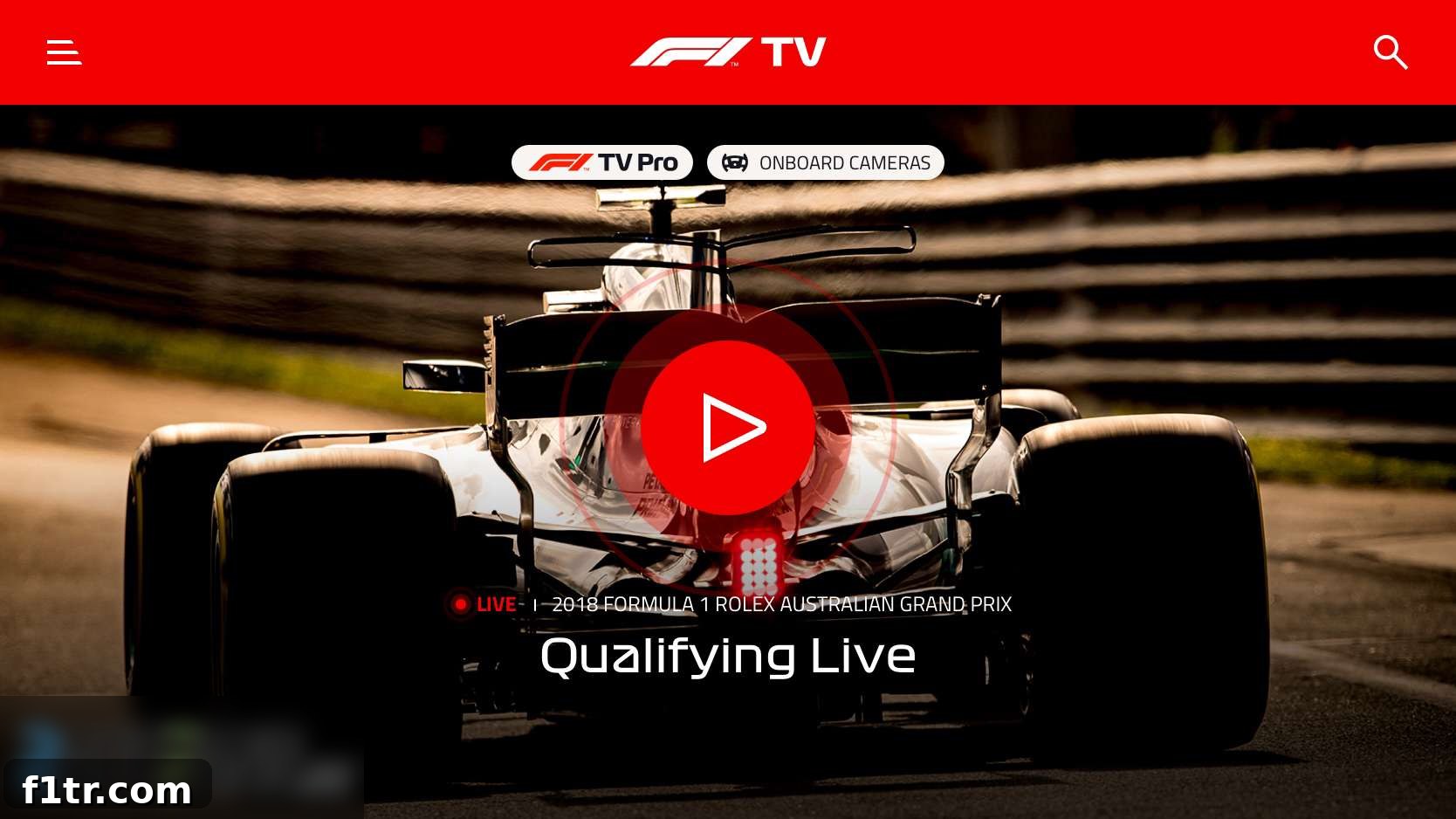
In a landmark move that promised to redefine how fans experience Formula 1, the launch of F1 TV marked a significant shift in the sport’s digital strategy. “This is the closest I’ll ever get to feeling like a driver, I suspect,” quipped Formula One’s Director of Digital, Frank Arthofer, during the official announcement to media, including RaceFans. This innovative streaming service, meticulously crafted for the modern F1 enthusiast, was designed to immerse viewers deeper into the world of motorsport than ever before, arriving just in time for the exhilarating start of the 2018 F1 season.
The introduction of F1 TV represented Formula One’s pioneering direct-to-consumer live video service, poised to revolutionize access to the pinnacle of motor racing. This ambitious undertaking was presented to the media with meticulous detail, and Arthofer addressed a myriad of questions, shedding light on the vision behind this groundbreaking platform. The service was structured around two distinct packages, each tailored to cater to different segments of the expansive global fanbase, aiming to deliver unparalleled access and a truly customizable viewing experience.
At its core, F1 TV offers an unprecedented level of engagement. The premier offering, **F1 TV Pro**, stands as the marquee premium product. Launched initially in approximately 40 countries, F1 TV Pro shattered traditional barriers by making live Formula 1 races available without the prerequisite of a cable television subscription or free-to-air broadcasts. This represented a pivotal moment for F1 fans globally, granting them direct access to the action with unprecedented flexibility. The depth of content within F1 TV Pro is truly groundbreaking, featuring a staggering 24 live feeds simultaneously streaming from a single event.
This extensive suite of feeds includes the universally recognized world feed, presented in four key languages: English, French, German, and Spanish. Beyond this, a remarkable 20 onboard cameras offer a driver’s-eye view, placing fans directly into the cockpit with their favorite racers for the entirety of a Grand Prix weekend. Furthermore, three additional feeds, one dedicated to a comprehensive data channel and two more under active development, promise an even richer analytical and experiential layer. From a sports broadcasting perspective, offering 24 live, simultaneous feeds from a single event is a pioneering achievement, setting a new benchmark for immersive sports coverage and placing F1 TV Pro at the forefront of digital sports entertainment.
Complementing the premium offering is **F1 TV Access**, a lower-tier service designed for broader, near-global availability. While not featuring live race broadcasts, F1 TV Access provides an invaluable resource for fans, offering extensive race replays, a rich archive of historical content, and access to existing F1 Access products such as the detailed data channel and live radio streaming. This package caters to enthusiasts who desire to relive the excitement, delve into the sport’s storied past, or stay connected with live updates and analysis without the full live race experience, serving as an accessible entry point to the F1 digital ecosystem.
In terms of pricing, F1 TV Pro is positioned competitively, available for an estimated $8-12 per month or a yearly subscription of approximately $100, with prices converted into relevant local currencies. The F1 TV Access package offers an even more affordable option at $2-3 per month, or around $20 annually. The service underwent rigorous beta testing, with an ambitious target launch date of March 22nd for the Australian Grand Prix, signaling a meticulous approach to ensuring a stable and high-quality user experience from day one.
The strategic impetus behind F1 TV is multi-faceted. Firstly and foremost, it centers on enhancing the fan experience, delivering Formula One content in a manner that is more engaging and accessible than ever before. Secondly, the product strategically targets two core demographics. The first group comprises Formula One fans who reside in markets where F1 is typically a pay-TV offering but who do not subscribe to traditional cable services. For these “cord-cutters,” F1 TV Pro offers a direct, unbundled pathway to their favorite sport. The second, and arguably more passionate, demographic is the “super-hardcore” fan.
With an estimated 500 million Formula One fans globally – a significant 5% of the world’s population – even a conservative estimate of 1% representing these super-avid enthusiasts translates into a substantial addressable audience of 5 million potential subscribers. These are fans who are likely willing to pay an incremental fee for what is unequivocally positioned as the most comprehensive and immersive way to watch Formula One available in the market. F1 TV is, therefore, not just a service; it’s a dedicated platform for the sport’s most devoted followers, offering them an unparalleled depth of content and control over their viewing experience.
Addressing concerns regarding the reaction of existing broadcast partners who have invested significantly in F1 rights, Arthofer emphasized transparency and collaboration. In markets where F1 has carved out direct-to-consumer rights, this has been done with full disclosure and within the framework of existing contract agreements, ensuring no surprises for partners. This approach acknowledges the evolving media landscape, where having both linear TV and digital distribution partners is becoming increasingly common. For markets where direct rights have not been carved out, such as the UK, Formula 1 expressed openness to collaborating with broadcasters to explore pathways for up-selling F1 TV to their existing customer bases, fostering a symbiotic relationship rather than direct competition.
Content security and geo-blocking are paramount considerations for F1 TV, especially given the varying territorial rights. While specific technology partners remain unnamed, with the exception of Tata Communications, Formula 1 is committed to deploying best-in-class content security and protection measures. This reflects the sport’s consistently conservative stance on intellectual property protection. Frank Arthofer explicitly stated, “We’ve been aggressive in protecting our IP and will continue to do so on this service,” underscoring the determination to prevent unauthorized access via methods like VPNs and ensure that content is viewed only within its licensed territories, thereby safeguarding the interests of broadcast partners and the sport’s revenue streams.
The ambitious target of 5 million potential subscribers was framed as a global estimation of the “super-avid” fan base. Arthofer clarified that converting all these individuals in the initial year or two would be a significant marketing and product challenge, yet the optimism for the long-term opportunity size remains high. The immediate focus is not on delivering specific customer numbers but on perfecting the product. “The biggest pressure on us is not a fiscal one at this stage,” Arthofer explained, “It’s about delivering a great product and a stable technical experience for fans.” This philosophy dictates a measured rollout, starting with desktop-only availability for the first race in Australia to ensure optimal stability, followed by phased launches for mobile apps and connected TV devices.
This cautious, quality-first approach is crucial, especially when pioneering a service with 24 simultaneous streams from the track. The goal is to establish a solid, reliable customer experience upon which future enhancements can be built, emphasizing a belief in iterative development and continuous improvement. F1 TV is not designed to cannibalize existing free-to-air subscriber bases but rather to enhance overall engagement with the sport. Drawing parallels with social media content, Arthofer noted how live clips during races can actually drive TV audiences rather than detract from them. The service offers fans a chance to engage more deeply, creating a win-win scenario for all stakeholders: sponsors, broadcast partners, and the Formula 1 teams themselves.
The concept of “competition” with rights-holders was also nuanced. While F1.com provides content, it’s not seen as directly competing with sites like SkySports.com but rather as building an indispensable platform for fans’ overall journey with the sport. A comprehensive list of the initial 40 countries for F1 TV Pro includes almost all of Latin America (excluding Brazil), the US, Germany, France, Turkey, Belgium, Hungary, and Poland. Some smaller markets were intentionally excluded where the commercial viability for direct consumer sales was deemed insufficient, such as Mexico. Scandinavian countries were initially absent due to existing broadcast deal timings, with long-term plans for market entry to evolve over several years.
For commentary, F1 TV will largely integrate with its broadcast partners’ existing feeds. The English language feed will utilize Sky’s UK commentary, while French broadcasts are provisionally set to use Canal Plus. This approach ensures high-quality, familiar commentary for regional audiences. Regarding data costs for customers, it’s anticipated that the vast majority of live sports viewing will occur via home broadband connections rather than mobile data, making data allowances less of a primary concern for most users. Furthermore, Formula 1 is open to future collaborations with mobile partners to offer cost-effective product propositions tailored for mobile streaming, recognizing the growing trend of on-the-go content consumption.
The intention behind F1 TV is emphatically not to replace the traditional broadcaster model that generates significant income for the sport. With an average race attracting around 100 million viewers globally, and F1 TV targeting a niche of 5 million “superfan” subscribers, there is clearly a complementary role for both products. Traditional free-to-air and cable TV services continue to offer a great and cost-effective value proposition for many fans. F1 TV is about delivering an unparalleled service for the most hardcore enthusiasts, enhancing their experience rather than supplanting established viewing methods. Partnership agreements with broadcasters like Sky, which grant F1 the rights to use their commentary, are confidential but underscore a collaborative relationship.
Addressing the concern about Formula 1’s audience shrinkage since 2008, Arthofer expressed confidence that digital initiatives, including F1 TV, serve as powerful levers to attract new fans and deepen engagement with existing ones. Social media clips, for instance, have proven to drive viewership. The overarching strategy involves significant investment in social media channels, which have seen 70% year-over-year growth, alongside the launch of F1 TV and a relaunched F1.com and app in 2018. Success will be primarily measured by growth in fanbase and deeper fan engagement. Crucially, F1 TV will launch without any advertising, ensuring an uninterrupted, premium viewing experience for its subscribers, with any future monetization strategies beyond subscriptions remaining open.
The historical content accessible through F1 TV is a standout feature. Despite the service being developed in a remarkably short six months (compared to a typical 18), the team, in partnership with Tata, aimed to make a handful of full races and highlights available at launch, spanning back to 1981—an impressive 36 years of motorsport history. Much of this archival footage, previously stored in production studios at Biggin Hill, has never been widely seen or released. This treasure trove of content is expected to “surprise and delight” fans, offering a unique journey through Formula 1’s rich heritage.
The US market, with its new broadcast partner, is viewed as an important “test bed” for how the marriage between OTT (Over-The-Top) streaming services and traditional broadcast partners can successfully coexist. Drawing parallels to the NBA League Pass product, which offers live games in almost every country, F1 TV is a pioneering venture for Formula 1 but not for the global sports landscape. The US offers a valuable learning environment for optimizing this hybrid model. Plans for Germany, as confirmed by Arthofer to an RTL journalist, involve continuing to work with existing broadcast partners, utilizing their commentary and presentation.
Looking ahead, F1 TV’s roadmap includes crucial feature enhancements within the first few months post-launch. This encompasses the introduction of mobile and TV apps, alongside essential casting compatibility features like Chromecast and AirPlay. These additions are estimated to be rolled out within approximately two months, reflecting a commitment to broad device accessibility. The motivation to address VPN access remains “very” high, driven by the critical need to protect broadcast partners and uphold regional licensing agreements, even if it means users in territories without rights cannot access the service by circumventing geo-restrictions.
The “end game” for F1 TV is unequivocally centered on serving the fan. While Formula 1 operates as a substantial, publicly traded business with revenues around $2 billion, every initiative, including F1 TV, is designed to enhance the fan experience. The long-term vision is to deliver incremental value to the business, but success is not tied to a single, rigid target. The rapidly evolving world of online streaming means that building a stable, high-quality product is a victory in itself. Formula 1 actively monitors fan feedback, including discussions on platforms like Reddit, to make iterative adjustments and ensure the product continually meets and exceeds expectations. This commitment to delivering a truly great product for the fans is not mere lip-service but a core operational mandate.
The reaction from Formula 1 teams to the F1 TV service has been overwhelmingly positive. This initiative represents an “obvious win” for teams, as they certainly share in the financial benefits generated by increased fan engagement. Moreover, F1 TV offers an unprecedented opportunity for teams and drivers to connect with their fan bases. For instance, a Mercedes fan can, for the first time, watch Lewis Hamilton’s onboard camera feed for an entire race, a truly compelling proposition that fosters deeper allegiance. Teams have positioned themselves as partners in this endeavor, actively assisting in marketing the service and promoting it to their fans, recognizing its value in strengthening brand loyalty and extending reach.
While F1 TV Pro launches with four languages (English, French, German, Spanish), Formula 1 acknowledges the “beautiful challenges and opportunities” of being a truly global sport. Unlike other global sports platforms, which may offer content in fewer languages, F1’s long-term goal is to serve fans of all nationalities and linguistic backgrounds. The initial selection of languages was based on their prevalence within the launch countries and overlapping fanbases, driven by a clear return on investment case. As F1 expands into new territories, such as potentially China in the future, the introduction of additional language options, like Chinese, would naturally follow suit, ensuring a truly inclusive global viewing experience. F1 TV, therefore, represents not just a new product but a long-term strategic commitment to fan engagement and the digital evolution of Formula 1.
Read more about F1 TV
- Formula 1 confirms details and price of new F1 TV Premium streaming service
- Formula 1 to offer new “premium tier” F1 TV with extra streams and 4K quality this year
- F1 TV Pro viewers will receive refunds for Azerbaijan GP broadcast faults
- F1 testing to be broadcast live on F1 TV Pro
- First new region to get F1 TV Pro in 2019 announced
- F1 TV coming to new regions next year in FOM deal with TV broadcasters
- F1 TV Pro is amateur viewing – for now
- F1 begins urgent investigation into faults which blighted F1 TV launch
- F1 TV users may receive compensation over faults
- Delayed F1 TV Pro to arrive in time for the Spanish Grand Prix
Browse all F1 TV articles