In a surprising turn of events at the Miami Grand Prix, McLaren’s Lando Norris clinched a memorable victory, marking his first career win in Formula 1. While a timely Safety Car intervention undoubtedly played a pivotal role in his triumph, reigning world champion Max Verstappen has candidly admitted that Norris and McLaren were demonstrating formidable pace even before the race-altering incident. Verstappen suspects that Norris would have emerged as a significant threat regardless of the Safety Car’s deployment, challenging the narrative that luck alone handed McLaren the win.
The Miami International Autodrome, known for its vibrant atmosphere and challenging street circuit layout, set the stage for a race brimming with strategic nuances and unexpected twists. From the outset, Max Verstappen, starting from pole position, appeared to be in his customary dominant form, leading the initial laps comfortably. However, a different story was unfolding further down the field, particularly with Lando Norris. The young Briton adopted an unconventional strategy, extending his first stint on the medium compound tyres significantly longer than his rivals, including Verstappen.
This extended run proved to be a masterclass in tyre management and raw pace. While other drivers pitted for fresh rubber, Norris continued to push his used medium tyres, remarkably maintaining and even improving his lap times. Verstappen, initially focused on managing his own race and monitoring the Ferraris and Oscar Piastri behind him, soon became acutely aware of Norris’s astonishing performance. He recounted hearing Norris’s sector times and realizing the McLaren’s incredible speed on worn tyres. “I heard the pace that he was doing on the used Mediums,” Verstappen explained. “I was like, ‘I mean, that’s quite insane.’ I would have never been able to do so.” This observation underscored a growing concern for the Red Bull driver: McLaren’s unexpected surge in performance.
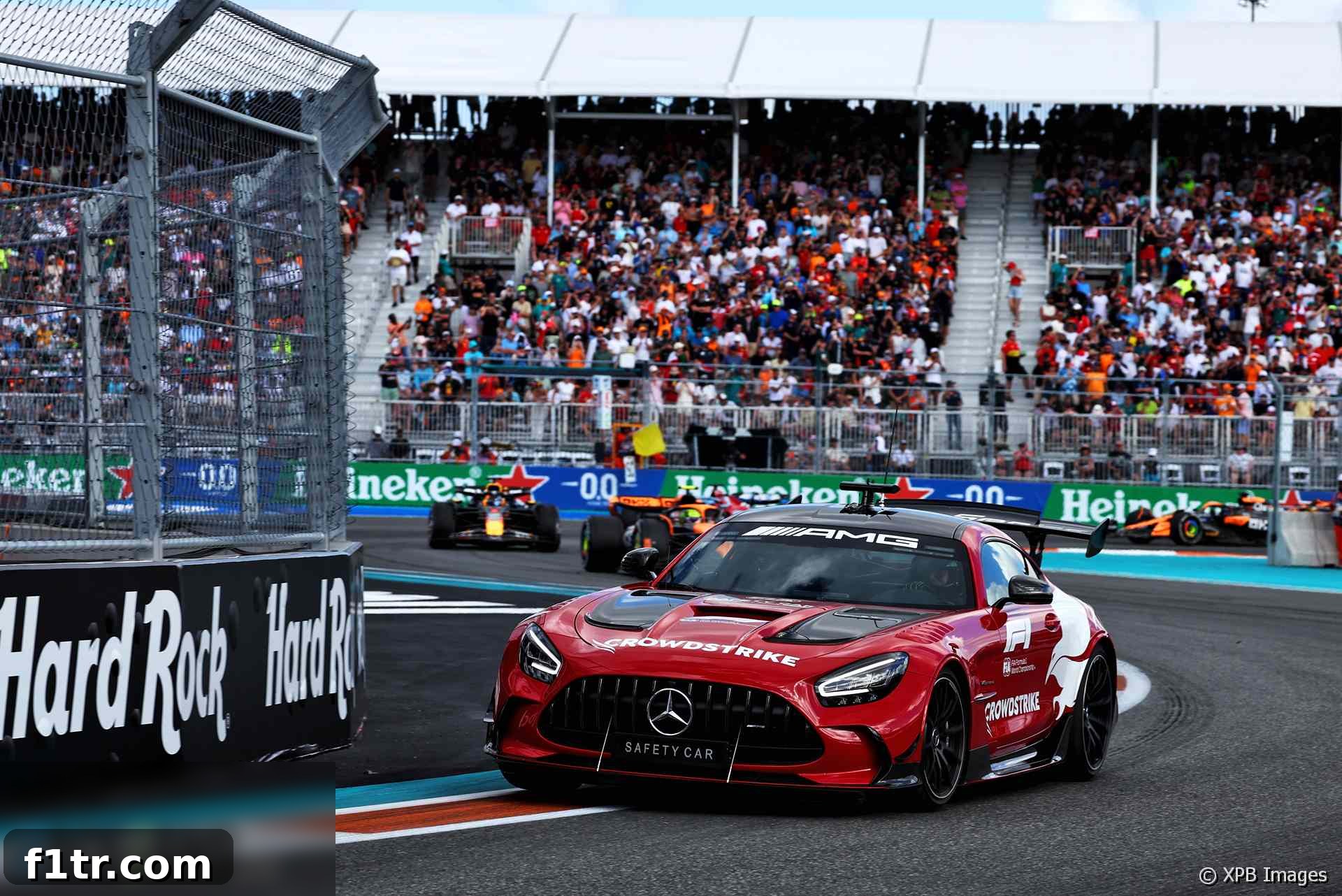
The turning point arrived with the deployment of the Safety Car. Kevin Magnussen and Logan Sargeant’s collision necessitated the Safety Car period, which came at a critical juncture. Norris, still yet to make his pit stop, seized the golden opportunity. Under Safety Car conditions, drivers can pit without losing as much time as they would under normal racing circumstances. This allowed Norris to dive into the pits, switch to fresh hard compound tyres, and rejoin the race at the very front of the field, leapfrogging Max Verstappen, who had already completed his stop. On the surface, it appeared to be a stroke of immense fortune, precisely what Norris and McLaren needed to convert their strategic gamble into a lead.
However, Verstappen’s post-race comments painted a more nuanced picture, suggesting that Norris’s victory was far from a mere stroke of luck. The Red Bull ace firmly believes that even without the Safety Car, he would have faced a monumental challenge in keeping Norris behind him. His assessment was rooted in Norris’s exceptional pace on the used medium tyres. Verstappen recognized that if Norris had continued his charge and eventually pitted, he would have re-emerged on fresh tyres with a significant performance advantage. “I knew even if there wouldn’t have been a Safety Car that when he would come out on fresh tyres that I would have had to push on quite a lot to be able to keep him behind,” Verstappen admitted. This statement highlights his respect for Norris’s driving and McLaren’s improved car, suggesting that a head-to-head battle was inevitable and perhaps even favorable to McLaren.
Verstappen acknowledged the capricious nature of motor racing, where fortune can swing unpredictably. “The Safety Car came [and] it’s racing: Sometimes it works for you, sometimes it works against you,” he philosophized. Despite the adverse timing of the Safety Car for his own race, he maintained that Red Bull still had a fighting chance. However, the critical factor wasn’t just the Safety Car; it was the subsequent lack of pace from his RB20. Once the race restarted, it became glaringly evident that Max Verstappen simply couldn’t match Norris’s blistering speed on the new hard tyres. McLaren, propelled by a significant upgrade package introduced in Miami, had unlocked a new level of performance. “Even with that Safety Car, we still had all the opportunities to win today, but we’re clearly not quick enough after that Safety Car,” Verstappen conceded. Recognizing the insurmountable gap, he pragmatically settled for second place, crossing the finish line over seven seconds behind the victorious McLaren.
The fundamental reason behind Verstappen’s struggle lay in persistent issues with his Red Bull RB20 throughout the Miami Grand Prix weekend. From Friday practice sessions through to the race, Max Verstappen reported a distinct lack of grip, a problem that severely compromised his ability to extract maximum performance from the car. “I was just quite poor, I would say, in the race,” he stated frankly. This wasn’t an isolated race-day problem; it was a pervasive discomfort. “I never really felt comfortable the whole weekend with it,” he added. While the medium tyres offered a semblance of manageability, the hard compound proved to be “quite a disaster” for the three-time world champion.
Verstappen detailed a complex and frustrating balance issue. He described the car as having “low grip” and a “very tricky balance in the low-speed [corners].” Specifically, he struggled to lean on the rear of the car through slower turns, which is crucial for traction and corner exit speed. Simultaneously, in the high-speed sections of the track, the car exhibited significant understeer, meaning the front end wasn’t turning into corners as aggressively as he needed. These two issues — a loose rear in low-speed and an unresponsive front in high-speed — presented a contradictory challenge for setup. “When you have these two issues, you cannot also balance it out because you’re chasing two different things,” Verstappen explained. This forced him into a defensive driving style, adapting to the car’s limitations rather than attacking the track. “So yeah, just driving to the grip that I had and it was not a lot.” The lack of confidence and the inability to push the car to its absolute limit ultimately prevented him from challenging Norris for the win, regardless of the Safety Car.
McLaren’s triumphant weekend in Miami marked a significant moment not only for Lando Norris but also for the team’s trajectory in the 2024 season. Their aggressive development approach, particularly with the substantial upgrade package unveiled at this race, appears to have paid dividends. The MCL38 demonstrated genuine pace, not just fleeting speed, validating the team’s engineering efforts. This victory, therefore, isn’t just an outlier; it signals McLaren’s emergence as a consistent front-running contender, capable of challenging Red Bull on merit. The performance in Miami suggests that the competitive landscape of Formula 1 could be shifting, promising a more thrilling and unpredictable season ahead. For Norris, it was a long-awaited and well-deserved breakthrough, cementing his status as one of the sport’s elite talents.
The Miami Grand Prix served as a stark reminder that even the most dominant teams and drivers can be challenged, not just by external factors but by genuine on-track performance. Lando Norris’s victory, supported by McLaren’s strategic brilliance and effective upgrades, has injected fresh excitement into the championship. While Max Verstappen’s assessment acknowledges the Safety Car’s role, his deeper analysis confirms that McLaren’s pace was a legitimate threat that day. This outcome sets a fascinating precedent for the remainder of the 2024 Formula 1 season, hinting at closer battles and a renewed challenge to Red Bull’s supremacy.
2024 Miami Grand Prix Coverage & Analysis
- McLaren had superior pace before Verstappen’s damage in Miami – Norris
- Sainz ‘struggles to understand’ why he got penalty when Perez didn’t
- Alonso’s unusual brake problem and more unheard Miami team radio
- McLaren’s Miami upgrade success points to even stronger form in coming races
- Norris expects more wins this year and believes “100%” in 2025 title bid
Browse all 2024 Miami Grand Prix articles