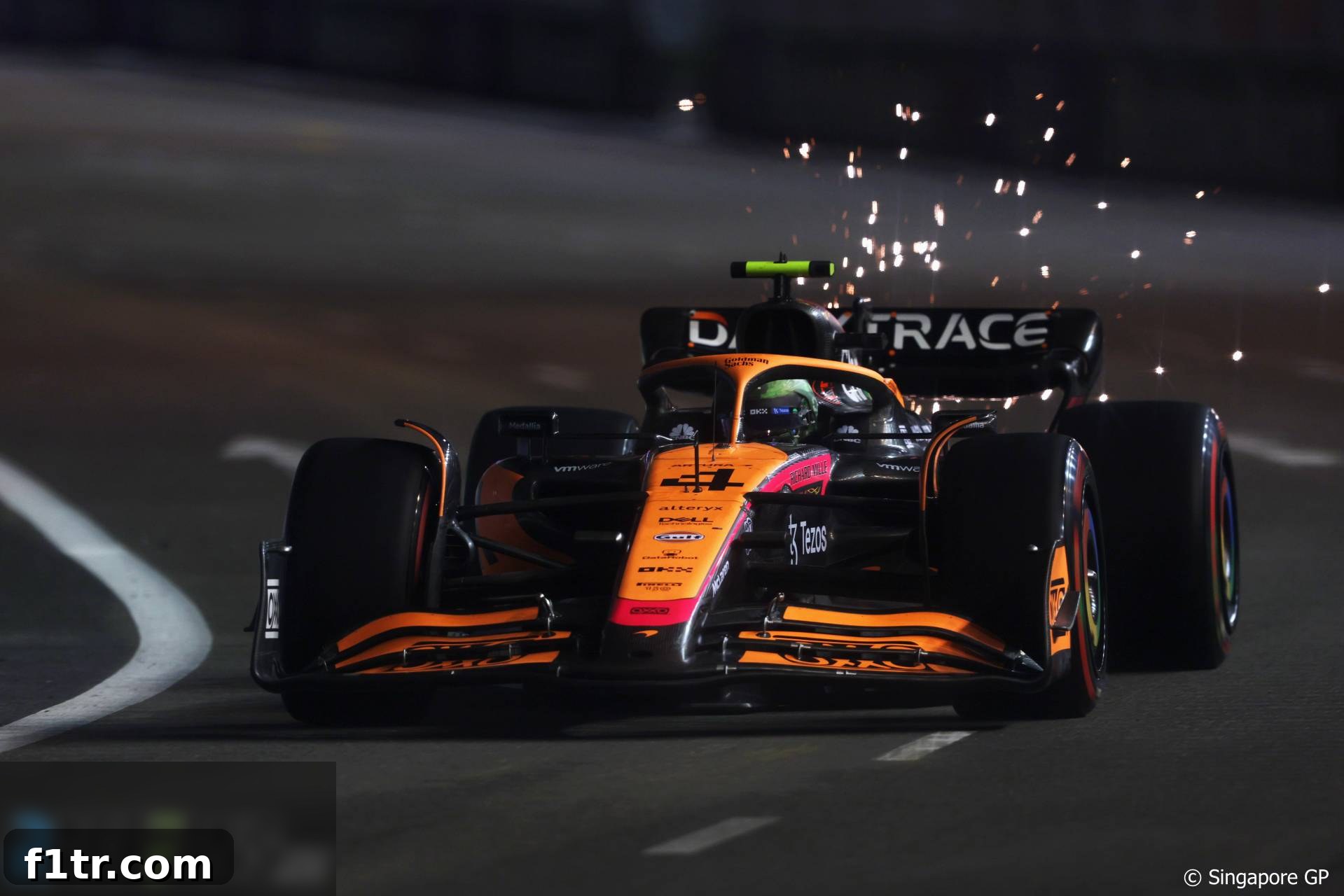
In the high-stakes world of Formula 1, every detail matters, from car setup to driver technique and regulatory compliance. During a challenging Singapore Grand Prix, McLaren driver Lando Norris found himself navigating not only the treacherous Marina Bay Street Circuit but also the intricacies of the FIA’s new porpoising regulations. The McLaren F1 team proactively instructed Norris to modify his driving style to mitigate severe bouncing, ensuring they remained within the strict limits imposed by the sport’s governing body and safeguarding both car performance and driver welfare.
Advert | Become a Supporter & go ad-free
McLaren’s Strategic Call: Managing Bouncing at the Singapore Grand Prix
The critical instruction unfolded during the intense final phase of last weekend’s race around the illuminated Marina Bay Street Circuit. Norris, who was running impressively in fourth place, received precise directions from his race engineer, Will Joseph. Joseph directed his driver to adopt a wider line through Turn 6, a specific right-hand kink located within the DRS zone that flows directly into the challenging left-hander of Turn 7. This seemingly minor adjustment was far from arbitrary; it was a crucial strategic maneuver prompted by growing concerns over the car’s vertical oscillations and the potential breach of the FIA’s recently introduced porpoising limits.
The FIA’s Aerodynamic Oscillation Metric (AOM): A New Challenge for Teams
The underlying reason for McLaren’s real-time intervention was the FIA’s Aerodynamic Oscillation Metric (AOM). This sophisticated formula, designed to precisely measure the vertical G-force applied to drivers, was introduced through a technical directive at the Belgian Grand Prix in August. The AOM acts as a quantitative measure for detecting how severely cars are “porpoising” or “bottoming out” on track. Porpoising, a phenomenon where the car bounces violently at high speeds due to the intermittent stalling and reattachment of aerodynamic flow beneath the car, became a significant concern for the FIA early in the 2022 season. The new ground-effect cars, while designed for increased downforce, inadvertently brought back this historic issue, raising serious questions about driver comfort, safety, and potential long-term health implications.
Lando Norris, offering a driver’s perspective on the issue, told Sky Sports: “It’s just bumps. It’s a certain amount of how hard you can hit the ground.” This statement, while succinct, highlights the direct physical impact on the drivers and the tangible nature of the regulation. The FIA introduced the AOM to ensure that teams maintained their cars within safe operating parameters, threatening penalties for any persistent breaches. The bumpy nature of the Marina Bay track, with its street circuit characteristics, undoubtedly exacerbated the porpoising effect, making McLaren’s management of the issue even more challenging and crucial.
“Some laps, I was hitting bigger bumps than others and obviously there’s the rule with how much you’re allowed to bump with the new rules of porpoising and stuff,” Norris further explained, underscoring the variability and difficulty in consistently adhering to the metric throughout a grueling race. This delicate balance between pushing the car to its absolute limit for performance and staying within regulatory boundaries is a constant challenge for Formula 1 teams and drivers alike.
A Vital Result: McLaren’s Leap in the Constructors’ Championship
Thanks to their diligent management of the porpoising issue and a strong overall performance, McLaren successfully avoided falling foul of the FIA’s metric. Lando Norris masterfully brought his MCL36 home in an impressive fourth position, a critical result for the Woking-based squad. His teammate, Daniel Ricciardo, also delivered a commendable performance, finishing just behind Norris in fifth place. This double points finish proved invaluable, catapulting McLaren above their closest rivals, Alpine, in the Constructors’ Championship standings, securing fourth place.
The shift in championship position was particularly significant, aided by the unfortunate mechanical problems that led to the retirement of both Alpine drivers, Fernando Alonso and Esteban Ocon. Norris acknowledged the importance of this outcome, stating: “I’m just happy I got Fernando – that was the main task. It was not to finish ahead of Max [Verstappen] or whatever, but to be ahead of Fernando. I mean, [the Alpines] both retired in the end, so it probably didn’t make too much difference. But those kind of things are what we need right now.” This candid remark underlined the intense midfield battle and how every point and every position gained against a direct rival like Alpine contributed significantly to McLaren’s aspirations for a strong championship finish. The reliability and strategic acumen displayed by McLaren in Singapore demonstrated their capability to capitalize on competitors’ misfortunes while managing their own technical challenges.
Embracing the Challenge: Lando Norris Looks Ahead to Suzuka
With the demanding Singapore Grand Prix behind them, the Formula 1 circus swiftly moved to one of the most revered circuits on the calendar: the legendary Suzuka Circuit for the Japanese Grand Prix. For Lando Norris, the prospect of racing at Suzuka carried a special excitement, given his limited experience there, having only driven the circuit once in his F1 career during his debut season in 2019.
Norris eloquently described what makes Suzuka so special for drivers: “I think the best thing here is just the flow to the circuit.” This “flow” is a characteristic that sets Suzuka apart from many modern venues. Unlike tracks that often feature distinct sequences of corners followed by long straights, Suzuka is a relentless, interconnected series of turns that demand absolute precision and commitment. As Norris elaborated, “You’ve got to have a good variance of corners – high-speed, low-speed, some very tight chicanes like the last chicane, the tight hairpin in the middle. But the rest of it is just you have one corner and you go straight into another. It’s not like you have kind of one corner – straight – another corner – straight. It’s just you come out of one and you’re preparing straight away for the next one. As soon as you kind of get one part a little bit wrong, it generally continues into the next one.”
This unique figure-of-eight layout, which sees the track crossing over itself, is famous for its iconic S-curves, the demanding Spoon Curve, and the ultra-fast 130R. These sections not only test a driver’s courage but also demand a car with superb balance and aerodynamic efficiency. Suzuka is also known for its unforgiving nature; vast gravel traps line many parts of the circuit, leaving little room for error. “It’s just, especially in a Formula 1 car, incredibly fast, incredibly enjoyable,” Norris continued. “Just a lot of fun – not a lot of run-off, gravel in most places, so you get punished for making mistakes. That’s sometimes not always what we like, but generally as a driver is what you want.” This sentiment is widely echoed across the paddock, highlighting Suzuka as a true driver’s circuit that rewards skill, bravery, and meticulous preparation, making it a favorite among the Formula 1 elite.
Teamwork Under Pressure: Norris’s Singapore Grand Prix Radio Exchanges
The real-time pressure of adapting to track conditions and regulatory demands, all while competing at the pinnacle of motorsport, is vividly illustrated by the radio exchanges between Lando Norris and his race engineer, Will Joseph, during the Singapore Grand Prix. These snippets from the McLaren cockpit offer a unique insight into the immediate problem-solving and communication required.
| Joseph | Also, avoid apex of turn six, please. The apex kerb. |
| Joseph | Lando, we think being further to the left in turn six will help. |
| Joseph | Lando, this is difficult. So entry to six is good. Exit, you need to be a bit to the right. |
| Joseph | Whatever you did that lap was good. Keep doing that please. |
| Norris | But I’m doing the same thing every lap? You’re just frickin’ making me do the hokey pokey. |
| Joseph | Understand – it’s something weird. Whatever you did this was good, so do it. |
This candid dialogue encapsulates the dynamic tension between a driver’s feel and the data-driven directives from the pit wall. Norris’s humorous “hokey pokey” comment perfectly conveys his frustration and perhaps a touch of confusion at being asked to make subtle yet critical adjustments to a line that felt consistent to him. Joseph’s calm persistence, even acknowledging that “it’s something weird,” underscores the team’s reliance on telemetry and real-time analysis to guide the driver. Such exchanges highlight the incredible synergy required between driver and engineer, especially when navigating complex technical regulations under the immense pressure of a Grand Prix. These swift decisions and precise communications are often the crucial elements that determine success or failure in Formula 1.
Advert | Become a RaceFans supporter andgo ad-free
Further Reading: 2022 Japanese Grand Prix Insights
- From F1 to Formula Ford, 2022 was the year of the championship anti-climax
- Suzuka points confusion didn’t take shine off title win – Verstappen
- FIA to publish findings of inquiry into use of crane during Japanese GP
- Does F1 only need slicks and wets? The case for dropping intermediate tyres
- Hamilton’s work ethic “has not changed at all” in face of difficult 2022 campaign
Browse all 2022 Japanese Grand Prix articles