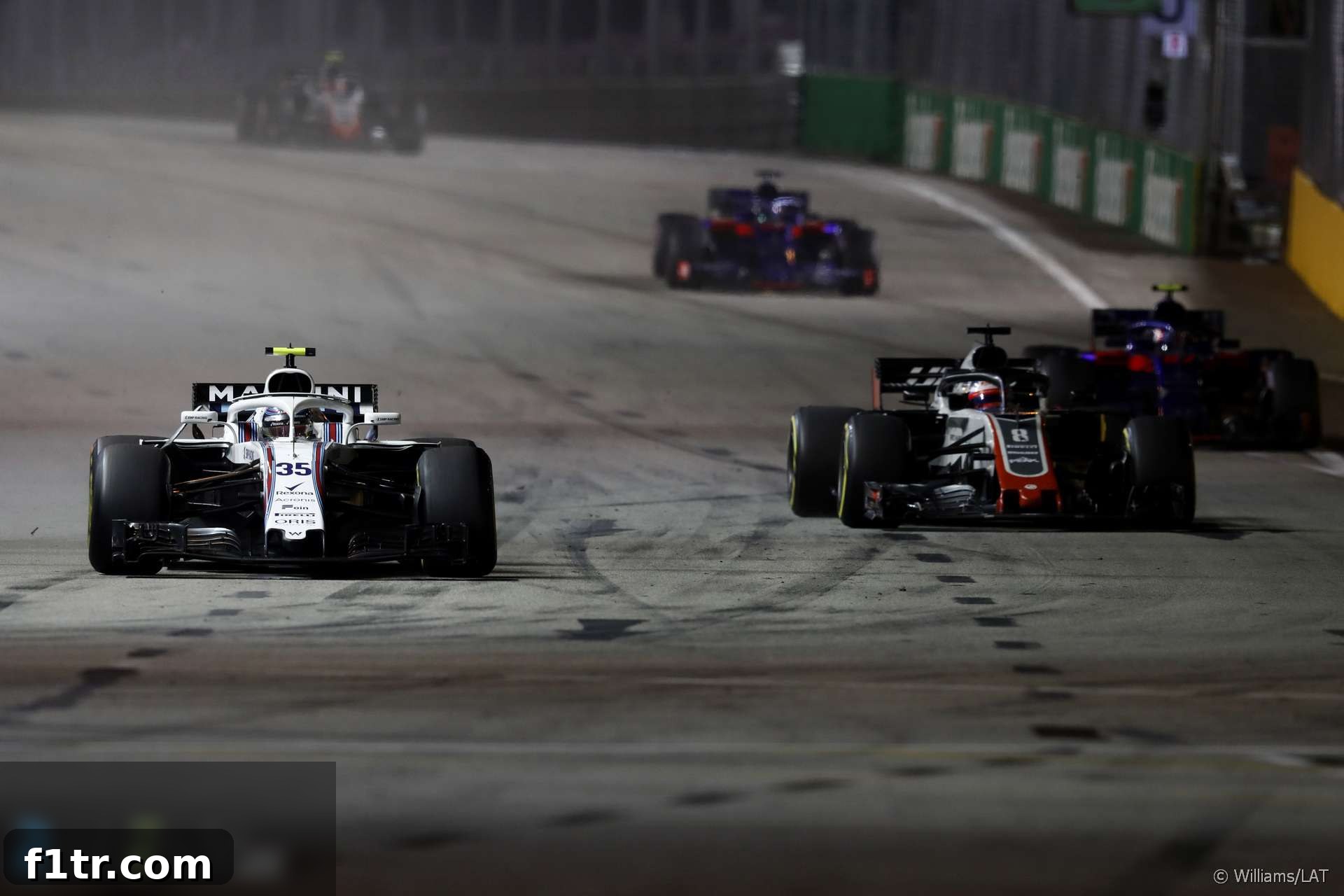
The thrilling spectacle of Formula 1 racing, while often a showcase of raw speed and strategic brilliance, is also a delicate dance governed by a myriad of regulations designed to ensure fairness and safety. Among the most critical of these rules are the blue flags, signaling to slower cars that they must yield to faster competitors, especially those on a different race strategy or battling for championship points. A high-profile incident that brought the strict enforcement of these rules into sharp focus involved Haas driver Romain Grosjean. He found himself at the center of a heated controversy after being penalized for failing to let championship leader Lewis Hamilton past, all while embroiled in a fierce on-track skirmish with Williams driver Sergey Sirotkin.
The incident not only resulted in a time penalty for Grosjean but also sparked a contentious debate, with the French driver vociferously accusing rival Sergey Sirotkin of employing “go-kart racing” tactics. This pointed accusation highlighted the immense pressure and frustration drivers experience when navigating multi-car battles while simultaneously attempting to comply with blue flag directives – a conundrum that demands split-second decisions with significant consequences.
Advert | Become a Supporter & go ad-free
The severity of Grosjean’s infraction was underscored by FIA race director Charlie Whiting, a revered figure whose interpretation of the rules was paramount. Whiting publicly described Grosjean’s delayed reaction to the blue flags being waved for him as “one of the worst” examples of a backmarker failing to promptly and safely allow the race leaders to pass. Such a strong rebuke from the sport’s highest official carried significant weight, reinforcing the critical importance of blue flag compliance for maintaining the integrity of competition and preventing potentially dangerous situations on track.
The immediate repercussions for Grosjean were tangible and impactful. He was issued a five-second time penalty, which was applied to his total race time, effectively altering his final classification. In addition to the time penalty, his Super Licence was endorsed with penalty points. The accumulation of these points is a serious matter in Formula 1, as reaching a specific threshold within a 12-month period can lead to a race ban – a deterrent designed to encourage consistent adherence to sporting regulations. While Grosjean expressed regret for inadvertently delaying Hamilton, he staunchly defended his actions, asserting that Sirotkin’s driving had left him with an incredibly limited range of options.
“I’m sincerely sorry if I blocked anyone, as that was absolutely not my intention,” Grosjean articulated post-race, signaling an understanding of the impact on Hamilton’s race while simultaneously defending his own conduct. “I genuinely believe that I did my absolute best in what was an exceptionally challenging and dynamic on-track situation.” His defense hinged on the argument that the intense multi-car battle he was engaged in made it incredibly difficult to yield immediately without compromising his own race or, worse, creating a dangerous scenario for himself and those around him.
Expanding on the details of the incident, Grosjean painted a vivid picture of the tight racing conditions: “I was intensely fighting with Sergey, who, to be frank, was driving with tactics that felt a little like ‘go-kart racing’ out there – very aggressive and uncompromising. In that moment, I simply couldn’t afford to slow down significantly without inviting a collision or losing critical track position to the cars directly behind me. Pierre [Gasly] was pushing hard and was right on my gearbox, exerting immense pressure, and Sergey was glued to my front wing. It was an extremely tight three-car battle. My priority was to complete the overtake on Sirotkin safely, and then, as soon as I successfully passed him and secured the position, I immediately made sure to let Lewis by, giving him a clear run.” This detailed account highlighted the intricate decisions drivers must make in fractions of a second, often under conflicting imperatives.
Ultimately, Grosjean’s penalty proved to be costly for his race result. The five-second addition to his time caused him to drop from a hard-earned 13th position to a less favorable 15th in the official final classification. While not a points-scoring position, every place matters for team standing and individual pride. Such incidents serve as a potent reminder of how quickly a driver’s fortunes and efforts can be undone by regulatory decisions, regardless of their original intent.
Haas Team Principal Guenther Steiner, known for his no-nonsense and often candid assessments, offered a broader, more strategic perspective on the team’s predicament and Grosjean’s entanglement. He vocalized his frustration with an inherent structural disadvantage within the Formula 1 regulations. Teams that successfully qualify within the top 10 positions are mandated to start the Grand Prix on the same set of tires they used during the Q2 session – typically softer, faster compounds that degrade more quickly. Conversely, those qualifying outside the top 10 enjoy the strategic freedom to choose their starting tire compound, often opting for more durable or tactically advantageous options.
“If you are forced to start on these specific tyres, particularly when other teams have the liberty to choose compounds that are so much superior for the race start, qualifying outside of the top 10 suddenly grants you such a significant strategic advantage in the early laps of the race,” Steiner explained. He argued that this regulatory nuance often leads to situations where cars that genuinely possess more pace, but are on suboptimal starting tires, find themselves stuck behind slower cars that are on more favorable compounds. This creates bottlenecks and increases the likelihood of congested racing scenarios where blue flag situations become more complex and prone to incident.
Steiner further elaborated, connecting the tire strategy directly to Grosjean’s blue flag incident: “Following that initial strategic disadvantage, we then got effectively stuck behind the Williams, which in our view, didn’t move out of the way as quickly or as cleanly as it should have. One thing inevitably led to another, escalating the situation, and that’s ultimately where we ended up with the penalty.” His comments suggested a cascading effect, where a strategic disadvantage combined with perceived uncooperative driving from a rival team created the perfect storm for Grosjean’s infringement, highlighting the multifaceted challenges that teams face on a race weekend.
The debate surrounding blue flags and their consistent application has long been a contentious topic within Formula 1. While the rule itself is fundamentally clear – slower cars must allow faster cars, especially those competing for wins or championships, to pass without obstruction – its real-time implementation during intense racing is anything but simple. Drivers frequently highlight the immense difficulty of finding a safe, opportune, and non-disruptive moment to yield without either compromising their own race significantly, or worse, inadvertently creating a hazardous situation for themselves or other competitors. This specific incident involving Grosjean, Hamilton, and Sirotkin served as a powerful and highly visible illustration of these inherent, perennial challenges within the sport.
Ultimately, the episode brought into sharp focus not only the nuanced interpretation of racing rules but also the broader themes of sportsmanship, driver conduct under extreme pressure, and the unequivocal authority of race control. While Grosjean maintained his best efforts, the FIA’s stance, as articulated by Charlie Whiting, was clear: the primary responsibility for effectively and safely yielding to blue flags rests firmly with the backmarker. This incident, therefore, served not merely as a disciplinary action against a single driver but as a stark and crucial reminder to all competitors across the grid about the rigorous enforcement of blue flag regulations and the significant repercussions for any failure to comply promptly and in a manner that ensures the smooth and safe flow of the race.
Advert | Become a RaceFans supporter andgo ad-free
Don’t miss anything new from RaceFans
Stay connected and up-to-date with all the latest news, insightful analyses, and exclusive content from the dynamic world of Formula 1. Follow RaceFans on our various social media platforms to join our vibrant community of enthusiasts and ensure you never miss a beat of the action:
- Join RaceFans on Facebook to engage in lively discussions, get real-time updates, and connect with fellow F1 aficionados from around the globe.
- Follow RaceFans on Twitter for instant news alerts, compelling live race commentary, and breaking stories as they unfold during race weekends and beyond.
- Get daily email updates from RaceFans delivered directly to your inbox, providing you with a comprehensive digest of all the crucial F1 news and features every day.
Exploring the 2018 F1 Season: Insights and Retrospective
The 2018 Formula 1 season was a truly memorable year, marked by fierce championship battles, innovative technological developments, and numerous on-track dramas. Delve deeper into the pivotal moments and key narratives that defined this thrilling championship campaign. From the intense rivalry between top teams to the strategic intricacies and driver heroics, our curated articles offer comprehensive coverage and in-depth analysis:
- F1 feared “death knell” for Drive to Survive after Ferrari and Mercedes snub
- McLaren staff told us we were “totally crazy” to take Honda engines in 2018 – Tost
- ‘It doesn’t matter if we start last’: How Red Bull’s junior team aided Honda’s leap forward
- Honda’s jet division helped F1 engineers solve power unit problem
- McLaren Racing losses rise after Honda split
Browse all 2018 F1 season articles