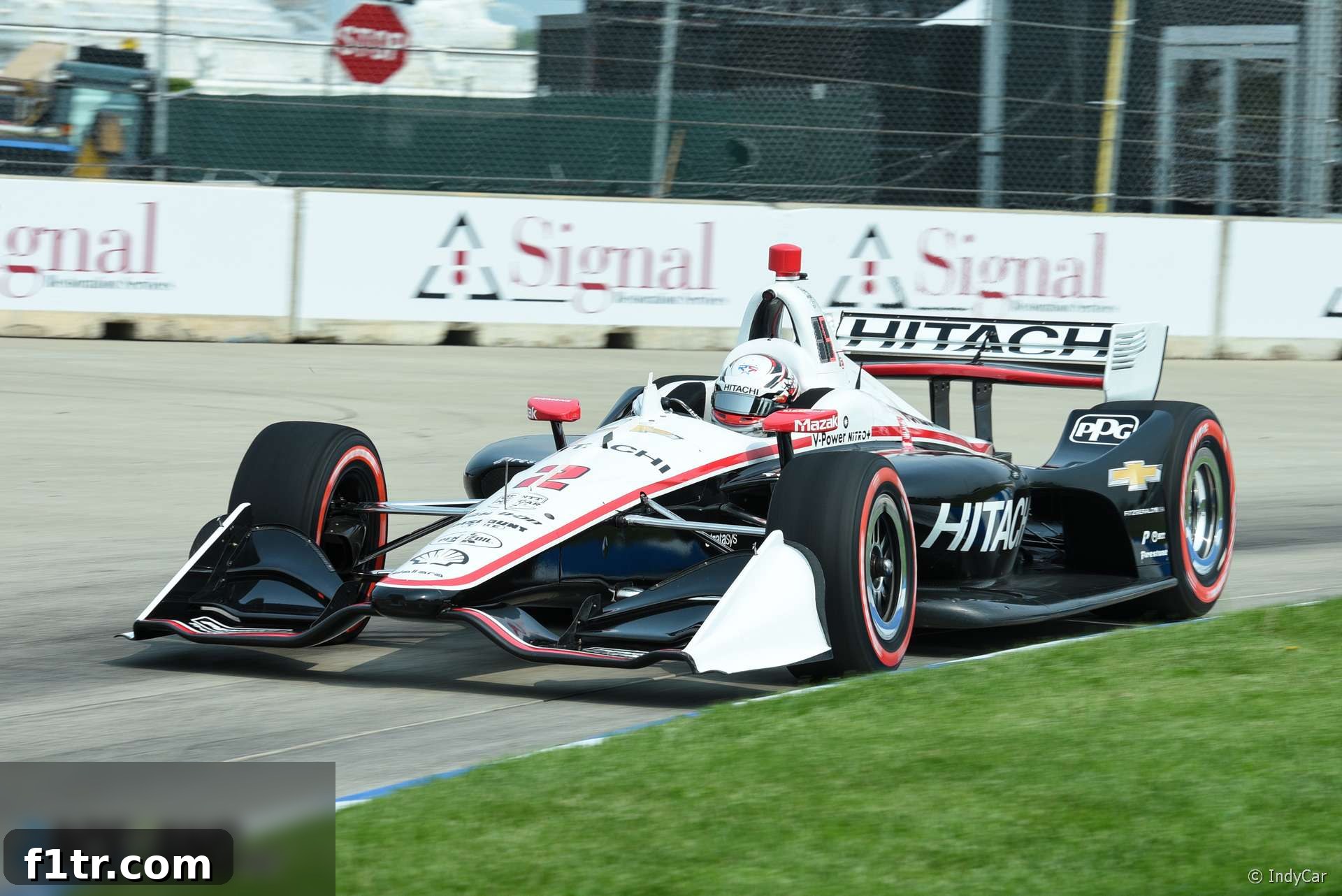
Josef Newgarden Dominates Rain-Hit Detroit Grand Prix with Flawless Strategy
Josef Newgarden showcased a masterclass in strategic racing and wet-weather driving to clinch his second NTT IndyCar Series victory of the 2019 season at the dramatic Detroit Grand Prix. Navigating treacherous, rain-soaked conditions on the iconic Belle Isle Street Circuit, the Team Penske driver made a perfectly timed switch to slick tyres that ultimately decided the outcome of a chaotic race. This pivotal win not only cemented his status as a formidable championship contender but also highlighted the critical role of team strategy and driver adaptability in the high-stakes world of IndyCar racing.
A Weather-Affected Weekend at the Detroit Grand Prix
The Chevrolet Detroit Grand Prix presented by Lear has long been a highlight on the IndyCar calendar, known for its demanding street course layout on Belle Isle. However, the 2019 edition was immediately overshadowed by adverse weather conditions. Heavy rain plagued the build-up to Saturday’s race, leading to significant delays and ultimately postponing the start. This created an atmosphere of uncertainty and heightened the challenge for all competitors, forcing teams to prepare for a race where track conditions could evolve rapidly from saturated to drying.
The unique nature of a street circuit, with its unforgiving concrete walls and limited run-off areas, amplifies the difficulty when combined with rain. Drivers faced reduced visibility, treacherous grip levels, and the constant threat of aquaplaning. The race, initially scheduled for a longer duration, was eventually cut to a demanding 75-minute sprint, adding an extra layer of urgency and making every strategic decision even more impactful.
Newgarden’s Strategic Genius: The Decisive Tyre Switch
As the track slowly began to dry, the crucial decision regarding tyre choice loomed large. Early in the race, drivers were running on wet-weather tyres, designed to channel water away and provide grip on a saturated surface. However, as the rain subsided and a dry line started to emerge, the performance advantage shifted. Josef Newgarden, piloting the No. 2 Team Penske Chevrolet, demonstrated remarkable foresight and executed a daring strategy by being among the first to pit for slick, dry-weather tyres.
This decision, made during a pivotal moment of the race, was a high-stakes gamble. Switching too early meant risking a loss of control on still-damp patches, while waiting too long meant losing valuable track position to those who had committed sooner. Newgarden and his Team Penske strategists timed it to perfection. As other cars struggled for grip on their deteriorating wet tyres, Newgarden found immediate pace with the slicks, carving through the field and establishing a commanding lead that he would not relinquish.
Alexander Rossi’s Pole Position Dominance Halted by Caution
Starting from pole position, Alexander Rossi in the No. 27 NAPA AUTO PARTS Honda for Andretti Autosport had initially appeared to be the dominant force. Fresh off a strong performance in Indianapolis six days prior, Rossi quickly established a comfortable lead in the early stages, showcasing his renowned skill in adverse conditions. He looked poised to convert his pole into a victory, a testament to his raw speed and aggressive driving style.
However, fate intervened in the form of a full-course caution period triggered by Ed Jones. This yellow flag period, while necessary for safety, proved to be incredibly disruptive to Rossi’s race strategy. Forced to pit under caution to switch to slick tyres, he lost critical track position. While the tyre switch itself was the correct call for the drying conditions, the timing under yellow allowed competitors like Newgarden, who had already made their strategic move or were in a better position to capitalize, to gain an advantage. Rossi re-emerged in second place, a position he would hold until the checkered flag, but it was a frustrating outcome for a driver who had controlled much of the race.
A Caution-Filled Sprint: Incidents and Shifting Fortunes
The abbreviated 75-minute race was a relentless spectacle of drama, punctuated by a series of full-course caution periods. These yellow flags played a significant role in shaping the race’s narrative, constantly resetting the field and creating opportunities and setbacks for various drivers. Two of these caution periods were notably caused by Matheus Leist, whose incidents added to the race’s chaotic flow and further complicated pit stop strategies for many teams.
The most impactful incident for the podium battle, however, came towards the end of the race. Scott Dixon, a multiple IndyCar champion and formidable competitor, was running strongly and appeared to be on course for a valuable third-place finish. In a cruel twist of fate, Dixon crashed out, bringing out yet another full-course yellow. This incident dramatically reshuffled the top positions, allowing others to capitalize on his misfortune. Takuma Sato, driving the No. 30 Mi-Jack / Panasonic Honda, seized this opportunity, deftly nipping past Felix Rosenqvist just before the final caution to claim a well-deserved third spot on the podium. Rosenqvist, who had been a strong contender throughout the race, eventually finished fourth, showcasing consistent pace despite the challenging conditions.
The Elite Ten: Battling Through Belle Isle’s Rigors
Beyond the podium, the battle for top positions was equally fierce. Ryan Hunter-Reay in the No. 28 DHL Honda demonstrated resilience and skill, claiming an impressive fifth place despite a momentary excursion into an escape road during the race. His ability to recover and maintain pace underscored his veteran experience. He crossed the finish line right on Felix Rosenqvist’s tail, indicative of the incredibly tight competition at the front.
Defending Indy 500 champion and reigning series champion Simon Pagenaud, another Team Penske ace, was hot on Hunter-Reay’s heels, ultimately securing sixth position. This strong showing from Pagenaud further highlighted Team Penske’s overall dominance and strategic acumen in Detroit. Completing the top ten were Graham Rahal, Zach Veach, James Hinchcliffe, and Spencer Pigot. Each of these drivers displayed remarkable car control and strategic thinking to navigate the demanding conditions and avoid the numerous pitfalls that plagued many of their rivals throughout the tumultuous race.
Will Power’s Race Derailed by Pit Lane Drama
While some drivers excelled, others faced significant setbacks. Will Power, a pole position master and one of IndyCar’s fastest drivers, began the race with an aggressive charge through the field, making up several positions in the opening stages. His early pace suggested he could be a factor for victory, especially as the track transitioned to dry conditions. However, his race unraveled dramatically during a pit stop when his team attempted to switch him to slick tyres.
In a rare and costly error, Power was released from his pit box before the front-right wheel was properly secured. As he navigated the pit exit, the wheel detached from his car, leaving him stranded and his race effectively ruined. This safety infraction immediately resulted in a drive-through penalty, compounding the loss of time and track position. Power ultimately finished a disappointing 18th, a stark reminder of how quickly fortunes can change in IndyCar racing due to even the slightest misstep, both by driver and team.
Championship Battle Heats Up: Newgarden Extends His Lead
Josef Newgarden’s commanding victory in Detroit was not just a standalone triumph; it carried significant weight for the NTT IndyCar Series championship standings. This win allowed him to significantly extend his lead, putting him 25 points clear heading into the second race of the Detroit Grand Prix weekend. This crucial advantage provides a valuable buffer in what is always a fiercely contested championship battle.
The Detroit Grand Prix double-header format, with two distinct races, meant that every point was vital. Newgarden’s stellar performance in the first race positioned him perfectly for the remainder of the weekend and the rest of the season. His ability to perform under pressure, adapt to changing conditions, and execute flawless strategy solidified his position as a primary contender for the 2019 IndyCar title, setting the stage for an exhilarating continuation of the championship fight.
Explore More IndyCar Series Insights
Stay up-to-date with the latest news and analysis from the NTT IndyCar Series:
- IndyCar driver McLaughlin cleared of injury after crashing through barrier at Barber
- Schumacher says his IndyCar feels like ‘an F2 car, just with better tyres’
- IndyCar “way faster than Formula 1” in some corners, says Grosjean
- FIA to award more F1 superlicence points to IndyCar drivers from 2026
- Schumacher to race full-time in IndyCar with RLL in 2026