Lando Norris Explains Spanish Grand Prix Incident, McLaren’s Ferrari Challenge and Car Development Focus
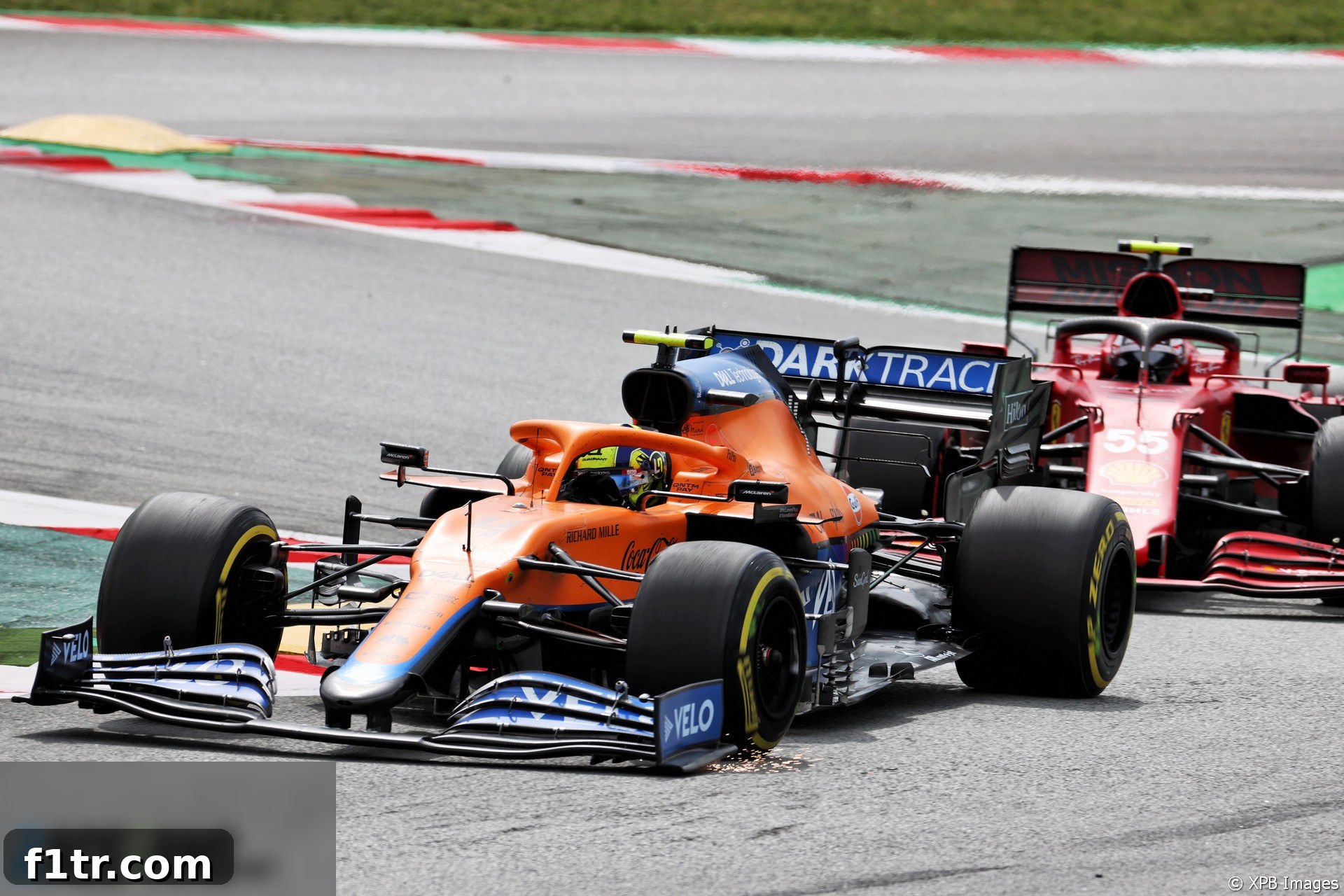
Lando Norris, the highly-regarded McLaren driver, has offered a candid explanation regarding the black-and-white ‘unsporting conduct’ flag he received during a race incident with Carlos Sainz Jnr at the Spanish Grand Prix. Norris firmly stated that he had no intention of making an aggressive defensive move against the Ferrari driver, elaborating on the split-second decision-making process that led to the stewards’ cautionary flag.
Advert | Become a Supporter & go ad-free
The Unsporting Conduct Flag: A Clarification from Norris
The incident unfolded on the pit straight as Lando Norris found himself under pressure from Carlos Sainz Jnr’s Ferrari. The McLaren driver, attempting to defend his position, was shown the black-and-white flag, a rare warning in Formula 1 signaling unsporting behaviour, typically for weaving or making multiple changes of direction to block a competitor. This particular flag is usually issued when a driver makes more than one move to defend their position, a practice strictly prohibited under F1 regulations to ensure fair racing and driver safety.
Speaking to Sky Sports after the race, Norris reflected on the moment: “I need to look at it from above, bird’s eye view and stuff.” He acknowledged the critical rule violation: “I was going to defend to Carlos and I moved over and then I moved again slightly, which you’re not really allowed to do.” Despite the technical breach, Norris was keen to emphasize his lack of malicious intent. “So I didn’t mean to do anything aggressive, I knew he was coming past. So it was just the way it is. But I didn’t mean anything.” This clarifies that while the action itself might have contravened the spirit of the rules, it was not an attempt to dangerously impede Sainz, but rather a misjudgment in the heat of the moment during intense wheel-to-wheel combat.
Such incidents highlight the fine line drivers must tread in modern Formula 1. Defensive manoeuvres are a crucial part of racing, but the ‘one move’ rule is strictly enforced to prevent dangerous blocking tactics. Norris’s admission of a “slight” second move confirms the stewards’ reasoning and underscores the difficulty of making precise, compliant decisions at speeds exceeding 300 km/h, especially when fighting for track position against a rival like Sainz.
McLaren’s Battle Against Ferrari: A Resurgent Rivalry
Beyond the individual incident, Norris also provided valuable insight into McLaren’s overall performance at the Spanish Grand Prix and their ongoing challenge against Ferrari. The 2021 season had seen both legendary teams making significant strides towards regaining their competitive edge, and the Circuit de Barcelona-Catalunya served as a critical barometer for their progress. Norris openly admitted that McLaren needed to outperform Ferrari in qualifying to stand a realistic chance of beating them in the race, a feat they ultimately failed to achieve.
Norris qualified ninth, trailing both Ferrari cars and even his teammate Daniel Ricciardo, who secured sixth place. “We didn’t show our potential yesterday, from my side,” said Norris, contrasting his qualifying result with Ricciardo’s stronger showing. “Daniel did and he finished sixth,” Norris explained, indicating that the car had more to give, at least in the hands of his teammate on that particular Saturday.
Underestimating Ferrari: A Costly Mistake
A key point of contention for Norris was what he perceived as a general underestimation of Ferrari’s capabilities. “But the Ferraris have been good all year, I don’t know why people underestimate them so much. They’re Ferrari and they’ve been one of the quickest cars in terms of cornering all season.” This statement underscores a crucial aspect of the 2021 season: Ferrari, despite early struggles in previous years, had developed a car that was exceptionally strong in the corners, making them formidable opponents on specific tracks.
Norris elaborated on how this characteristic impacted their performance at Barcelona: “So when you come to this track, where there’s less long straights and things like we’ve had in Imola and so on, they’re quick. They’ve been quick all season.” The Circuit de Barcelona-Catalunya is renowned for its challenging combination of medium and high-speed corners, with fewer long straights where raw engine power might dominate. This track layout perfectly suited Ferrari’s car strengths, allowing them to extract maximum performance through its aerodynamically efficient chassis, especially in the technical sections of the circuit. This intrinsic characteristic of the SF21, combined with the talents of Sainz and Charles Leclerc, made them particularly strong contenders in Spain, and Norris’s comments served as a stark reminder to those who might have written them off too soon.
Qualifying Pace vs. Race Pace: McLaren’s Barcelona Conundrum
McLaren’s strategy for the Spanish Grand Prix hinged on a strong Saturday performance. Norris highlighted this, stating, “We knew they were going to be particularly good here and on quali pace, we probably could have matched them yesterday, even though they probably had a slightly better car.” This indicates that on a single lap, with fresh tyres and low fuel, McLaren believed they had the potential to be very close to Ferrari, even if their rivals possessed a marginally superior overall package.
However, the race day presented a different challenge altogether. “But today, in the long run, when you kind of need a bit more rear and you have to rely on the car a little bit more, then we struggled. So I think we knew this was going to be the case.” The “long run” refers to the car’s performance over an extended stint, typically during the race, where factors like tyre degradation, fuel load, and consistent car balance become paramount. The comment about needing “a bit more rear” stability is a telling one. A car with a stable rear end inspires confidence, allowing drivers to push harder through corners without fear of snap oversteer or excessive tyre wear.
Norris’s observation that “when it’s struggling more with the rear, that’s when we struggled more too” directly points to a fundamental aerodynamic or mechanical balance issue within the MCL35M. This weakness would manifest itself acutely over a race distance, where the continuous strain on the tyres and the cumulative effect of minor instabilities would make it harder to maintain pace compared to a more balanced car like the Ferrari. This issue is particularly pronounced at a circuit like Barcelona, which features numerous high-speed direction changes and long, sweeping corners that demand precise rear stability.
Addressing Car Weaknesses: McLaren’s Plan for Improvement
Despite the challenges faced in Spain, Lando Norris conveyed a clear sense of determination and a strategic outlook for McLaren’s development path. He openly admitted, “We know the weaknesses of the car and today, when it’s struggling more with the rear, that’s when we struggled more too.” This level of transparency is crucial for a team to identify and address its shortcomings effectively. The fact that the team is fully aware of these specific weaknesses is a positive sign, indicating that their engineering department has pinpointed the areas requiring the most urgent attention.
“So I think we have a plan of what we need to still try and improve on. It’s not easy, but we’re doing what we can,” Norris concluded. This statement highlights the arduous nature of Formula 1 car development. Improving an F1 car’s aerodynamic balance, especially in critical areas like rear stability, involves complex simulations, wind tunnel testing, and real-world track analysis. It’s a continuous, iterative process that requires significant investment of time, resources, and engineering ingenuity. The competition in Formula 1’s midfield is incredibly tight, meaning even marginal gains can make a substantial difference in the constructors’ standings.
McLaren’s commitment to addressing these known weaknesses is vital for their ambition to consistently challenge top teams and maintain their competitive position against rivals like Ferrari. The feedback provided by drivers such as Norris and Ricciardo plays a critical role in guiding the development team, ensuring that updates are targeted and effective. As the season progresses, fans and analysts will be keenly watching to see how McLaren’s “plan” unfolds and whether they can mitigate the rear stability issues to unlock more consistent race pace on a wider variety of circuits.
Advert | Become a RaceFans supporter andgo ad-free
Looking Ahead: The Battle Continues
The 2021 Spanish Grand Prix, while providing valuable lessons for Lando Norris and McLaren, was just one chapter in a long and demanding Formula 1 season. The incident with Carlos Sainz Jnr served as a reminder of the intense pressures and tight margins in elite motorsport, while McLaren’s performance against Ferrari underscored the ongoing development race. Norris’s articulate assessment provides a clear picture of the team’s challenges and their determined approach to overcome them.
For McLaren to sustain their strong start to the season and continue their upward trajectory, consistently improving their car’s race-day characteristics will be paramount. Their battle with Ferrari is a compelling storyline, showcasing two historic teams vying for supremacy in the midfield. With a clear understanding of their car’s strengths and weaknesses, McLaren, under the guidance of drivers like Norris, is poised to continue pushing the boundaries of performance in what promises to be an exciting championship fight.
2021 Spanish Grand Prix Coverage
- Two reasons why Catalunya may not predict the championship – at least this year
- McLaren to keep “drip-feeding” updates onto 2021 car
- Working group tackling F1’s track limits problem
- ‘We’ll discuss what went wrong’: Hamilton and Verstappen team radio transcript analysis
- 2021 Spanish Grand Prix Star Performers
Browse all 2021 Spanish Grand Prix articles