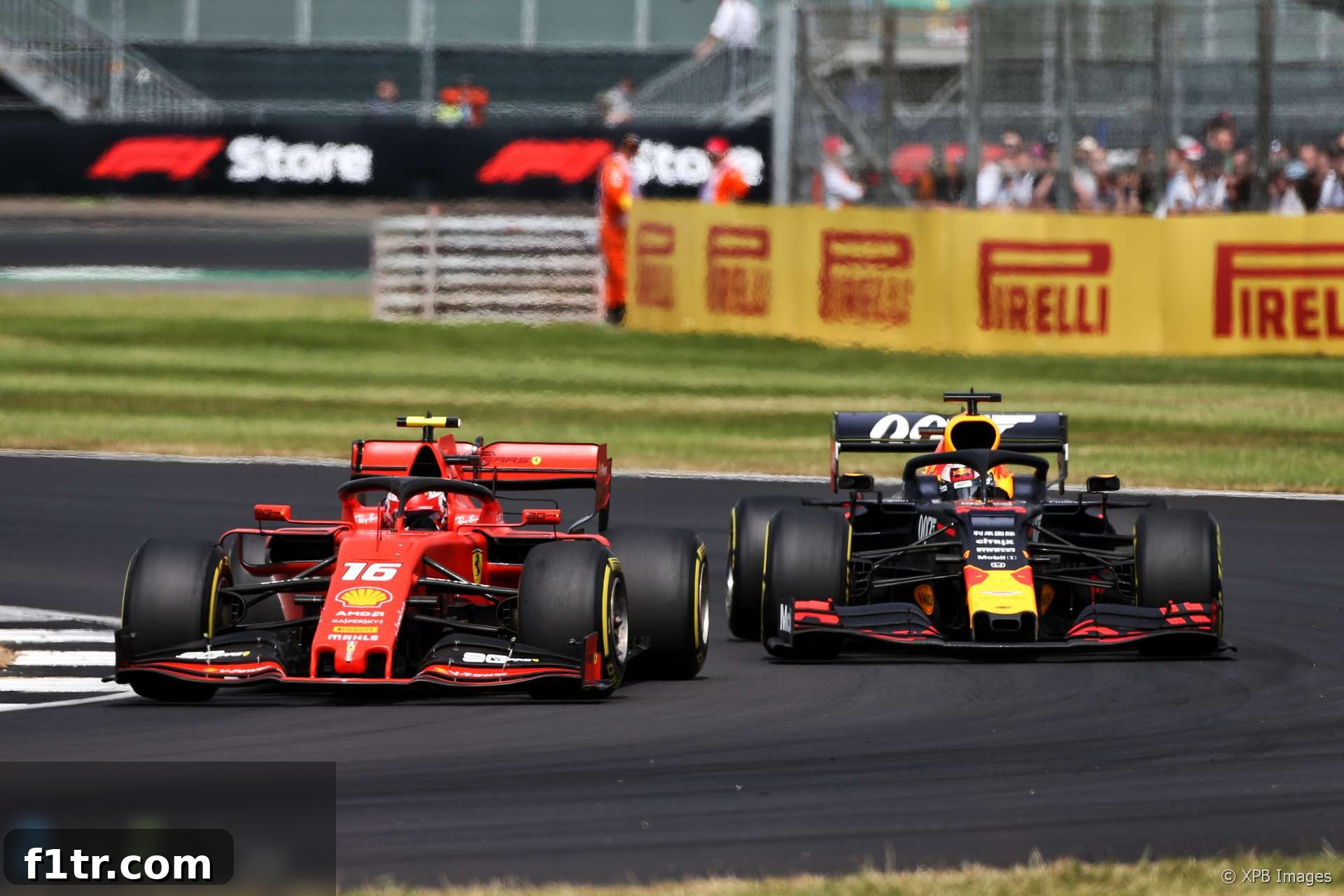
The thrilling 2019 Formula 1 season delivered yet another captivating chapter at the British Grand Prix, a race that saw Red Bull’s Max Verstappen embroiled in intense on-track skirmishes. Following a contentious victory over Charles Leclerc at the Austrian Grand Prix just two weeks prior, all eyes were on the young Dutch sensation and his Ferrari counterpart. Verstappen candidly reflected on the Silverstone battle, noting that Leclerc presented an even stiffer challenge than their prior encounter at the Red Bull Ring, setting the stage for one of the season’s most compelling rivalries.
Verstappen’s comments highlight the escalating intensity between the two rising stars of Formula 1. Their previous duel in Austria culminated in a controversial pass where Verstappen made contact with Leclerc, eventually claiming the win after stewards deemed the move legal. At Silverstone, the dynamics shifted, with Verstappen sensing a heightened level of aggression and determination from the Ferrari driver. “I think he was a little bit sore still from Austria so he was defending really hard,” Verstappen remarked, offering a glimpse into the psychological warfare inherent in elite motorsport. Despite the perceived tenacity, Verstappen maintained a philosophical stance: “But it’s fine, I’m all for that.”
The Battle at Silverstone: A Masterclass in Defensive Driving
The British Grand Prix at the iconic Silverstone circuit is renowned for its high-speed corners and natural overtaking opportunities, making it a true test of driver skill and strategic acumen. In this environment, Charles Leclerc’s defensive driving against Max Verstappen became a focal point of their engagement. Verstappen, known for his relentless pursuit and aggressive overtaking style, found himself frequently challenging Leclerc, only to be met with resolute resistance. On his team radio, Verstappen voiced concerns about Leclerc’s “very late” defensive moves, suggesting that the Ferrari driver was pushing the boundaries of fair play, making it exceptionally difficult to find a clear path past. This type of radio communication is common in F1, as drivers seek to gain an advantage or alert race control to potentially questionable maneuvers, though it also offers an insight into the heat of the moment during intense racing.
Despite the frustration, Verstappen’s strategic thinking quickly took precedence. Recognizing the inherent pace advantage of his Red Bull car over Leclerc’s Ferrari, he opted for a more measured approach. “Of course I didn’t want to take too much risk in those battles to damage the car because I knew we were quite a bit faster so I just needed to pick my moment,” he explained. This pragmatic decision underlined his growing maturity as a driver, understanding when to push and when to preserve the car for the long game. It was a calculated risk assessment, prioritizing a strong finish over a potentially costly early victory in a wheel-to-wheel scrap. This patience ultimately paid dividends, as Red Bull Racing’s strategic team leveraged their understanding of the car’s performance and the track conditions.
Red Bull’s Strategic Brilliance and Verstappen’s Patience
The team’s role in navigating the Silverstone challenge proved crucial. While Verstappen was holding his nerve on track, Red Bull’s strategists were working behind the scenes to optimize his race. “But then luckily the team did it for me with a good strategy and then it was all looking good for a good result,” Verstappen acknowledged, crediting his team for their foresight and execution. This perfectly orchestrated pit stop timing and tire management allowed Verstappen to leapfrog Leclerc without having to engage in prolonged, high-risk duels. This move highlighted the symbiotic relationship between driver and team, where a driver’s calm assessment on track is amplified by a team’s sharp strategic calls off it. The ability to execute such a strategy effectively underscored Red Bull’s competitiveness and their ambition to challenge the established front-runners, Mercedes, in the Constructors’ Championship.
Indeed, with the strategic advantage secured, Verstappen’s prospects for a strong finish looked exceedingly bright. The Red Bull car was performing optimally, and Verstappen was driving with characteristic flair and control. The groundwork had been laid for what he believed could have been a podium finish, further cementing his impressive run of form in the 2019 season. However, the capricious nature of Formula 1 racing, where fortunes can change in an instant, was soon to intervene in a dramatic and unfortunate manner, completely altering the trajectory of his race and denying him the reward for his strategic patience and on-track prowess.
The Collision with Vettel: A Race-Ruining Incident
Just as Max Verstappen looked set to capitalize on his improved track position and the superior pace of his Red Bull, fate, or rather Sebastian Vettel, intervened. The pivotal moment of Verstappen’s race came when he was involved in a collision with Ferrari driver Sebastian Vettel, Leclerc’s seasoned teammate. The incident occurred as both drivers were fiercely battling for position, a common sight in the cutthroat environment of Formula 1. As Verstappen was navigating the challenging circuit, Vettel, who had locked up his tires, misjudged his braking point and crashed into the rear of Verstappen’s car, sending both vehicles spinning into the gravel trap. The contact was significant, severely damaging Verstappen’s Red Bull and effectively ruining his hopes for a podium finish. For Vettel, the incident led to a time penalty, further compounding a difficult race for the German driver.
The aftermath of the collision was particularly frustrating for Verstappen. His race car, which had shown such promising speed and potential, was now compromised. Despite managing to recover and continue, the damage meant he could no longer compete at the same level. The incident underscored the fragility of a Formula 1 race, where one moment of misjudgment from a competitor can erase a driver’s hard work and strategic gains. For Verstappen, it was a bitter pill to swallow, especially given his prior efforts to avoid unnecessary risks in his battle with Leclerc. His measured approach had been undermined by an external factor, highlighting the unpredictable elements that often define Grand Prix racing.
What Could Have Been: A Podium Denied
Reflecting on the premature end to his competitive challenge, Verstappen was unequivocal about his potential. “We were clearly faster than Ferrari in the race,” he asserted, confident in the performance of his Red Bull. This statement was not just a post-race lament but an observation based on his direct experience on track. He felt that the Red Bull car possessed a distinct advantage over the Ferraris in race trim, a crucial factor that had been building towards a strong result. However, he also acknowledged that he “never really had clear laps” due to being constantly in traffic or battling other cars, making it difficult to demonstrate the car’s full pace over an extended period. Despite these challenges, his belief in a top-three finish remained strong.
When asked about his potential outcome, Verstappen didn’t hesitate: “I think Lewis [Hamilton] was really quick but in general I think we could have finished second or third today.” This assertion places his Red Bull firmly in contention with the dominant Mercedes, particularly Lewis Hamilton, who ultimately clinched victory at his home race. Verstappen’s confidence was well-founded, given his strong form throughout the season and the consistent improvements seen from Red Bull Racing. The lost podium was a significant missed opportunity, not only for points in the drivers’ championship but also for reinforcing Red Bull’s position as a genuine contender against the formidable Mercedes-Ferrari duopoly. The incident with Vettel served as a stark reminder of how quickly aspirations can be dashed in the high-stakes world of Formula 1, leaving fans and drivers alike to ponder what might have been under different circumstances.
Verstappen’s Form and the Evolving F1 Landscape
The 2019 season was a testament to Max Verstappen’s growing stature in Formula 1. Consistently delivering strong performances, he had firmly established himself as a front-runner capable of challenging the sport’s most seasoned champions. His ability to extract maximum performance from his Red Bull machine, coupled with his aggressive yet increasingly refined race craft, made him a formidable opponent on any given Sunday. The battles with Charles Leclerc at both the Austrian and British Grands Prix were emblematic of a new generation of talent pushing the boundaries and injecting fresh excitement into the sport. These head-to-head duels were not just about race positions; they were about laying down markers for future championships, showcasing the raw speed and strategic intelligence of two future legends.
The Silverstone race, despite its unfortunate conclusion for Verstappen, highlighted several key aspects of Red Bull Racing’s performance. The team’s strategic prowess, as evidenced by their ability to gain track position through clever pit stop timing, underscored their continuous development and ambition. Furthermore, the Red Bull car’s speed in race conditions, particularly when compared to Ferrari, provided a promising outlook for the remainder of the season. While Mercedes continued to demonstrate outright dominance, especially with Lewis Hamilton’s commanding drive at Silverstone, Red Bull was proving to be the closest challenger, consistently snapping at the heels of the Silver Arrows. This dynamic made for a compelling championship narrative, where different teams and drivers were pushing each other to their absolute limits, race after race.
The Broader Championship Picture
In the grander scheme of the 2019 Formula 1 Drivers’ Championship, every point was crucial. While the incident at Silverstone denied Verstappen valuable points, his overall consistency and string of strong finishes kept him firmly in the hunt for a top-three finish in the standings. These intense rivalries, particularly with Leclerc, were not just individual battles but crucial components of the constructors’ championship fight between Red Bull and Ferrari, both vying to be the strongest challenger to Mercedes. The British Grand Prix, with its blend of strategic plays, thrilling overtakes, and unexpected collisions, perfectly encapsulated the drama and unpredictability that makes Formula 1 such a captivating spectacle. Verstappen’s reflections on the race offered a rare insight into the driver’s perspective, highlighting the blend of tactical thinking, raw emotion, and sheer determination required to compete at the pinnacle of motorsport.
Looking ahead, the rivalry between Verstappen and Leclerc was set to be one of the defining narratives of the coming years in Formula 1. Their on-track encounters, marked by aggression, skill, and mutual respect (despite the occasional complaint), promised many more thrilling chapters. The British Grand Prix, for all its twists and turns, merely added another layer to this exciting rivalry, reminding fans that in Formula 1, the race is never truly over until the checkered flag waves, and even then, the echoes of battle continue to resonate.
Don’t miss anything new from RaceFans
Follow RaceFans on social media:
- Join RaceFans on Facebook
- Follow RaceFans on Twitter
- Get daily email updates from RaceFans
2019 F1 season
- Crying in the Melbourne car park at 2019 grand prix was my career low – Ocon
- McLaren Racing reports reduced £71 million loss in 2019
- Kvyat: Hockenheim podium last year was “my biggest achievement” so far
- How the FIA’s new encrypted fuel flow meter targets Ferrari’s suspected ‘aliasing’ trick
- “He smashed my office door”: 23 must-see moments from ‘Drive to Survive’ season two
Browse all 2019 F1 season articles