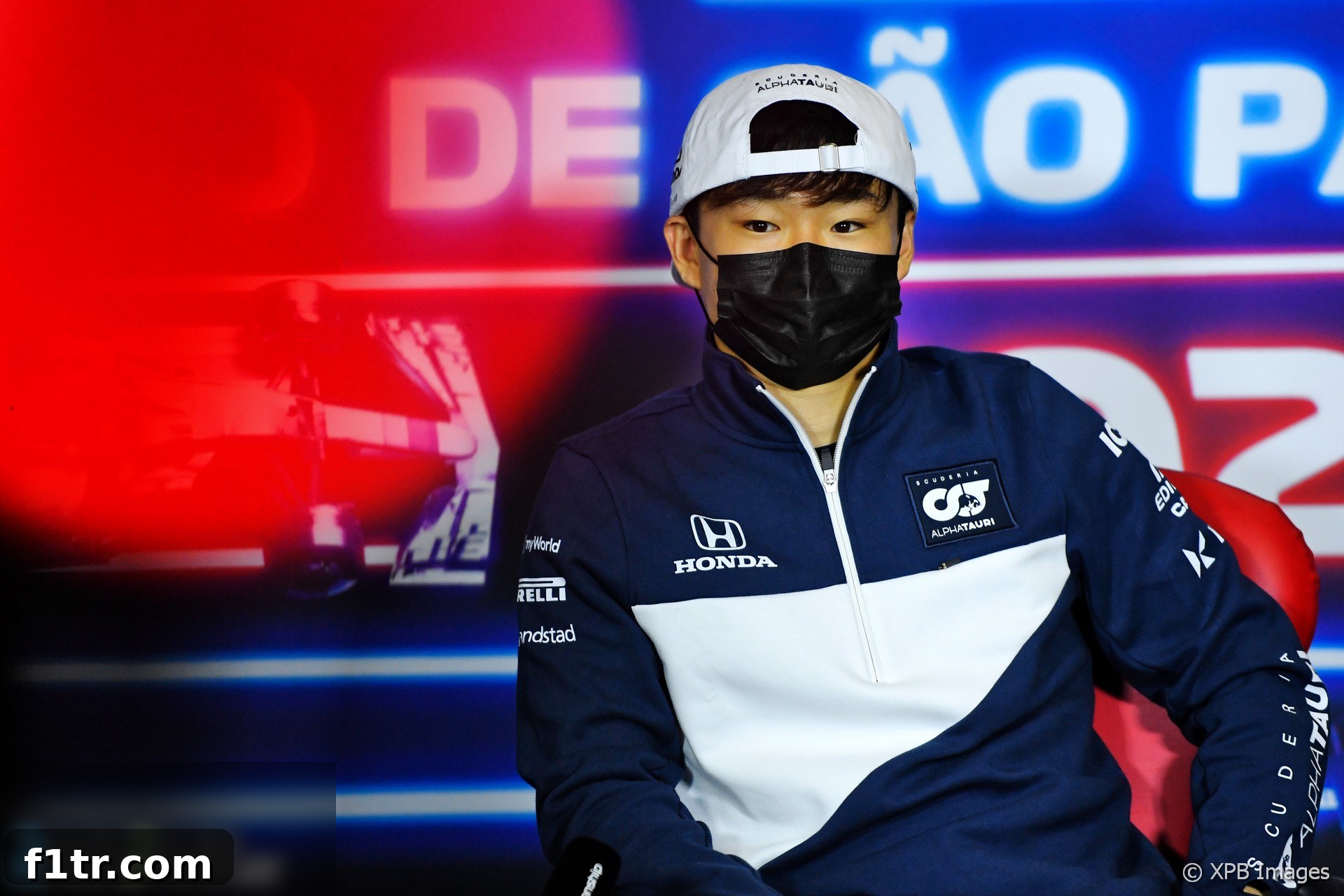
[raceweekendpromotion]Yuki Tsunoda found himself at the center of a significant post-qualifying discussion following a contentious incident during Q3 at the Mexican Grand Prix. The young AlphaTauri driver engaged in crucial talks with his team’s engineers and senior Red Bull management to fully dissect the events that unfolded on track.
Advert | Become a Supporter & go ad-free
The incident in question saw both Red Bull Racing drivers, Sergio Perez and Max Verstappen, unable to improve their critical final lap times in the dying seconds of the qualifying session at the renowned Autodromo Hermanos Rodriguez. The reason? They encountered Tsunoda on his cool-down lap. While Tsunoda diligently moved off the racing line to allow the faster cars through, the timing proved exceptionally unfortunate. Sergio Perez had to run wide to avoid further impeding, and Max Verstappen, seeing the compromised situation, was forced to back off, effectively losing his chance to challenge for pole position.
The Controversial Moment: Q3 in Mexico
Qualifying sessions in Formula 1 are high-stakes affairs, with every tenth of a second making a monumental difference, especially in the crucial final segment, Q3. Drivers push their cars to the absolute limit, seeking the perfect lap to secure the best possible grid position. The 2021 Mexican Grand Prix Q3 was no exception, promising a thrilling climax. As the clock ticked down, the Red Bull duo of Verstappen and Perez were on flying laps, poised to challenge for pole. However, their hopes were dashed when they came across Yuki Tsunoda, who was easing off after completing his own run.
Tsunoda’s attempt to yield was clear; he steered his AlphaTauri off the racing line. Yet, the narrow margins and high speeds of F1 meant that even this effort wasn’t enough to prevent disruption. Perez, having to react quickly, went wide, compromising his corner entry and exit. Verstappen, observing the developing situation ahead, instinctively lifted off the throttle, recognizing that his lap was already compromised. This immediate impact on two championship-contending drivers ignited a swift and significant reaction within the paddock and among fans.
Initial Reactions and the “Tsunoda’d” Remark
In the immediate aftermath of the qualifying session, the frustration within the Red Bull garage was palpable. Christian Horner, Red Bull Racing’s team principal, wasted no time in expressing his disappointment. His memorable comment, describing his drivers as having been “Tsunoda’d,” quickly became a talking point, fueling online discussions and placing the spotlight firmly on the rookie driver. This type of public criticism, even if born of raw emotion, can be incredibly taxing for any athlete, particularly a young driver still finding his footing in the intense world of Formula 1.
The media quickly picked up on Horner’s remark, amplifying the narrative that Tsunoda was at fault. However, as cooler heads prevailed and more information surfaced, the perspective began to shift. Horner himself later acknowledged that Tsunoda “could have been helped a bit more” by his team, hinting at deeper issues than just driver error. This shift from immediate blame to a more nuanced understanding underscored the complexities of real-time decision-making and communication in the sport.
Tsunoda’s Perspective and Team Dialogue
Speaking to RaceFans, Yuki Tsunoda offered his candid thoughts on the incident and the extensive discussions that followed. “We spoke lots of things about the quali three situation,” Tsunoda confirmed, indicating the seriousness with which the incident was addressed. He revealed that his AlphaTauri engineers were understanding of his predicament, recognizing that he had been warned too late about the approaching Red Bull cars.
“The engineers agree that I couldn’t do anything more than really that [in the] situation,” he stated, providing crucial insight into the team’s internal assessment. This exoneration from his own team was a significant step, validating his actions on track given the information he had at the time. However, the discussions didn’t stop there. Tsunoda and his team identified a critical area for improvement: radio communication.
“But also at the same time, we can clearly see that there’s a space that we have to learn about radio conversation,” Tsunoda admitted. He highlighted the dual responsibility in such situations: “I think [if] we have had more information before that or if I’m asking for more information I think we could [avoid] that situation as well. So it’s just really unfortunate situation.” This reflective self-assessment from Tsunoda demonstrates a maturity beyond his years, acknowledging that proactive information gathering from a driver can be as vital as timely information delivery from the pit wall. The collaborative learning process between driver and engineers is paramount in an environment where split-second decisions dictate outcomes.
Red Bull’s Official Stance: Clarity from the Top
Beyond the discussions with his immediate AlphaTauri team, Tsunoda also engaged directly with members of the senior Red Bull outfit, their sister team. “I spoke with a Red Bull as well the day after and we had a good chat and I also heard from their perspective about the quali three,” he shared, emphasizing the open dialogue that took place. This comprehensive approach ensured that all parties understood the full context of the incident and could move forward constructively.
Further reinforcing this collaborative understanding, Red Bull motorsport consultant Helmut Marko, a figure known for his direct and often unvarnished assessments, publicly backed Tsunoda. Speaking to Sky on the day after qualifying, Marko emphatically stated, “It wasn’t the fault of Yuki. Where should he go? He should have been told earlier go out of the way [because] the cars were coming.” Marko’s clear statement provided definitive closure on the matter from Red Bull’s side, unequivocally shifting the primary responsibility away from Tsunoda’s on-track actions and towards the team’s communication protocols. This support from a key figure like Marko was undoubtedly a relief for Tsunoda, helping to alleviate the immense pressure that had mounted following the initial outcry.
Advert | Become a RaceFans supporter andgo ad-free
Lessons Learned and Future Implications for F1 Communication
The Q3 incident at the Mexican Grand Prix, while initially contentious, ultimately served as a valuable learning experience for Yuki Tsunoda, AlphaTauri, and indeed, the broader Red Bull family. It underscored the absolute criticality of precise and timely radio communication in the fast-paced, high-pressure environment of Formula 1 qualifying. In a sport where even fractions of a second can determine success or failure, a few moments’ delay in conveying crucial track information can have significant consequences, not only for the driver involved but also for competitors.
For Tsunoda, this event was a crucial part of his ongoing development as an F1 driver. Navigating traffic efficiently, especially when other cars are on hot laps, is a skill that comes with experience. More importantly, understanding the nuances of how and when to request information from the pit wall, and how to interpret it under pressure, is vital. His willingness to engage in discussions, accept areas for improvement, and integrate feedback demonstrates a strong professional ethos that bodes well for his future career.
For AlphaTauri, the incident prompted a review and refinement of their communication strategies during critical qualifying moments. Ensuring that drivers receive early, clear, and actionable warnings about approaching cars or evolving track conditions is paramount. This includes optimizing radio message brevity and clarity, as well as establishing clear protocols for different scenarios.
The collective understanding reached by all parties—Tsunoda, AlphaTauri engineers, and Red Bull management—highlights a healthy team culture focused on problem-solving rather than simply assigning blame. This proactive approach to learning from incidents is what drives continuous improvement in Formula 1, ensuring that such “unfortunate situations” are minimized in the future. The episode serves as a powerful reminder that while drivers are the ones on track, success in F1 is a meticulously coordinated team effort, where every link in the communication chain must function flawlessly.
Further F1 Reading and Related News
2021 Sao Paulo Grand Prix
- Red Bull and Mercedes summoned to FIA hearing on review of Sao Paulo incident
- McLaren must “get back to scoring the results that are on the table” – Seidl
- Hamilton makes his second-biggest climb to victory from 10th on the grid
- F1 releases missing video footage from Verstappen’s car of Hamilton incident
- How Alonso and Ocon “pushed team tactics to the ultimate limit” to delay Gasly
Browse all 2021 Sao Paulo Grand Prix articles