Formula 1 Grid 2025: A New Era of Blended Experience and Youth
The 2025 Formula 1 season is poised to mark a significant inflection point in the sport’s illustrious history, ushering in an unprecedented blend of seasoned veterans and burgeoning young talent. As the lights prepare to go out for the season opener in March, the grid will feature a unique demographic landscape, characterized by the return of two drivers over the age of 40 – a phenomenon not witnessed in over a decade. This convergence of invaluable experience and raw potential signifies a fascinating dynamic for the championship, promising a season rich with compelling narratives, fierce competition, and a compelling glimpse into the future of elite motorsport. Beyond the headlines of age, the underlying currents suggest a profound changing of the guard, with new faces making their full-season debuts and established figures embarking on fresh challenges, all while the sport itself continues its global expansion and evolution.
The Enduring Prowess of F1’s Veterans
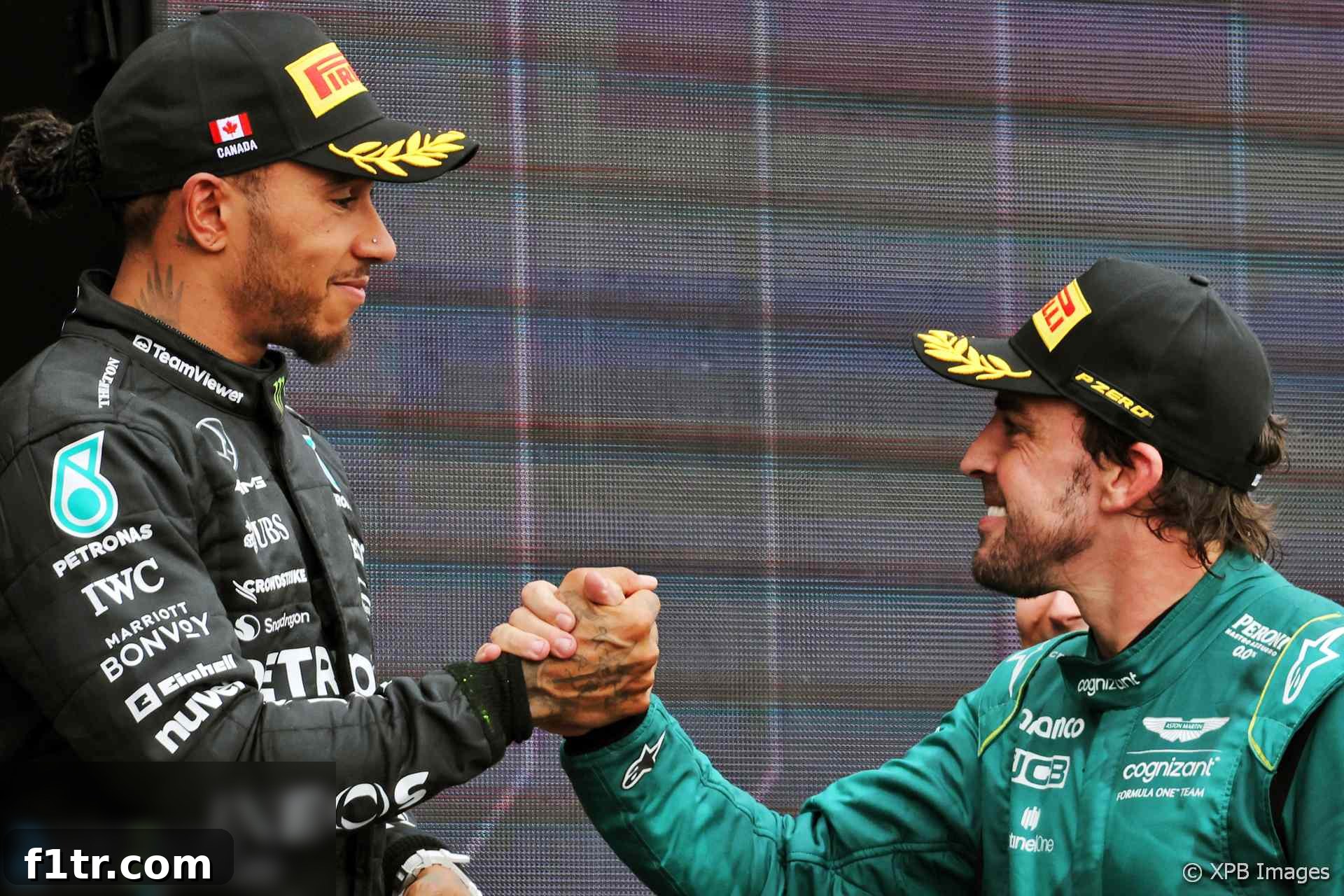
For the first time since the legendary Michael Schumacher and Pedro de la Rosa graced the grid in 2012, Formula 1 will witness two drivers over the age of 40 competing for glory. Lewis Hamilton, a seven-time world champion and one of the sport’s most decorated figures, celebrated his 40th birthday earlier this month. His continued presence embodies resilience, an unwavering pursuit of excellence, and an undiminished hunger for further success. Joining him in this exclusive club is Fernando Alonso, the two-time world champion, who will turn 44 later this year. Alonso’s remarkable career resurgence and consistent performance in recent seasons have solidified his reputation as one of F1’s most tenacious and strategic racers.
Their continued participation at the pinnacle of motorsport is a testament not only to their extraordinary physical conditioning and mental fortitude but also to the evolving longevity of athletic careers in demanding sports like Formula 1. These veteran drivers, with decades of experience between them, continue to defy conventional expectations, proving that age is merely a number when combined with relentless dedication, cutting-edge training, and an unquenchable desire to win. Their experience, strategic acumen, and unparalleled racecraft offer an invaluable benchmark for the younger generation, providing a fascinating contrast in driving styles and approaches to Grand Prix weekends. Their battles and mentorship, whether direct or indirect, will undoubtedly shape the competitive narrative of the 2025 season.
A Youthful Surge: The Changing of the Guard
Despite the notable presence of these two seasoned champions, the overall complexion of the 2025 grid skews significantly younger than in recent memory. The average age of competitors for this year’s season-opener in Australia is projected to be 27.2 years, a notable decrease from 29.4 years at the start of the 2024 season in Bahrain. This significant shift underscores a clear changing of the guard that has transpired during the off-season. Several experienced race-winners and consistent performers, including Sergio Perez and Valtteri Bottas, have departed the grid, following the earlier exit of Daniel Ricciardo shortly before the end of last year. Their places have been eagerly filled by an exciting wave of six drivers embarking on their first full seasons in Formula 1, signaling a deliberate and widespread investment in the sport’s future talent pool.
Among this fresh contingent is Andrea Kimi Antonelli, a highly anticipated talent who, at 18 years and 203 days old at the start of the new season, will be F1’s youngest rookie since Lance Stroll made his debut in 2017. Antonelli arrives with a formidable junior career record, carrying immense expectations as a Mercedes-backed prodigy. He will be joined by another prodigious teenager, 19-year-old Oliver Bearman, making this the first time since 2017 (when Lance Stroll and Max Verstappen began the season as teenagers) that a Formula 1 season commences with two drivers under the age of 20 on the grid. This unique age spread now sees two drivers in their teenage years, two in their thirties, two in their forties, with the remainder predominantly in their twenties. This creates a truly diverse and compelling competitive landscape, where the wisdom of age will clash with the audacious spirit of youth, promising a fascinating season with established stars battling against eager newcomers for supremacy.
The Stories Behind the Numbers: F1’s Career System
Since the FIA introduced the permanent career number system in 2014, each Formula 1 driver has chosen a unique identifier that stays with them throughout their journey in the sport. This system has added a layer of personal branding and historical resonance, allowing fans to associate specific numbers with their favorite drivers and their legacies. The influx of new talent for 2025 has brought several iconic numbers back to the grid, evoking memories of past champions and beloved figures, further enriching the sport’s narrative. Gabriel Bortoleto, for instance, has proudly taken number 5, famously used by four-time world champion Sebastian Vettel during his illustrious career. This choice instantly connects Bortoleto to a legacy of success, precision, and championship-winning pedigree.
Similarly, Jack Doohan has chosen number 7, a digit synonymous with the immensely popular 2007 world champion Kimi Räikkönen, often referred to affectionately as ‘The Iceman.’ Räikkönen’s distinctive personality, raw speed, and immense global following make number 7 a fan favorite, now carried by a promising new talent aiming to forge his own path. Isack Hadjar will sport number 6, which was famously used by Nico Rosberg when he clinched the world championship title in 2016. While that number was more recently associated with Nicholas Latifi from 2020-22, its return to the grid still carries the weight of a championship victory and a significant chapter in F1 history. Liam Lawson, continuing his journey after impressive substitute appearances, will again use number 30, a number previously seen on Jolyon Palmer’s Renault in 2017. Andrea Kimi Antonelli, another highly anticipated rookie, will carry number 12, a number that last appeared on Felipe Nasr’s Sauber in 2016. These numerical choices are rarely random; they often reflect a driver’s inspiration, a tribute to a hero, or simply a personal preference that now becomes an indelible part of their F1 identity and brand.
The Unique Choice: Oliver Bearman’s #87
Among the returning and newly chosen numbers, Oliver Bearman stands out for selecting a number that no one has used since the current career number system was implemented in 2014. His choice, number 87, is remarkably unique and carries a fascinating historical footnote. In fact, this specific number has only appeared on an F1 car once in the sport’s entire world championship history: on Yves Girard-Cabantous’ Talbot at the 1951 German Grand Prix. While the number 87 was also utilized by various drivers who competed in the Indianapolis 500 when it briefly counted towards the world championship – although it’s crucial to note those were not Formula 1 cars – Bearman’s selection marks a truly fresh start on the modern grid. This bold and unusual choice highlights a desire for Bearman to forge his own path and create a new legacy, distinct from any recent F1 history, making him an instant talking point as he begins his full-time career and looks to carve his name into the sport’s annals with a number that is uniquely his.
Consistency Amidst Change: Unaltered Line-ups
In a season marked by significant driver movement and widespread changes across the grid, only two teams have opted to retain their driver line-ups from the previous year. This strategic decision highlights a strong commitment to continuity, stability, and belief in their existing partnerships. Aston Martin will once again field the experienced pairing of Fernando Alonso and Lance Stroll. This duo enters their third consecutive season as teammates, a partnership that has seen them contribute significantly to the team’s ongoing development and ambitious pursuit of competitiveness at the sharp end of the grid. Their combined experience, deep familiarity with the team’s operations, and understanding of the car’s characteristics are considered crucial assets in a rapidly evolving technical and sporting landscape.
Similarly, McLaren will continue with the formidable duo of Lando Norris and Oscar Piastri. This dynamic pairing, too, embarks on their third season together, having rapidly established themselves as one of the most exciting and potent partnerships on the grid. Both drivers have demonstrated exceptional pace, mature racecraft, and a remarkable ability to work cohesively, driving McLaren’s impressive resurgence in recent seasons and positioning them as strong contenders. The stability in these two teams offers a fascinating contrast to the widespread upheaval elsewhere, potentially providing them with an invaluable advantage in terms of driver-team synergy, consistent feedback for development, and a focused approach from the very start of the championship. Their unchanged rosters signify profound confidence in their current trajectories and a firm belief that consistency in the cockpit will yield stronger, more predictable results in the fiercely competitive world of Formula 1.
National Representation: Shifts and Resurgences
The geographical tapestry of the Formula 1 grid is undergoing notable changes for 2025, reflecting the global ebb and flow of talent in motorsport and the sport’s ever-widening reach. One significant development is the absence of a Mexican driver for the first time since 2010, the season before Sergio Perez made his impactful debut. Perez’s departure from a full-time seat leaves a notable void, particularly for the sport’s fervent fanbase in Mexico, who have passionately supported their national hero for over a decade. Consequently, the eagerly anticipated Mexican Grand Prix is set to be the first without a home driver since 1992, an emotional moment for local supporters who have grown accustomed to cheering on a national icon. This highlights the profound cultural and economic impact a single driver can have on the national identity and attendance of a Grand Prix.
Conversely, the arrival of Isack Hadjar will significantly boost the French contingent on the grid, bringing the total to three drivers from France. This resurgence in French talent is particularly noteworthy given that the French Grand Prix itself dropped off the F1 calendar in 2022, demonstrating that national talent can thrive and emerge even without a home race to inspire them directly. Similarly, Oliver Bearman’s debut increases the British population on the grid to four drivers, reinforcing the United Kingdom’s long-standing position as a powerhouse in motorsport talent development and home to numerous F1 teams. Furthermore, the continued presence of London-born Thai racer Alexander Albon means that a remarkable quarter of the entire grid can proudly call the United Kingdom their home, underscoring the UK’s deep roots, extensive motorsport infrastructure, and unparalleled contribution to Formula 1. This diverse representation adds to the rich cultural mosaic that defines the sport’s global appeal.
The return of full-time representation for two other significant motorsport nations also marks a pivotal moment for 2025. Brazil, a country with an unparalleled legacy in Formula 1 through legends like Senna, Piquet, and Fittipaldi, will once again have a full-time driver on the grid for the first time since Felipe Massa concluded his illustrious career in 2017. This much-awaited return comes courtesy of Gabriel Bortoleto, the reigning Formula 2 champion from 2024. Bortoleto’s direct step-up to F1 as the current F2 champion is a notable achievement, making him the first reigning F2 champion to do so since Mick Schumacher in 2021. While Aston Martin has not yet seen fit to provide 2022 F2 champion Felipe Drugovich with a full race seat, Bortoleto’s presence for Sauber injects renewed hope, excitement, and national pride into Brazilian motorsport, filling a long-standing void.
Italy, another nation deeply embedded in Formula 1’s heritage and home to iconic teams, also welcomes a full-time driver with Andrea Kimi Antonelli’s highly anticipated debut. This marks Italy’s return to a full-time grid slot since Antonio Giovinazzi lost his seat at the end of 2021. Both Bortoleto and Antonelli represent the future of their respective nations in Formula 1, carrying the hopes and expectations of millions of passionate fans and adding further layers of national pride to the global spectacle that is Formula 1. Their arrival underscores the enduring appeal of the sport in countries with rich motorsport traditions.
Strategic Returns and Rebranding: Sauber’s Evolution
The 2025 season will also be characterized by significant team evolutions and strategic personnel moves that will shape the competitive landscape for years to come. Nico Hulkenberg, a driver known for his consistency, extensive experience, and ability to extract performance from various machinery, makes a notable return to Sauber, a team he previously drove for in 2013. This marks the second time Hulkenberg has rejoined a former outfit, having previously left and subsequently returned to Force India in 2012 and 2014, respectively. His extensive technical knowledge, adaptability, and calm demeanor will be invaluable as Sauber embarks on its final year under its current identity before a monumental transformation into a full-fledged factory team.
Indeed, this season represents Sauber’s swansong under its long-standing identity. The Swiss-based team has a rich history of rebranding and adapting to various manufacturer partnerships, having previously operated as BMW Sauber after 2005 and then as Alfa Romeo from 2018. For 2026, it is set to undergo its most significant metamorphosis yet, becoming the factory Audi team. This transition marks a thrilling new chapter for both the team and Formula 1, bringing another major premium automotive manufacturer into the sport with a full factory entry. The anticipation around Audi’s entry has been building for years, and 2025 will serve as a crucial preparatory phase, laying the groundwork for what promises to be an ambitious, high-profile, and technologically advanced campaign on the world stage.
Anticipating Grid Expansion: Cadillac’s Arrival
Beyond team rebrands and driver movements, the 2025 season is widely expected to be the last year featuring a grid of just 20 cars. There is an agreement in principle for Cadillac, in partnership with Andretti Global, to join the Formula 1 championship in 2026. This potential expansion would boost the field to 22 competitors, a sight not seen in Formula 1 since 2016. The addition of an eleventh team signifies Formula 1’s soaring global popularity, commercial appeal, and the increasing demand for participation at the highest level of motorsport. It promises more opportunities for aspiring drivers, more strategic variety on track, and an even greater spectacle for fans worldwide, with additional cars to follow and new narratives to unfold.
The prospect of Cadillac, an iconic American brand with a rich motorsport heritage, entering F1 further solidifies the sport’s strategic growth in the crucial North American market, building on the immense success of new races like Miami and Las Vegas. This expansion underlines the dynamic nature of Formula 1, constantly evolving to meet demand, embrace new participants, and push the boundaries of technology and competition. It ensures the sport’s future remains vibrant, globally resonant, and at the forefront of automotive innovation, promising an exciting new chapter for fans and competitors alike as the grid potentially grows.
A Season of Unprecedented Dynamics and Future Promises
The 2025 Formula 1 season is shaping up to be one of the most intriguing and pivotal in recent memory, defined by a captivating interplay of enduring experience, youthful exuberance, and significant structural changes. From the historic return of over-40 champions Lewis Hamilton and Fernando Alonso to the exhilarating debut of teenage prodigies Andrea Kimi Antonelli and Oliver Bearman, and from the reintroduction of iconic driver numbers to the anticipation of major team rebrands and potential grid expansion, every element points towards a championship filled with drama, innovation, and unforgettable moments. The unique blend of seasoned veterans and fresh talent, coupled with the strategic shifts among teams and the prospect of new manufacturers, sets the stage for a truly transitional and exciting period for Formula 1. As the sport continues to push boundaries on and off the track, 2025 promises to be a pivotal chapter, shaping the narrative for years to come and reinforcing F1’s position as the undisputed pinnacle of global motorsport.