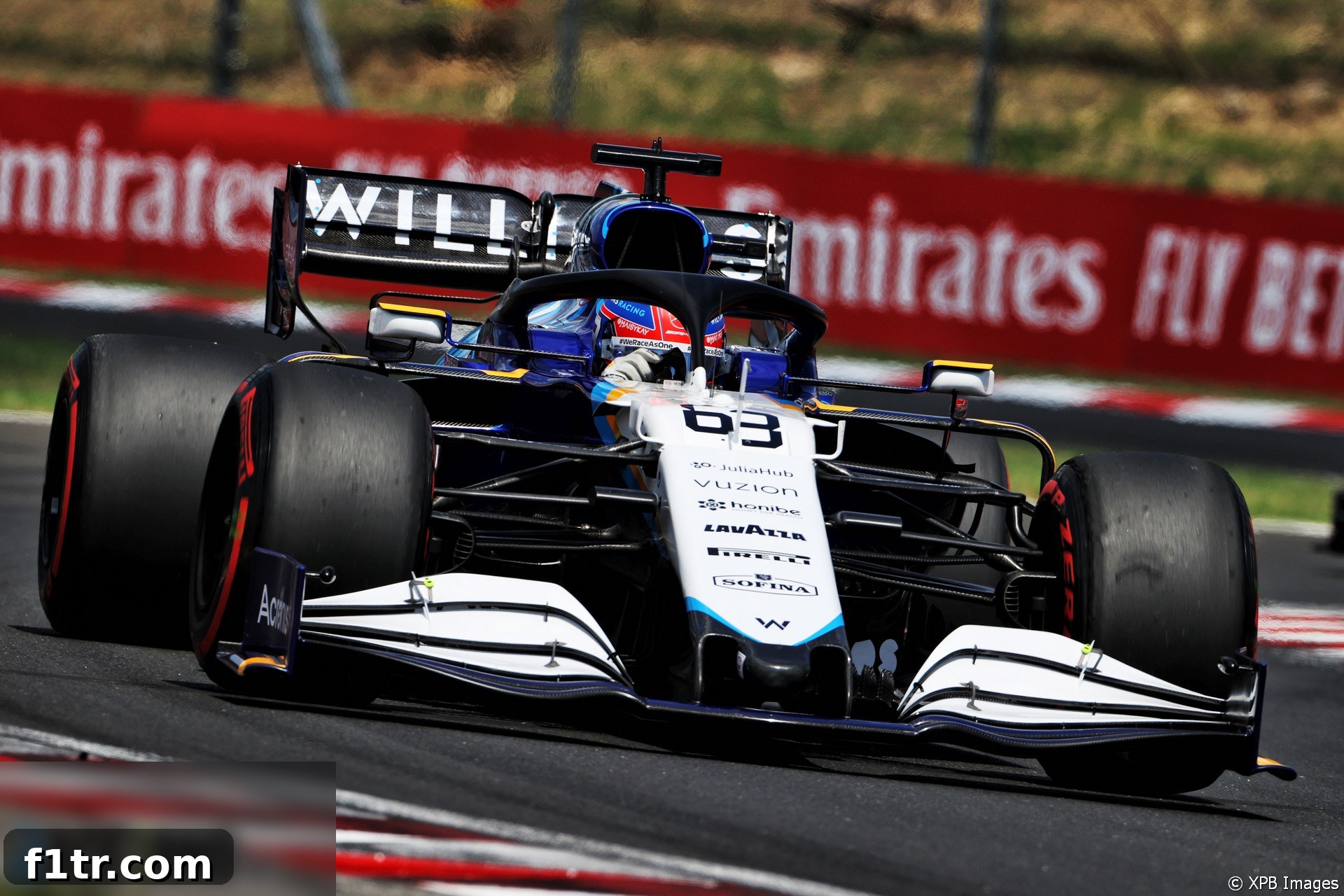
In a stunning turn of events that sent ripples through the Formula 1 paddock, George Russell, widely regarded as one of the sport’s most promising talents and a qualifying specialist, found himself eliminated in Q1 for the first time since the 2020 season. This unexpected exit occurred during qualifying for the Hungarian Grand Prix at the challenging Hungaroring circuit, a track where Williams Racing had harbored significant hopes for a strong performance.
The young British driver had arrived in Budapest with considerable momentum, having consistently propelled his Williams FW43B into the second and even third qualifying sessions in recent races. His impressive run included reaching Q3 at the Austrian Grand Prix and securing strong Q2 appearances, marking a significant uplift in Williams’ competitiveness and Russell’s personal stock. Anticipation was high that the tight, twisty nature of the Hungaroring, often likened to a street circuit without the walls, would play into the strengths of the Williams chassis, potentially offering another opportunity for Russell to battle for points.
However, reality proved to be a stark contrast to expectations. Russell fell at the very first hurdle in qualifying, managing to outperform only his teammate Nicholas Latifi and the two Haas drivers, Mick Schumacher and Nikita Mazepin. This outcome was a bitter pill to swallow for a driver who had confidently stated pre-weekend, “Ahead of the weekend I thought Q2 would be a breeze.” The ease with which he had previously progressed seemed to vanish under the Hungarian sun, leaving him searching for answers and highlighting the unpredictable nature of Formula 1 qualifying sessions.
“For whatever reason, I just haven’t had the same rhythm as I have at other circuits,” Russell admitted, articulating the frustration of a driver whose confidence in his machine and his ability to extract its maximum potential had been a hallmark of his season. The Hungaroring, with its relentless sequence of corners and minimal straights, demands absolute precision, a perfect synergy between driver and car, and a chassis that responds crisply to every input. Without that crucial “rhythm,” even the most talented drivers struggle to unlock performance, losing critical tenths that can separate success from an early exit in the fiercely competitive midfield.
The surprise elimination was all the more perplexing given Williams’ previous assessments of the Hungaroring. “Ahead of the season, I would have said this would have been our strongest circuit and our best opportunity,” Russell revealed. This sentiment was based on the track’s characteristics, which traditionally favour cars with strong aerodynamic performance in medium and low-speed corners over outright engine power – an area where Williams often finds itself at a disadvantage compared to its rivals. The team had identified Budapest as a prime chance to shine, making the Q1 exit a particularly hard blow. “Yet it’s the first time we’ve not made it through to Q2,” he added, underlining the unprecedented nature of the setback for the season and the unexpected dip in their perceived potential.
Despite the palpable disappointment, Russell maintained a philosophical outlook. “Obviously I’m a bit disappointed now, but as I said, we can’t get it right every time.” This mature perspective highlighted his understanding that Formula 1 is a sport of fine margins and constant adaptation, where even the most meticulous preparations can sometimes fall short due to unforeseen variables or subtle changes in conditions. It’s a testament to the demanding environment F1 drivers operate in, where perfection is strived for but rarely achieved.
Delving deeper into the potential causes of Williams’ unexpected struggle, Russell confessed he was “not too sure exactly” why their competitiveness waned. However, he did point to prevailing weather conditions as a possible contributing factor. “It’s definitely windier and gustier than it has been at the last four events, which definitely does not play in our favour. It’s fine margins.” Wind can have a disproportionate effect on Formula 1 cars, especially those running on the edge of aerodynamic stability. Gusts can destabilize the car mid-corner, reduce downforce, and make it incredibly difficult for a driver to commit to corner entry and exit points, disrupting the crucial “rhythm” Russell spoke of. For a team like Williams, constantly pushing the limits to compete with better-funded rivals, these fine margins can make all the difference between progressing and being eliminated, particularly on a circuit where stability and consistent aero are paramount.
Russell further elaborated on his personal struggle behind the wheel. “Usually, I get going in qualifying and I’m in a groove and I can just pull the lap out. And today I knew when I crossed the line, it just didn’t come together for me. I didn’t have that good feel, that right rhythm with the car, with the tyres.” This candid admission highlights the intensely psychological aspect of Formula 1 qualifying. Drivers often describe entering a “zone” where the car becomes an extension of their will, allowing them to extract every ounce of performance. When that connection is absent, even a fraction of a second can be lost, enough to drop them out of contention in a fiercely competitive session like Q1. “I knew it wasn’t good enough. Usually it just sort of comes to me much easier and then when I go into Q2, I can make another step up from there,” he added, contrasting his usual effortless ascent through qualifying with the struggles faced that day, underscoring the extent of his difficulty in finding the sweet spot.
Adding another layer to the narrative was Williams’ qualifying strategy. Russell revealed that the team opted for only two attempts to set a competitive time in Q1, a decision driven by the desire to conserve fresh sets of tyres for potential use in Q2 and Q3. This is a common strategic play, especially for teams battling in the midfield, as having fresh rubber in later sessions can be a significant advantage, potentially allowing for a higher grid slot. However, it also carries an inherent risk: if the initial two runs aren’t good enough due to unexpected pace or track conditions, there’s no backup opportunity.
Russell drew a comparison with their rivals, explicitly mentioning the Alfa Romeo team. “The Alfa Romeo drivers did three sets of tyres. If we did three sets of tyres we’d’ve got through to Q2, but we would have had a lesser shot in Q2 to get into Q3.” This perfectly encapsulates the strategic tightrope walked by teams outside the absolute front runners. Do you guarantee safe passage into Q2 by using more resources, potentially compromising your Q3 ambitions? Or do you gamble, commit fewer tyres to Q1, and maximize your chances for a higher grid slot, albeit with the risk of early elimination? It’s a calculated gamble that often defines the qualifying narrative for many teams.
“So it depends on how you want to play your cards,” Russell explained. “I don’t want to sit on the fence, I want to put everything on the table, and that’s why we decided to only use the two sets of new tyres and really go for it for Q2 to get a shot into Q3. So it’s one of those things and we just have to try and understand why.” The team’s aggressive approach, aiming for a bigger prize, ultimately backfired on this occasion. While the strategy was sound in principle, hoping to capitalize on Russell’s ability to extract more from the car in subsequent sessions, it underscored an underlying pace deficit that even optimal tyre management couldn’t overcome on this particular day. The focus now shifts to a thorough analysis by the team to pinpoint whether the issue lay with setup, driver feel, or the overall package’s suitability for the specific track conditions.
The Q1 elimination at a circuit perceived as a strong opportunity casts a shadow over Williams’ immediate aspirations for points. Starting from the back of the grid at the Hungaroring is notoriously challenging, given the circuit’s tight and twisty layout that severely limits overtaking opportunities. Drivers often describe it as Monaco without the barriers, where track position is paramount. Russell’s task for race day will be incredibly difficult, requiring a flawless performance, shrewd strategy, and perhaps a stroke of luck (such as safety cars or adverse weather) to climb up the order and salvage a respectable finish. This result emphasizes the fierce competition in the F1 midfield, where even a slight misstep, a subtle shift in track conditions, or an unlucky strategic gamble can dramatically alter fortunes and derail an entire race weekend, forcing teams and drivers to reflect and regroup for the next challenge.
2021 Hungarian Grand Prix
- Ocon congratulated by past French F1 aces after breakthrough win
- Alpine doubt first win signals a performance breakthrough
- Vettel disqualification hearing to take place on Monday
- Why no one received a Grosjean-style race ban for the Hungarian GP pile-up
- Ocon’s “beautiful” late-stint pace was other key to Alpine’s breakthrough win
Browse all 2021 Hungarian Grand Prix articles