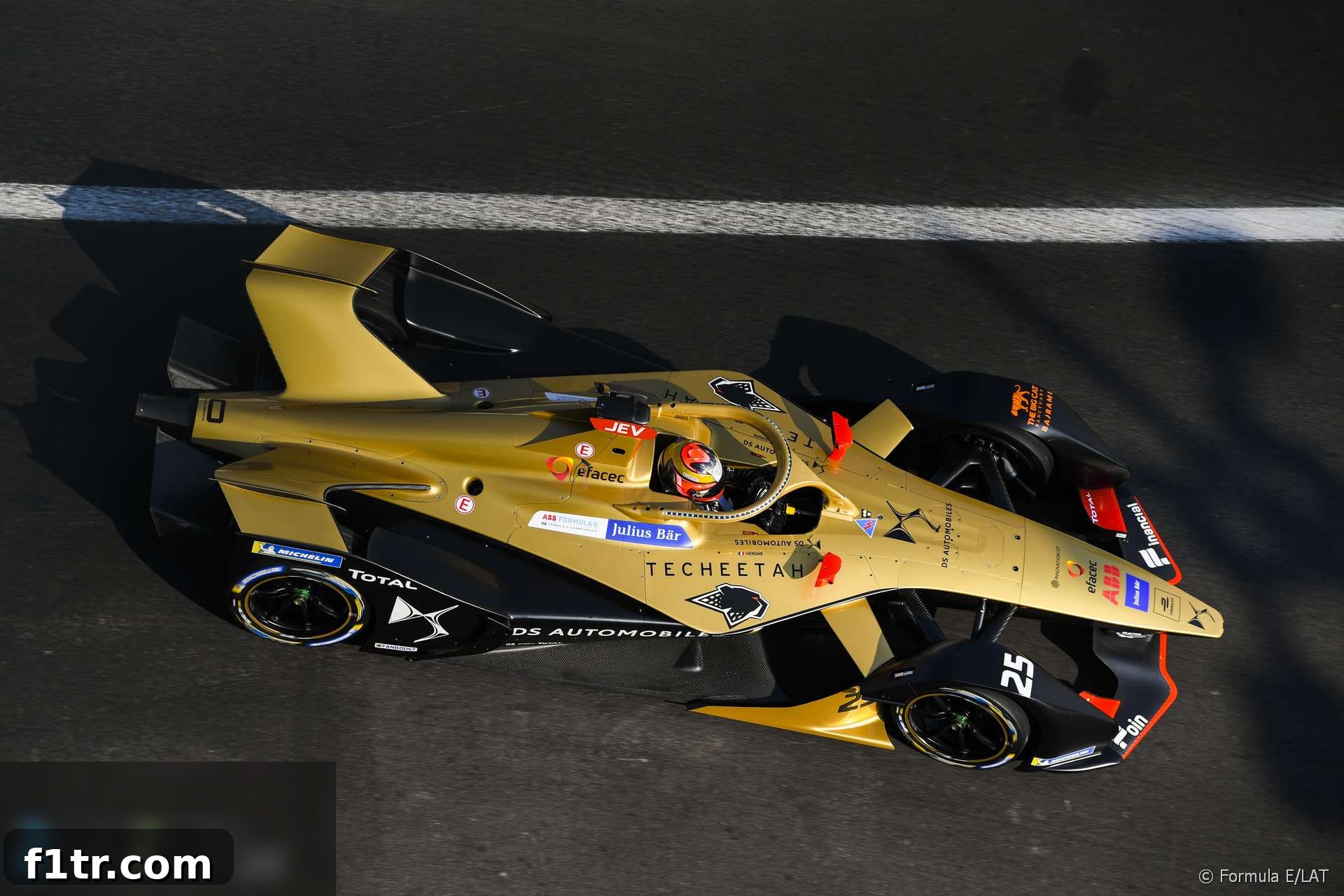
The electrifying atmosphere of the Formula E season finale in New York City culminated in a truly unforgettable race, delivering a thrilling conclusion to a fiercely contested championship. Jean-Eric Vergne of DS Techeetah cemented his status as a Formula E legend, comfortably claiming his second Drivers’ Championship title. The race itself was a spectacle of strategic prowess and dramatic moments, with Robin Frijns of Envision Virgin Racing taking a brilliant second win of the season. However, it was the championship fight, fraught with tension and unexpected twists, that truly captivated audiences, culminating in a dramatic final lap collision between title contenders Lucas di Grassi and Mitch Evans, which inadvertently handed second place in the overall championship standings to the consistent Sebastien Buemi.
This final race of the season was not just about individual glory; it was the ultimate showdown for both the Drivers’ and Teams’ championships, with multiple contenders still in the hunt. The pressure was immense, and the unique challenges of street circuit racing in the heart of Brooklyn were set to push drivers and teams to their absolute limits. The stakes were incredibly high, promising an exhilarating end to what had been an exceptional season of all-electric motorsport.
The Grand Finale: High Stakes in New York City
As the Formula E paddock gathered for the season’s climactic round, the air buzzed with anticipation. The New York City E-Prix, renowned for its challenging track layout and vibrant backdrop, was the perfect stage for the championship decider. With the Drivers’ Championship still mathematically open to Jean-Eric Vergne, Lucas di Grassi, and Mitch Evans, every point, every position, and every strategic decision would prove critical. The narrative of the entire season – a relentless pursuit of performance and consistency – boiled down to these final few laps.
Pre-Race Dynamics and FIA’s Attack Mode Twist
Adding another layer of intrigue to the already complex scenario, the FIA announced a unique alteration to the Attack Mode rules for this specific race. Instead of the customary two mandatory activations seen throughout the rest of the season, drivers would be required to activate Attack Mode three times. This decision, consistent with Formula E’s original plan to vary the length and number of activations, was designed to introduce an additional strategic element, potentially shaking up the established pecking order and forcing teams to rethink their energy management and race pace strategies.
Ahead of the lights out, the championship standings provided a tantalizing prospect. Jean-Eric Vergne held a comfortable lead, but not an unassailable one. Lucas di Grassi and Mitch Evans, although needing exceptional results, were still within touching distance. Evans, in particular, faced the toughest challenge, needing a victory and the fastest lap, coupled with Vergne scoring no points whatsoever, for any realistic chance at the title. Vergne, starting a strategic tenth, was positioned right alongside his closest rival, di Grassi, who started eleventh. This close proximity on the grid promised an immediate head-to-head battle for vital championship points, setting the stage for an intense psychological and on-track duel.
Race Start: Early Action and Championship Implications
When the lights went out, pole-sitter Alexander Sims of BMWi Andretti made a textbook getaway, cleanly holding his lead into the first corner. However, the drama unfolded just behind him. Sebastien Buemi, starting from third position for Nissan e.Dams, demonstrated superb racecraft, mimicking Alex Lynn’s impressive move from the previous day’s race. Utilizing the cleaner side of the grid, Buemi surged forward, snatching second place from Robin Frijns and positioning himself perfectly among the front-runners. The start was crucial, as gaining track position early is often paramount on the tight New York street circuit.
But the race’s early stages were marred by a significant incident that would have immediate implications for the Teams’ Championship. On the very first lap, Andre Lotterer, driving for DS Techeetah, made contact with the rear of Jose-Maria Lopez’s GEOX Dragon car. The collision sent Lopez spinning, and in a bizarre twist of fate, as Lopez’s car righted itself, it then made contact again with Lotterer, dealing a critical blow to Techeetah’s ambitions. At this point, Techeetah’s lead in the Teams’ Championship over Audi was by no means secure, and an early incident involving one of their key drivers was the last thing they needed.
Safety Car and Shifting Fortunes
The situation for DS Techeetah worsened considerably when, with approximately 40 minutes remaining on the race clock, Andre Lotterer was forced to pit due to the damage sustained in the earlier collision. Shortly thereafter, the Safety Car was deployed as Jose-Maria Lopez’s Dragon car, having suffered terminal damage from the initial contact, came to a halt on the track. This intervention neutralised the race, allowing marshals to clear the circuit and reset the field. When the race eventually restarted with just over 34 minutes to go, the order at the very front changed frenetically, with drivers jockeying for position and optimal Attack Mode windows. Crucially, however, these initial changes did not immediately impact the championship fight in a significant way. Mitch Evans remained in eighth, while Lucas di Grassi and Jean-Eric Vergne held tenth and eleventh positions respectively. Although Vergne was outside the points, his relative position to di Grassi meant that, for now, his grip on the championship trophy remained firm.
Mid-Race Battles: Front Runners and Title Contenders
As the race settled into a rhythm, strategic decisions surrounding Attack Mode activations became paramount. The front of the field saw a fierce and captivating duel unfold between Alexander Sims and Robin Frijns. Both drivers displayed exceptional pace and tactical acumen, trading positions and utilising their Attack Mode activations to gain crucial advantages. The battle was intense, with neither driver willing to concede an inch. Eventually, Frijns managed to make a decisive move, passing Sims just before the half-hour mark and taking command of the lead. Despite being harried relentlessly by Sebastien Buemi behind him, Sims held his composure and maintained contact with Frijns, indicating the high level of competition at the sharp end of the grid.
The Championship Chess Match: Vergne, Di Grassi, and Evans
The true heart of the drama, however, lay in the intricate chess match being played out among the championship contenders. Initially, Vergne seemed glued to di Grassi’s rear wing, a strategy of watchful waiting to ensure he finished ahead or scored sufficient points. This close proximity was briefly disrupted when Antonio Felix da Costa managed to split the two title rivals, slotting into tenth place. This was a critical moment; if Vergne scored even a single point, di Grassi and Evans’s task became mathematically harder, almost insurmountable. Recognizing the urgency, Vergne wasted no time, swiftly activating his Attack Mode to reclaim his tenth position from da Costa, reaffirming his determination to control his own destiny. The two championship protagonists remained locked together, their every move scrutinised. Meanwhile, Mitch Evans, demonstrating his fighting spirit, managed to elevate himself to sixth place. This gain was significant, as it positioned him to potentially snatch second place in the overall championship from di Grassi, adding another layer of complexity to the unfolding narrative.
The Scramble for the Teams’ Title
While the Drivers’ Championship dominated the headlines, the battle for the Teams’ Championship was equally intense, primarily fought between DS Techeetah and Audi Sport ABT Schaeffler. With only 24 points separating the two titans, every single point scored by their respective drivers held immense value. As the race progressed, Daniel Abt, driving for Audi, began to make impressive progress, passing Evans for eighth, then seventh, and eventually sixth. This strong performance from Abt, combined with di Grassi’s consistent presence, suggested that Audi’s chances of frustrating Techeetah for one of the titles, much as they had done in the previous season, were looking increasingly likely. The inter-team rivalry added a fascinating strategic dimension, as Audi drivers potentially worked together to maximise their collective points haul.
The Climax: Last Lap Mayhem and Historic Outcomes
As the final minutes ticked away, the tension became palpable. Lucas di Grassi, determined to salvage his championship aspirations, began to move up the field, carving his way through traffic. He found himself separated from Vergne by a descending Stoffel Vandoorne and then Oliver Rowland, while Mitch Evans held out ahead, now strategically sandwiched between the two Audi drivers, Daniel Abt ahead and di Grassi behind. With just three and a half minutes remaining on the clock, a critical warning was issued to Evans: he was advised not to take unnecessary risks with Abt. The implication was clear – Abt, a newly re-signed Audi driver, might be willing to risk a collision or strategic move to allow his teammate, di Grassi, to gain an advantage, potentially at Evans’s expense. This moment perfectly encapsulated the cut-throat nature of championship racing and the strategic alliances within teams.
The Shocking Collision: Di Grassi and Evans Out
The race had been a gruelling, hard-fought contest for the majority of its duration, with drivers pushing the limits of their machines and their own endurance. But no one could have predicted the dramatic conclusion that awaited on the very final turns of the final lap. In a moment of intense desperation and extreme pressure, Lucas di Grassi made a decisive lunge, colliding with Mitch Evans. The impact was significant, sending both cars into the Tecpro barriers. The dreams of a championship for both drivers were shattered in that instant, their machines coming to rest side-by-side, a poignant image of what could have been. It was a cruel and brutal end to a season of relentless effort for both competitors.
Vergne’s Triumph and Buemi’s Unexpected Podium
The immediate consequence of the di Grassi-Evans collision was a stunning shift in the final championship standings. With both drivers eliminated, Sebastien Buemi, who had driven a strong and consistent race to finish third, inherited second place in the overall championship, a truly unexpected but well-deserved outcome for the Swiss driver. Lucas di Grassi, despite the incident, retained third place in the championship due to his points tally accumulated over the season. However, the ultimate victor on the day and for the season was undoubtedly Jean-Eric Vergne. By finishing seventh, he comfortably secured his second Formula E Drivers’ Championship, etching his name further into the sport’s history books. Adding to the celebrations, DS Techeetah achieved a dominant double, securing both the Drivers’ and Teams’ titles, a testament to their exceptional performance and teamwork throughout the challenging season.
Race Review and Final Classification
The New York City E-Prix season finale was a masterclass in motorsport drama, showcasing everything that makes Formula E compelling: strategic energy management, intense wheel-to-wheel racing, and championship narratives that kept fans on the edge of their seats until the very last moment. Robin Frijns’ victory was a fitting reward for his consistent performance, while Vergne’s championship confirmed his status as one of the sport’s greatest. The dramatic conclusion involving di Grassi and Evans will be remembered as a stark reminder of the fine margins in championship battles, and Buemi’s quiet ascent to second place in the overall standings highlighted the importance of consistency. The season closed with DS Techeetah celebrating a double championship victory, solidifying their position at the pinnacle of electric racing.
Provisional Race Classification
1. Robin Frijns (Envision Virgin)
2. Alexander Sims (BMWi Andretti)
3. Sebastien Buemi (Nissan e.Dams)
4. Sam Bird (Envision Virgin)
5. Daniel Abt (Audi)
6. Oliver Rowland (Nissan e.Dams)
7. Jean-Eric Vergne (DS Techeetah)
8. Stoffel Vandoorne (HWA AG)
9. Antonio Felix da Costa (BMWi Andretti)
10. Gary Paffett (HWA AG)
11. Jerome D’Ambrosio (Mahindra)
12. Alexander Lynn (Panasonic Jaguar)
13. Pascal Wehrlein (Mahindra)
14. Oliver Turvey (NIO)
15. Tom Dillman (NIO)
16. Felipe Massa (Venturi)
17. Mitch Evans (Panasonic Jaguar)
18. Lucas di Grassi (Audi)
19 Maximilian Guenther (GEOX Dragon)
DNF Edoardo Mortara (Venturi)
DNF Andre Lotterer (DS Techeetah)
DNF Jose-Maria Lopez (GEOX Dragon)