Red Bull’s Heat Advantage Decisive at US Grand Prix, Hamilton Believes
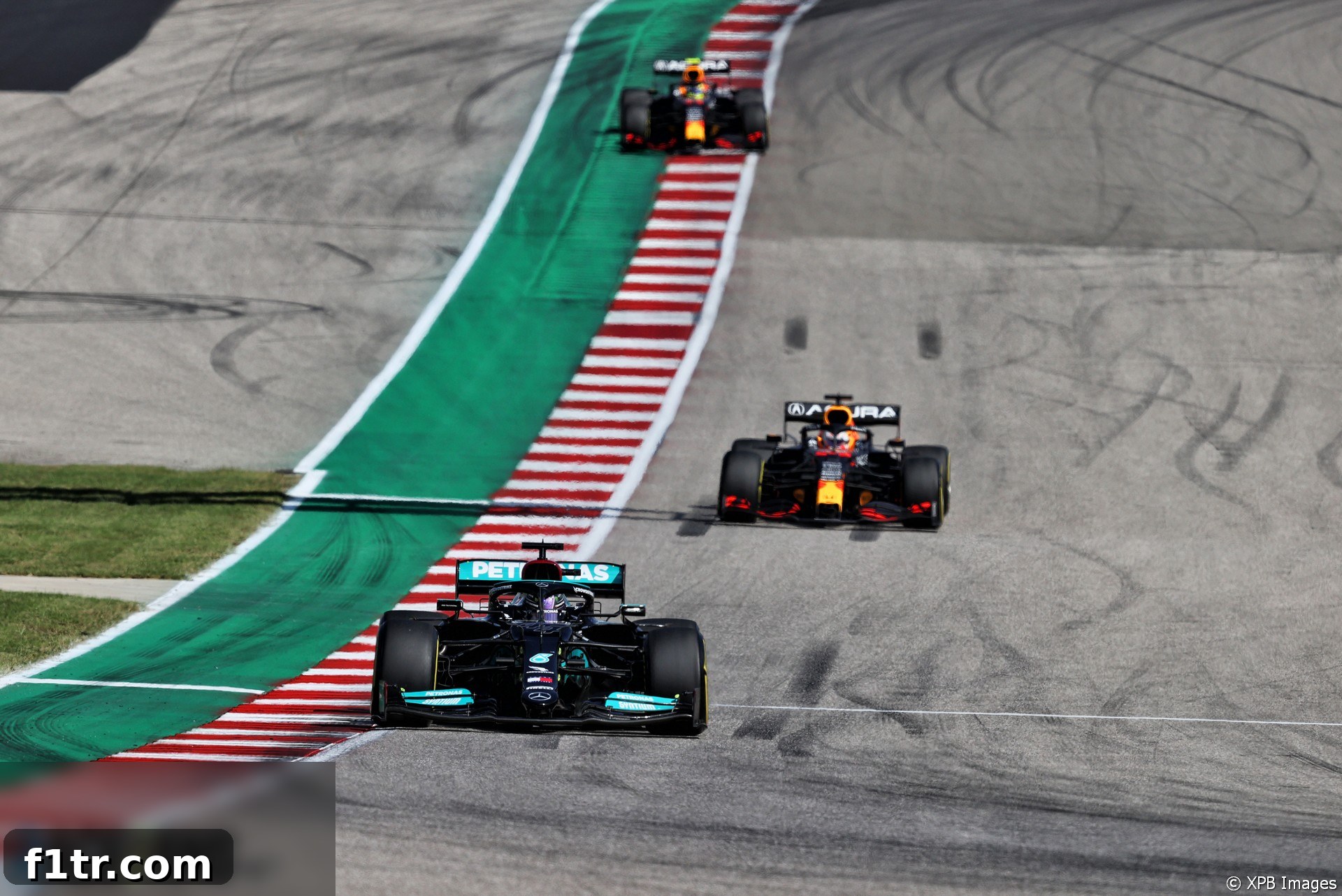
In a pivotal moment of the intensely contested 2021 Formula 1 season, Lewis Hamilton has articulated his belief that Red Bull’s inherent performance advantage, particularly pronounced in hotter conditions, proved to be the decisive factor in their triumph at the United States Grand Prix. The high-stakes race in Austin, Texas, saw the championship contenders lock horns in a strategic and physical battle, ultimately tipping in favour of Red Bull and Max Verstappen.
Advert | Become a Supporter & go ad-free
Advertisement Space
The Mercedes-AMG Petronas driver, Hamilton, initially seized the lead during the opening phases of yesterday’s thrilling race. Despite his strong start, he found himself unable to establish a significant buffer against his primary rival, Max Verstappen, who was lurking ominously close behind. The strategic turning point arrived when Verstappen executed an earlier first pit stop, a bold move that allowed him to get ahead of Hamilton. While the seven-time world champion mounted a relentless pursuit in the latter stages of the race, closing the gap dramatically, he ultimately ran out of laps and opportunities to attempt a decisive overtake.
Following his initial pit stop, where he switched from medium to hard compound tyres, Hamilton appeared to unlock a noticeable performance uplift in his Mercedes W12, seemingly outperforming the Red Bull for a significant portion of the stint. This surge in pace saw him whittle down Verstappen’s substantial 8.8-second lead to less than a single second during the final stint of the race. A crucial element of this late-race charge was the fresher rubber on Hamilton’s car; his hard tyres were eight laps newer than Verstappen’s, theoretically offering a grip and performance advantage that hinted at a potential comeback.
However, despite the tantalizing prospect of a late-race challenge, Hamilton maintained a pragmatic view, convinced that Red Bull held a fundamental performance edge over Mercedes across all tyre compounds throughout the weekend. Reflecting on the race, he stated, “I think they were quicker all weekend, on all tyres today.” This assessment suggests that while Mercedes might have found a window of relative strength on certain compounds or at specific points, the overarching pace belonged to their rivals.
Hamilton further elaborated on the environmental factors that he believes amplified Red Bull’s capabilities. “Just in the heat, I think the real strength has shone through this weekend, a bit like it has in other places, like Bahrain, this year. So I did the best I could with what we had.” This observation highlights a recurring theme in the 2021 season: Red Bull’s ability to extract peak performance in high-temperature conditions. These venues often present unique challenges for tyre management, cooling, and overall car balance, areas where the RB16B chassis, with its distinct aerodynamic philosophy, seemed to thrive. The consistent pattern in races like Bahrain and the United States Grand Prix suggested a fundamental characteristic of the Red Bull package, which appeared particularly potent when track temperatures soared, allowing them to maintain grip and manage degradation more effectively than their Mercedes counterparts.
Mercedes initially demonstrated impressive form as the Austin weekend commenced, with their cars lapping almost a full second faster than Verstappen during the first practice session. This early dominance sparked optimism within the team and among their supporters. However, team principal Toto Wolff later disclosed that the team subsequently made significant alterations to its car’s setup. These changes were necessitated by the notoriously bumpy nature of the Circuit of the Americas, with Wolff stating the adjustments were crucial to prevent the car from being “massacred” by the uneven track surface. Such modifications are common in Formula 1, as teams constantly seek to optimize their car’s suspension and ride height to suit the specific characteristics of each circuit, balancing aerodynamic performance with mechanical grip and driver comfort over challenging terrain.
Despite these extensive alterations, Hamilton expressed skepticism regarding their ultimate impact on the car’s performance. According to the driver, the changes made little significant difference. “There wasn’t a big problem,” he explained. “It was a bumpy circuit, first of all, but we ended up going back to where we started the weekend so there was no problem.” This revelation suggests that the team’s efforts to combat the bumps might have been an overreaction or that the initial setup was, in fact, the most optimal configuration for the conditions. The complex interplay between suspension setup, aerodynamic downforce, and tyre performance on a bumpy track like COTA often leads teams down experimental paths, and in this instance, Mercedes seemingly reverted to their baseline, indicating that the initial settings were perhaps the most balanced compromise.
Further adding to the intricate narrative of Mercedes’ weekend, the team also confirmed that they ran their engines in a higher engine mode during the first practice session. While this practice is not uncommon, as teams often use early sessions to gather data and test the limits of their power units, it can sometimes mislead observers about true race pace. The use of ‘party modes’ or higher-power settings in practice sessions can artificially inflate lap times, making a car appear quicker than it can consistently perform over a full race distance. This factor, combined with the setup adjustments and subsequent reversion, paints a picture of a Mercedes team grappling with optimization at COTA, perhaps struggling to unlock the consistent race-day performance that had been their hallmark in previous seasons.
Hamilton, despite the ultimate outcome, drew considerable satisfaction from his start from second on the grid. He executed a masterful maneuver into turn one, passing Verstappen with precision and claiming the lead in the early stages of the race. This initial success was a moment of pride for the Briton. “I had a great start. The goal was to get in the lead and I finally got a good start – I’ve not had as good a start as that for a long time so I was really happy with it.” His strong getaway showcased his renowned race craft and determination. However, the momentary triumph was soon overshadowed by the relentless pace of Red Bull, leading Hamilton to conclude that his rivals were simply too formidable to overcome in Austin.
“Then it was just about staying clean and coming out ahead and holding onto it. It felt good at the time, to get into the lead, I thought ‘okay, this is step one’ but, as I said, they were just too quick.” Hamilton’s candid assessment underscores the sheer challenge of competing against a Red Bull package that appeared to have an inherent speed advantage, especially when the temperatures rose. The United States Grand Prix result was not just another race victory; it was a testament to Red Bull’s strategic prowess and their car’s specific strengths, further intensifying the already gripping battle for the 2021 Formula 1 World Championship. As the season progressed, every point and every strategic decision became magnified, and Austin served as a stark reminder of the finely balanced competition between the two dominant forces in modern F1.
Advert | Become a RaceFans supporter andgo ad-free
Advertisement Space
2021 United States Grand Prix News & Analysis
- Mercedes encouraged despite ‘toughest race for a long time’ in Austin
- For the sake of the title fight, F1 must get a grip on its track limits problem
- Pit stop problems costing Ferrari “quite a lot of points” – Sainz
- Sold-out crowd of 380,000 at COTA shows F1 can add third US race – Brawn
- While the pressure’s off I can “push myself” more – Russell
Browse all 2021 United States Grand Prix articles