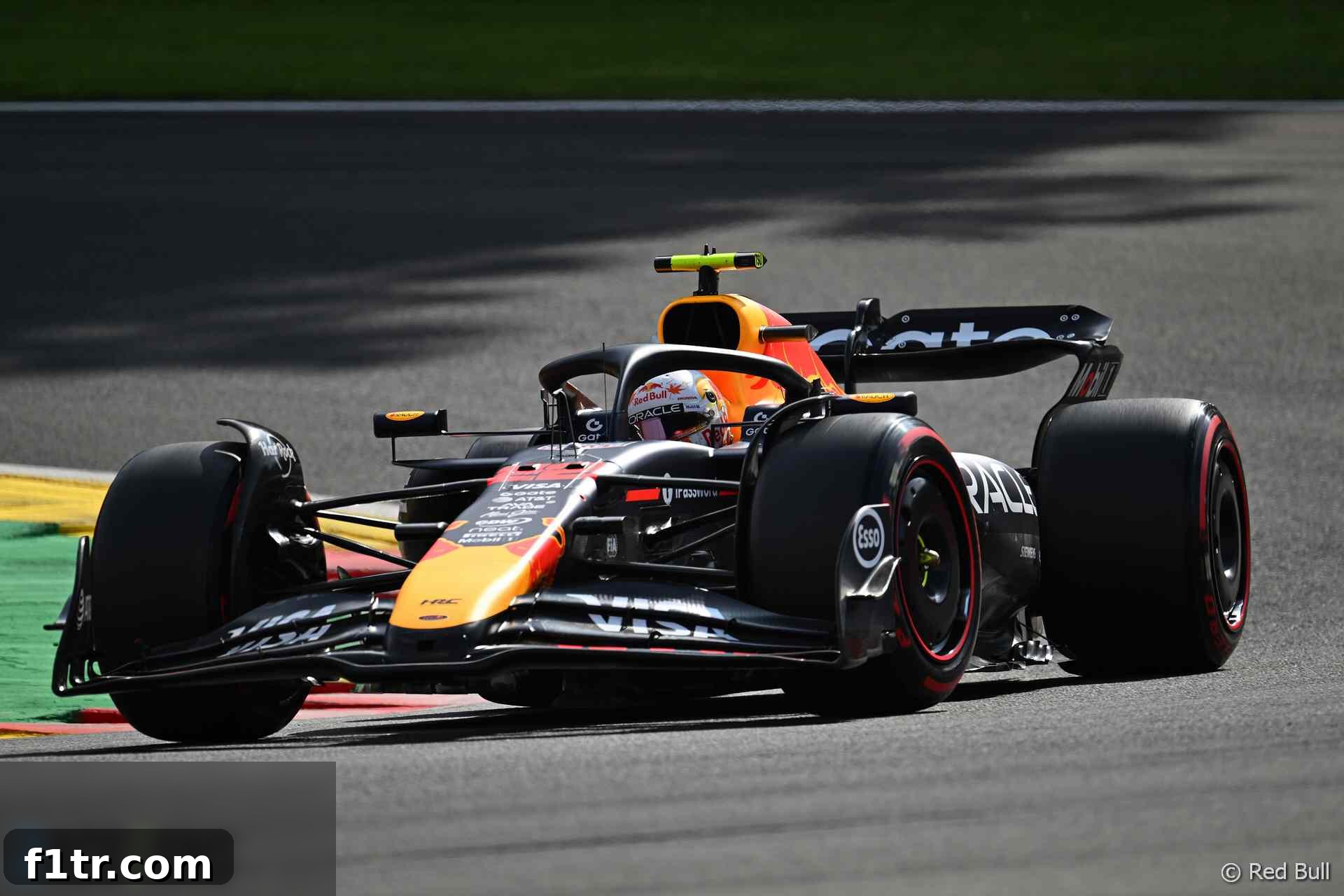
In a bold strategic move ahead of the crucial qualifying session for the Belgian Grand Prix, Red Bull Racing’s new team principal, Laurent Mekies, confirmed that a significant upgrade package had been applied to Yuki Tsunoda’s car. This decision, made under intense pressure and with limited time, paid dividends almost immediately as Tsunoda delivered his best qualifying performance of the season, securing an impressive seventh position on the grid at the iconic Spa-Francorchamps circuit.
The announcement from Mekies came as a pleasant surprise, especially after Tsunoda himself had expressed pre-weekend concerns that his car would be “a couple of steps behind” that of his illustrious teammate, Max Verstappen, in terms of development specification. This candid admission from the Japanese driver underscored the magnitude of the team’s rapid response and their commitment to maximizing the potential of both cars, even under challenging circumstances.
Advert | Become a Supporter & go ad-free
Yuki Tsunoda’s Breakthrough Performance and the Strategic Gamble
Tsunoda’s P7 finish marked a pivotal moment in his season, showcasing not only his growing confidence and skill but also the efficacy of Red Bull’s rapid development cycle. The gap between him and Verstappen, a mere three-tenths of a second over the longest lap on the F1 calendar, was a testament to how well the upgrade package worked and how effectively Tsunoda exploited its benefits. This performance at Spa, a track renowned for its demanding nature and high-speed sections, speaks volumes about the progress both the driver and the team have made.
Laurent Mekies shed light on the high-stakes decision-making process behind the upgrade. “We upgraded his car just before qualifying as we are always pushing to the edge on our car parts quantity,” Mekies explained to the official Formula 1 channel. “But we decided to take the risk to upgrade his car, so that’s why you may have seen we were nearly a bit late to go out in qualifying.” This statement highlights the intricate balance between performance gains and operational risks that top-tier Formula 1 teams constantly navigate. The delay in getting Tsunoda out on track was a minor consequence of a major strategic gamble that ultimately paid off handsomely.
The ‘risk’ Mekies referred to wasn’t merely about time. Rushing new parts to a car before a crucial session involves meticulous checks, potential for unexpected setup issues, and the sheer logistical challenge of integrating components that might have arrived last minute. For a driver like Tsunoda, who has shown flashes of brilliance but also struggled with consistency, such a vote of confidence from his new team principal could be a significant psychological boost. It signifies a belief in his ability to deliver when given the tools, reinforcing his position within the Red Bull driver lineup and potentially influencing future development paths.
Mekies lauded the collective effort, stating that the result was “worth the effort from everyone and certainly it helped in supporting his performance to get to a very, very good level.” This emphasizes the synergistic relationship between engineering excellence and driver execution, a cornerstone of success in Formula 1. Tsunoda’s ability to immediately adapt to the updated specifications and extract maximum performance under pressure solidifies his reputation as a formidable talent on the grid, proving that calculated risks, when executed flawlessly, can yield spectacular rewards.
Max Verstappen’s Qualifying Frustration and a Bold Race Strategy
While Tsunoda celebrated his season-best, Max Verstappen experienced a rare moment of frustration, qualifying in third place despite having looked destined for a higher grid position. Verstappen’s Q3 lap, his only attempt on fresh tyres, was marred by a critical error that cost him valuable time and allowed Charles Leclerc to snatch third place by a mere three-thousandths of a second. This incredibly tight margin underscored the razor-thin differences that define success and disappointment in Formula 1’s elite tier.
Mekies offered insight into Verstappen’s Q3 struggles, acknowledging that “Max went through quite easily in Q1 and Q2,” but that his “Q3 laps certainly felt a little bit more difficult to extract everything from the car, the balance a bit less together.” This suggests that as track conditions evolved or as Verstappen pushed the limits, the car’s handling characteristics became less predictable, making it harder for even a driver of his caliber to extract every ounce of performance. Such a nuance in car balance can be the difference between pole position and a position further down the grid at a demanding circuit like Spa.
Advert | Become a RaceFans supporter andgo ad-free
Despite the slight disappointment of not securing pole, Mekies maintained a realistic perspective on Red Bull’s competitive standing. “But I think the gap to McLaren is probably fair,” he remarked. “Obviously it’s a bit frustrating to be beaten by Charles for a few thousandths, but it’s part of the game. I think overall the gap is what it is, two to three tenths to McLaren, I think it’s reflecting the reality, and we’ll fight from there tomorrow.” This assessment confirms that McLaren, with their recent strong performances, has closed the gap significantly to Red Bull, setting the stage for an intense battle for victory.
Verstappen’s pre-race strategy revealed another layer of Red Bull’s proactive decision-making. Having used a lower-downforce configuration for the sprint race, he opted for a higher-downforce trim for the main Grand Prix, a decision heavily influenced by the forecast for rain. This strategic pivot is a classic gamble at Spa, where changeable weather conditions can dramatically alter race dynamics and favour different aerodynamic setups.
“We’ve made quite a few choices on the car thinking that tomorrow we’ll get a bit less grip compared to now,” Verstappen elaborated. “Obviously, we’ve increased our downforce significantly, so in that context, I think the rain is probably the best chance we have to reduce further the gap to McLaren.” High downforce generally provides more grip in wet conditions and through high-speed corners, but it can make a car slower on the long straights of Spa. Verstappen’s willingness to make such a pronounced setup change underscores his confidence in the team’s analysis and his ability to adapt to varying car characteristics.
Even if the rain doesn’t materialize, Verstappen believes the higher-downforce setup offers benefits. “But if it’s dry we’ll take that as well, it will still be a big tyre management gain, even in the dry,” he noted. In dry conditions, a higher downforce setup might increase drag on the straights, but it can also be kinder to the tires through corners, potentially allowing for longer stints or a more aggressive attack strategy late in the race. This flexible outlook showcases Red Bull’s readiness to tackle any scenario, highlighting their championship-winning mentality.
Red Bull’s Championship Aspirations and the Dynamics of Spa
The Belgian Grand Prix at Spa-Francorchamps is not just another race; it’s a litmus test for both car and driver, a severe challenge that often reshapes championship narratives. For Red Bull, the contrasting qualifying experiences of Tsunoda and Verstappen perfectly encapsulate the complexities of modern Formula 1: a relentless pursuit of performance, strategic gambles, and the psychological fortitude required to compete at the very highest level.
Laurent Mekies, in his new leadership role, demonstrated a proactive and decisive approach by sanctioning Tsunoda’s upgrade. This move not only boosted one of his drivers but also sent a clear message across the paddock about Red Bull’s aggressive development philosophy and their unwavering ambition to stay ahead of the curve. It’s these kinds of bold decisions that often define successful championship campaigns, especially when rivals like McLaren and Ferrari are consistently improving.
Verstappen’s slight qualifying setback, coupled with his strategic setup change, positions Red Bull perfectly for a dynamic race. Spa’s reputation for unpredictable weather often turns races into tactical chess matches, where the right setup call can be as crucial as raw pace. The team’s decision to prioritize downforce, anticipating rain, indicates a calculated risk aimed at maximizing their chances against increasingly competitive rivals. Should the rain arrive, Verstappen’s car will likely be formidable, offering superior grip and stability in challenging conditions. If it remains dry, the focus will shift to tyre degradation and strategic pit stops, where the higher downforce could still offer an advantage in managing the Pirelli compounds.
The 2025 Belgian Grand Prix promises to be a thrilling encounter, with Red Bull at the heart of the action. The dual narrative of Tsunoda’s personal triumph and Verstappen’s strategic foresight underscores the team’s depth and adaptability. As the grid prepares for battle, all eyes will be on the skies over Spa and the performance of Red Bull’s drivers, as they aim to consolidate their championship lead against formidable opposition. The outcomes of such finely balanced decisions can sway the momentum of an entire season, making every strategic choice and every millisecond earned a critical component of their ongoing pursuit of Formula 1 glory.
Go ad-free for just £1 per month>> Find out more and sign up
Miss nothing from RaceFans
Get a daily email with all our latest stories – and nothing else. No marketing, no ads. Sign up here:
2025 Belgian Grand Prix
- Hadjar’s Silverstone crash shows FIA was right to be cautious with Spa rain, say drivers
- “Stay out”: Antonelli told Mercedes track was ready for slicks on same lap as Hamilton
- Antonelli ‘paying the price for wrong steps’ made by Mercedes – Allison
- Verstappen is in his longest run of races without a podium finish for six years
- “I’m down to try”: How Hamilton changed his mind about crucial Spa pit stop
Browse all 2025 Belgian Grand Prix articles