The dawn of the 2022 Formula 1 season promised an exhilarating spectacle, not least within the Mercedes-AMG Petronas F1 Team. It was billed as a monumental clash: the seven-time world champion, Lewis Hamilton, facing off against the ascendant young star, George Russell, in what many anticipated would be one of the year’s most captivating intra-team battles. This narrative alone held immense appeal, drawing global attention to how the seasoned veteran would fare against the fresh talent within the same machinery, especially under a new era of technical regulations designed to level the playing field.
However, the highly anticipated contest was quickly overshadowed by the profound and unexpected challenges presented by Mercedes’ revolutionary W13 challenger. Designed under the sport’s radical new ground-effect aerodynamics, the car proved to be a fundamentally flawed tool for a significant portion of the opening half of the season. Both Hamilton and his new team mate, Russell, found themselves grappling with an immediate and all-consuming problem: taming a car that exhibited severe porpoising – a violent vertical oscillation at high speeds – along with a host of other unpredictable handling characteristics. This pervasive issue became a profound distraction, diverting their focus from the immediate goal of extracting maximum performance and securing top results to the more pressing, mid-to-long term challenge of understanding and rectifying a complex engineering conundrum.
The severity of the W13’s issues meant that Mercedes’ early race weekends were transformed into intensive testing sessions. With in-season testing virtually non-existent under modern F1 regulations, and practice time during grand prix weekends more tightly constrained than ever before, the team was forced into an unorthodox approach. They deliberately sacrificed potential maximum performance in initial races to accelerate their investigation into a car they simply did not fully comprehend from the outset. This involved extensive experimentation with diverse car settings, aerodynamics, and suspension configurations, a process that continued to yield surprises and puzzles deep into the season. The primary objective shifted from winning races to gathering crucial data, a stark reality for a team accustomed to championship dominance.
This phase of aggressive experimentation persisted until the Canadian Grand Prix, often involving Hamilton running the most radical and sometimes most compromised set-ups. This tactical decision was logical from a team perspective; as a driver with vastly more experience, both in Formula 1 generally and with Mercedes’ past championship-winning machinery, Hamilton possessed the unique ability to provide nuanced and invaluable feedback on the car’s behaviour, even under extreme conditions. However, this strategy frequently came at a significant personal cost to his performance. A prime example was the Baku City Circuit, where he endured a lower ride height than Russell. The resulting ride was not only excruciatingly painful for the driver, exacerbating the car’s inherent discomfort, but it also demonstrably hampered his speed, highlighting the difficult balance between data gathering and competitive results.
Hamilton’s season began with a podium finish in Bahrain, a result that, in hindsight, flattered the W13’s true performance at that stage and would take four months to improve upon. Following this, he found himself consistently beaten home by George Russell in the subsequent seven races. This period fuelled speculation and provided ammunition for his detractors, who were quick to question his form. However, a closer look reveals that much of this early disparity was attributable to the team’s experimental setup approach, coupled with a degree of misfortune, particularly with Safety Car and Virtual Safety Car interruptions in races like Melbourne and Miami, which often played into Russell’s hands. Once Mercedes began to settle on more conventional and performance-focused setups, Hamilton’s undeniable class began to shine through, and he clearly held the upper hand until the very final races of the season.
The tide turned significantly in the middle part of the campaign. Over the subsequent 11 races, Hamilton emphatically out-qualified Russell in almost every instance. The exceptions were Austria, where both drivers unfortunately crashed during qualifying, and Hungary, where a debilitating DRS (Drag Reduction System) fault on his Mercedes compromised his qualifying performance. Beyond single-lap pace, Hamilton’s race craft and consistency were notably strong. A standout performance came at the Hungaroring, where he climbed from seventh on the grid to finish ahead of his pole-winning team mate, showcasing his superior race pace and tyre management. This period saw Hamilton regularly battling closer to the front, often engaging with the Red Bulls and Ferraris, demonstrating his relentless pursuit of performance and his ability to maximize the improving W13.
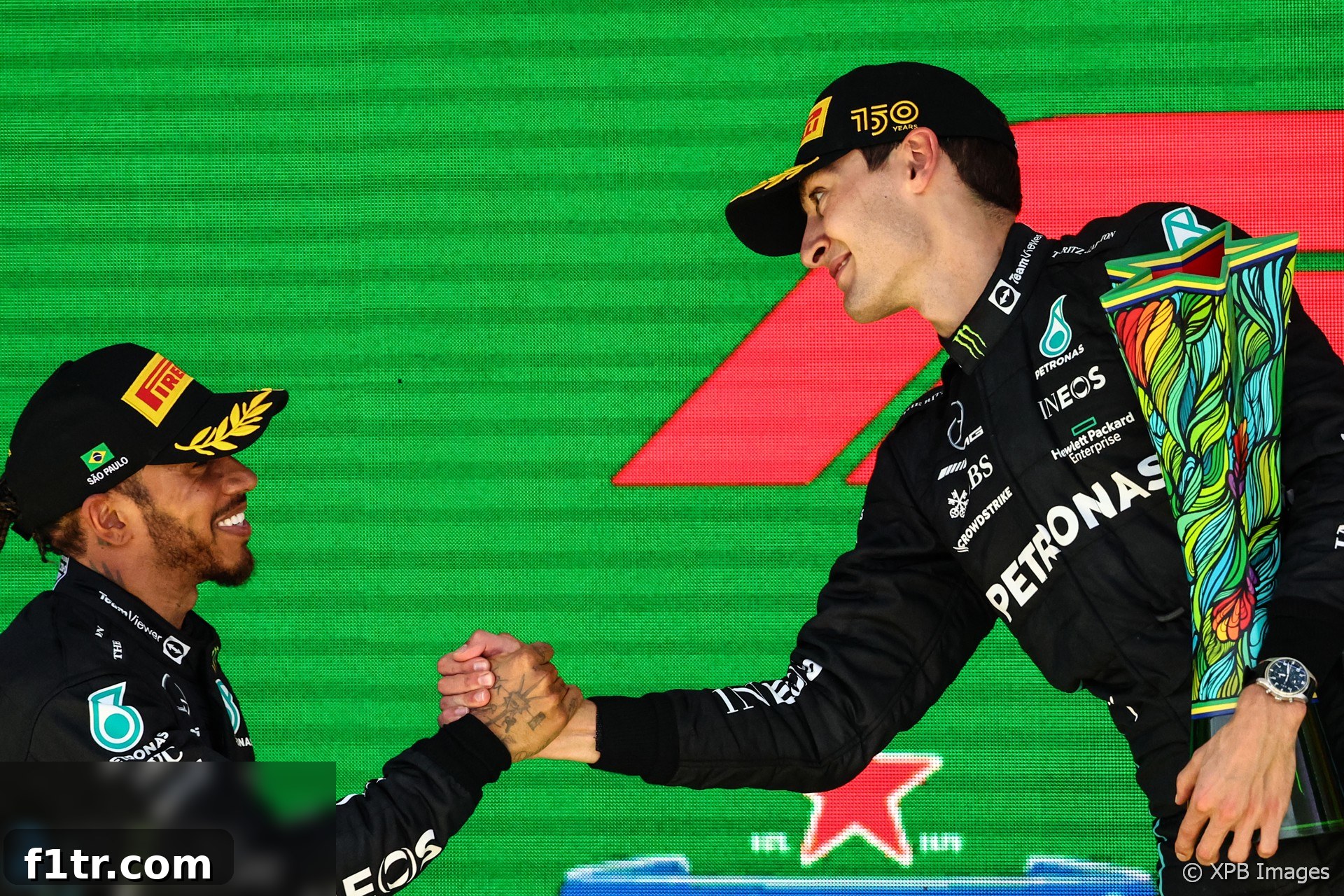
As the 2022 season drew to a close, a noticeable shift occurred in Russell’s performance. This surge appeared to coincide with the introduction of Mercedes’ final major upgrade package for the W13, which transformed the car into a much more competitive proposition. The qualifying gap between the two drivers, which had widened considerably in Hamilton’s favour during the mid-season, shrank to virtually nothing in races like Mexico and Abu Dhabi. Russell capitalized on this improved machinery and his own growing confidence, culminating in a useful third-place finish in Brazil. This result was partly aided by a spin in Q3 during changing rain conditions, which ultimately placed him in an advantageous starting position for the Sprint race, setting the stage for his breakthrough grand prix victory just two days later. This maiden win in Brazil was a testament to his talent and an exciting glimpse into his future potential, especially with a more compliant car.
Despite the W13’s early struggles, Mercedes managed to mount a formidable challenge in the constructors’ championship, coming tantalizingly close to embarrassing Ferrari for second place. This impressive recovery was largely due to the largely error-free and consistent performances delivered by both their drivers. However, when errors did occur, they were often spectacular and impactful. Hamilton famously tripped over Fernando Alonso’s Alpine at Spa, a rare misjudgment that cost valuable points. Similarly, Russell was involved in a collision with Carlos Sainz Jnr at the Circuit of the Americas, demonstrating that even the best drivers are not immune to race incidents under intense pressure. These isolated incidents, however, did little to detract from their overall solid contributions to the team’s points tally.
After the initial eight races of the year, George Russell held a seemingly commanding 37-point lead over his illustrious team mate. As discussed, this substantial gap could be largely attributed to Mercedes’ aggressive experimental setup approach that disproportionately affected Hamilton, combined with Hamilton’s ill fortune regarding race interruptions in Melbourne and Miami. However, by the time the curtain fell on the season in Abu Dhabi, Hamilton had significantly clawed back that deficit, narrowing it to just 25 points. A particularly cruel blow came in the final race, where a car failure with just four laps to go cost him a potential podium and resulted in a 14-point swing, further highlighting the fine margins and unpredictable nature of the sport.
While the final points standings showed Russell ahead of Hamilton, the nuanced story of their season suggests that Russell might not have entirely “deserved” to end the year ahead on points, given the specific circumstances and Hamilton’s mid-season resurgence. Nevertheless, the margin was remarkably slim, and the newcomer was undeniably in the peak of his form during the concluding races, securing a maiden victory that, under different circumstances, his team mate might well have claimed. George Russell will undoubtedly enter his second season at Mercedes with immense confidence, knowing that he measured up remarkably respectably against the sport’s most successful driver of all time, a true benchmark of his talent and potential. His debut season at a top team demonstrated resilience, adaptability, and ultimately, race-winning capability, solidifying his position as a future championship contender.
| BAH | SAU | AUS | EMI | MIA | SPA | MON | AZE | CAN | GBR | AUT | FRA | HUN | BEL | NED | ITA | SIN | JAP | USA | MEX | BRZ | ABU | ||
| Hamilton | Q | ||||||||||||||||||||||
| R |
Unrepresentative comparisons omitted. Negative value: Hamilton was faster; Positive value: Russell was faster
2022 F1 Season Insights and Further Reading
Delve deeper into the intricacies of the 2022 Formula 1 season with these related articles:
- Mercedes told me “you’re wrong” about 2022 car’s problems – Hamilton
- FIA confirms all 10 F1 teams complied with 2022 cost cap
- Steiner “not ashamed” of panning “slow” Schumacher in Drive to Survive
- Albon believes year out of F1 improved him as a driver
- Hamilton sees diversity gains in F1 years on from his ‘traumatising’ experience of racism
Browse all 2022 F1 season articles