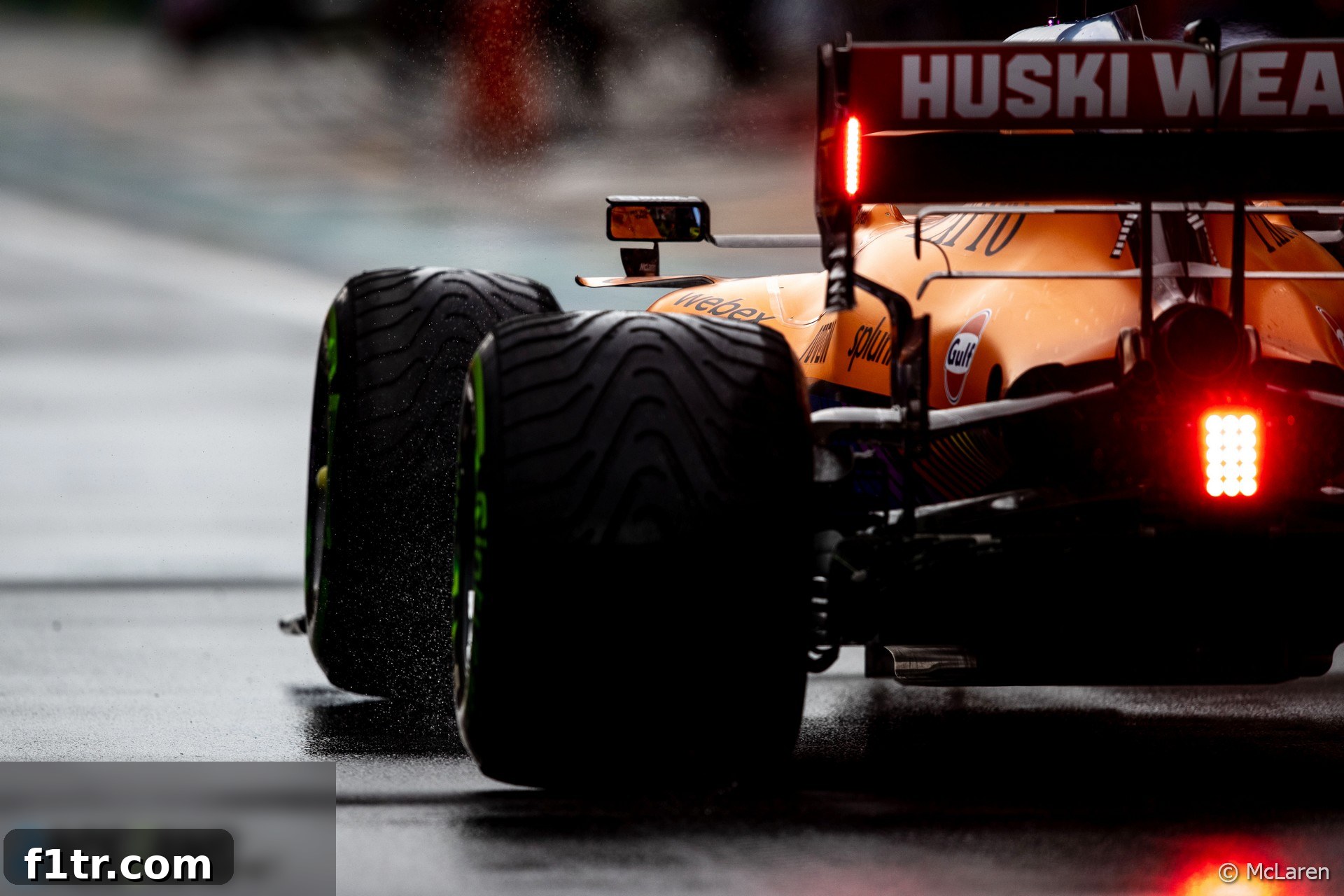
McLaren’s Russian Grand Prix Drama: Unpacking Norris’s Costly Tyre Decision
The 2021 Russian Grand Prix delivered a nail-biting finish, epitomizing the high-stakes world of Formula 1 where split-second decisions dictate destiny. As rain began to fall in the closing stages, McLaren found itself at a critical juncture, facing a dilemma that would ultimately separate triumph from heartbreak for its two drivers. One McLaren driver made the astute, race-altering call to pit for intermediate tyres, while his teammate, on the cusp of a glorious maiden victory, made a race-losing decision to stay out on slicks, gambling against the worsening conditions. This strategic divergence dramatically reshaped the outcome, turning a potential double-podium into a stark lesson in F1’s brutal unpredictability.
Daniel Ricciardo, experiencing the rapid decline in track conditions more acutely from his mid-pack position, made the decisive move on lap 48, diving into the pits for a set of intermediate tyres. This call proved to be a stroke of genius. His teammate, Lando Norris, who had heroically led the majority of the race and was battling hard to secure his first-ever Grand Prix win, chose a different path. He bravely, or perhaps misguidedly, opted to remain on his slick tyres until lap 51. By that point, the treacherous conditions had sealed his fate, costing Norris a shot at victory and a moment of personal history.
The Shifting Sands of Sochi: Differing Realities on Track
As the race hurtled towards its dramatic conclusion, the two McLaren drivers were operating under vastly different pressures and perceptions of the track. Race leader Norris found himself under immense pressure, with seven-time world champion Lewis Hamilton breathing down his neck. The fight for first place consumed his focus, with the rest of the field a considerable distance behind – Sergio Perez, for instance, was trailing by over 40 seconds on lap 47. Norris’s primary concern was defending his lead and keeping Hamilton at bay, making any pit stop decision feel like an existential threat to his position.
Ricciardo, meanwhile, was running in fifth position and had recently been overtaken by Perez. Crucially, he was also on an older set of tyres compared to Norris, meaning his slick compounds had less tread and were already more degraded. This factor significantly influenced his experience of the rain; his older tyres lost grip far more rapidly and dramatically when the first drops began to fall, giving him an earlier and clearer signal of the track’s deterioration.
The Pit Wall’s Role: Communication in Crisis
In the tense final laps, communication between the McLaren pit wall and their drivers became paramount. Information regarding the worsening state of the track flowed, but its frequency and emphasis differed between the two cars. Ricciardo and his race engineer, Tom Stallard, engaged in more frequent and detailed exchanges regarding the conditions than Norris and his engineer, Will Joseph. This disparity in communication proved to be a critical element in their divergent decisions.
Given that Ricciardo was over 40 seconds behind Norris at this stage, he encountered increasingly worse conditions on each subsequent lap than Norris had experienced moments earlier on the same parts of the circuit. This meant Ricciardo was effectively forecasting the deteriorating grip levels that Norris would face shortly after.
| Lap | Voice | Message | Voice | Message |
|---|---|---|---|---|
| 45 | Stallard | First spots of rain in pit lane. Very, very light. | ||
| 46 | Joseph | And Lando umbrellas are going up. | Stallard | Alonso, 1.2. Silver entry six, silver entry six. |
| 46 | Norris | Spitting quite a bit. | Stallard | Alonso 1.2. |
| 46 | Norris | Spitting middle sector. | Ricciardo | Turn seven a bit slippery, let me know what pit lane’s like, |
| 46 | Joseph | Okay, understood. | Stallard | Stopped raining, stopped raining in pit lane. |
| 47 | Joseph | Okay Lando this intensity will stay till the end of the race, we think. | Stallard | 1.2. Seven laps to go. |
| 47 | Joseph | Possibly wet from here ’til turn 10. | Stallard | Okay there is a bit more rain. Plus one rain intensity, a little bit more rain. Wettest part five, six, seven, eight. |
| 47 | Joseph | No more [unclear] needed. | Ricciardo | Yeah, very slippery. |
| 47 | Stallard | Alonso 0.6. It’s not raining in pit lane, just very, very few spots. |
Ricciardo’s Intuition: The “Black and White” Call
As the rain intensified, both drivers grappled with the increasingly difficult task of keeping their high-powered cars on the rapidly wetting track. However, their responses diverged significantly. While Ricciardo made the immediate and unequivocal decision to fit intermediate tyres, Norris stubbornly remained out, holding onto the hope that the rain would subside or that his slicks could somehow endure.
Speaking after the race, and notably without prior knowledge of his teammate’s radio exchanges, Ricciardo articulated his clear directive to McLaren regarding the necessity of intermediate tyres. His experience on track, exacerbated by older, colder slick tyres, gave him a unique and critical perspective.
“My situation is that when some of the track’s dry and some of it’s wet, it really has to be us [the drivers] that decides,” Ricciardo explained, highlighting the driver’s crucial role in such fluid conditions. “The team can help us on pit wall and they were saying there’s a bit of rain on pit wall, but not too heavy. Then I was saying, look, it’s really wet turn five and seven. And that next lap I nearly went off. Well, I did go off.” His direct experience of losing control solidified his conviction. “So I just told the team I need to come in for inters. I was very black and white with them, but that was my situation and that was the right thing for me at the time.” Ricciardo’s firm stance contrasted sharply with the pit wall’s initially more cautious assessment, showcasing the driver’s unique insight into the real-time conditions.
| Lap | Voice | Message | Voice | Message |
|---|---|---|---|---|
| 48 | Joseph | Yellow flags, turn seven. | Stallard | Suggest red mid six, red mid six. |
| 48 | Joseph | Norris runs wide at turn seven Track clear, track clear. |
Stallard | Track showing slippery turn three. Lando struggling turn five to 10. |
| 48 | Norris | I need blue flags. | Stallard | First cars are pitting, inter. First cars are pitting inter. |
| 48 | Joseph | Yep, we’re on it, we’re on it. | Stallard | DRS disabled. |
| 48 | Joseph | You should have blue flags. DRS has been disabled, DRS disabled. | Ricciardo | Yeah, crazy slippery now. |
| 48 | Stallard | Daniel copy, five laps after this, do we need the inter? | ||
| 48 | Ricciardo | Yeah, I can’t keep it on track. The hard’s just got no temp. | ||
| 48 | Stallard | Copy Daniel we’ll box, we’ll box. | ||
| 48 | Stallard | Daniel we’re box this lap. | ||
| 48 | Ricciardo | Yep. | ||
| 48 | Stallard | Box now. Launch map on after the bridge, after the bridge. | ||
| 48 | Ricciardo | Daniel, pit lane. | ||
| 48 | Stallard | Launch map. Silver entry nine, silver entry nine. |
Norris’s Gamble: The Lure of Victory and the Cost of Delay
Around the same time Ricciardo was making his crucial pit stop – and crucially, being further ahead on the track, Lando Norris was still under the immense psychological pressure of leading the race. With Hamilton filling his mirrors, Norris was preoccupied with maintaining his lead and navigating through backmarkers, a task made exponentially harder by the onset of rain. He made it abundantly clear to his team that he wished to remain on his slick tyres, convinced he could still nurse them to the finish.
McLaren kept Norris informed about other drivers who had opted for intermediates, a standard practice in F1. However, a critical piece of information was withheld or simply not communicated: they did not explicitly point out that his own teammate, Daniel Ricciardo, was among those who had made the switch. As Norris later revealed, he was heavily relying on McLaren’s overarching assessment of the weather conditions to guide his decision. The knowledge that his teammate had already pitted, and was therefore gaining significant pace on intermediate tyres, would have been a vital, perhaps even game-changing, piece of information for Norris to process in real-time. This oversight potentially cemented his ill-fated decision to stay out.
| Lap | Voice | Message | Voice | Message |
|---|---|---|---|---|
| 49 | Joseph | Lando… | Stallard | Silver entry nine. Overtake available. Launch map, launch map. |
| 49 | Norris | How many laps to go? | Stallard | There’s still cars on dries. Gasly still on medium. |
| 49 | Joseph | Four to go after this one, four after this one. Some cars have pitted for inter, Bottas has gone already. | Stallard | Orange torque four, four orange torque four. |
| 49 | Joseph | Track very slippery from here to turn 10, lots of cars going off. | Stallard | Yellow diff three, yellow diff three. |
| 49 | Norris | Yeah, shut up! | ||
| 49 | Joseph | Lando, what do you think about inter? What do you think about inter? | ||
| 49 | Norris | No! | ||
| 49 | Norris | I need blue flags, what are they doing? |
Even as Norris saw Lewis Hamilton pitting for intermediates in his mirrors, an immediate and clear warning sign, he chose to stay out once more. This was arguably his last real chance to salvage a strong result. Had he pitted at this precise moment, leveraging the substantial lead he still held over the rest of the field (excluding Hamilton), he could have very likely secured at least a second-place finish. However, the allure of a debut victory proved too strong, leading him to gamble against the increasingly impossible odds.
| Lap | Voice | Message | Voice | Message |
|---|---|---|---|---|
| 50 | Joseph | Okay Lando Hamilton has taken it, he’s gone to inter. | Stallard | Use a straight-line braking where you can, straight-line braking where you can for front brake temperatures. Red mid seven, red mid seven. |
| 50 | Norris | Yes, I see, I see. We’ve just got to commit to slicks. | Stallard | Orange torque five, orange torque five. |
| 50 | Joseph | Norris passed the pit lane entrance after this message Okay Lando just to confirm, we have to be able to stay on-track here. Are you happy to stay out on this tyre? |
Stallard | Vettel is turn five now on hard, that’s an opportunity. |
| 50 | Stallard | You could be racing Perez, Leclerc and Alonso at pit exit this time, use overtake now, let’s try and get close. |
The Unraveling: A Heartbreaking End to a Potential Win
It must have been a sickening realization for Lando Norris the moment he swept past the pit lane entrance on lap 50, effectively committing to another lap on slick tyres. The track was rapidly transforming from merely damp to dangerously wet. He ran wide at the final two corners of the lap, struggling to find any semblance of grip. And while the braking zone for turn two initially held some grip, his car slithered uncontrollably off-track at turn four, a clear sign of the dire conditions.
“It’s full wet, boys,” he desperately radioed his team, the urgency in his voice palpable. Despite his efforts to slow down significantly and manage the car, he spun off at the very next corner. The subsequent tour of the circuit became an excruciating ordeal, a slow-motion ballet of understeer and repeated spins, culminating in another spin on his way into the pits. This harrowing lap, which took over three minutes to complete, was a painful testament to the consequences of his strategic gamble.
Once Norris finally pitted and fitted intermediate tyres, his pace immediately returned to form, matching Ricciardo’s lap time to within a tenth of a second on the final tour. However, the damage was already done. Over the preceding five laps, his unwavering commitment to slicks had cost him a massive 68 seconds to his teammate, transforming a potential victory into a distant memory.
| Lap | Voice | Message | Voice | Message |
|---|---|---|---|---|
| 51 | Norris | Norris skids off at turn seven and Hamilton takes the lead This fucking… it’s full wet, boys. I’ve got to box. I’m going to shunt. I can’t do this. |
Stallard | Turn five, looked very wet now it could be full wets in turn five, you need to take care there. Three laps to go, three laps to go. Leclerc turn two now on medium. Leclerc turn two now on medium. |
| 51 | Joseph | Yeah, we’re going to come in and do this. We’re going to come in. We’re going to box. | Stallard | Green shape four, green shape four. |
| 51 | Joseph | Okay, Lando, we’re boxing this lap. Pit lane very slippy. | ||
| 51 | Norris | Yes box, Yes, confirm. | ||
| 51 | Joseph | I need silver D9 before you come to a stop. | ||
| 52 | Joseph | Launch map on when you’re in the pit lane. | Stallard | Overtake available for Giovinazzi in pit exit, three laps to go. |
| 52 | Joseph | Could be to Alonso at exit. | Stallard | Two laps, this is P4. Bottas is on inter 4.9 seconds behind. |
| 52 | Joseph | Close to Raikkonen at exit. | Stallard | Bottas last lap, 51.6, he’s the fastest car on-track. |
| 52 | Joseph | Just green F4, green F4. | ||
| 53 | Joseph | This is the last lap. | Stallard | Last lap, strat five, strat five. |
| 53 | Stallard | Bottas still 4.1. |
Post-Race Reflections: What Went Wrong and Lessons Learned
A desolate Lando Norris remained silent on his way back into the pits, the weight of the lost victory undoubtedly crushing. His silence spoke volumes about the profound disappointment and frustration of missing out on his dream win. In stark contrast, Ricciardo, having made the correct call and secured a strong fourth place, offered further insight into just how dramatically the conditions had deteriorated in the final moments of the race, providing a valuable perspective that illuminated the critical strategic choices made.
| Lap | Voice | Message | Voice | Message |
|---|---|---|---|---|
| CF | Joseph | Recharge on please. Watch for low revs. We finished P7. | Stallard | Okay Daniel that’s P4 mate. P4. Good job. We need recharge on, ACS off. And keep the RPM up, please keep the RPM up. That got pretty tasty at the end. Well done, buddy. That was a good call with the inters. |
| CF | Joseph | And remember to turn the car completely off and check it once you jump out, please. | Ricciardo | Okay, yeah that spiced it up a little. Okay, yeah, I think that was a good call so we did what we could, thank you. |
| CF | Stallard | Yeah, well done. Switches are good. So just watch the RPM as I said. As long as you’re above 8,000 we’re good. Finishing order: Hamilton, Verstappen, Sainz, yourself, Bottas, Alonso, Lando, Raikkonen, Perez, Russell. Lando tried to stay out on the on the slick tyres and it just got too wet. | ||
| CF | Ricciardo | OK, understood. Yeah it was really bad through turn five, this part of the track. Where you guys are wasn’t too bad. But it got very heavy last couple of laps. |
The post-race analysis from McLaren confirmed what many observers already understood: the decision to allow Norris to stay out on slick tyres was a strategic misstep. Andreas Seidl, McLaren’s Team Principal, later acknowledged that while the driver ultimately makes the call, the team should have been more assertive in overruling Norris, especially considering the rapidly worsening conditions and the information available. This incident served as a critical learning experience for the entire McLaren team, highlighting the fine line between trusting a driver’s instinct and providing decisive strategic guidance in chaotic situations.
The Lasting Impact: A Strategic Blueprint for Future Races
The 2021 Russian Grand Prix will forever be etched in Formula 1 history as a poignant example of how a race can be lost and won in the final moments due to weather and strategy. For Lando Norris, it was a brutal initiation into the harsh realities of fighting for a Grand Prix victory, a moment that undoubtedly fueled his determination for future successes. For McLaren, it underscored the immense challenges of real-time decision-making in highly dynamic environments and the crucial importance of a holistic communication strategy that ensures all relevant information, including a teammate’s divergent call, is shared. This dramatic race continues to serve as a vital case study in F1 tyre strategy, emphasizing the delicate balance between driver intuition and expert pit wall guidance, a balance that can often determine championship outcomes.
2021 Russian Grand Prix: Related Articles
- Norris says he missed few chances to win in 110-race wait for first F1 victory
- Sochi disappointment will make Norris and McLaren stronger, says Seidl
- F1 race start times could be brought forward to avoid Spa-style wash-outs
- New technology in Ferrari’s power unit update vital for 2022 – Binotto
- Mercedes have left too many points on the table, admits Wolff
Browse all 2021 Russian Grand Prix articles