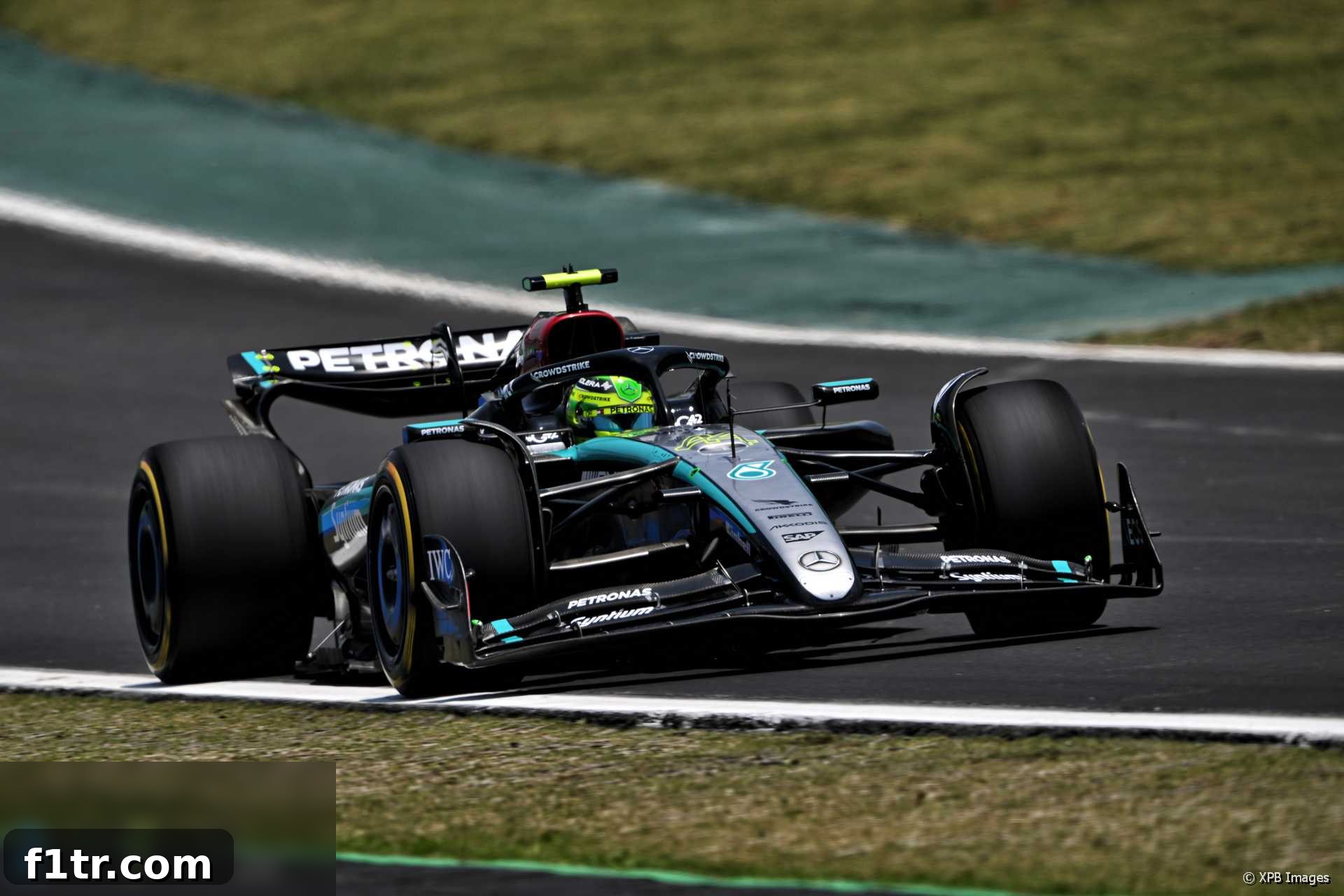
The highly anticipated Brazilian Grand Prix weekend at the iconic Interlagos circuit has begun with a significant wave of criticism from some of Formula 1’s most prominent drivers regarding the newly resurfaced track. Mercedes-AMG Petronas F1 Team driver, Lewis Hamilton, was particularly vocal following a challenging first day of running, which saw him qualify a disappointing 11th for the sprint race.
Hamilton’s frustrations stemmed directly from what he described as a “pretty bad” and excessively bumpy track surface, prompting comparisons to one of his most challenging races in recent memory. The seven-time world champion explained that the initial practice session felt eerily similar to the Azerbaijan Grand Prix in 2022, a race where Mercedes famously struggled with the brutal porpoising of their W13 chassis. That year, the team grappled with an uncompetitive car prone to violent bouncing, causing both physical discomfort and a significant performance deficit.
Detailing the immediate impact of the uneven surface, Hamilton elaborated on the difficult driving conditions experienced in Friday’s single practice session. “The ride is pretty bad on the track, I think for everyone,” Hamilton shared with official F1 channels after the day’s activities. “The track has been resurfaced, and they’ve not done a particularly great job, I think, so it’s bumpy for everyone.” His remarks suggest a widespread issue affecting the entire grid, rather than a problem unique to Mercedes’ car setup or performance characteristics.
The comparison to Baku 2022 was stark and telling for the British driver. “First practice was like Baku 2022 for us down the straight, it was hitting so hard,” he recalled. This extreme impact forced Mercedes engineers to make immediate adjustments to the car’s setup, specifically increasing the ride height to mitigate the severe bouncing. While this modification offered some relief, preventing the car from “hitting the deck so badly” and alleviating the physical discomfort, it introduced other compromises. “So I wasn’t in pain or anything like that, but through corners, the thing’s hopping through corners, the thing’s very hard to drive,” Hamilton added, highlighting the precarious balance and significant handling challenges posed by the bumpy asphalt.
The decision to resurface a circuit like Interlagos is typically made to improve safety, enhance grip, and provide a smoother racing experience. However, when the execution falls short, it can lead to unintended consequences, as evidenced by the drivers’ complaints. A consistently bumpy surface not only makes the cars harder to control but also places immense stress on the suspension systems and the drivers themselves, leading to fatigue and potential injuries over a full Grand Prix distance.
Despite his uncharacteristic 11th place start for the sprint race, Hamilton maintained a pragmatic outlook, emphasising that his primary focus remained on optimising the car for the main event. “It is what it is, it’ll be what it is,” he stated calmly. “I’m not really massively bothered, if I’m honest.” This philosophical approach underscores the strategic importance of the sprint weekend format, where the sprint race results impact the grand prix grid, but qualifying for the grand prix itself remains the most crucial session for Sunday’s main event.
Hamilton expressed his intention to use the sprint race as another opportunity to gather data and potentially move forward, but crucially, his sights are set on the qualifying session for the Grand Prix. “If I can move forwards in the sprint, great. I’ll try again in qualifying two, make some changes to the car and see what we can do.” This adaptability and focus on continuous improvement are hallmarks of a seasoned champion, even when faced with challenging track conditions and an imperfect car setup.
The concerns about the track surface were not isolated to Hamilton alone. His Mercedes teammate, George Russell, echoed similar sentiments, expressing his disappointment and confusion regarding the state of the newly laid asphalt. “The track’s so bumpy, I don’t know what happened when they repaved it,” Russell remarked, reinforcing the general bewilderment among drivers. While Russell acknowledged that “it’s the same for everyone,” implying an equal playing field in terms of the challenge, it did not diminish the frustration over the suboptimal conditions.
Russell, however, managed to navigate the tricky conditions more effectively than Hamilton during sprint qualifying, securing a respectable sixth place on the grid. Reflecting on his performance, he noted, “It was a challenging session as it got colder as the session progressed.” His assessment of their overall team standing remained consistent with previous weekends: “Sixth, as I’ve said for a little while, that’s where we are as a team, so it could be better, could be worse.” Russell’s comments highlight Mercedes’ ongoing quest to bridge the gap to the front-runners and the difficulties they face in maximising performance on certain track layouts and conditions.
The impact of such a bumpy track surface extends beyond driver comfort; it fundamentally alters car setup philosophy. Teams typically aim for the lowest possible ride height to maximise aerodynamic efficiency and generate more downforce. However, when confronted with an uneven surface, this ideal setup becomes untenable, forcing engineers to raise the ride height. This adjustment invariably leads to a reduction in downforce, compromising cornering speeds and overall car stability. Furthermore, the constant jarring and vibrations can affect the reliability of sensitive electronic components and mechanical parts, adding another layer of complexity for team engineers.
For a historic circuit like Interlagos, known for its thrilling elevation changes and iconic turns like the Senna S, track conditions play a crucial role in delivering spectacular racing. When the surface is compromised, it can detract from the racing spectacle, making overtakes more difficult and potentially leading to more errors from drivers struggling to control their vehicles. The incident at Baku 2022, cited by Hamilton, serves as a stark reminder of how severely porpoising and extreme bumpiness can impact not just driver well-being but also the competitive balance and safety of the sport.
As the Brazilian Grand Prix weekend progresses, all eyes will be on how the teams adapt to these challenging conditions. Will the track “rubber in” and smooth out over the weekend, or will the bumps remain a persistent challenge? The ability of teams to refine their car setups and for drivers to master the unpredictable surface will undoubtedly be a defining factor in who emerges victorious from what promises to be an intensely demanding race weekend at Interlagos.
The feedback from prominent drivers like Hamilton and Russell serves as a critical indicator for circuit organisers regarding the quality of track maintenance. Ensuring optimal track conditions is paramount for driver safety, competitive integrity, and maintaining Formula 1’s reputation for delivering the pinnacle of motorsport entertainment. The 2024 Brazilian Grand Prix, therefore, has started not just as a test of speed, but also as a profound test of endurance and adaptability for all involved.
Don’t Miss Out on the Latest F1 Updates
Get a daily email with all our latest stories – no marketing, no ads, just pure F1 content. Subscribe now:
(Note: This is a placeholder for a subscription form. Actual subscription will require a functional form.)
2024 Brazilian Grand Prix Coverage
- “I didn’t really want to come back” – Hamilton explains cryptic Brazil radio message
- Ocon’s role in Gasly’s Q2 exit was almost another ‘flare-up’ at Alpine – Oakes
- Interlagos must improve “very bad” new track surface for 2025, say F1 drivers
- “That’s how we silence them”: Verstappen’s stunning Brazil win from start to finish
- Verstappen now has as many wins as F1’s first six world champions combined
Browse all 2024 Brazilian Grand Prix articles