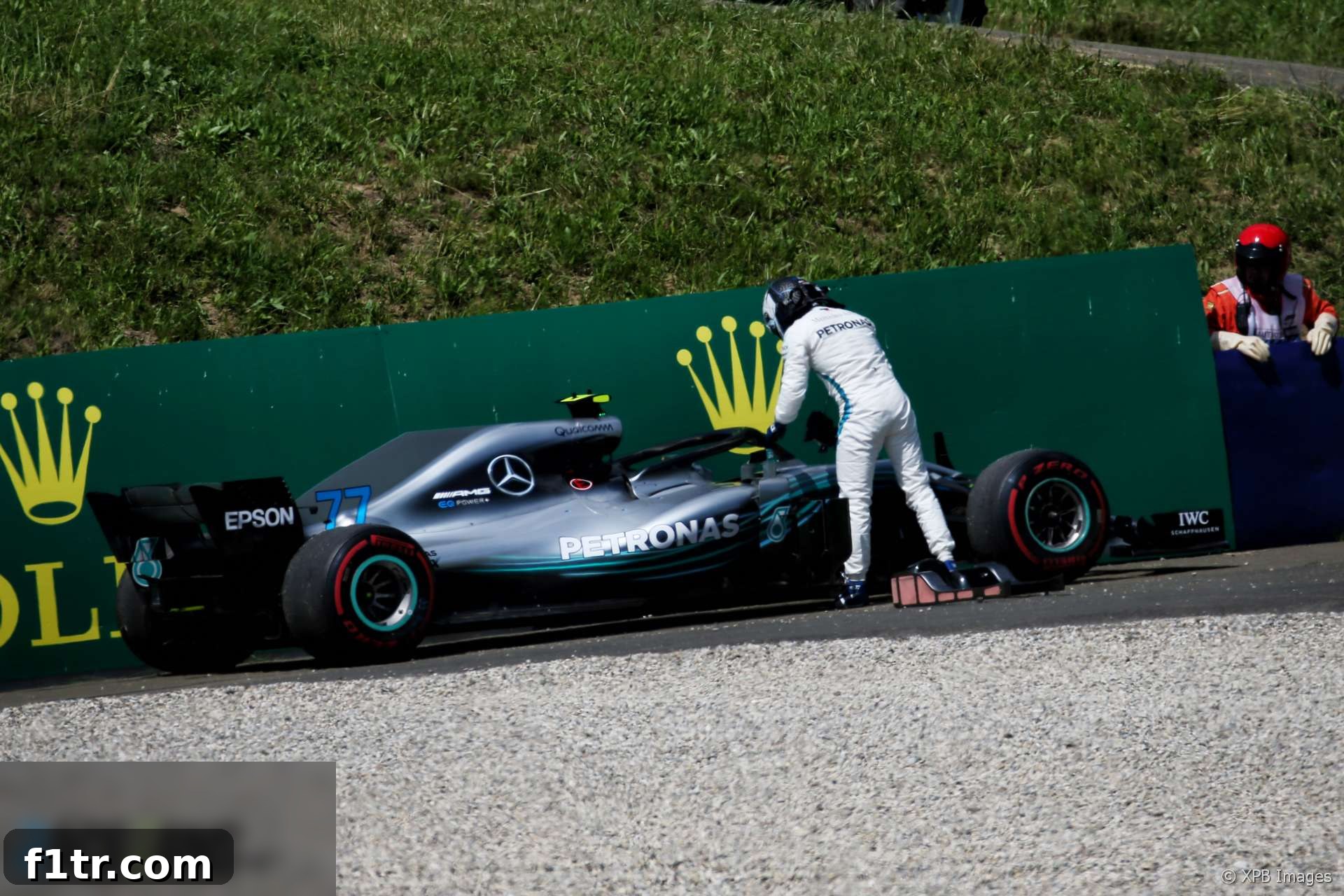
The 2018 Formula 1 season delivered one of its most dramatic and unexpected twists at the Austrian Grand Prix, as the dominant Mercedes-AMG Petronas Motorsport team suffered a devastating double retirement. Both championship leader Lewis Hamilton and his teammate Valtteri Bottas were forced to pull their cars out of the race, a monumental blow for a team that had secured a commanding front-row lockout just hours before. While initial speculation immediately turned to the team’s newly introduced power unit, Mercedes swiftly moved to quell these concerns, asserting that the catastrophic failures were unrelated to their upgraded engine specification.
This unprecedented setback at the Red Bull Ring sent shockwaves through the paddock and had significant implications for both the Drivers’ and Constructors’ Championships. It served as a stark reminder of the sport’s unpredictable nature, even for teams at the pinnacle of engineering and performance.
A Day of Unforeseen Mechanical Failures
The Austrian Grand Prix had started promisingly for the Silver Arrows. Valtteri Bottas, who had secured pole position, maintained his lead in the opening laps, looking set for a strong points finish. However, his race quickly unraveled. On Lap 14, Bottas reported a loss of hydraulic pressure, which rapidly escalated into an issue affecting his steering. The problem proved terminal, forcing him to retire from the race, an early and significant loss for Mercedes.
Just a few laps later, the team’s fortunes worsened dramatically. Lewis Hamilton, who had been battling hard and maintaining a strong position, began to report a loss of power and unusual readings from his car. Mercedes tried to guide him through the issue, but it soon became clear that his W09 EQ Power+ was suffering from a critical problem. On Lap 62, Hamilton was instructed to retire due his own car experiencing a drop in fuel pressure. The sight of both Mercedes cars out of contention in the same race was almost unthinkable for a team renowned for its meticulous reliability and engineering excellence during the turbo-hybrid era.
Such an event is a rarity in modern Formula 1, especially for a top-tier constructor like Mercedes. The last time the team suffered a double retirement due to mechanical issues was many years prior, underscoring the gravity of the situation and the sheer shock that permeated the team and the broader F1 community. The collective gasp from fans and pundits alike highlighted the unprecedented nature of this double DNF for a team that had dominated the championship battle for years.
The New Power Unit: Vindicated Despite Retirements?
Prior to the Austrian Grand Prix, Mercedes had introduced its revised ‘phase 2.1’ M09 power unit. This engine upgrade was initially slated for introduction at the Canadian Grand Prix but was delayed by one race after the team identified a problem during pre-race checks. Consequently, the upgraded unit made its debut in France just the weekend before, performing strongly and showing no immediate signs of concern.
Naturally, when both cars retired in Austria with mechanical issues, the focus of speculation immediately turned to this new engine specification. However, Mercedes team principal Toto Wolff was quick to definitively state that the problems were unrelated to the core power unit. Speaking to media, including RaceFans, Wolff clarified, “I think none of the issues today on the cars had something to do with the [power unit’s] reliability as far as you can see.”
Wolff elaborated on the distinct causes of each failure: “We had a hydraulic leak that was linked to the steering on Valtteri. And we had a drop in fuel pressure on Lewis’s car which was linked to the fuel system. This is the current understanding.” This distinction is crucial for Mercedes. Hydraulic systems and fuel delivery systems, while integral to the car’s operation, are often considered peripheral to the main internal combustion engine, turbocharger, and MGU-H/K components that constitute the core power unit. By separating these issues, Mercedes aimed to reassure both the team and external observers that their new engine specification remained robust and reliable.
The decision to introduce a new specification engine is always a calculated risk, weighing performance gains against potential reliability challenges. Wolff’s firm “no regrets on introducing the engine” statement underscored the team’s confidence in the updated M09 unit. This vindication of the power unit itself was a small but significant relief amid the profound disappointment of the race day. It meant that the team wouldn’t have to fundamentally rethink its engine development path, but rather focus intensely on resolving the specific ancillary system failures that led to the retirements.
Toto Wolff’s Heartbreak: “Most Painful Day” for Mercedes
For Toto Wolff, a figure known for his measured composure, the double retirement at the Austrian Grand Prix was an intensely emotional experience. He openly declared it the “most painful day” in his long tenure at Mercedes-AMG, even surpassing the dramatic Barcelona crash of 2016, where Lewis Hamilton and then-teammate Nico Rosberg collided on the first lap, eliminating both cars from the race.
Wolff explained why Austria felt worse: “For me [it’s] the most painful day in my years at Mercedes, worse than Barcelona. I had plenty of people coming to see me before the race saying this is going to be a walk in the park, one and two, you have the quickest car. And I said we’ll talk in two hours. This is exactly how motorsport, motor racing can go. It can be very cruel. I think we had all the cruelty go against us today.”
The expectation before the race was incredibly high. Having locked out the front row, with Bottas on pole and Hamilton alongside him, a dominant 1-2 finish seemed almost a foregone conclusion for many. The W09 had demonstrated superior pace throughout the weekend, reinforcing the belief that Mercedes was poised to extend its championship lead. This sense of assured victory, only to be utterly shattered by unforeseen mechanical failures, compounded the pain for Wolff and the entire team. In Barcelona 2016, the retirements were the result of a racing incident between teammates, an unfortunate but sometimes understandable consequence of fierce competition. In Austria, the failures were entirely out of the drivers’ control, a stark reminder of the fragility of even the most sophisticated machinery.
Wolff’s reflection on the “cruelty of motorsport” resonated deeply. It encapsulates the inherent unpredictability of Formula 1, where months of meticulous preparation, advanced engineering, and strategic planning can be undone in an instant by a single component failure. The feeling of helplessness when the cars simply stop, despite leading or performing strongly, is a unique burden for team principals and engineers, and it was powerfully evident in Wolff’s candid admission of pain.
Significant Championship Implications
The double retirement had immediate and significant ramifications for both the Drivers’ and Constructors’ Championships. Lewis Hamilton, who had been leading the Drivers’ standings, saw his advantage diminish considerably. While he remained atop the championship table, the lost points allowed his closest rivals, particularly Sebastian Vettel of Ferrari, to close the gap significantly, turning up the heat in what was already shaping up to be a thrilling title fight. For Bottas, the DNF further hampered his own championship aspirations, pushing him further away from the leading contenders.
In the Constructors’ Championship, the loss of 43 potential points (assuming a 1-2 finish) was a massive blow. Ferrari, who went on to secure a podium finish with Kimi Räikkönen and strong points with Sebastian Vettel, capitalized on Mercedes’ misfortune, seizing a vital opportunity to leapfrog them in the standings. Red Bull Racing, with Max Verstappen securing an unexpected victory on home turf, also gained crucial ground. The championship battle, which had seen Mercedes holding a comfortable, albeit not insurmountable, lead, was suddenly thrown wide open. Every point gained or lost became even more critical in the remaining races of the 2018 Formula 1 season.
Mercedes’ Unwavering Resolve and Path Forward
Despite the profound disappointment, Mercedes’ history demonstrates a remarkable capacity for resilience and recovery. The team’s generally stellar reliability record in the turbo-hybrid era means that such a double mechanical retirement is an anomaly, not the norm. This incident served as a powerful catalyst for immediate and intensive investigations back at the factory in Brixworth and Brackley.
Engineers and strategists would have worked tirelessly to diagnose the precise root causes of the hydraulic leak and the fuel pressure drop. Every component, every sensor reading, and every piece of data from the two stricken W09s would have been meticulously analyzed to understand exactly what went wrong and, more importantly, how to prevent a recurrence. The pressure to find quick and effective solutions before the next race was immense, not just for championship points, but also for maintaining team morale and public confidence.
The psychological impact of such a day cannot be understated, but Mercedes has consistently shown an ability to channel adversity into renewed determination. The team’s ethos of learning from failures and bouncing back stronger is deeply ingrained. While the Austrian Grand Prix of 2018 will forever be remembered as one of Mercedes’ toughest days, it also highlighted the relentless challenge of Formula 1 and the constant pursuit of perfection required to succeed at its highest level. The team’s resolve to rectify the issues and continue fighting for both championships remained unwavering, setting the stage for an even more intense second half of the season.
The Austrian Grand Prix stood as a powerful testament to the thrilling unpredictability of Formula 1. Mercedes’ double retirement was a shocking turn of events that reshaped the championship narrative, yet their swift clarification regarding the power unit showcased their confidence in their core technology. The incident underscored the fragility of engineering at its peak and the emotional toll it takes, but also reaffirmed Mercedes’ commitment to learning, adapting, and ultimately, overcoming challenges in their relentless pursuit of success.