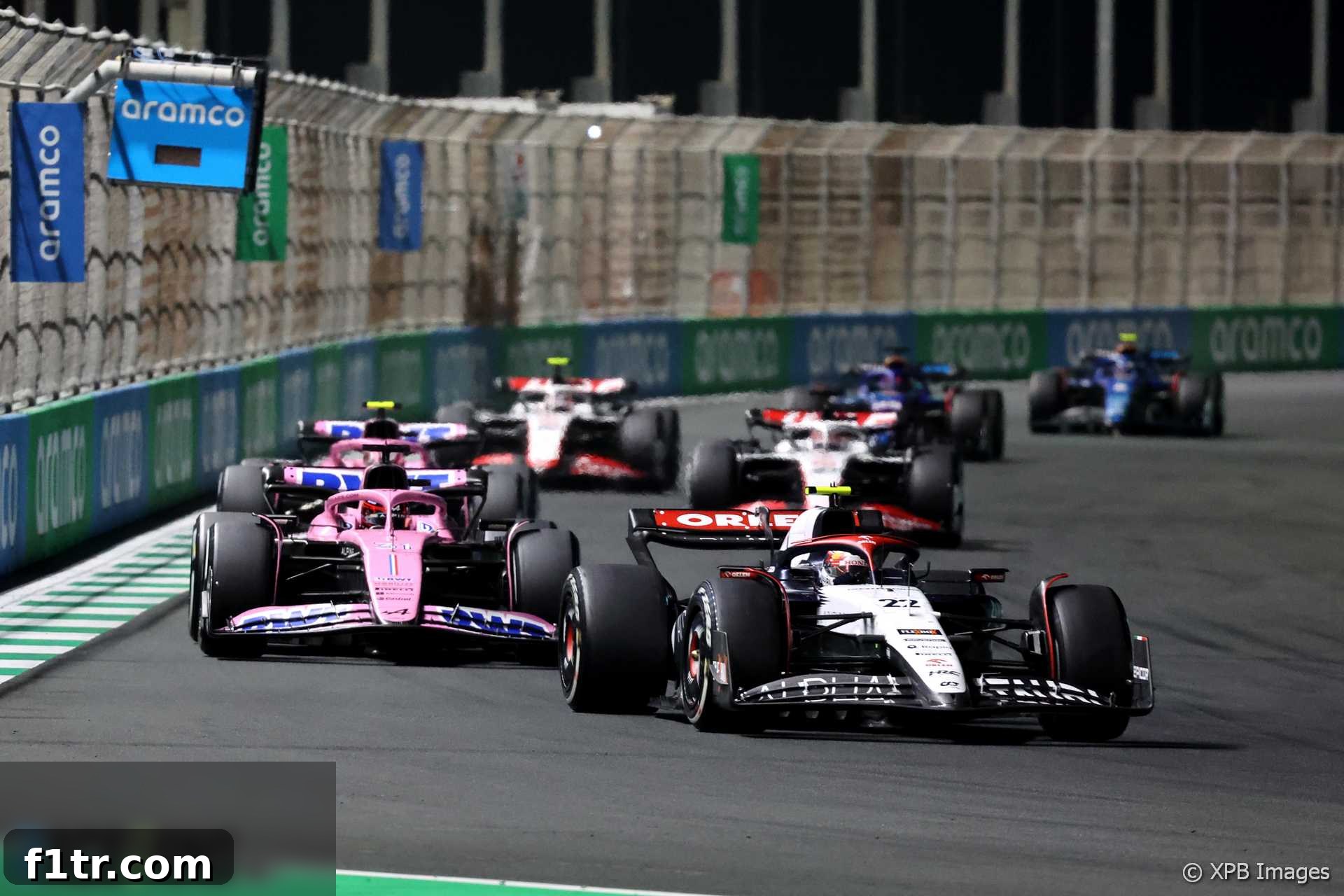
Formula 1, the pinnacle of motorsport, has long grappled with a fundamental challenge: how to facilitate exhilarating, wheel-to-wheel racing while preserving the technological marvel of its cars. This intricate balance was at the heart of the radical technical regulations introduced for the 2022 season, designed primarily to enable cars to follow each other more closely and, consequently, improve overtaking opportunities. As the 2023 season unfolds, questions naturally arise about the sustained effectiveness of these changes. However, Pat Symonds, Formula 1’s esteemed Technical Director, offers a reassuring perspective, suggesting that F1 cars have not, in fact, regressed in their ability to follow closely this year.
Advert | Become a Supporter & go ad-free
While some drivers have voiced concerns that overtaking has become more challenging in the second year under the revised rules, Symonds’ analysis, based on robust F1 data, indicates otherwise. “I’m not sure,” he stated, referring to the suggestion of reduced following capability. “Our statistics of how close the cars are following don’t appear to have changed much.” He acknowledges the limited sample size – with only a couple of races completed at the time of his comments – but assures that this crucial aspect remains under diligent monitoring by both Formula 1 and the FIA.
The 2022 technical regulations represented a monumental shift in aerodynamic philosophy. Prior to these changes, Formula 1 cars were notorious for generating immense amounts of “dirty air” – turbulent airflow created by their complex aerodynamic surfaces, particularly the front wings, bargeboards, and intricate floor designs. This turbulent wake significantly hampered the performance of following cars, robbing them of downforce and making it extremely difficult to maintain close proximity, let alone attempt an overtake. The effect was often described as driving into a brick wall of disturbed air, leading to widespread complaints about processionary races and a lack of on-track action.
Revolutionizing Aerodynamics for Enhanced Racing
The core objective of the 2022 regulations was to fundamentally alter the way F1 cars generate downforce and manage their aerodynamic wake. Key changes included a drastic simplification of the upper-surface aerodynamics, particularly around the front wing and bodywork, to reduce the production of disruptive turbulence. Crucially, the regulations championed a significant reintroduction of ground effect aerodynamics. This involves shaping the car’s underbody, specifically via large Venturi tunnels, to accelerate airflow beneath the car, creating a low-pressure area that effectively sucks the car to the track. The primary benefit of ground effect is that it generates downforce more efficiently and with far less reliance on turbulent-air-generating components, leading to a much cleaner wake profile.
Furthermore, critical areas of the car’s design were tightly restricted. The aim was to condition the airflow in such a way that it would be less disruptive to a following car, allowing for significantly closer racing. These prescriptive rules sought to prevent teams from designing aerodynamic surfaces that would push air outwards in a detrimental manner – a phenomenon known as ‘out-washing’ – which was a major culprit in creating the chaotic wakes of previous generations of cars.
Symonds confirmed that, from a regulatory standpoint, there have been no significant changes observed in this year’s cars that would fundamentally undermine the effectiveness of the 2022 regulations. “I talk to my aerodynamic colleagues in the FIA, we haven’t seen anything in the cars that really makes us think that things have fundamentally changed,” he remarked. This suggests that the foundational principles of the new aero package are holding strong, despite the natural evolutionary trajectory of car development.
He added a pragmatic note, acknowledging the continuous development cycle in Formula 1: “So at the moment, a watching brief – nothing to be terribly concerned about. I guess that we always expected the cars would evolve to be slightly worse rather than slightly better in this respect.” This underscores the constant battle between regulators striving for competitive equality and teams pushing the boundaries of performance within the rulebook. Even if some marginal degradation in following capability occurs over time, the starting point established by the 2022 rules was so vastly improved that any minor setbacks are unlikely to negate the overall positive impact.
Advert | Become a RaceFans supporter andgo ad-free
Indeed, Symonds remains unequivocally convinced that F1 cars can still follow far more closely than they ever could in the final season of the previous rules set (2021). “We had such a margin between ’21 and ’22 in terms of close following capability that even if we’ve lost a little bit of it, we’re still way, way better than we would have been had we not done anything,” he emphasized. This provides crucial context: the benchmark for improvement was so high that even minor regressions from the initial 2022 ideal still leave the sport in a significantly better position for competitive racing.
A specific, crucial goal of the 2022 regulations was to actively prevent teams from creating aerodynamic surfaces that generated an ‘out-washing’ effect. This phenomenon involves directing turbulent air from the sides of the chassis outwards, which disproportionately affects cars attempting to follow closely. Symonds candidly admitted that Formula 1 anticipated teams would inevitably attempt to recreate this performance-enhancing, but racing-detrimental, effect as much as possible within the confines of the new rulebook.
The Ongoing Battle: Regulators vs. Ingenuity
“This is the way they find performance, to try and reintroduce that out-wash,” he explained. The relentless pursuit of lap time means that engineering teams will always seek every possible advantage. He specifically highlighted areas where this innovation is manifesting: “There was a little bit of a change in the nuance of the wording of what you can do with the flap gap separators. People are using that a little bit to push things out.” These seemingly minor technical interpretations can have significant aerodynamic consequences, illustrating the constant cat-and-mouse game between rule-makers and ingenious designers.
Despite these attempts by teams, Symonds reiterated his current assessment: “But as I said earlier, at the moment, I don’t think we’ve got any real concerns on this. I think we’ve got to keep watching it. We’ve got to make sure that nothing really goes awry.” This vigilance is paramount; the FIA and F1 technical department must continuously monitor car development to ensure the spirit and letter of the regulations aimed at improving racing are upheld. He also pointed out that minor rewording was also applied to “the wing endplates themselves which were was designed to stop some of the out-washing that was beginning to occur in some of the vanes.” This shows an iterative approach to rule-making, adjusting details as new interpretations arise.
Symonds encapsulated the philosophical approach: “So we’re just going to keep on these things. It’s the team’s jobs to develop their cars to get the aerodynamics better and we don’t want to stop that, all we want to do is make sure we get good racing.” The challenge is to foster innovation and technological advancement, which are hallmarks of F1, without compromising the fundamental objective of creating a better spectacle for the fans.
Advert | Become a RaceFans supporter andgo ad-free
Gazing Towards the Future: The 2026 Regulations
Looking further ahead, Symonds candidly admitted that there remains significant scope for improvement in how closely cars can follow. He anticipates that the next generation of technical rules, currently slated for introduction in 2026, will deliver even greater strides in this area. “This work now has been passed on to the FIA, so we don’t get directly involved in determining how that that work is done and what’s done on a particular week, et cetera,” he explained, clarifying the division of labor in rule development.
The development of the 2026 car is a complex undertaking, balancing the ongoing understanding of current cars with the considerable resources required for future design. “But it is a balance between ensuring that there’s a good understanding of the current cars and balancing that against the quite considerable amount of work that still needs doing on the 2026 car,” Symonds noted. The planning for the 2026 cars commenced several years ago, indicating a long-term strategic vision for the sport. This next iteration is expected to feature a “quite a different configuration,” notably focusing on “much more efficient aerodynamics by using the sort of active aspect of the aerodynamics.”
Active aerodynamics, a concept that has intrigued F1 designers for decades, promises to be a game-changer. This could involve movable wing elements or ride height systems that can adapt in real-time to optimize performance. For instance, active aero could allow for high downforce in corners for maximum grip and then flatten out on straights to reduce drag, enhancing both top speed and fuel efficiency. Crucially, it could also be employed to actively manage and reduce the turbulent wake behind the car, presenting a dynamic solution to the dirty air problem.
Symonds holds strong conviction that significant progress can still be made in enhancing the close following capability of F1 cars. “Perhaps more importantly, I think that we learned a lot of lessons from doing the 2022 car about the wake, about the effects of the wake on the cars, about what we needed to do to promote the close following,” he reflected. The 2022 regulations, while revolutionary, were considered a “work in progress” at the time of their finalization. The initial set of rules had to be released to teams to allow them sufficient time for car design and manufacturing, even though there was “still an awful lot more to do” in terms of research and optimization.
The invaluable data and insights gained from the conceptualization and implementation of the 2022 cars are now being directly fed into the development of the 2026 regulations. “A lot of that work and some of the concepts that we were working on at that time are now being incorporated into the 2026 car,” Symonds revealed. This iterative process of learning, refining, and applying knowledge is a cornerstone of Formula 1’s engineering philosophy. His optimism for the future is palpable: “So my hope is that when we release the 2026 car, we’ll actually get an even better ability for close following than we had with the ’22 car.”
In conclusion, while the initial stages of the 2023 season prompted some debate, Formula 1’s technical leadership, spearheaded by Pat Symonds, maintains that the fundamental improvements in close following capabilities introduced in 2022 remain intact. The sport is in a constant state of evolution, with regulators working diligently to counterbalance the relentless innovation of teams. Looking ahead, the advent of the 2026 regulations, featuring advanced concepts like active aerodynamics and incorporating lessons learned from the current era, promises to further elevate the spectacle of Formula 1, ensuring even more thrilling, nose-to-tail racing for years to come. The commitment to delivering exceptional on-track action remains a top priority, continuously pushing the boundaries of technology to enhance the fan experience globally.
Advert | Become a RaceFans supporter andgo ad-free
2023 Australian Grand Prix
- Australian GP to forbid fans from entering track at end of this year’s race
- I only missed one chance to score points this year – Albon
- Formula 1’s stewards should listen to drivers less, not more
- Mercedes unsure whether gains seen in Melbourne were ‘track-specific’
- Why Ferrari saw a ‘real step forward in pure performance’ in point-less Australian GP
Browse all 2023 Australian Grand Prix articles