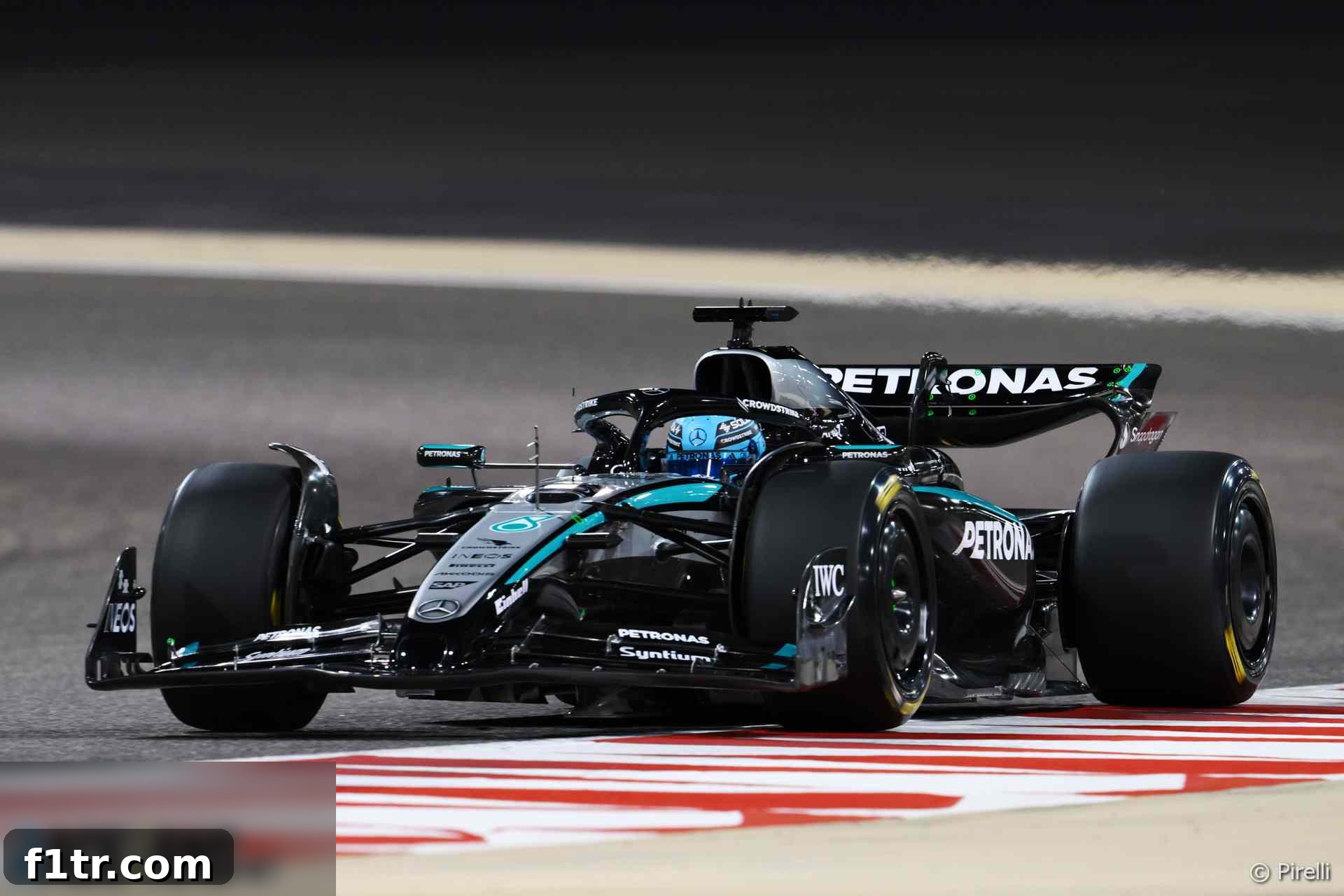
Mercedes W16: George Russell Reveals Key Improvements in Driveability and Predictability
Mercedes-AMG Petronas Formula 1 Team driver, George Russell, has offered promising insights into the much-anticipated W16 challenger, suggesting that the team has successfully addressed the profound handling characteristics that plagued its predecessor. The notoriously unpredictable W15, while capable of race wins, frequently left both Russell and his former teammate, Lewis Hamilton, grappling with erratic balance shifts and a narrow operating window that severely hampered performance consistency. Russell’s initial feedback indicates a significant step forward in making the new car more intuitive and forgiving for its drivers.
The W15, which secured four victories in the previous season, often presented a paradox: formidable speed in specific conditions, yet bewildering instability in others. Russell candidly recalled the challenges: “It was clear last year we struggled a lot in the hot races and we had a lot of oversteer in the car when the track was very hot. This is something we’ve tried to dial out [with the W16].” This persistent struggle with excessive oversteer, particularly under high temperatures, was a recurring theme throughout the season, hindering the team’s ability to consistently challenge for pole positions and race victories.
Overcoming the W15’s Unpredictable Temperament
The W15’s propensity for oversteer, especially as track temperatures soared, wasn’t merely an inconvenience; it was a fundamental performance limiter. Oversteer, where the rear tires lose grip before the front tires, forces drivers into constant corrections, leading to increased tire degradation, reduced cornering speed, and a significant drop in driver confidence. In the cutthroat world of Formula 1, where milliseconds define success, such unpredictability can be the difference between a podium finish and struggling outside the points. Russell further elaborated on the car’s unforgiving nature: “Also, it was on a knife’s edge. You saw us all have a few crashes last year: You go outside of the window and you were in the wall.” This vivid description underscores the tightrope act drivers faced, where even minor deviations from the car’s optimal, yet elusive, operating window could result in costly accidents and shattered hopes.
The engineering challenge for Mercedes was immense. Addressing deep-seated aerodynamic and mechanical issues without compromising the car’s inherent speed required a comprehensive redesign. The goal for the W16 was clear: create a platform that offers drivers greater confidence and consistency across a wider range of conditions. “So we’ve put a lot of focus on making the car more drive-able, more intuitive to drive. And I think from what we’ve seen so far, it seems to be doing that,” Russell stated, offering a beacon of optimism for the upcoming season. This shift towards enhanced driveability signifies a renewed focus on the human element of racing, recognizing that even the most aerodynamically efficient car is only as fast as its drivers can push it.
The Quest for Driveability: A New Design Philosophy
The concept of “driveability” in Formula 1 extends beyond mere comfort; it encompasses a car’s responsiveness, predictability, and its ability to inspire confidence in the driver. An intuitive car allows a driver to push closer to the absolute limit without fear of sudden, unannounced changes in balance. For the W16, Mercedes engineers embarked on a mission to iron out the W15’s capricious tendencies. This likely involved meticulous adjustments to the car’s aerodynamic platform, suspension geometry, and even power unit mapping, all aimed at achieving a more benign and consistent handling characteristic. The focus would have been on creating a broader ‘sweet spot’ for the car, reducing its sensitivity to external factors like temperature fluctuations and tire wear.
Achieving this requires a holistic approach, integrating feedback from drivers, trackside engineers, and simulation experts. The aim is to eliminate the ‘snap oversteer’ that plagued the W15, especially when pushing hard through high-speed corners or under heavy braking. A more stable rear end not only mitigates the risk of spins but also allows drivers to attack corners with greater aggression, carry more speed, and manage their tires more effectively over a race stint. Russell’s early positive remarks suggest that this comprehensive effort is beginning to bear fruit, potentially unlocking a significant performance reserve that was previously inaccessible due to the W15’s challenging nature.
Bahrain Testing: Promising Start, Cautionary Notes
Russell’s initial assessments of the W16 were made during its shakedown test and subsequent running at the Bahrain International Circuit. While the early indications are positive, Russell quickly tempered expectations with a crucial caveat: the prevailing weather conditions during the test were unusually cool and windy. “It’s very important to take the data away from this week and take into consideration the conditions that we’ve got,” he cautioned. “But you’ve also got to try and think what it could have been if the temperature was 20 degrees hotter, if the wind was 180 degrees different.”
This highlights a fundamental challenge in pre-season testing. F1 cars are incredibly sensitive to environmental variables. Higher temperatures typically reduce air density, impacting aerodynamic downforce, and more significantly, increase tire temperatures, altering grip levels and accelerating degradation. Wind, particularly strong or gusty wind, can drastically affect a car’s aerodynamic balance, leading to unexpected understeer or oversteer, especially in high-speed sections. Therefore, while the W16 performed well in the specific Bahrain conditions, the team must rigorously evaluate its behaviour in a hypothetical range of more typical race weekend scenarios to ensure its newfound driveability translates across the diverse F1 calendar.
The Indispensable Role of Simulator Correlation in Modern F1
This is where the role of advanced simulation technology becomes paramount. Russell emphasized the critical importance of simulator correlation: “That’s what we use the simulator for because it’s all well and good saying the car feels great here in Bahrain [at] 15 degrees [Celsius]. We’re never going to race in Bahrain in 15 degrees and the wind probably as strong as it is today.” F1 simulators are not merely sophisticated video games; they are highly complex engineering tools designed to replicate the dynamic behaviour of an F1 car with astonishing fidelity. They allow teams to virtually test hundreds of setup variations, aerodynamic configurations, and driver inputs in a controlled environment, saving invaluable track time and resources.
Simulator correlation involves meticulously comparing data collected on track (from sensors, telemetry, and driver feedback) with the predictions generated by the simulator. The closer the correlation, the more confidence a team has in the simulator’s ability to accurately model real-world performance. For Mercedes, this process will be crucial in predicting how the W16 will behave under the scorching temperatures of circuits like Jeddah, Miami, or Singapore, or the blustery conditions of Silverstone. By feeding the Bahrain test data into their advanced simulator models and running “what-if” scenarios, engineers can project the car’s performance under different thermal loads, wind directions, and tire conditions, anticipating potential limitations before they manifest on a race weekend.
Russell underscored this point: “So that’s why I think the simulator correlation is really, really important and ensure you go through that sweep of conditions of wind to really try and understand what limitations you are probably going to expect in a different circumstance.” This iterative process of track testing, data analysis, simulation, and refinement is the backbone of modern F1 car development. A well-correlated simulator allows teams to optimize car setups, develop race strategies, and even train drivers for specific circuits and conditions without burning through limited track mileage or expensive components. It’s an essential bridge between theory and reality, enabling Mercedes to maximize the potential of their new W16 and ensure its enhanced driveability is a constant, not a conditional, attribute.
Formula 1 Insights & Analysis
- Deep Dive: Understanding F1 Aerodynamics and Car Balance
- Driver Feedback: The Unsung Hero of F1 Car Development
- F1 Pre-Season Testing: What Teams Learn Beyond Lap Times
- The Evolution of F1 Simulation and its Impact on Performance
- Mercedes’ Road to Redemption: Can the W16 Challenge for the Title?
Browse all Formula 1 articles