TecPro Barriers Praised After Massive F2 Crash at Sochi: A Deep Dive into Motorsport Safety
In the high-stakes world of motorsport, where speed and precision collide, the effectiveness of safety measures is paramount. A dramatic incident during a Formula 2 sprint race at the Sochi Autodrom brought this into sharp focus, with the performance of the innovative TecPro barrier system receiving significant acclaim from seasoned Formula 1 drivers. The crash, involving Jack Aitken and Luca Ghiotto, was severe enough to prematurely end the race, yet remarkably, both competitors emerged from their extensively damaged vehicles unharmed, a testament to modern safety engineering.
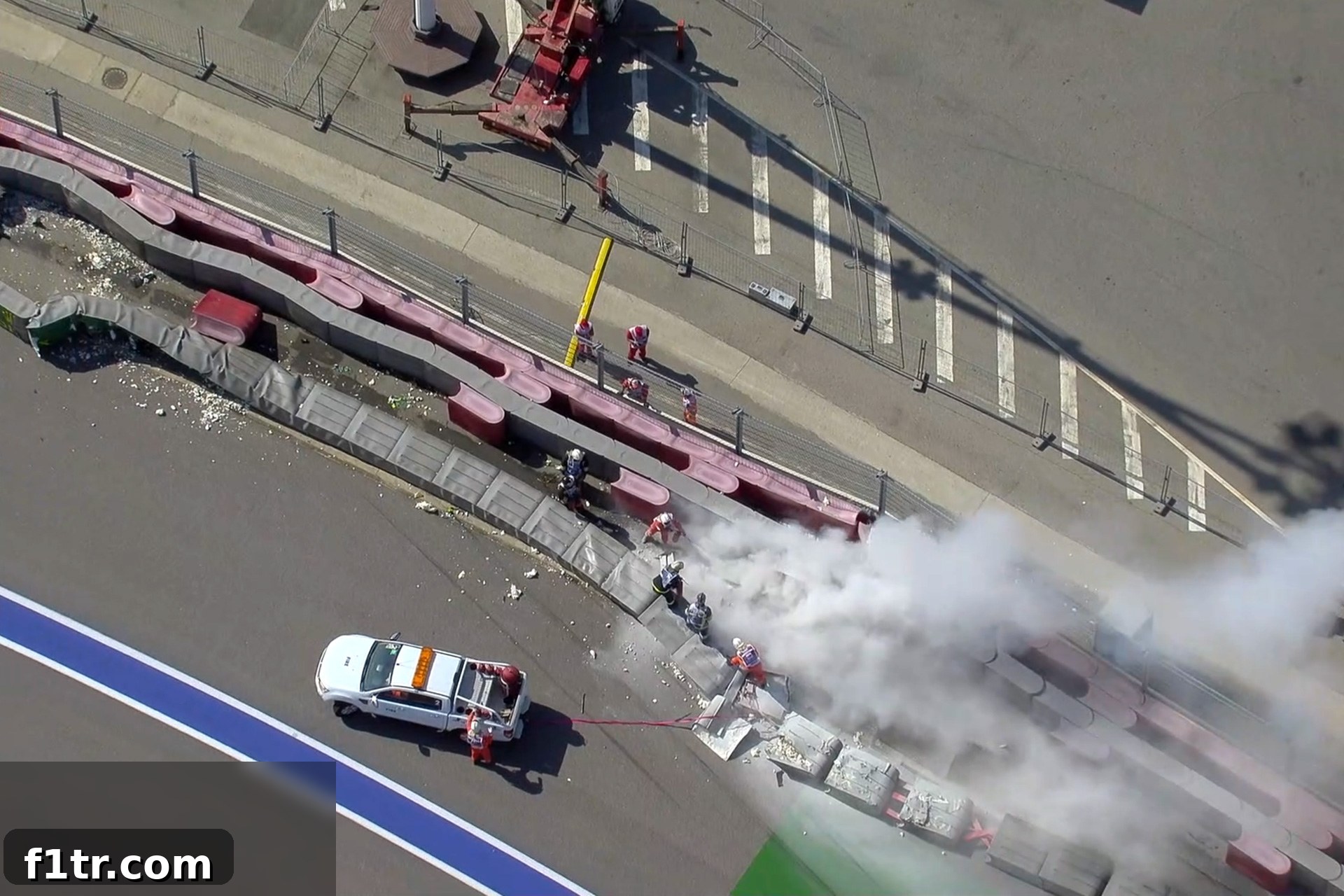
The incident unfolded during Sunday’s F2 sprint race when Aitken and Ghiotto made contact in the challenging Turn Three. Their cars subsequently speared into the TecPro barrier positioned on the outer edge of the corner with immense force. The sheer violence of the impact caused considerable damage to both single-seaters and the barrier itself. Crucially, despite the visible devastation, both drivers were able to climb out of their cockpits independently, a sight that immediately reassured onlookers and sparked conversations about the exceptional safety standards now prevalent in motorsport.
The Vital Role of TecPro Barriers: Driver Perspectives
The extensive damage to the barrier meant the race could not be restarted before the afternoon’s Formula 1 Grand Prix. Nonetheless, the incident provided a critical real-world test for the TecPro system, and its performance garnered significant praise from F1 drivers, highlighting a collective appreciation for continuous safety advancements.
Daniel Ricciardo, then a driver for Renault, was among those deeply impressed by how the barrier performed in such extreme circumstances. “The crash was obviously very big,” Ricciardo stated, acknowledging the severity of the impact. “TecPro, I think, was really good for that. I was quite amazed that they got out so easily, which was obviously what I wanted to see.” He elaborated on the mechanism of protection: “I would definitely say the TecPro is very important on some of these high-speed corners. It does absorb a lot and lets the car kind of slow down gradually by the look of it.” This gradual deceleration is key to reducing the peak G-forces experienced by drivers, significantly minimizing the risk of serious injuries in high-speed collisions.
Adding another seasoned perspective, George Russell, who himself had been involved in a formidable crash with Antonio Giovinazzi at Spa, shared his observations on the barrier’s efficacy. “Obviously it was really positive to see those guys get out of the cars so quickly,” Russell noted. “It was such a huge impact, it was a scary speed, and I guess it shows what a great job the FIA have been doing and F2 to create such a strong car.”
Russell further highlighted a crucial advantage of TecPro over older safety installations like tyre barriers. “The TecPro was also really interesting. It obviously took the speed out of it really well. What was really quite nice, you didn’t have like a rebound effect, which is often what you have with tyres like you saw with Giovinazzi’s incident at Spa. Hit a tyre barrier and you rebound back into the line of [fire] of others.” This ability to absorb energy without propelling the vehicle back onto the track is a significant safety enhancement, particularly in scenarios where multiple cars might be involved or follow closely behind.
Understanding TecPro: An Evolution in Circuit Safety
TecPro barriers represent a significant leap forward in passive safety devices on race circuits. Composed of modular, deformable polyethylene blocks, often filled with a proprietary energy-absorbing material, these barriers are engineered to progressively deform and absorb kinetic energy upon impact. This mechanism extends the duration of the impact and distributes the deceleration forces over a larger area, thereby substantially reducing the peak forces transmitted to the driver and the car’s structure. Unlike traditional tyre walls, which can be less predictable in their energy absorption and prone to creating rebound effects, TecPro systems are designed for consistent, controlled energy dissipation. Their strategic placement at high-risk, high-speed corners globally underscores their critical role in the ongoing evolution of motorsport safety standards, directly contributing to the increasing number of drivers walking away from spectacular accidents.
Advert | Become a RaceFans supporter andgo ad-free
Fire Safety and Marshal Response: Areas for Scrutiny
While the TecPro barrier was lauded, the incident also brought forth critical discussions concerning other facets of race safety, notably the marshal response to a post-crash fire. After Luca Ghiotto safely exited his vehicle, his car caught fire, and it took several minutes for trackside marshals to bring the blaze under control. This delay, though ultimately not endangering Ghiotto, sparked concerns among drivers.
Daniel Ricciardo, despite his praise for the barrier, expressed reservations regarding the speed of the marshal intervention. “I don’t want to be critical in such an accident, but the marshals, I think they were quite slow to put the fire,” he commented. He quickly qualified his statement, adding, “Obviously Ghiotto had got out of the car but I would like to think that they would have acted quicker if he was struggling to get out.” This observation underlines the critical expectation within the racing community for immediate and decisive action from safety personnel, especially when a driver’s egress from a compromised vehicle is at risk.
George Russell also articulated a distinct, yet equally pertinent, concern related to the interaction between the barrier and the burning car. “The only negative is that the TecPro went over top of the car, that car ended up on fire and he was very fortunate to be able to get out of it,” Russell highlighted. He then considered a chilling hypothetical: “Had that TecPro been over the top of his helmet it may have been a different story.” This comment underscores the complex considerations in safety design: while barriers are designed to absorb impact, their behavior post-impact, particularly when combined with potential fire hazards, demands continuous evaluation. The risk of a safety barrier inadvertently impeding a driver’s escape from a burning vehicle is a scenario that safety experts tirelessly work to mitigate.
FIA Response and the Logistics of Incident Management
Following the incident, FIA Formula 1 Race Director Michael Masi visited the crash site during the extensive barrier repair operations. He addressed the concerns regarding marshal response, acknowledging the challenges involved in rapidly responding to incidents in certain track locations. “The challenge was that it was quite a distance between two marshal posts is where the incident occurred,” Masi explained. He noted the physical demands on marshals: “I wouldn’t want to be running with a fire extinguisher for the best part of 150-odd metres or whatever.”
Masi also pointed out the coordinated response once the track was deemed safe for intervention. “As soon as the race was suspended and all of the competition cars had gone past, we also saw marshals from the opposite side of the track cross.” He concluded his assessment by reiterating the paramount positive outcome: “So I think that in the circumstances, yes, seeing a fire is never good, the positive part was that both drivers got out unscathed, which is the most important element of all.” This statement highlights the often-unsung dedication and professionalism of volunteer marshals who operate under immense pressure to ensure driver safety, despite the logistical difficulties inherent in covering vast circuits.
Race Curtailment and Lessons Learned
The F2 sprint race, which was the second of three scheduled motorsport events at the Sochi Autodrom that weekend, was red-flagged after only seven laps and could not be restarted. The severity of the barrier damage required extensive repairs, a process that ultimately consumed approximately 90 minutes. This substantial delay encroached upon the strict timetable for the eagerly anticipated Formula 1 Grand Prix later that afternoon, making a restart of the F2 race logistically impossible. Consequently, half points were awarded to the competitors.
Michael Masi acknowledged the disappointment of the curtailed race but emphasized the necessity of the decision. “But, at the end of the day, we have a timetable to adhere to, for starters. And secondly, the degree of that incident and the repair that needed to take place, I think in the end it took in the vicinity of 90 minutes to do that repair,” he stated. Masi added, “So I think what happened, yes, it was unfortunate that the FIA Formula 2 championship didn’t get to complete its race but it does happen occasionally.” This highlights the complex balancing act race organizers face between ensuring safety, completing events, and adhering to tight broadcast and operational schedules.
The FIA confirmed that, as is standard procedure for significant incidents, the crash would be meticulously scrutinised to extract every possible lesson. Such investigations are crucial for continually refining safety protocols, improving barrier designs, enhancing marshal training, and optimizing emergency response procedures across all levels of motorsport. Every major incident, despite its dramatic nature, serves as an invaluable opportunity to push the boundaries of safety and make racing an even more secure sport for its participants.
Continuing the Drive for Enhanced Motorsport Safety
The F2 crash at Sochi serves as a powerful microcosm of modern motorsport safety: remarkable progress in protective technology, yet a constant need for vigilance and improvement in all areas. The TecPro barrier unequivocally demonstrated its effectiveness in absorbing a colossal impact, playing a pivotal role in ensuring Jack Aitken and Luca Ghiotto could walk away from a potentially devastating accident. However, the incident also sparked a vital dialogue on the efficiency of emergency response, particularly fire suppression, and the complex, sometimes unforeseen, interactions between safety barriers and post-crash scenarios, such as the barrier potentially impeding driver escape in the presence of fire.
Motorsport is an ever-evolving field, where the pursuit of performance is continually matched by an unwavering commitment to safety. The detailed lessons learned from the Aitken/Ghiotto incident at Sochi will undoubtedly be integrated into future revisions of circuit design, barrier technology, and marshal training protocols. This iterative process of review, innovation, and implementation reinforces the FIA’s dedication to making racing as safe as possible without diminishing its thrilling essence. The drivers’ ability to emerge unscathed from such a violent impact stands as a profound testament to the collective efforts of engineers, safety experts, and the dedicated trackside personnel who form the bedrock of motorsport safety.
Advert | Become a RaceFans supporter andgo ad-free
Further Insights into Formula 2 and Motorsport
- Formula 2 to debut in Miami and Montreal after Iran war cancellations
- Ex-McLaren junior Dunne’s move to Alpine finally confirmed
- Schumacher says his IndyCar feels like ‘an F2 car, just with better tyres’
- The Formula 2 team with an older driver line-up than almost half the F1 grid
- FIA to award more F1 superlicence points to IndyCar drivers from 2026
Browse all Formula 2 articles