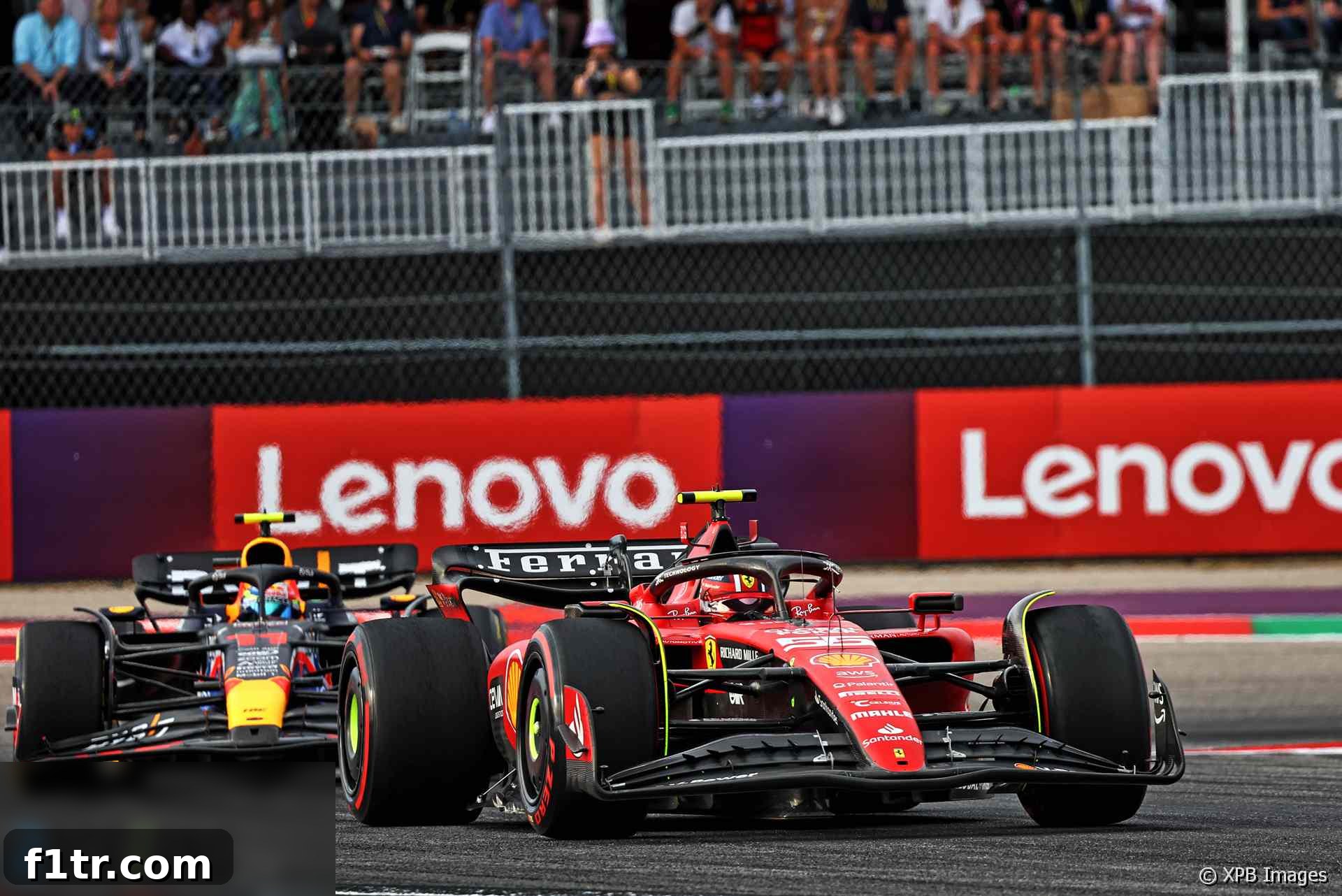
Carlos Sainz and Ferrari’s Calculated Risk: Decoding the Soft Tyre Strategy at the US Grand Prix Sprint
The high-octane world of Formula 1 often sees teams pushing the boundaries of strategy, and the United States Grand Prix sprint race at Circuit of the Americas (COTA) was no exception. Ferrari driver Carlos Sainz Jnr found himself at the centre of a bold strategic play, as he was the only competitor to start the sprint on soft compound tyres. This decision, Sainz revealed, was not a spur-of-the-moment gamble but a carefully considered move based on Ferrari’s extensive tyre modelling data.
In a sport where every millisecond and every tyre compound can dictate the outcome, being an outlier on the grid is always a talking point. Sainz commenced the sprint from sixth position and demonstrated the immediate grip advantage of the softs by quickly climbing to fourth on the opening lap. However, the inherent trade-off of the soft compound – its higher degradation rate – soon began to manifest. As the race progressed, Sainz found himself battling to maintain pace, eventually being overtaken by McLaren’s Lando Norris and Red Bull’s Sergio Perez, relegating him back to sixth place. He skillfully defended against Mercedes’ George Russell for several laps, ultimately holding onto P6 until the chequered flag.
The Lone Wolf on Softs: Sainz’s Race Unfolds
“Being the only one on softs doesn’t give you a lot of confidence,” Sainz candidly admitted after the sprint. His initial expectation was that more rivals would opt for the softer compound, providing a comparative benchmark and potentially alleviating some of the pressure. The isolation of his strategy became particularly apparent mid-race. “Obviously, mid-race once Lando and Perez passed me and George was attacking me, I thought we were just going to go backwards,” he recounted, highlighting the intense mental battle faced by drivers in such unique scenarios.
Despite the challenges, Sainz showcased his racecraft and resilience. “I managed to recover the tyre well and did some good defending in order to keep him [Russell] behind, and we brought home a P6 that at one point it didn’t look like it was going to be possible.” This defensive masterclass was crucial, not only for securing points but also for validating, to some extent, Ferrari’s data-driven approach.
Data Over Intuition: Ferrari’s Strategic Foundation
Sainz was quick to clarify that Ferrari’s choice of the soft tyre was not a reckless punt but a thoroughly researched decision. “First of all, if we go for softs, it means that our tyre model suggests that it’s not a bad tyre to go,” he explained. “If not, we simply wouldn’t even consider it.” This statement underscores the sophistication of modern Formula 1 strategy, where complex algorithms and simulations guide every critical decision, from race pace to tyre selection.
The team’s models indicated that the soft compound could be a viable option for the COTA sprint, drawing parallels from previous years where the soft tyre had performed creditably on this particular circuit. However, the on-track reality of 2023 presented a different picture. “This time around, clearly we need to analyse if we can do something because was it worth the risk? Maybe it wasn’t,” Sainz reflected, pointing towards the iterative nature of F1 strategy development. Even with advanced data, track conditions, temperature fluctuations, and competitor performance can introduce variables that require real-time adaptation and post-race evaluation. “In the end, it paid off at the start, but at one point it did look like it was going to be very tricky.”
Strategic Learnings for Sunday’s Grand Prix
While Sainz’s sprint race offered a mixed bag of results, its true value lay in the invaluable data it provided for the much longer and strategically demanding main Grand Prix on Sunday. “We learned some valuable information for my team,” Sainz affirmed. “Tomorrow, there’s plenty of strategies available out there, and now we know how the soft behaves, we can map it and compare it to the medium.”
This insight is particularly critical for Ferrari, given that Sainz’s teammate, Charles Leclerc, finished an impressive third in the sprint race and secured pole position for Sunday’s Grand Prix. Leclerc’s likely success on a different tyre compound (presumably mediums) combined with Sainz’s detailed soft tyre feedback, arms Ferrari with a comprehensive understanding of tyre performance across the full range of compounds available. This dual perspective is a strategic goldmine, allowing the team to fine-tune their race plans, predict degradation, and anticipate potential pit stop windows with greater accuracy for both their drivers.
The data from Sainz’s race can inform Leclerc’s strategy from pole, providing insights into potential threats from rivals opting for similar or contrasting tyre choices. Understanding the degradation characteristics of the softs, even if they aren’t chosen for the main race, helps Ferrari model how other teams might fare if they *do* take a soft-tyre gamble, or how quickly medium tyres might degrade relative to a soft initial stint.
The Max Verstappen Factor
Adding another layer of complexity to Sunday’s race is the formidable presence of Max Verstappen. Despite winning the sprint race convincingly, Verstappen will start the main Grand Prix from sixth position due to a grid penalty. This places him just two places behind Sainz on the grid, who starts fourth. When questioned about the inevitability of Verstappen passing him during the Grand Prix, Sainz offered a pragmatic, almost resigned response: “Yeah, that is not news.”
Verstappen’s ability to carve through the field is well-documented, and starting from P6 with a car as dominant as the Red Bull RB19 means his progression through the pack is almost a foregone conclusion. Ferrari’s strategy for both Sainz and Leclerc will undoubtedly account for Verstappen’s relentless charge, aiming to maximize their own performance and points while mitigating the impact of the reigning world champion’s advance. The COTA track, with its blend of high-speed sections and challenging corners, offers opportunities for both overtaking and strategic defence, making tyre management and timing even more crucial.
The Nuances of F1 Tyre Strategy and Sprint Races
The US Grand Prix sprint race provided a fascinating case study in Formula 1 tyre strategy. Sprint races, by their very nature, are shorter and often encourage teams to take more aggressive risks than they might in a full Grand Prix. The reduced distance means tyre degradation is less of a long-term concern, potentially making a soft-tyre start more appealing for immediate gain. However, Sainz’s experience highlights that even in a sprint, managing degradation remains paramount, especially on a demanding circuit like COTA known for its abrasive surface and challenging high-speed esses.
A team’s decision-making process is a continuous loop of simulation, real-world testing, and post-race analysis. Ferrari’s willingness to experiment with Sainz’s tyre choice reflects their commitment to extracting every ounce of performance and data. While the immediate outcome for Sainz wasn’t a podium, the strategic intelligence gathered could prove invaluable for Leclerc’s pole position advantage and the team’s overall points haul on Sunday. In the quest for competitive advantage, every piece of data, every lap on a different compound, contributes to a clearer picture of optimal performance.
The 2023 Formula 1 season has seen intense battles not just for race wins, but also for strategic supremacy. Ferrari, alongside Mercedes and McLaren, has consistently challenged Red Bull’s dominance, and nuanced decisions like Sainz’s soft tyre gamble are indicative of the lengths teams go to find an edge. The COTA Grand Prix weekend perfectly encapsulated this high-stakes game of speed, strategy, and data analysis.
Advert | Become a RaceFans supporter andgo ad-free
Related Coverage: 2023 United States Grand Prix
- US GP was Mercedes’ best race of 2023 despite disqualification – Wolff
- Singapore and Austin retirements cost top 10 championship place – Ocon
- United States Grand Prix result unchanged as FIA rejects Haas’ call for review
- Sargeant admits he’s ‘struggled to use all the downforce at times’ in F1
- Mercedes’ Brazilian GP set-up was “conservative” after US GP disqualification
Browse all 2023 United States Grand Prix articles