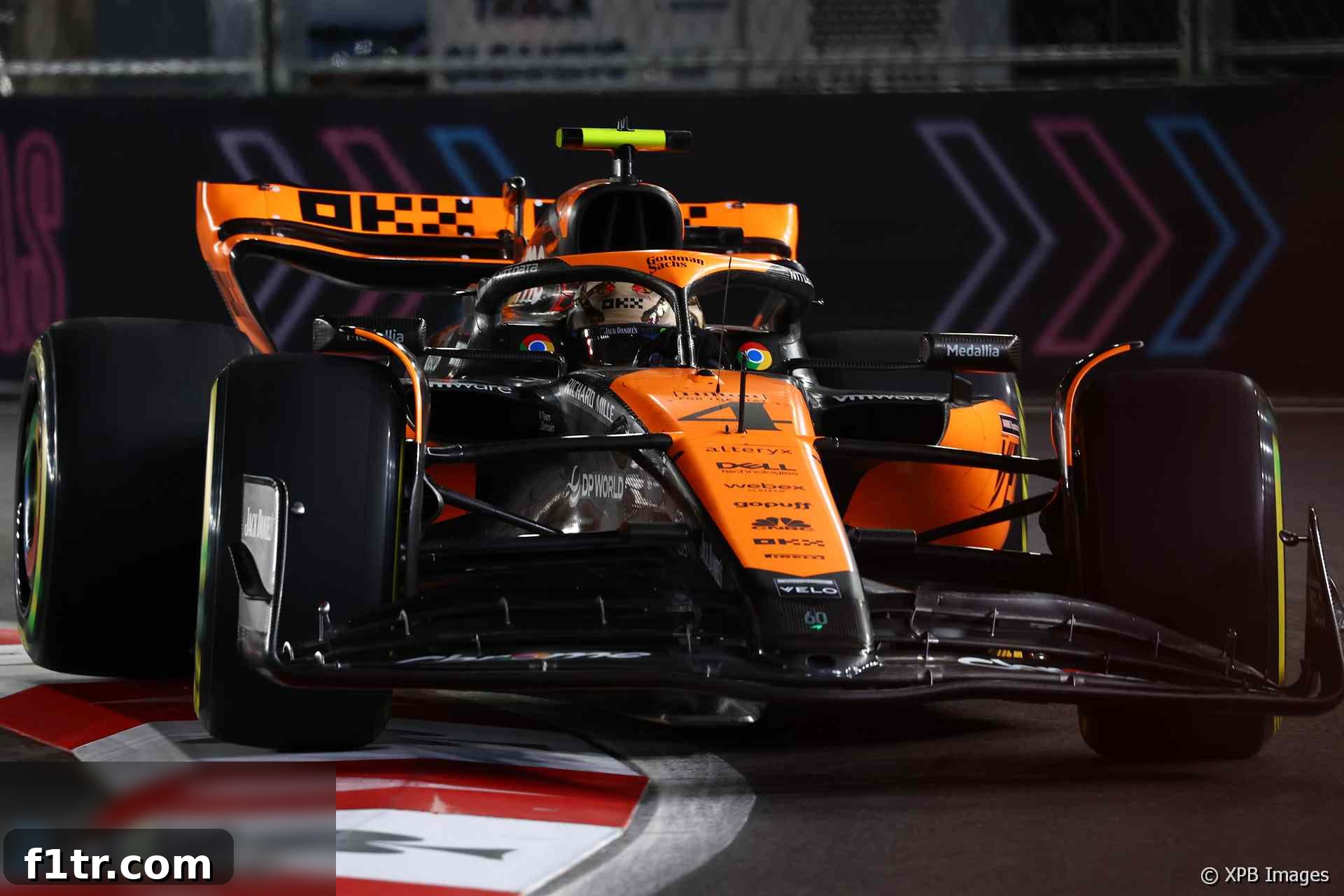
Lando Norris’s Las Vegas GP Crash: Unpacking the “Rare” Combination of Factors
Lando Norris, the highly regarded McLaren driver, recently shed light on the complex interplay of events that culminated in his dramatic crash at the inaugural Las Vegas Grand Prix. The incident marked the first time in his otherwise impeccable 2023 season that he failed to finish a grand prix, highlighting the unique challenges presented by the new street circuit.
During the fast left-hand Turn 11, Norris lost control of his MCL60, spinning violently into the unforgiving outside barrier. Following the high-speed impact, he was promptly taken to a local medical center for precautionary checks, a standard protocol in modern Formula 1 designed to prioritize driver safety. Thankfully, he was quickly released, confirming he was largely unscathed, albeit understandably frustrated.
Speaking to media, including RaceFans, at the Yas Marina circuit ahead of the Abu Dhabi Grand Prix, Norris attributed the accident, which occurred shortly after the race resumed under a Virtual Safety Car, to a “combination of things.” His detailed explanation offers a fascinating glimpse into the micro-factors that can dictate the fine margins of success and failure in elite motorsport.
The Anatomy of a Las Vegas Crash: A Confluence of Conditions
Norris meticulously dissected the sequence of events, pointing to several critical elements that, when combined, created a perfect storm for the incident. “The obvious one being there is quite a big bump there,” he began, identifying a significant track imperfection as a primary catalyst. Bumps, even minor ones, can profoundly unsettle an F1 car, especially at high speeds, by disrupting its delicate aerodynamic balance and mechanical grip. The precise moment of impact with such an imperfection, coupled with other environmental factors, can be the deciding factor between maintaining control and an inevitable loss of traction.
Adding to this challenge were the “cool tyres,” a persistent issue throughout the Las Vegas weekend due to the low ambient temperatures and the track’s new, abrasive surface. Cool tires offer significantly less grip than their optimally heated counterparts, reducing the car’s adhesion to the track. This reduction in grip inherently leads to “lower ride heights than what you’re normally running with,” as drivers push to generate any available downforce. A lower ride height increases the car’s susceptibility to ground contact over bumps, further amplifying their unsettling effect on the chassis and potentially causing porpoising or bottoming out, which momentarily deprives the car of critical aerodynamic grip.
The situation was compounded by Norris “following a lot of cars through all of this,” which significantly reduces the car’s aerodynamic efficiency. In the turbulent “dirty air” created by cars ahead, an F1 machine experiences a substantial loss of downforce. This makes it more difficult for the car to maintain grip, particularly through high-speed corners. The combination of reduced downforce from following other vehicles and the car’s inherent lower ride height due to cool tires meant that the critical bump had an exponentially greater impact than it might have under normal racing conditions, drastically narrowing the margin for error.
Norris also hinted at “a couple of other little things in the background that just made this bump have a bigger effect than what it normally has.” While not specified, these could include subtle changes in brake application, steering input, or even a momentary lapse in concentration—tiny variables that can have monumental consequences at the razor’s edge of Formula 1 performance. “I think somehow I must have caught it at a worse angle than normal,” he mused, acknowledging the precision required to navigate such hazards. “I always knew there was a bump there, but just for some reason, the effects of it on this one lap seemed a lot bigger than what it had done previously. So, just a little bit unlucky at the same time.” This confluence of specific circumstances underscores the highly nuanced and often unpredictable nature of top-tier motorsport, where the smallest deviation can lead to significant consequences.
The Unpredictable Nature of New Circuits: Las Vegas Strip Circuit Analysis
The McLaren driver firmly believes that the intricate combination of factors leading to his crash was so specific that replicating it would be a formidable challenge, even if he were to intentionally try. “For all of those things to happen again and to cause this is quite rare,” he stated. “Probably if I did everything, almost tried to drive everything the same now, it’s not a guarantee that it would happen again.” This sentiment highlights the unique, almost statistical improbability of such a precise alignment of variables reoccurring in the exact same manner.
He elaborated on the minuscule margins that separate a clean lap from an incident, illustrating the precise requirements for F1 car control. “If I was 30cm to the right or to the left, maybe it would be different. If there was one less car ahead of me, it would have been different. If I’d clipped the battery a little bit earlier, it would have been different. There’s so many different circumstances.” This perspective not only emphasizes the hyper-sensitive dynamics of Formula 1 vehicles but also the critical role of track positioning, aerodynamic interactions, and precise timing in a sport where milliseconds and millimeters define performance, especially on a new, evolving circuit that drivers are still learning.
Beyond his personal incident, Norris echoed the sentiments of many of his rivals regarding the overall layout and characteristics of the Las Vegas Strip Circuit. While acknowledging its unique setting and visual appeal, he was pragmatic about its racing qualities. “I think the track is okay – it’s not the best track I’ve ever driven,” he admitted. A significant point of contention for many drivers was the newly laid tarmac, which offered unexpectedly low grip levels. “If it was just higher grip – I think the Tarmac made it a lot worse than what every driver would have wanted.” The challenge of generating tire temperature on the cold, low-grip surface exacerbated the issues, turning every corner into a high-stakes balancing act.
The lack of natural grip profoundly impacts how F1 cars can be driven, influencing braking points, cornering speeds, and overall lap times. It forces drivers to adapt their style, often resulting in more sliding and less optimal performance. Despite these inherent challenges, Norris observed that the Grand Prix itself was surprisingly engaging for spectators. “It plays a big part in [the] racing, but the racing was pretty decent – I think almost because it was so tricky and difficult to drive.” This suggests that while challenging conditions can hinder outright performance and comfort for drivers, they can also foster more dynamic and unpredictable racing, as drivers are forced to push the limits and make strategic compromises, leading to overtakes and closer battles that might not occur on higher-grip, more predictable tracks.
Driver Safety and Post-Incident Protocol in Formula 1
Following such a high-speed impact, comprehensive medical assessments are standard procedure in Formula 1, reflecting the sport’s unwavering commitment to driver safety. Norris’s journey to the hospital for checks was part of this rigorous protocol, yet he assured everyone that his physical condition was never a major concern. “Honestly, I was never bad,” he stated emphatically. “They just said they wanted to do a lot of check-ups and stuff, kind of the new norm nowadays, it seems. But I was fine.” This routine, though perhaps inconvenient, is a testament to the advancements in F1 safety, where even seemingly minor incidents trigger thorough evaluations to ensure no underlying issues are missed.
He candidly recalled the immediate aftermath of the crash: “Obviously I was winded, probably you heard on the radio when I had the impact because I breathed in or breathed out at the wrong time and it just kind of caught me off-guard a little bit. It happened quite quickly. So still a decent impact. But I was fine. I never struggled with anything.” This experience underscores the incredible G-forces drivers endure during an F1 crash and the importance of split-second reactions, even involuntary ones, in mitigating injury. Modern F1 car design, with its robust carbon-fiber monocoque, the HANS device, advanced crash structures, and strategically placed safety barriers, plays a pivotal role in ensuring drivers can walk away from such significant incidents, highlighting the continuous evolution of safety in motorsport.
Beyond the physical aspect, Norris shared his emotional response. “I was more just frustrated that I was out of the race in Vegas so early on. So it was more just a shame. But I was fine.” This sentiment is common among top athletes; the disappointment of an early exit often outweighs any discomfort from the incident itself. The intense desire to compete and perform at their peak drives these individuals, making forced retirements, especially from a high-profile event like the Las Vegas Grand Prix, particularly galling. “I’ve then been advised to just chill out and relax for a few days. But I was good since I pretty much jumped out of the car. A little shaken at first, just because it caught me by surprise so much, what happened, but then all good after that.” His swift recovery and readiness to return to competition exemplify the extraordinary resilience and physical conditioning of Formula 1 drivers, who must be prepared for both the physical and mental demands of the sport.
A Season of Resilience: Lando Norris’s 2023 Performance
The Las Vegas DNF stood out as an anomaly in what was otherwise a stellar 2023 season for Lando Norris and McLaren. Having started the season with a challenging car, the team executed a remarkable mid-season turnaround, developing the MCL60 into a consistent podium contender. Norris, in particular, showcased exceptional skill and consistency, securing multiple podium finishes and establishing himself as one of the grid’s most promising talents. This solitary non-finish underscores the rarity of such incidents in his recent track record, further highlighting the unique combination of factors that contributed to the Vegas crash rather than any inherent misjudgment on his part. It serves as a reminder that even the best in the business are at the mercy of the myriad variables in Formula 1.
His performance throughout 2023, often outperforming the car’s initial capabilities and consistently challenging the front-runners, solidified his reputation for speed and race craft. The incident in Las Vegas, therefore, serves as a stark reminder that even the most talented drivers, in the most advanced machinery, are susceptible to the unpredictable variables of racing, especially on a brand-new street circuit. It’s a testament to his character and the team’s ongoing development that this setback did not derail their impressive momentum heading into the season finale in Abu Dhabi, where they aimed to consolidate their strong finish to the year.
The Future of the Las Vegas Grand Prix: Lessons Learned
The inaugural Las Vegas Grand Prix was undoubtedly a spectacle, blending the high-octane world of Formula 1 with the city’s unique glamour and entertainment. However, it also presented a steep learning curve for both organizers and teams alike. Lando Norris’s insights, particularly regarding the track surface and localized bumps, provide invaluable feedback for future iterations of the event. Addressing these specific track characteristics, potentially through targeted resurfacing or bump mitigation efforts in Turn 11 and other critical areas, could significantly enhance driver confidence, improve overall racing quality, and reduce the risk of similar incidents in the future.
While the initial reception from some drivers and fans was mixed, the event’s overall entertainment value, its unique atmosphere, and its potential to attract a new, diverse audience to Formula 1 are undeniable. Lessons learned from incidents like Norris’s crash are crucial for the continuous improvement of new circuits, ensuring they evolve to offer both thrilling competition and uncompromising safety. The unique challenges posed by temporary street circuits, combined with their spectacular backdrops, mean that events like Las Vegas will continue to be a focal point for discussion and development in the sport, striving to balance spectacle with the demands of top-tier racing.
Support Independent F1 Journalism
RaceFans is committed to delivering authentic Formula 1 news and insights directly from the heart of the paddock. This dedication to original journalism, providing in-depth analysis and timely reports, is made possible, in part, by the invaluable support of our readers, the RaceFans Supporters.
By contributing a modest amount, such as £1 per month or £12 per year (or the equivalent in your local currency), you actively help us cover the essential costs associated with producing high-quality, independent content. This includes expenses for travel to races, in-depth writing and editorial efforts, creative production of multimedia, robust website hosting, maintaining crucial industry contacts, and continuous platform development to improve your reading experience.
For over a decade, our work has been proudly sustained by the generosity and belief of our readers. If you appreciate our independent coverage, commitment to journalistic integrity, and the unique perspective we offer on Formula 1, we warmly invite you to consider becoming a RaceFans Supporter today. As an added benefit, all our Supporters enjoy an ad-free browsing experience across the site, allowing for uninterrupted reading. Learn more or sign up through the links provided below:
- Become a RaceFans Supporter
- RaceFans Supporter FAQ
Related Articles: 2023 Las Vegas Grand Prix
- Tost blames track inspection oversight for Sainz’s damage in Las Vegas
- Hard to repeat “rare” combination of factors behind Vegas shunt – Norris
- Las Vegas Grand Prix “got a lot more hate than it deserved” – Sargeant
- Williams’ “incredible” Vegas qualifying made us “poor” in race – Vowles
- Piastri is first rookie to take two fastest laps in a season since Hamilton
Browse all 2023 Las Vegas Grand Prix articles