Mercedes Confronts its Pace Gap as Aston Martin’s F1 Surge Highlights Own Development Imperative
The opening qualifying session of the 2023 Formula 1 season delivered a stark message to the Mercedes-AMG Petronas F1 Team. While their primary focus remains on closing the gap to front-runners, the remarkable leap forward demonstrated by their engine customer, Aston Martin, served as an immediate and undeniable benchmark for the progress Mercedes itself needs to achieve.
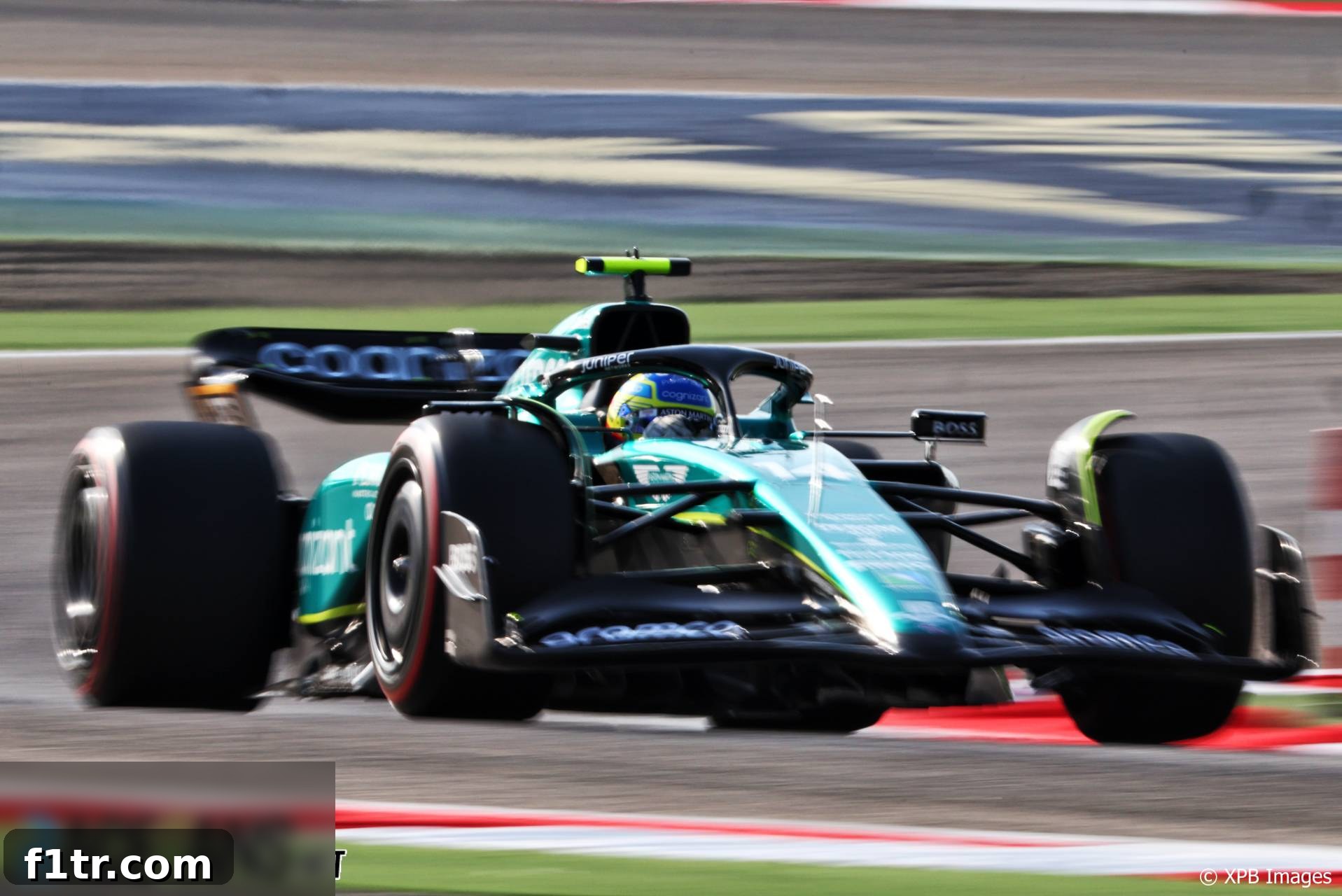
Aston Martin, long considered a midfield team, lived up to its pre-season hype in spectacular fashion. Veteran driver Fernando Alonso qualified his AMR23 in an impressive fifth place on the grid for the Bahrain Grand Prix. This monumental achievement was not merely a marginal improvement; Alonso’s qualifying lap was an astonishing two-and-a-half seconds faster than the team’s best effort at the very same circuit just 12 months prior. This colossal performance gain has sent ripples through the paddock, forcing established top teams like Mercedes to re-evaluate their own development trajectories.
Aston Martin’s Stunning Ascent and Mercedes’ Introspection
The speed shown by the new AMR23 was particularly telling given its close proximity to the Mercedes W14. Fernando Alonso’s fifth-place grid slot was secured by narrowly edging out both Mercedes drivers, with George Russell trailing by a mere four thousandths of a second. For Russell, this direct comparison highlighted the potential that Mercedes should aspire to unlock within their own package. “You’ve got to take Aston Martin’s case,” Russell stated after qualifying, acknowledging the impressive turnaround. “I think they probably had a good basis last year and they added a load of performance over the winter. And if it’s possible, if anybody can do it, we can do it. So I think they’re a good example of what is possible.” Russell’s comments underscore the competitive spirit within Mercedes and the belief that, with focused development, they too can achieve similar breakthroughs.
Aston Martin’s transformation from a P7 constructor in the previous year to the third-quickest team in qualifying at the 2023 season opener is a testament to effective off-season development and shrewd strategic decisions. Their ability to extract such significant performance from their new challenger provides a tangible target for Mercedes, which shares crucial components with the Silverstone-based outfit.
The W14 Challenge: Building on a Troubled Legacy
Mercedes endured a challenging 2022 campaign with its W13 chassis, a car famously plagued by severe “porpoising” – an aerodynamic phenomenon causing the car to bounce excessively at high speeds. This issue severely hampered the team’s ability to extract performance, often forcing them to run the car higher than optimal, thereby sacrificing crucial downforce.
The team has expressed confidence that they have successfully addressed these fundamental aerodynamic problems with their new W14 car. While they went into the 2023 season with realistic expectations, knowing they wouldn’t start as the fastest car, the objective was to have a stable and developable platform. “We went into the season knowing that we’re not going to hit the ground being the fastest car,” Russell acknowledged, “But we wanted to make sure that we had a car that could build upon.”
Unlike the W13, which took a significant portion of the season to tame, Russell believes the W14 provides a much stronger foundation for future performance gains. He indicated that major improvements are anticipated over the coming races, likely coinciding with the introduction of their first significant upgrade package. “It took us probably 16 races last year to get a car that we were relatively happy with,” Russell reflected. “But I feel we’re in a much stronger place to build upon. So I guess from our first upgrade package onwards, we’ll probably see. But for now, this is probably where we’ll sit for the coming couple of races.” This outlook suggests a strategic, phased approach to development, aiming for sustained progress throughout the demanding F1 calendar.
Toto Wolff’s Candid Assessment: Aerodynamics at the Core of Mercedes’ Shortcomings
Mercedes Team Principal Toto Wolff provided a blunt assessment of the situation, drawing direct comparisons between the W14 and the surprising AMR23. The similarities between the two cars, particularly in shared Mercedes components, underscore where the Silver Arrows need to progress. “They gained two seconds in half a year and their car is half ours from the engine, gearbox and the rear suspension,” Wolff stated, highlighting the technical alliance. He also pointed out the significant detail that Mercedes’ state-of-the-art wind tunnel is also utilized by Aston Martin, making their divergent performance even more perplexing and indicative of underlying issues within Mercedes’ own design philosophy. “So given there’s a lot of parallels, we just need to acknowledge that they’ve done an outstanding job.”
Wolff firmly believes that Mercedes’ current shortcomings are primarily down to aerodynamics. This diagnosis is crucial because if the problem were mechanical or related to suspension, the customer team, Aston Martin, sharing these core components, would likely be suffering from similar issues. “If it was mechanic[al] and suspension the Aston Martin should have it too,” Wolff explained. This pinpointing of aerodynamics as the root cause directs Mercedes’ engineering focus squarely on improving airflow, downforce generation, and overall car efficiency.
The competitive landscape further illustrates Mercedes’ predicament. Aston Martin, after finishing seventh in the constructors’ championship last year, catapulted to become the third-quickest team in Bahrain qualifying. Meanwhile, Mercedes found themselves as far away from pole position as they were 12 months ago, facing a persistent performance deficit. “We started last year with six tenths [deficit] and we are starting this year with six tenths and that is the reality,” Wolff lamented. Despite this current gap, the team’s ambition remains undimmed. “And our aim, whilst being humble about it, is to fight for victories and the world championship. So whatever is between us and pole position is less relevant,” Wolff affirmed, emphasizing the long-term vision over immediate frustration.
Redefining the Concept: A Fundamental Rethink for Mercedes
Facing this persistent performance gap, Toto Wolff candidly admitted that Mercedes will need to profoundly rethink the fundamental concept of its car to regain a competitive edge. The team has been finding good levels of downforce in their wind tunnel tests for many months, suggesting their simulation tools are providing positive feedback. However, translating this theoretical downforce into on-track performance has proven to be the critical challenge. “We are finding good downforce in the tunnel. We have found good downforce in the tunnel since many months,” he said. “But we’ve got to look at how we can optimise this in a way where maybe we find more of that.” This indicates a potential correlation issue between simulation and real-world performance, or perhaps a design concept that struggles to deliver its full potential in varying track conditions.
Wolff articulated a philosophy of learning and adaptation, even from setbacks. “What I really enjoy is working in the team and discovering that. And I said it last year sometimes it’s important for the long time to get it wrong,” he reflected. This perspective highlights Mercedes’ resilient culture and their willingness to confront uncomfortable truths. The acknowledgment that “we’ve got the physics wrong” is a powerful statement of accountability and an imperative for change. With the current Formula 1 regulations set to remain largely stable for another three years, the urgency to correct these fundamental physics and optimize their car concept is paramount for Mercedes to reclaim its position at the pinnacle of motorsport.
The journey ahead for Mercedes will undoubtedly be challenging, but the competitive spirit ignited by Aston Martin’s success, coupled with the team’s renowned engineering prowess, suggests a determined effort to understand, adapt, and ultimately overcome their current performance deficit. The F1 paddock will be watching closely as the Silver Arrows embark on this critical period of introspection and strategic redirection.
To support independent Formula 1 journalism and enjoy an ad-free browsing experience, consider becoming a RaceFans supporter.
Bringing the F1 News from the Source
RaceFans strives to bring its readers news directly from the key players in Formula 1. We are able to do this thanks in part to the generous backing of our RaceFans Supporters.
By contributing £1 per month or £12 per year (or the equivalent in other currencies) you can help cover the costs involved in producing original journalism: Travelling, writing, creating, hosting, contacting and developing.
We have been proudly supported by our readers for over 10 years. If you enjoy our independent coverage, please consider becoming a RaceFans Supporter today. As a bonus, all our Supporters can also browse the site ad-free. Sign up or find out more via the links below:
- Become a RaceFans Supporter
- RaceFans Supporter FAQ
Become a RaceFans supporter and go ad-free
2023 Bahrain Grand Prix Related Articles
- FIA no longer applying its limit on F1 cars ‘porpoising’
- Why F1’s 2023 tyres are requiring drivers to change their management style
- The familiar and unfamiliar problems holding McLaren back at the start of 2023
- ‘Not like a rookie’: How McLaren glimpsed Piastri’s potential in curtailed debut
- “I’m a shouty guy”: Tsunoda told to rein in “emotional” radio chatter
Browse all 2023 Bahrain Grand Prix articles