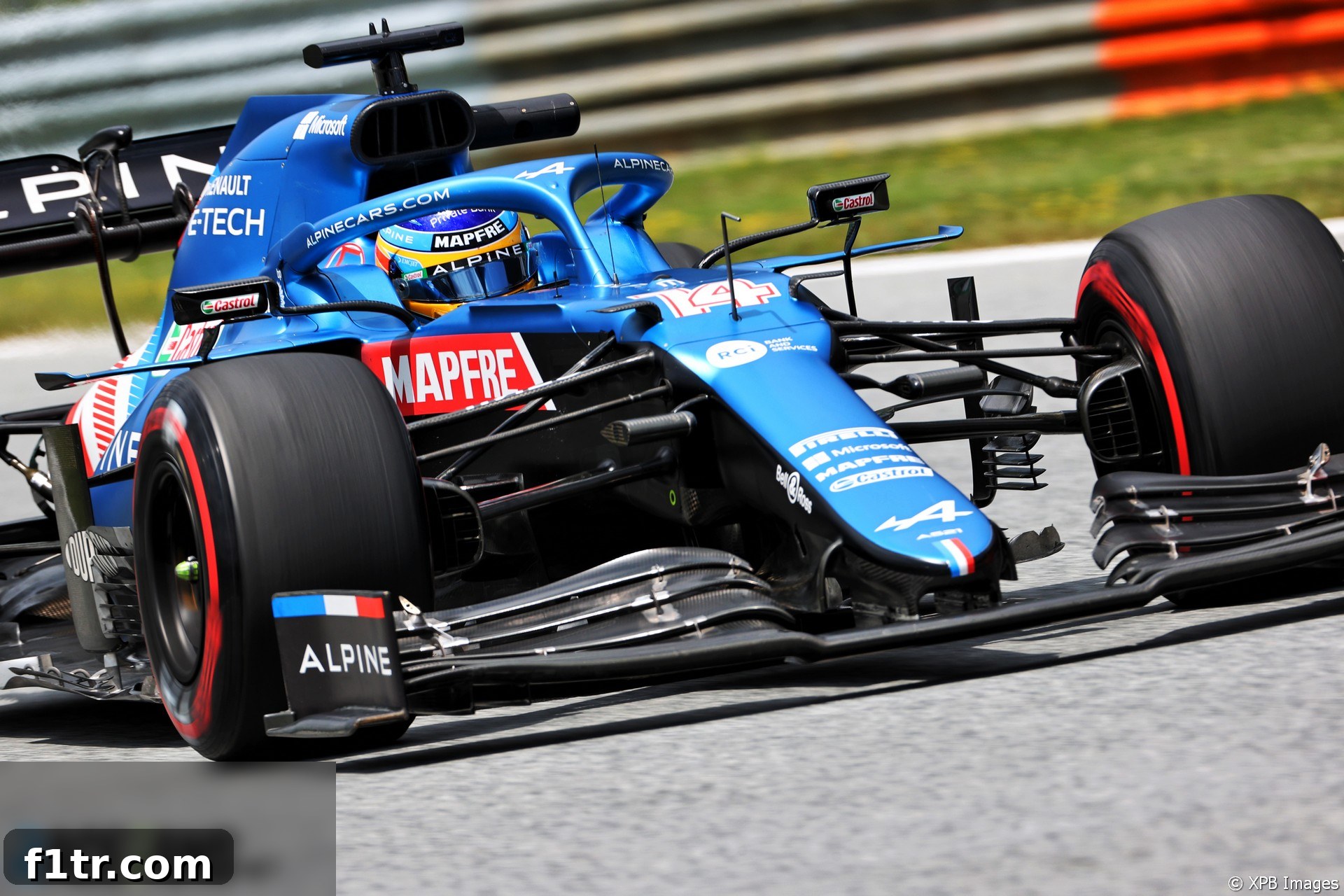
Fernando Alonso has issued a firm challenge to the FIA, calling for a significant overhaul in how Formula 1’s rules are policed, particularly in high-stakes qualifying sessions. The veteran driver’s demand comes after his own qualifying performance at the Red Bull Ring was severely compromised by other competitors intentionally slowing down on track, creating a frustrating and potentially unsafe scenario.
Advert | Become a Supporter & go ad-free
Alonso Demands Stricter FIA Enforcement After Red Bull Ring Qualifying Frustrations
The incident that sparked Alonso’s outspoken criticism occurred during the second segment of qualifying for the Austrian Grand Prix. Drivers had been explicitly warned in the race director’s notes that deliberately backing off through the final two corners of the circuit to create space for a flying lap could lead to them being reported to the stewards. Despite this clear directive, multiple drivers engaged in this practice, leading to a chaotic situation on track and directly impacting Alonso’s ability to progress to Q3.
The Compromised Lap: Alonso’s Near Miss for Q3
Alonso, driving for Alpine, found himself catching Sebastian Vettel at the very end of his crucial Q2 lap. Vettel was among those slowing down, creating a significant impediment for Alonso and effectively ruining his final attempt to secure a top-10 grid slot. While Vettel was subsequently penalised for the incident, two other drivers who were investigated for similar infringements were ultimately cleared. This decision was based on the rationale that numerous other drivers had also slowed down at the same point on the lap, highlighting a systemic issue rather than isolated transgressions.
Speaking before the stewards’ decisions were finalised, Alonso minced no words, urging the sport’s governing body to adopt a much tougher stance against rule-breakers. His frustration was palpable, rooted in a belief that the FIA’s current approach fosters an environment where drivers feel they can push the boundaries without consistent repercussion.
“I’m sure the FIA will have to learn as well and police this a little bit better because in the top category of motorsport, you cannot see turn nine and 10 with 10 cars waiting to open the lap at 5kph,” the two-time world champion stated firmly. His words underscored the absurdity of a situation where elite drivers in the pinnacle of motorsport are forced to navigate through a crawl of cars at critical points on the track.
The Perils of ‘Too Soft’ Penalties and Inconsistent Policing
Alonso attributed the recurring problem directly to what he perceives as overly lenient penalties. “I think that has to be managed a little bit better in the top category and be harsh with penalties. This is a consequence of being too soft on penalties,” he argued. His sentiment reflects a common concern among drivers and fans alike: that penalties, when applied, often do not serve as sufficient deterrents, especially when compared to the competitive advantage gained or the detrimental impact on rivals.
Advert | Become a RaceFans supporter andgo ad-free
The issue, according to Alonso, is not confined to qualifying alone. He pointed to instances in free practice sessions where similar slow-downs occurred without any disciplinary action. “Yesterday, I couldn’t make any lap with Raikkonen in the last corner and then one of the Toro Rossos [AlphaTauris] and nothing happened. So even in free practice, we see this is kind of problematic, and there is no policeman on this. So that’s sad.” This lack of consistent enforcement across all sessions suggests a broader supervisory vacuum that drivers are quick to exploit.
The inherent danger of such speed differentials on a high-speed track like the Red Bull Ring cannot be overstated. When some cars are pushing the limits for a flying lap while others are barely moving, the risk of a serious incident escalates dramatically. Alonso highlighted the precarious situation drivers find themselves in, relying heavily on their engineering teams for real-time information about track congestion. However, even the best radio communications cannot mitigate the physical risk or the competitive disadvantage when multiple cars are deliberately obstructing the flow.
Alonso also touched upon the FIA’s potential reluctance to penalise a large number of drivers, an issue that contributes to the very inconsistency he criticises. “I guess they will not penalise 10 or 12 cars, which is the only way that could change our weekend. So it is an unfortunate situation and an unlucky situation.” This statement reveals a cynical understanding of the governing body’s operational realities: a widespread penalty might be seen as undermining the integrity of the event itself, even if it is the rightful consequence of rule infringements.
The Call for Consistency: Lessons from Other Sports
To bolster his argument for consistent rule enforcement, Alonso drew a compelling parallel to other sports, specifically football. “In football, if you touch [the ball] with the hand in the area, it’s a penalty. So here the rules says that you’re going to not slow down from nine to 10. I don’t know if there are 11 cars, five, two or 16 but whoever did that should at least get some kind of penalty.”
This analogy cuts to the core of the issue: clear rules require clear consequences, regardless of the number of offenders. The principle of equal application of rules is fundamental to sporting fairness and integrity. If a rule exists and is violated, the penalty should follow. Allowing a multitude of infringements to go unpunished simply because of their sheer volume undermines the rule itself and the authority of the body tasked with enforcing it.
Advert | Become a RaceFans supporter andgo ad-free
The Red Bull Ring, with its relatively short lap and fast final corners, is particularly susceptible to this issue. Drivers often find themselves in a tight window to prepare for their flying laps, leading to bottlenecks as they try to create optimal space. The challenge for the FIA is to find a way to manage this without stifling genuine preparation or unfairly penalising drivers who are simply trying to position themselves safely.
Beyond Penalties: Exploring Solutions for Fairer Qualifying
Alonso’s plea is not just about retroactive punishment but about fostering a safer and fairer competitive environment. Stricter penalties, such as heavier grid drops or more significant license penalty points, could serve as a stronger deterrent. However, the FIA also needs to consider proactive measures. This could include designated speed zones in critical areas during qualifying, or even exploring alternative qualifying formats that mitigate the need for drivers to deliberately create large gaps.
The issue also highlights the evolving nature of Formula 1 and the constant battle between drivers seeking every marginal gain and the regulators attempting to maintain order and safety. The increasing competitiveness of the field means that every fraction of a second, and every clear piece of track, can make the difference between Q3 and an early exit.
Ultimately, Fernando Alonso’s strong comments serve as a critical reminder to the FIA: the rules are only as effective as their enforcement. For the integrity of Formula 1, for the fairness of competition, and most importantly, for the safety of its drivers, clarity, consistency, and a firm hand in policing are paramount. The Red Bull Ring incident, and Alonso’s subsequent call to action, underscore the urgent need for the governing body to re-evaluate its approach and ensure that the “top category of motorsport” operates with the highest standards of fair play and safety.
2021 Austrian Grand Prix: Related Insights
- Vasseur on Alfa’s “huge step forward” and why he’s vexed by technical directives
- How Ricciardo “got some enjoyment back” after “really low” first race in Austria
- F1’s penalty points are not “harsh” and won’t be reviewed this year – Masi
- Austrian double showed Sainz found his feet faster than 2021’s other big-name moves
- 2021 Austrian Grand Prix Star Performers
Browse all 2021 Austrian Grand Prix articles