Few phenomena in the world of competitive sports capture the imagination and analytical prowess of sports psychologists quite like the concept of “home field advantage.” It’s an intangible yet potent force, the inherent edge competitors gain simply by performing on their familiar ground, surrounded by their local supporters. This psychological and sometimes physiological boost has been observed across a myriad of sporting disciplines, from the roar of a football stadium to the focused intensity of an Olympic arena, influencing outcomes in subtle yet significant ways.
Advert | Become a Supporter & go ad-free
Motorsport, with its high stakes, precision, and immense pressure, is no exception to this intriguing phenomenon. The history books are replete with examples: from the legendary Nigel Mansell famously attributing genuine gains in lap time to the electric energy of his devoted “Mansell-mania” legions at Silverstone, to the consistent success Ferrari has savored over many decades in front of their fiercely loyal Tifosi. This profound connection between competitors and their home crowd often transcends mere morale, manifesting as a palpable advantage that can indeed help determine race winners, influence championship narratives, and even etch moments into sporting folklore.
The 2021 Formula 1 season presented a compelling case study for this very concept. As the championship battle intensified, a critical question began to emerge: could the inherent power of home advantage ultimately determine the destination of that year’s coveted world championship trophy? The stage was perfectly set for this hypothesis to be tested at a very familiar venue for one of the primary contenders.
Verstappen’s Home Turf Triumph: A Defining Moment in the 2021 Season
When Max Verstappen and Red Bull Racing rolled into the Austrian circuit that proudly carries their name, they did so riding a wave of formidable momentum. They had just delivered a decisive blow to their fierce Mercedes rivals in France, executing an aggressive and masterful strategy to hunt down and overtake Lewis Hamilton in the closing laps. This victory not only extended their lead in both the drivers’ and constructors’ championships but also served as a sweet retribution for Mercedes’ similar tactical triumph over them just a month prior in Barcelona. The Red Bull Ring, therefore, represented more than just another race track; it was Verstappen’s spiritual home, a fortress where the ‘orange army’ of his fans created an atmosphere unlike any other.
The grid for the Styrian Grand Prix mirrored the escalating championship rivalry, with the two protagonists, Verstappen and Hamilton, once again lining up on the front row. This time, however, the advantage of pole position belonged to Verstappen. Hamilton had inherited his place alongside his championship rival due to a three-place grid penalty issued to his teammate, Valtteri Bottas, for a contentious pit lane spin during Friday practice. This minor reshuffle further amplified the tension, setting the stage for an explosive start to the race.
Explosive Start and Early Chaos
As the five red lights extinguished, a cacophony of cheers erupted from the thousands of orange-shirted supporters filling the limited-capacity crowd around the circuit. Verstappen, fueled by the energy of his fans, launched perfectly from pole, seizing the lead ahead of Hamilton. Behind them, the opening moments of the race descended into a flurry of dramatic action. Lando Norris’s McLaren, starting from an impressive third, immediately came under intense pressure from Sergio Perez’s Red Bull. Norris, known for his tenacious defense, masterfully used every inch of track, and perhaps a touch more, to fend off the charging Red Bull through the tight confines of the first turn, clinging onto his podium position.
Advert | Become a RaceFans supporter andgo ad-free
Further back in the field, as the cars sprinted uphill towards Turn 3, chaos unfolded. Pierre Gasly, in his AlphaTauri, found his mirrors completely filled – Fernando Alonso’s Alpine was to his right, and Charles Leclerc’s Ferrari was aggressively positioning to his left. Leclerc, attempting to gain a tow, misjudged his move, clipping Gasly’s left-rear wheel with his front wing. “Puncture. Puncture,” Gasly immediately reported over the radio, his race already compromised just moments after the start.
As Gasly valiantly fought to maintain control of his damaged car, he was quickly swallowed by the relentless chasing pack, making further contact almost inevitable. Antonio Giovinazzi, caught off guard while attempting to navigate around the ailing AlphaTauri, was pitched into a spin as the field converged on Turn 3. Nicholas Latifi also sustained a clip, resulting in a punctured right-rear tire. This dramatic sequence left Leclerc, Latifi, and Gasly all limping back to the pits. Gasly, unfortunately, was unable to continue after somehow coaxing his mortally wounded car back, marking a premature end to his race. Ferrari swiftly replaced Leclerc’s damaged front wing, sending him back into the fray, and Latifi also managed to resume after his pit stop.
Verstappen Pulls Clear, Norris’s Strategic Defense
Despite the frantic and incident-packed opening lap, the track remained clear enough to avert a Safety Car intervention, much to the relief of the frontrunners. Verstappen and Hamilton, having successfully navigated the early chaos, quickly established a significant lead over Norris and the rest of the field. This early separation allowed both Red Bull and Mercedes to turn their attention to getting their respective second drivers, Perez and Bottas, past the ‘orange roadblock’ of Norris. The goal was clear: position their support drivers to provide crucial strategic assistance for their championship contenders ahead.
The strategic game began to unfold on Lap 10 when Perez executed a somewhat conservative move up the inside of Norris into Turn 3. Norris, recognizing the superior pace of the Red Bull, displayed a level of generosity rarely extended to drivers from rival teams, leaving the door open for Perez to comfortably glide through into third place. Just one lap later, Bottas replicated the maneuver with similar ease, rounding the uphill kink of Turn 2 to take fourth. Norris later explained his tactical retreat: “With how much quicker Red Bull and Mercedes were today, I had no chance. I tried holding them off for as long as possible in the first stint but they were so much quicker I was starting to ruin my own race by harming my tyres and stuff.” His pragmatic approach aimed to preserve his tires and his own race, rather than engage in a futile battle.
Advert | Become a RaceFans supporter andgo ad-free
Russell’s Heartbreak and Pit Stop Drama
While Norris continued his diligent drive, his former Formula 2 rival, George Russell, was quietly delivering an exceptional performance in his Williams, holding a remarkable eighth place. Having arguably enjoyed his best-ever outing for the Grove-based team the previous weekend in France, Russell was, against all odds, performing even better in Styria. Sitting solidly in the points on pure merit, this appeared to be his strongest chance yet to score his long-overdue first points for Williams. However, like so many promising opportunities before it, those hopes dramatically evaporated. A sudden loss of pneumatic pressure in his power unit forced him into his pit box, where he sat for over 20 excruciating seconds, his dreams of points slowly vanishing with each passing moment. Despite making several more stops to address the persistent fault, the damage was done, and Russell eventually retired, uttering a poignant truth: “Racing’s cruel sometimes. It’s never straightforward, it’s never easy pickings.”
In the lead battle for third, Red Bull, eager to replicate their strategic mastery from France, pre-emptively brought Perez in from third place at the end of Lap 27. Their aim was to cover off any potential tactical attack from Bottas, who might have stopped for fresh tires earlier. While the strategic call itself was astute, the pit stop execution was flawed: a problem with the left-rear wheel delayed Perez’s departure by a crucial couple of seconds. Mercedes immediately pounced on this slender window of opportunity, bringing Bottas in a lap later. Their perfectly executed stop ensured Bottas rejoined the track ahead of Perez, snatching a valuable podium position from Red Bull.
Verstappen’s Unassailable Lead and Hamilton’s Struggle for Pace
Despite Red Bull losing third place to Mercedes, their grip on the most important position in the race – first place – remained absolute. With a comfortable lead of just under six seconds, there was little Mercedes could realistically do to overcome the margin before Verstappen simply pitted for his switch to hard tires and seamlessly retained the lead. Hamilton pitted for hard tires on lap 28, with Verstappen following suit a lap later. The Red Bull driver emerged with an almost five-second gap, enjoying clear road ahead, a testament to his commanding performance.
While Verstappen cruised, his team radio did indicate minor causes for concern. On two occasions, he reported an issue with his brake-by-wire system, which gave him an unsettling sensation when hitting the left pedal. Red Bull engineers swiftly diagnosed the problem could be managed by avoiding the punishing kerb approaching Turn 10 while braking. This was a distraction the race leader could have done without, but behind him, the threat from Hamilton had significantly faded. The Mercedes’ rear tires were visibly suffering around the traction-limited Red Bull Ring, a stark contrast to Verstappen’s seemingly effortless pace.
This struggle was a significant concern for Mercedes, who not only lacked any real response to Verstappen’s blistering pace but had also dedicated considerable effort on their simulator during the week between rounds, trying various experimental setups. Their aim was to find a way to challenge Red Bull, as the team’s Director of Trackside Engineering, Andrew Shovlin, explained after the race: “We were sort of going further than we’ve ever gone and just really understanding the effects of that. Lewis, before he came here, was doing a lot of work in the driver-in-loop simulator and it looked like an interesting direction.” But whatever setup Hamilton was running, towards the end of his second stint, he began slipping back quickly from Verstappen. His race pace became alarmingly slow, unable to even match that of the lapped Carlos Sainz Jnr, who was hunting down Lando Norris’s McLaren.
“I never thought I would say this,” Sainz remarked afterwards, “but unfortunately, I was stuck behind Lewis.” The situation was so pronounced that Ferrari politely requested Mercedes to allow Sainz to unlap himself so he could continue his pursuit of Norris. Whether intentional or otherwise, Hamilton offered little resistance when Sainz eventually pulled alongside him, highlighting the Mercedes’ profound struggle for performance.
Leclerc’s Aggressive Comeback and Final Lap Thrills
Back in the midfield, Charles Leclerc was staging a sensational recovery drive after his early front wing damage. After plummeting through the field like a stone in the previous race at Paul Ricard just seven days prior, a combination of the Red Bull Ring’s track characteristics and the idiosyncrasies of the SF21 Ferrari was now producing a dramatically different level of performance. Moving onto hard tires so early allowed Leclerc to capitalize on clear air while many of the drivers ahead began their pit stops, propelling him into the top 10. His aggressive style was evident as he passed drivers like Esteban Ocon and Giovinazzi into Turn 4. He then closed in on Kimi Räikkönen, making an audacious move around the outside into Turn 4 and clipping the Alfa Romeo’s front wing, sending a small piece flying. “I actually didn’t feel any contact with Kimi,” Leclerc later explained, “I learned just before that we had touched with Kimi, but I didn’t feel anything in the car.” Räikkönen, unimpressed by Leclerc’s uncompromising move, stated that the damage ultimately made no difference to his result.
Remarkably, Leclerc emerged unscathed from his brush with Räikkönen, continuing his charge. He subsequently dispatched Sebastian Vettel’s Aston Martin and then Yuki Tsunoda in the sole remaining AlphaTauri. In another testament to his elbows-out driving, Leclerc had his third significant touch with another car when he tried to pass Alonso around the outside of Turn 3, yet both drivers again emerged without serious damage, a testament to modern F1 car robustness and perhaps a touch of luck.
As the race entered its final phase, Perez, now significantly behind Bottas in third, was close enough to occasionally flash in the Mercedes’ mirrors but also had to contend with the full impact of dirty air. With nothing left to lose – the gap to Norris behind being substantial – Red Bull opted for a bold strategy, bringing Perez in for a second pit stop on Lap 54 for a fresh set of medium tires. The question now became whether Bottas, on older hard tires, would be able to withstand the onslaught from the rejuvenated Red Bull in what promised to be a thrilling final-lap rendezvous.
Verstappen’s Dominant Victory and Championship Implications
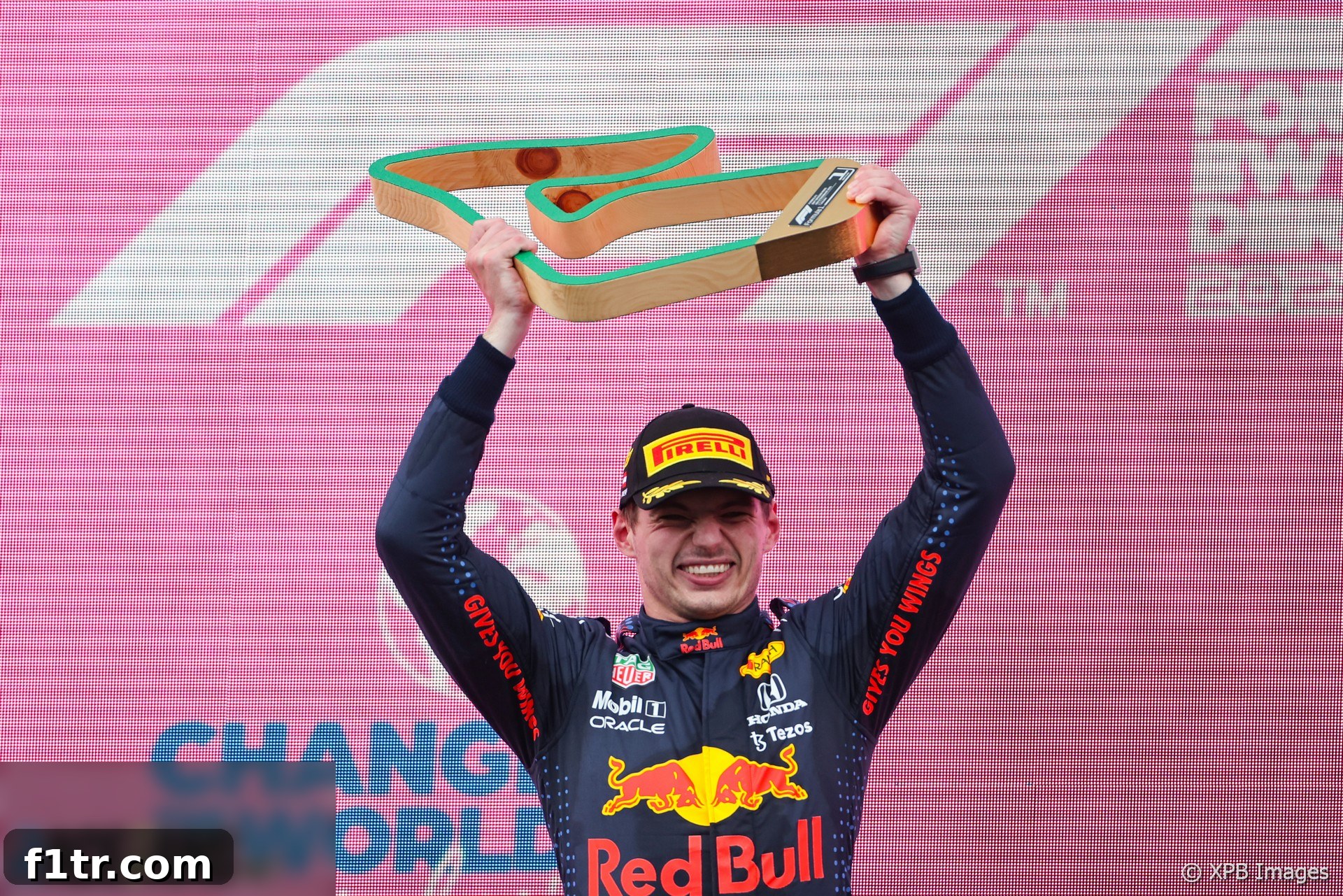
Out in front, race leader Verstappen was in a class of his own. With a substantial half-minute lead, he could afford to manage his pace and cruise to the finish line. He ultimately took the checkered flag to secure his fourth win of the season and his third victory in the preceding four races, significantly increasing his championship lead to 19 points over Hamilton. It was, without a doubt, his most dominant victory of the season thus far – a Hamilton-esque triumph for the Red Bull driver, delivered with clinical precision on his home ground.
Slowing down to treat his adoring fans to a celebratory burn-out – a move that earned the disapproval of race director Michael Masi in the process – Verstappen’s joy was palpable, further enhanced by the knowledge that this ‘home advantage’ would be extended to the following weekend’s race, held at the very same circuit. “That’s very positive,” he affirmed. “But of course, we have to show [the same] again next week, so we’ll definitely have a look what we can do better. I’m looking forward to it next week. We just have to keep on going, keep pushing really hard, and then I’m confident that we can do a very good job.”
Hamilton, meanwhile, succeeded in setting the fastest lap on the final tour after his late pit stop for soft tires, reducing Verstappen’s points lead by just a single point to 18. It had been an unusual and frustrating race for Hamilton and Mercedes, who simply had no answer to their rivals’ superior performance. “Naturally they’re faster so there’s not a lot that I can do in that respect,” Hamilton conceded. “Just got to keep trying to do the best that I can each weekend.”
Valtteri Bottas managed to hold off the charging Sergio Perez, securing the final podium position in third place. Perez had closed the gap dramatically but ran out of laps, eventually catching the second Mercedes right on the final lap of the race. Norris finished a commendable fifth after a relatively solitary afternoon, a strong result for McLaren despite his teammate Daniel Ricciardo finishing out of the points due to an early power loss problem. As a result, McLaren lost valuable ground to Ferrari, with Sainz and Leclerc occupying an impressive sixth and seventh, respectively, after Leclerc’s spectacular recovery drive.
Lance Stroll delivered a quiet but impressively solid performance to secure eighth place for Aston Martin, while Fernando Alonso and Yuki Tsunoda were both satisfied to be rewarded for their weekend’s efforts with the final points positions. In many ways, Verstappen and Red Bull had given Mercedes a stark taste of their own medicine for the second consecutive race weekend. For years, Verstappen had often been forced to settle for second, unable to match the sheer pace of Hamilton and Mercedes over the grueling 300-kilometer race distances.
At this pivotal stage in the season, it became undeniably clear that the momentum, and indeed the crucial performance advantage, lay firmly with Red Bull. And unless Mercedes could engineer a drastic solution to address this new reality, it seemed almost inevitable that Red Bull and Max Verstappen would continue to maximize their potent home field advantage when the sport returned for a second Red Bull Ring ‘rodeo’ the following weekend. The championship battle had swung, and the home crowd had played no small part in that seismic shift.
Go ad-free for just £1 per month>> Find out more and sign up
2021 Styrian Grand Prix
- 2021 Styrian Grand Prix Race Report
- Styrian Grand Prix Qualifying Analysis
- Styrian Grand Prix Practice Overview
- Circuit Guide: Red Bull Ring
Browse all 2021 Styrian Grand Prix articles
F1 Race Reviews
- Antonelli lucks in for second win and becomes youngest F1 championship leader
- Emotional Antonelli grabs first Formula 1 victory in Chinese Grand Prix
- Russell sees off Ferrari threat to lead Mercedes one-two in Melbourne
- Norris clinches F1 title by two points as Verstappen wins finale at Yas Marina
- McLaren strategy blunder in Losail hands Verstappen crucial win and shot at title
Read all F1 race reviews